

Century, Cantonment Cable Customers Could Lose WEAR 3 In 10 Days
December 21, 2010
Cable television subscribers in Century and Cantonment are just 10 days away from possibly losing WEAR TV 3, the local ABC affiliate.
 The current retransmission agreement that allows Bright House Networks to deliver the Sinclair Broadcast Group owned WEAR expires on December 31. That contract is still in the negotiation stage.
“If another agreement is not reached by the end of the year, our programming will no longer be available on their system,” WEAR Operations Manager Joe Smith said.
“Unfortunately, based on the status of the negotiations Sinclair does not believe we are going to be able to reach agreement on an extension of the deal,” according to statement released by Sinclair. “As a result, (Bright House) would no longer be carrying the stations covered by the agreement with Sinclair beginning on January 1, 2011.”
“As a normal part of business operations, our agreements with channels come up periodically for renewal. As a negotiating tactic, sometimes the channel owner threatens to take its channel off of the cable system. While this is an extreme measure, it rarely happens in our markets. Most channel owners stay on and put our mutual customers first,” Bright House said in a statement on their website.
In information aired on WEAR, the station is urging Bright House customers in Century and Cantonment to begin considering other methods to received WEAR 3.
“We are telling them to make plans to receive the station elsewhere, like DIRECTV, Dish Network or over the air with an antenna,” Smith said.
Bright House does not currently carry WEAR sister station WFGX MyTV 35. However, Smith said part of the Sinclair negotiations with Bright House would include adding the station to the cable provider’s lineup.
SEC Bowl Game Schedules
December 21, 2010
For the second straight season, the Southeastern Confernce has 10 teams participating in post-season bowl games. Here’s a look at SEC team bowl games:
Thursday, Dec. 30
Franklin American Mortgage Music City Bowl
Tennessee (6-6, 3-5) vs. North Carolina (7-5)
LP Field (67,000) • Nashville, Tenn. • ESPN • 6:40 p.m. ET (5:40 p.m. CT)
Series Record: UT leads, 20-10-1 • Last Meeting: UNC, 22-21 (Nov. 4, 1961 at Chapel Hill, N.C.)
Tennessee in bowl games: 25-23 • Tennessee in Music City Bowl: First appearance
Friday, Dec. 31
AutoZone Liberty Bowl
Georgia (6-6, 3-5) vs. #25 Central Florida (10-3)
Liberty Bowl Memorial Stadium (61,737) • Memphis, Tenn. • ESPN • 3:30 p.m. ET (2:30 p.m. CT)
Series Record: UGA leads, 1-0 • Last Meeting: UGA, 24-23 (Sept. 25, 1999 at Athens)
Georgia in bowl games: 26-16-3 • Georgia in Liberty Bowl: 1-1 (1967, 1987)
Chick-fil-A Bowl
#20 South Carolina (9-4, 5-3) vs. #23 Florida State (9-4)
Georgia Dome (71,147) • Atlanta, Ga. • ESPN • 7:30 p.m. ET (6:30 p.m. CT)
Series Record: FSU leads, 15-3 • Last Meeting: FSU, 38-10 (Nov. 9, 1991 at Tallahassee, Fla.)
South Carolina in bowl games: 4-11 • South Carolina in Chick-fil-A Bowl: 0-1 (1969)
Saturday, Jan. 1
Outback Bowl
Florida (7-5, 4-4) vs. Penn State (7-5)
Raymond James Stadium (65,657) • Tampa, Fla. • ABC Sports • 1 p.m. ET (Noon CT)
Series Record: UF leads, 2-0 • Last Meeting: UF, 21-6 (Jan. 1, 1998 at Orlando, Fla.)
Florida in bowl games: 18-19 • Florida in Outback Bowl: 1-2 (2003, 2004, 2006)
Capital One Bowl
#16 Alabama (9-3, 5-3) vs. #9 Michigan State (11-1)
Florida Citrus Bowl Stadium (65,438) • Orlando, Fla. • ESPN • 1 p.m. ET (Noon CT)
Series Record: First Meeting
Alabama in bowl games: 32-22-3 • Alabama in Capital One Bowl: 1-0 (1995)
Gator Bowl
#21 Mississippi State (8-4, 4-4) vs. Michigan (7-5)
EverBank Field (73,000) • Jacksonville, Fla. • ESPN2 • 1:30 p.m. ET (12:30 p.m. CT)
Series Record: First Meeting
Mississippi State in bowl games: 7-6 • Mississippi State in Gator Bowl: First appearance
Tuesday, Jan. 4
Allstate Sugar Bowl
#8 Arkansas (10-2, 6-2) vs. #6 Ohio State (11-1)
Louisiana Superdome (72,000) • New Orleans, La. • ESPN • 8:30 p.m. ET (7:30 p.m. CT)
Series Record: First Meeting
Arkansas in bowl games: 12-22-3 • Arkansas in Sugar Bowl: 1-4 (1962, 1963, 1969, 1970, 1980)
Friday, Jan. 7
AT&T Cotton Bowl
#11 LSU (10-2, 6-2) vs. #17 Texas A&M (9-3)
Cowboys Stadium (71,167) • Arlington, Texas • FOX • 8 p.m. ET (7 p.m. CT)
Series Record: LSU leads, 26-20-3 • Last Meeting: A&M, 33-17 (Sept. 2, 1995 at College Station, Texas)
LSU in bowl games: 21-19-1 • LSU in Cotton Bowl: 2-1-1 (1947, 1963, 1966, 2003)
Saturday, Jan. 8
BBVA Compass Bowl
Kentucky (6-6, 2-6) vs. Pittsburgh (7-5)
Legion Field (71,594) • Birmingham, Ala. • ESPN • 12 p.m. ET (11 a.m. CT)
Series Record: First Meeting
Kentucky in bowl games: 8-6 • Kentucky in BBVA Compass Bowl: First appearance
Monday, Jan. 10
Tostitos BCS National Championship Game
#1 Auburn (13-0, 8-0) vs. #2 Oregon (12-0)
University of Phoenix Stadium (73,000) • Glendale, Ariz. • ESPN • 8:30 p.m. ET (7:30 p.m. CT)
Series Record: First Meeting
Auburn in bowl games: 20-13-2 • Auburn in BCS National Championship Game: First appearance
Runner Up For Local Singer’s Group On NBC’s ‘The Sing-Off’
December 21, 2010

A local singer’s group finished as the runner-ups on NBC’s national a cappella singing competition series “The Sing-Off” Monday night.
 Adam Chance Ray, who performs as Adam Chance, sings bass for the six-member Street Corner Symphony. The group was one of four to make it through the preliminary rounds to appear on Monday night’s live show, but they fell short of America’s internet and telephone voting for a $100,000 prize and a Sony Music recording contract. First place went to the group Committed.
Chance’s friends and family gather at Atmore restaurant to cheer on the Nashville-based Street Corner Symphony, while Chance’s parents Glenn and Kristi Ray were in the live audience to cheer for their son.
Chance (pictured), who was born in the Florida Panhandle, currently resides in Tuscaloosa, but still has numerous relatives in the Atmore and Jay areas.
The members of Street Corner Symphony are from all over the Southeast United States and call Nashville their home base. The group was formed in May of 2010 for the sole purpose of competing in The Sing-Off.
Wreck Slows Traffic For Hours, Driver Trapped By Power Lines (With Photo Gallery)
December 20, 2010
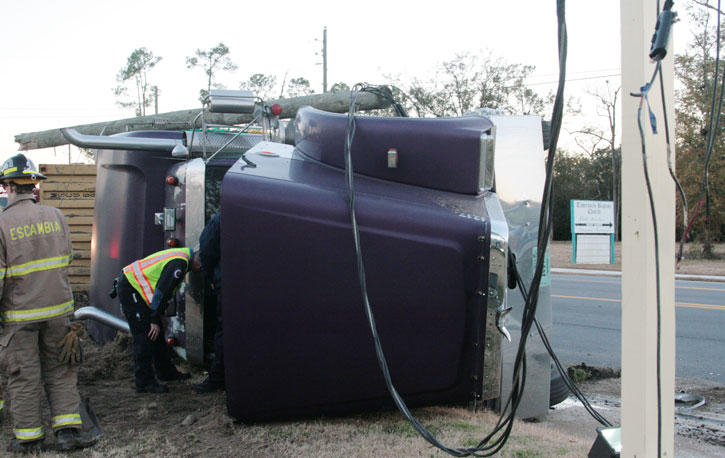

Traffic was slowed for about eight hours Monday on North Century Boulevard as crews worked to clean up after an afternoon traffic crash that left a truck driver trapped by live power lines.
The driver of the 18-wheeler lost control while northbound near Jackson Street and overturned. The overturning truck slammed into a power pole, sewage lift station, a large natural gas generator and a waterline, causing the truck’s load of plastic polymer beads to spill. The plastic beads are not hazardous, according to firefighters at the scene.
The truck driver, Freddie Pelzer, 67, of Douglasville, Georgia, was not injured in the crash. But he was trapped about 45 minutes with live power lines across the cab of his truck. Once Gulf Power arrived and cut the power lines, firefighters used an axe to bust out one of the truck’s windshields to free Pelzer.
Pelzer was charged with careless driving by the Florida Highway Patrol.
For a photo gallery from the scene, click here.
The wreck damaged a Town of Century sewage lift station and it’s electrical generator. Crews were working into the night to determine how best to return the lift station to service to avoid a sewage overflow. City workers said an attempt would be made to rig a temporary pump to the lift station, and septic tank trucks would be used to periodically pump out the station if it begins to fill with sewage.
A waterline busted in the crash caused water to flow across the accident scene, but Town of Century workers said no sewage spilled as a result of the crash.
Pictured top: The driver in a Monday afternoon crash on North Century Boulevard near Jackson street was trapped for about 45 minutes by these live power lines down across the cab of his truck. Pictured inset: A firefighter uses an axe to break out the window of the truck to free the driver. Pictured below: The truck spilled a load of plastic polymer beads. The wreck also damaged a sewage lift station (right). NorthEscambia.com photos, click to enlarge.

Area Departments Battle Brush Fire At State Line
December 20, 2010
Several fire departments battled a brush fire Monday afternoon in Atmore along the Florida state line.
The fire was contained in an area bordered by the state line, Presley Street, the Briar Lake subdivision and Tom Byrne Park. No structures were immediately threatened by the blaze, but firefighters worked to keep the wind-driven fire from reaching houses on Presley and in Briar Lake.
The Atmore Fire Department, Poarch Creek Fire Department,the Walnut Hill Station of Escambia Fire Rescue and the Alabama Division of Forestry worked to contain the fire, which was first reported about 1:15 p.m.
Another Escambia Homicide: Man Found Thrown From Vehicle
December 20, 2010
An injured man found along the side of Hollywood Avenue in the morning hours Sunday has died, and investigators have classified his death as a homicide.
Escambia County Sheriff’s Office deputies responded to the 4300 block of Hollywood Avenue at around 3:25 am for an unknown problem. They arrived to find a badly injured man lying near the road. It is believed that he was thrown out of a vehicle, according to Chris Welborn, spokesperson for the Sheriff’s Office.
Investigators have identified the victim as Christopher James Holland, 22, of Pensacola. He was transported to Baptist Hospital where he later died.
According to witnesses, Holland was last seen in a red, four door Chevrolet truck with dark green or black paint on the passenger side. A white male was said to be driving and they were traveling south on Hollywood Avenue from Massachusetts Drive.
Anyone with information regarding this case is asked to call the Sheriff’s Office at (850) 436-9620 or Crime Stoppers at (850) 433-STOP.
Census Bureau Releases 2009 Escambia Info
December 20, 2010
The U.S. Census Bureau 5-year American Community Survey estimates released last week for Escambia County are as follows:
HOUSEHOLDS AND FAMILIES: In 2005-2009 there were 117,000 households in Escambia County. The average household size was 2.4 people.
Families made up 65 percent of the households in Escambia County. This figure includes both married-couple families (46 percent) and other families (19 percent). Nonfamily households made up 35 percent of all households in Escambia County. Most of the nonfamily households were people living alone, but some were composed of people living in households in which no one was related to the householder.
NATIVITY AND LANGUAGE: Five percent of the people living in Escambia County in 2005-2009 were foreign born. Ninety-five percent was native, including 43 percent who were born in Florida.
Among people at least five years old living in Escambia County in 2005-2009, 8 percent spoke a language other than English at home. Of those speaking a language other than English at home, 44 percent spoke Spanish and 56 percent spoke some other language; 34 percent reported that they did not speak English “very well.”
GEOGRAPHIC MOBILITY: In 2005-2009, 78 percent of the people at least one year old living in Escambia County were living in the same residence one year earlier; 12 percent had moved during the past year from another residence in the same county, 3 percent from another county in the same state, 7 percent from another state, and 1 percent from abroad.
EDUCATION: In 2005-2009, 86 percent of people 25 years and over had at least graduated from high school and 24 percent had a bachelor’s degree or higher. Fourteen percent were dropouts; they were not enrolled in school and had not graduated from high school.
The total school enrollment in Escambia County was 74,000 in 2005-2009. Nursery school and kindergarten enrollment was 8,100 and elementary or high school enrollment was 44,000 children. College or graduate school enrollment was 23,000.
DISABILITY: In Escambia County, among people at least five years old in 2005-2009, percent reported a disability. The likelihood of having a disability varied by age – from percent of people 5 to 15 years old, to percent of people 16 to 64 years old, and to percent of those 65 and older.
INDUSTRIES: In 2005-2009, for the employed population 16 years and older, the leading industries in Escambia County were Educational services, and health care, and social assistance, 22 percent, and Retail trade, 13 percent.
OCCUPATIONS AND TYPE OF EMPLOYER: Among the most common occupations were: Management, professional, and related occupations, 31 percent; Sales and office occupations, 29 percent; Service occupations, 20 percent; Construction, extraction, maintenance, and repair occupations, 10 percent; and Production, transportation, and material moving occupations, 9 percent. Seventy-six percent of the people employed were Private wage and salary workers; 17 percent was Federal, state, or local government workers; and 6 percent was Self-employed in own not incorporated business workers.
TRAVEL TO WORK: Seventy-five percent of Escambia County workers drove to work alone in 2005-2009, 11 percent carpooled, 1 percent took public transportation, and 6 percent used other means. The remaining 7 percent worked at home. Among those who commuted to work, it took them on average 21.7 minutes to get to work.
INCOME: The median income of households in Escambia County was $43,148. Seventy-six percent of the households received earnings and 24 percent received retirement income other than Social Security. Thirty-one percent of the households received Social Security. The average income from Social Security was $14,051. These income sources are not mutually exclusive; that is, some households received income from more than one source.
POVERTY AND PARTICIPATION IN GOVERNMENT PROGRAMS: In 2005-2009, 16 percent of people were in poverty. Twenty-four percent of related children under 18 were below the poverty level, compared with 9 percent of people 65 years old and over. Twelve percent of all families and 31 percent of families with a female householder and no husband present had incomes below the poverty level.
POPULATION OF Escambia County: In 2005-2009, Escambia County had a total population of 303,000 – 153,000 (51 percent) females and 150,000 (49 percent) males. The median age was 36.6 years. Twenty-two percent of the population was under 18 years and 14 percent was 65 years and older.
For people reporting one race alone, 71 percent was White; 22 percent was Black or African American; 1 percent was American Indian and Alaska Native; 3 percent was Asian; less than 0.5 percent was Native Hawaiian and Other Pacific Islander, and 1 percent was Some other race. Three percent reported Two or more races. Four percent of the people in Escambia County was Hispanic. Sixty-eight percent of the people in Escambia County was White non-Hispanic. People of Hispanic origin may be of any race.
HOUSING CHARACTERISTICS: In 2005-2009, Escambia County had a total of 138,000 housing units, 15 percent of which were vacant. Of the total housing units, 70 percent was in single-unit structures, 22 percent was in multi-unit structures, and 8 percent was mobile homes. Twenty-nine percent of the housing units were built since 1990.
OCCUPIED HOUSING UNIT CHARACTERISTICS: In 2005-2009, Escambia County had 117,000 occupied housing units – 79,000 (67 percent) owner occupied and 39,000 (33 percent) renter occupied. Seven percent of the households did not have telephone service and 8 percent of the households did not have access to a car, truck, or van for private use. Multi Vehicle households were not rare. Thirty-nine percent had two vehicles and another 16 percent had three or more.
HOUSING COSTS: The median monthly housing costs for mortgaged owners was $1,207, nonmortgaged owners $362, and renters $802. Thirty-eight percent of owners with mortgages, 14 percent of owners without mortgages, and 55 percent of renters in Escambia County spent 30 percent or more of household income on housing.
Census Bureau Releases 2009 Century Info
December 20, 2010
The U.S. Census Bureau 5-year American Community Survey estimates released last week for Escambia County are as follows:
HOUSEHOLDS AND FAMILIES: In 2005-2009 there were 650 households in Century town. The average household size was 2.4 people.
Families made up 65 percent of the households in Century town. This figure includes both married-couple families (38 percent) and other families (27 percent). Nonfamily households made up 35 percent of all households in Century town. Most of the nonfamily households were people living alone, but some were composed of people living in households in which no one was related to the householder.
NATIVITY AND LANGUAGE: Five percent of the people living in Century town in 2005-2009 were foreign born. Ninety-five percent was native, including 61 percent who were born in Florida.
Among people at least five years old living in Century town in 2005-2009, 4 percent spoke a language other than English at home. Of those speaking a language other than English at home, 38 percent spoke Spanish and 62 percent spoke some other language; 42 percent reported that they did not speak English “very well.”
GEOGRAPHIC MOBILITY: In 2005-2009, 91 percent of the people at least one year old living in Century town were living in the same residence one year earlier; 5 percent had moved during the past year from another residence in the same county, less than 0.5 percent from another county in the same state, 3 percent from another state, and less than 0.5 percent from abroad.
EDUCATION: In 2005-2009, 75 percent of people 25 years and over had at least graduated from high school and 5 percent had a bachelor’s degree or higher. Twenty-six percent were dropouts; they were not enrolled in school and had not graduated from high school.
The total school enrollment in Century town was 340 in 2005-2009. Nursery school and kindergarten enrollment was 18 and elementary or high school enrollment was 280 children. College or graduate school enrollment was 42.
DISABILITY: In Century town, among people at least five years old in 2005-2009, percent reported a disability. The likelihood of having a disability varied by age – from percent of people 5 to 15 years old, to percent of people 16 to 64 years old, and to percent of those 65 and older.
INDUSTRIES: In 2005-2009, for the employed population 16 years and older, the leading industries in Century town were Manufacturing, 23 percent, and Educational services, and health care, and social assistance, 20 percent.
OCCUPATIONS AND TYPE OF EMPLOYER: Among the most common occupations were: Production, transportation, and material moving occupations, 25 percent; Service occupations, 24 percent; Sales and office occupations, 21 percent; Management, professional, and related occupations, 16 percent; and Construction, extraction, maintenance, and repair occupations, 13 percent. Seventy-six percent of the people employed were Private wage and salary workers; 16 percent was Federal, state, or local government workers; and 7 percent was Self-employed in own not incorporated business workers.
TRAVEL TO WORK: Seventy-six percent of Century town workers drove to work alone in 2005-2009, 18 percent carpooled, 1 percent took public transportation, and 3 percent used other means. The remaining 3 percent worked at home. Among those who commuted to work, it took them on average 24.9 minutes to get to work.
INCOME: The median income of households in Century town was $24,643. Fifty-nine percent of the households received earnings and 22 percent received retirement income other than Social Security. Fifty-two percent of the households received Social Security. The average income from Social Security was $11,246. These income sources are not mutually exclusive; that is, some households received income from more than one source.
POVERTY AND PARTICIPATION IN GOVERNMENT PROGRAMS: In 2005-2009, 32 percent of people were in poverty. Forty-nine percent of related children under 18 were below the poverty level, compared with 22 percent of people 65 years old and over. Twenty-four percent of all families and 38 percent of families with a female householder and no husband present had incomes below the poverty level.
POPULATION OF Century town: In 2005-2009, Century town had a total population of 1,600 – 900 (58 percent) females and 650 (42 percent) males. The median age was 42.5 years. Twenty-three percent of the population was under 18 years and 17 percent was 65 years and older.
For people reporting one race alone, 37 percent was White; 59 percent was Black or African American; less than 0.5 percent was American Indian and Alaska Native; 1 percent was Asian; less than 0.5 percent was Native Hawaiian and Other Pacific Islander, and less than 0.5 percent was Some other race. Two percent reported Two or more races. Two percent of the people in Century town was Hispanic. Thirty-six percent of the people in Century town was White non-Hispanic. People of Hispanic origin may be of any race.
HOUSING CHARACTERISTICS: In 2005-2009, Century town had a total of 760 housing units, 14 percent of which were vacant. Of the total housing units, 64 percent was in single-unit structures, 10 percent was in multi-unit structures, and 26 percent was mobile homes. Twenty-five percent of the housing units were built since 1990.
OCCUPIED HOUSING UNIT CHARACTERISTICS: In 2005-2009, Century town had 650 occupied housing units – 450 (69 percent) owner occupied and 200 (31 percent) renter occupied. Six percent of the households did not have telephone service and 19 percent of the households did not have access to a car, truck, or van for private use. Twenty-five percent had two vehicles and another 20 percent had three or more.
HOUSING COSTS: The median monthly housing costs for mortgaged owners was $829, nonmortgaged owners $275, and renters $406. Fifty-three percent of owners with mortgages, 19 percent of owners without mortgages, and 47 percent of renters in Century town spent 30 percent or more of household income on housing.
New Census Data Shows Population, Poverty In Century, Escambia
December 20, 2010
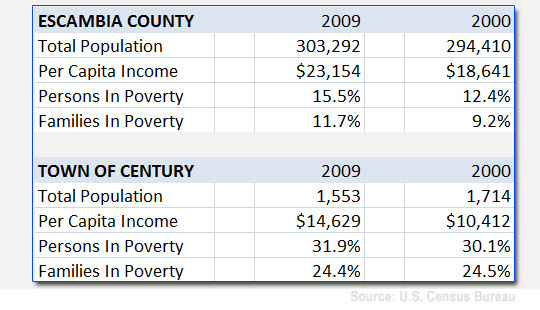
A new U.S. Census Bureau 5-year American Community Survey released last week shows that declining population and a high poverty level plagues Century when compared to Escambia County.
The U.S. Census Bureau data shows Century’s population declined just under 10 percent during the period, from 1,714 to 1,553. During the same 2000 to 2009 period, Escambia County’s population increased about three percent, from 294,410 to 303,292.
Among the Town of Century’s residents, 31.9 percent of residents lived below the federal poverty level in 2009, according to the data released last week. Of Century’s families, 24.4 percent lived in poverty. The percentage of Century’s residents in poverty was virtually unchanged during the nine year period.
Escambia County’s poverty levels increased during the period, but were half that of Century. In 2009, 15.5 percent of people in Escambia County lived in poverty, while 11.7 percent of families were below the poverty level.
Up until now, small geographic areas had to rely on outdated 2000 Census figures for detailed information about the characteristics of their communities. But the 2009 estimates released last week in the American Community Survey provides estimates to give even the smallest communities like Century more timely information on topics ranging from commute times to languages spoken at home to housing values.
- For complete data from the U.S. Census Bureau 5-year American Community Survey for Century, click here.
- For complete data from the U.S. Census Bureau 5-year American Community Survey for Escambia County, click here.
NHS Students Of The Month
December 20, 2010
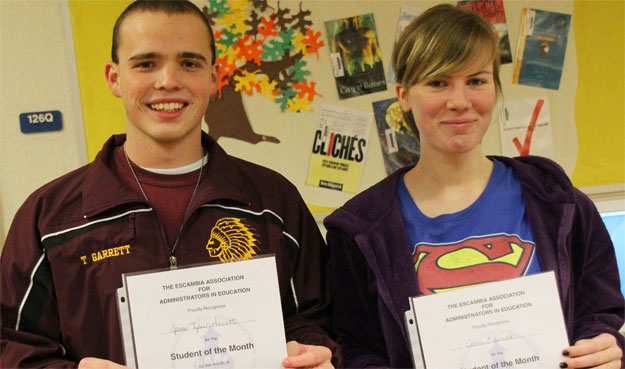
Northview High School has named senior Tyler Garrett and freshman Anna Donald as students of the month for the month of December. Submitted photo for NorthEscambia.com, click to enlarge.