

Wahoos Win Over Mississippi, Even Series
May 20, 2015
Starting pitcher Daniel Wright (2-4) was able to get some run support as the Pensacola Blue Wahoos (17-22) drove in a season-high seven runs to beat the Mississippi Braves (20-18) by a score of 7-4 on Tuesday night.
Wright went 5.0 innings and gave up three runs while striking out eight batters in the process. Greg Ross (2-3) earned the loss for the Braves as he gave up nine hits and five earned runs. Kevin Shackelford earned his first save of the season as he finished the game with a pair of scoreless innings. Wahoos reliever Blaine Howell, a former pitcher for Pensacola State College, also worked a pair of innings in his Double-A debut.
Kyle Waldrop, who hit safely in his first three at-bats of the evening, led the Wahoos at the plate with two singles, a double and an RBI. He is now hitting .361 in the month of May. Marquez Smith and Juan Perez contributed a pair of hits, with Smith driving in a pair of runs. Seth-Mejias-Brean and Ray Chang drove in a pair of runs each, as well.
The Wahoos got off to a good start in the first with a single from Kyle Waldrop and a two-out RBI double from Marquez Smith to drive him home.
The Braves responded in the second with a broken-bat single for an RBI from Eric Garcia, but Daniel Wright got out of the inning with consecutive strikeouts with runners at the corners, leaving the score tied 1-1.
The Wahoos threatened in the fourth inning, with Kyle Skipworth drilling a ball off the wall in straightaway center for a standup triple with one out. Juan Perez was able to draw a walk with two outs to put runners at the corners, but they were unable to take advantage of the opportunity.
Mississippi took the lead on the top of the fifth with a single from KD Kang. Wright then hit Seth Loman with a pitch to load the bases with one out, and Chris O’Dowd drove in another run with a single to right. Wright ended the inning with a pair of strikeouts, but the Braves would lead 3-1 by the end of the frame.
With two outs in the bottom of the fifth, Ryan Wright was able to beat a throw from third for a two-out infield single. It would prove to be crucial, as Waldrop would drive him home on a double the next at-bat. Marquez Smith would follow that up with a single to bring Waldrop home and tie it 3-3. Seth Mejias-Brean then ripped a line drive into left-center field to bring two runs home, giving the Wahoos a 5-3 lead.
Kang and O’Dowd struck again as Kang doubled and was eventually driven home from third on an RBI groundout from O’Dowd, bringing the Braves within a run.
Reliever Kevin Shackelford gave up a pair of singles and a walk to load the bases in the eighth, but was able to get out unscathed by forcing a groundout to end the top half.
After Mejias-Brean walked and Perez singled in the bottom of the eighth, Juan Silva put them both into scoring position with a sacrifice bunt. That set the table for defensive substitute Ray Chang, who would drive them both in on a single to make it 7-4.
Century Drive-by Shooting Under Investigation
May 19, 2015
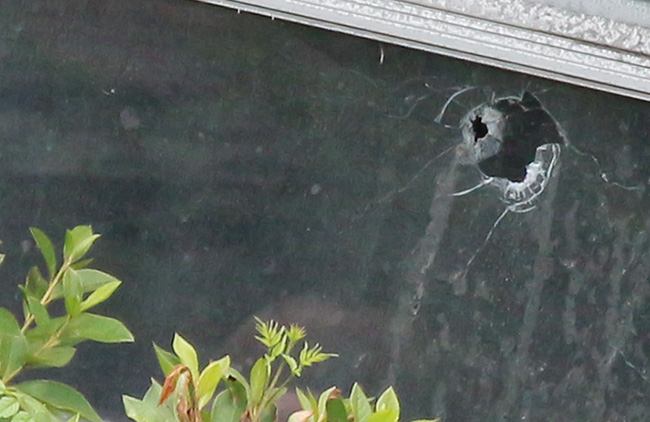
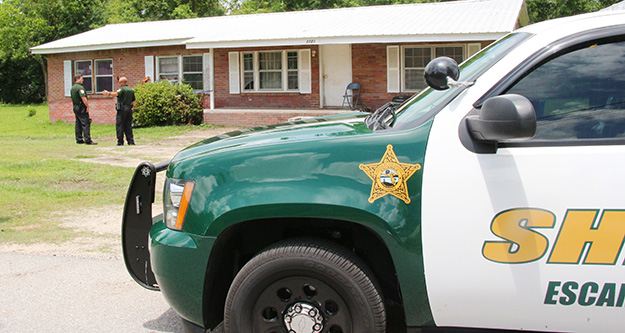
An apparent drive-by shooting reported Monday in Century is under investigation.
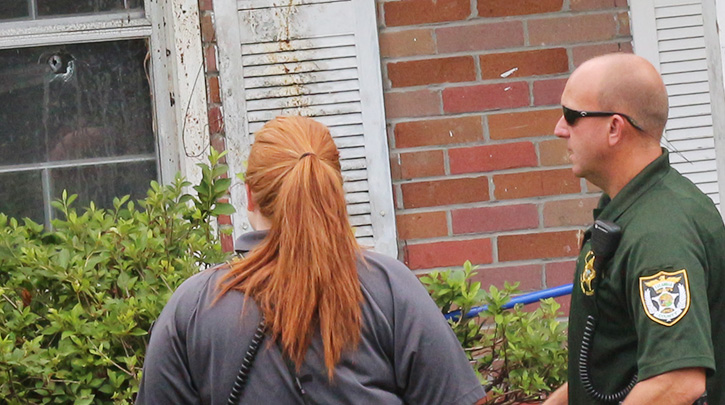
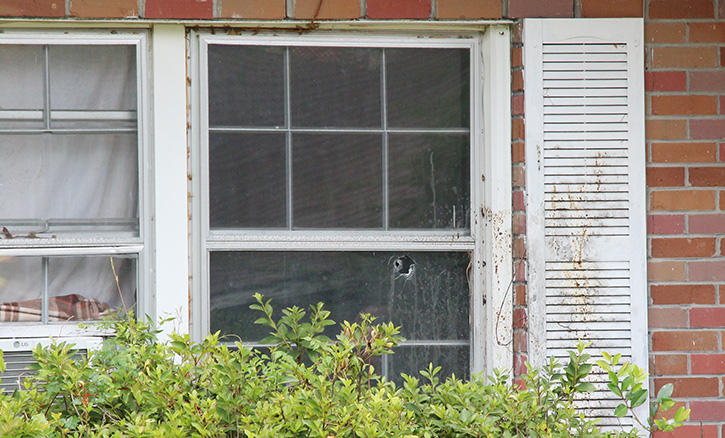
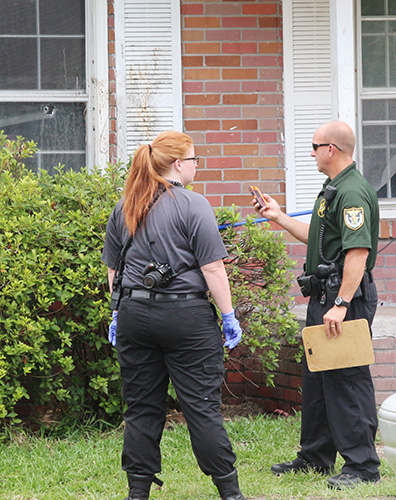 A resident of Archie Street called the Escambia County Sheriff’s Office reported that they had found apparent bullet holes in their home. One apparent bullet hole through a front window was easily visible from the street as deputies and a crime scene technician conducted their investigation just before noon Monday.
It was not immediately know exactly when the alleged drive-by occurred. There were no injuries.
A spokesperson for the Escambia County Sheriff’s Office said their investigation is continuing as they work to develop a suspect in the case.
Pictured: The investigation in to an apparent drive-by shooting Monday on Archie Street in Century. NorthEscambia.com photos, click to enlarge.
Mark Your Calendar For Graduations
May 19, 2015
Make your calendars now for graduation. Graduation ceremonies will be held for Escambia County Schools as follows:
Escambia Westgate School — May 28, 9 a.m. at Escambia Westgate
District Extended Program — May 29, 9:30 a.m., J.E. Hall Center, Room 160
Escambia Charter School — May 29, 7 p.m., UWF Conference Center
Northview High School — May 30, 2015, 4:00 p.m., Northview High Gym
Booker T. Washington High School – Jun 1, 2015, 11 a.m. — Pensacola Bay Center
Pensacola High School – June 1, 2:30 p.m. — Pensacola Bay Center
Escambia High School – June 1, 6 p.m. — Pensacola Bay Center
Pine Forest High School – June 2, 11 a.m. — Pensacola Bay Center
West Florida High School — June 2, 2:30 p.m. — Pensacola Bay Center
Tate High School — June 2, 6 p.m. — Pensacola Bay Center
Escambia Health Dept. Urges Steps To Avoid Swimming Related Illnesses
May 19, 2015
 The Florida Department of th in Escambia County is observing National Healthy and Safe Swimming Week, May 18-24, by promoting simple steps that everyone can take to reduce the spread of recreational water illnesses.
Every year, thousands of Americans get sick with recreational water illnesses (RWIs), which are caused by germs found in places where people swim. The most common locations for contracting or spreading RWIs are swimming pools, water parks, water play areas, hot tubs, rivers, lakes, and open bodies of water such as bayous, bays, and the Gulf of Mexico. Swallowing even a small amount of contaminated recreational water can make you sick.
RWIs can include ear, respiratory, eye, skin, wound, and gastrointestinal infections. A single swimmer with a diarrhea-causing illness can quickly contaminate the water of a large swimming pool or a water park. RWIs are preventable, but everyone needs to take an active role in protecting themselves and other swimmers.
Take these simple steps to help prevent the spread of germs that cause RWIs:
- Don’t swim when you have diarrhea.
- Don’t swallow pool or recreational water.
- Don’t swim when you have an open wound or broken skin.
- Practice good personal hygiene.
- Shower before entering a pool or other recreational water venue.
- Wash your hands after using the toilet or changing a diaper.
- Check diapers or take children to the restroom every 30-60 minutes and only change diapers in restrooms. Changing diapers pool-side can spread germs in and around the pool.
Following healthy swimming steps will help protect you, your family, and other swimmers from RWIs, according to the health department.
Ribbon Cut On Carver Park Improvements In Cantonment
May 19, 2015
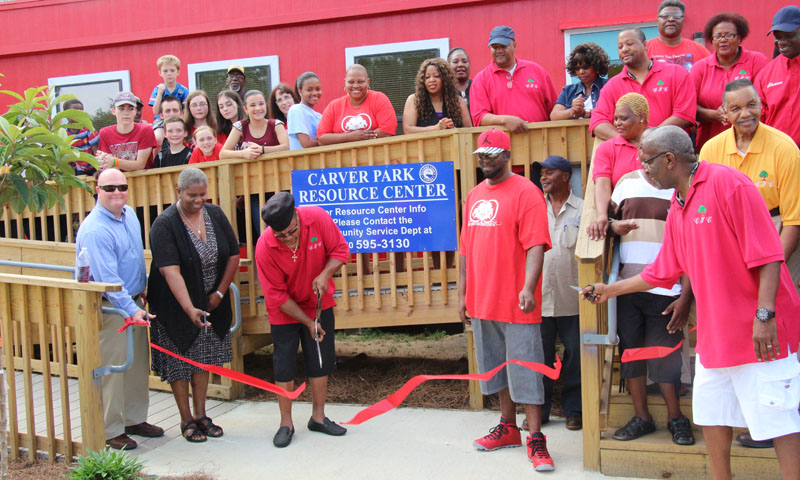
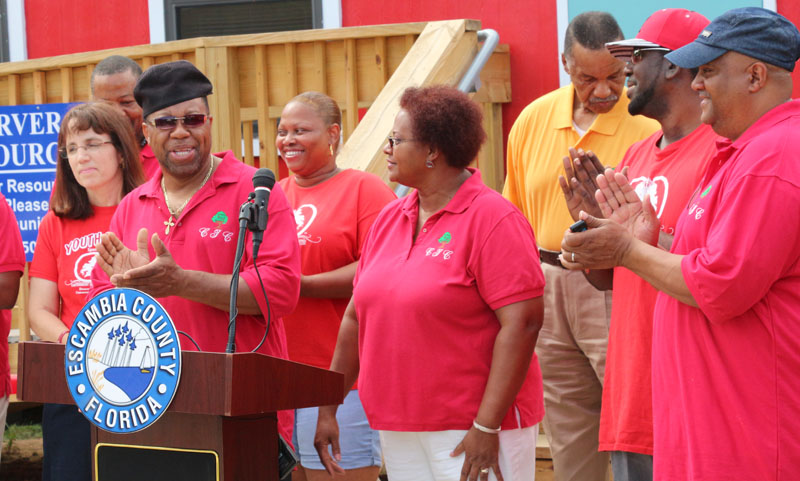
A ribbon cutting was held Monday for improvements at Carver Park in Cantonment.
 Improvements to Carver Park include a renovated community resource center, enlarged parking lot, volleyball court and re-striped basketball court. The park will also soon feature a new pavilion for family and local events. The improvements began in 2014 and were funded to Local Option Sale Tax dollars.
Much of the work at Carver Park has been spearheaded by the Cantonment Improvement Association, a group working, as their name implies, to improve the quality of life for all law-abiding citizens of Cantonment, with an emphasis on making sure children and safe and well-prepared.
“Like the Bible says, we are going from the least one to the most, so we want everybody to be involved because our kids need all of us.,” said Josh Womack, Cantonment Improvement Association president. “The more people that’s watching, the less people are going to mess with out kids. That’s the most valuable resource we have…that’s our children.”
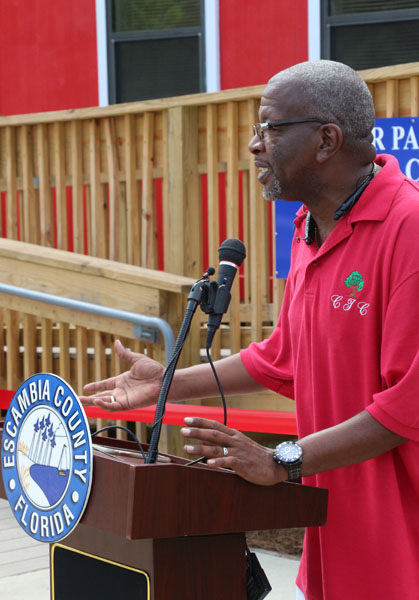
“They are working very hard and have put a lot into this,” Escambia County Commissioner Steven Barry said at Monday’s event. “The CIC is a group that will have more people show up for a work day than came today for a ribbon cutting and free food.”
For a photo gallery, click here.
Carver Park is located at 208 Webb Street. The play and picnic areas at the park are located under the largest natural oak canopy of any Escambia County park.
Ferry Pass Fire Station Promotes Volunteer Officers
May 19, 2015

The Ferry Pass Station of Escambia Fire Rescue recently met to discuss upcoming changes within the department and several promotions with the volunteer ranks.
Promotions were as follows:
- Lt. Ronnie McLellan promoted to assistant chief.
- Firefighter Mark Clark promoted to captain.
- Lt. Feliciano Santana promoted to captain.
- Firefighter Jared Sigler promoted to lieutenant.
The new office state at the Fire Pass Station of Escambia Fire Rescue has over 75 years combined experience. The volunteers are continuing to work alongside a 24/7 career crew recently placed at the station by the Escambia County Commission.
The Ferry Pass Station of Escambia Fire Rescue and the other fire stations in the county are continuing to accept volunteer firefighter applications. Applications are currently available at any fire stations and will soon be available online.
Pictured are: (top, L-R) Ferry Pass District Chief Kevin Winingar, Assistant Chief Ronnie McLellan, Captain Mark Clark, (below, L-R) Captain Feliciano Santana and Lt. Jared Sigler. Photos for NorthEscambia.com, click to enlarge.

Hospitals Push Back Against Scott On Revenue Sharing, Data
May 19, 2015
Florida hospitals fired back Monday against Gov. Rick Scott in the latest salvo over the governor’s suggestion that the health-care facilities mimic professional baseball teams in sharing revenues.
The Florida Hospital Association sent a letter to Scott objecting to the governor’s money-sharing proposal, which the group labeled a new “tax,” to help cover the costs of the Low Income Pool, or LIP, program, set to expire on June 30 unless state and federal negotiators come up with a new plan. At the same time, the hospital association urged Scott to support a Medicaid-funded coverage expansion proposed by the Senate.
“You have suggested that a new tax on hospital operating surpluses might be a way to sustain the existing LIP program. Such an arrangement is not a solution to the challenge we face,” Florida Hospital Association executives wrote in the letter. “The Senate’s comprehensive proposal would provide health care coverage to approximately 800,000 low-income, working Floridians. And, it fully funds a modified LIP program in the first year of a transition towards increased coverage. As more Floridians are covered, this approach allows our state to reduce its dependence over time, on a supplemental funding pool.”
The future of the LIP program is at the center of a health-care spending impasse that forced lawmakers to call a special session to negotiate and pass a budget, the only constitutionally required activity the Legislature must perform.
Scott gave the hospitals and insurers a Monday deadline to provide a wide range of data to be considered by a commission he created to examine health-care finances before lawmakers return to Tallahassee for the special session June 1. The Commission on Healthcare and Hospital Funding — which does not include any hospital executives — is scheduled to hold its first meeting Wednesday in Tallahassee.
In a response to Scott on Monday, the Safety Net Hospital Alliance of Florida, which represents public hospitals, teaching hospitals and children’s hospitals, pointed out that most of the information the governor demanded is already captured by the state Agency for Health Care Administration. Other data Scott is seeking is not available, according to a letter from alliance President Tony Carvalho.
“Eighty percent of the data is already in the hands of the agency,” alliance lobbyist Mark Delegal said in an interview with The News Service of Florida.
Some of the information Scott is seeking is also protected from public scrutiny through exemptions to Florida public-records laws.
In addition, Carvalho argued, Scott’s request for information fails to take into account other ways public hospitals are spending their earnings, including on research or clinics that serve low-income patients. That information is not captured in the Agency for Health Care Administration’s database, Carvalho wrote.
“These insufficiencies will directly jeopardize your commission’s analysis of hospital operating margins and deliberations on revenue sharing scenarios,” Carvalho wrote. “Failure to define and collect these expenditures will result in hospital operating margin comparisons that are insufficient. For these reasons, and in order for the commission to reach the desired goals as set forth in your executive order, the commission should request a tailored hospital operating margin template be designed, with input from the hospital industry, prior to embarking on a comparative analysis of profit sharing scenarios.”
Scott has received some of the information he’s requested from the hospitals and is posting it on the commission’s website, Scott spokeswoman Jackie Schutz said.
Scott’s request for the information and his suggestion about revenue sharing came amid battles in the Legislature and with the federal government about major health-care issues.
In its budget proposal during the regular session, the Senate included $2.2 billion for the LIP program, which funnels local and federal funds to hospitals and other health care providers that serve large numbers of poor and uninsured Floridians. The Senate also backed a $2.8 billion plan to use federal money to expand coverage under the Affordable Care Act, also known as Obamacare. The Senate plan would provide private health insurance for low- and moderate-income people, at least in part to shrink the amount of unreimbursed care that hospitals provide. LIP also has been aimed at compensating hospitals and other providers for such care.
But Scott and House Republican leaders, who vigorously oppose the coverage expansion and Obamacare in general, have balked at the Senate plan. Scott sued the Obama administration over federal health officials’ apparent linking of LIP and Medicaid expansion in negotiations.
And Scott, who made his foray into politics opposing Obamacare before it became law, has repeatedly blasted the federal Centers for Medicare & Medicaid Services for threatening to cut back on LIP funding, although the agency last year gave the state a one-year extension on the program with the caveat that future approval would be contingent on expanding the universe of insured Floridians.
by Dara Kam, The News Service of Florida
Study: Century Not Ready For Hotel Or Motel
May 19, 2015
Now is probably not a good time to open a hotel or motel in Century, according to a University of West Florida Haas Center study commissioned by the town council.
 The town’s recently developed economic development plan from the UWF identified a lodging business might be needed for Century to capitalize on visitors that pass through the town on a daily basis — about 10,200 vehicles per day average on Highway 29.
The $12,500 study found that development of a hotel may need to wait for Century to grow a bit.
The hotel feasibility study included a neighborhood and market area analysis that considered interstate and CSX access, Century Correctional Institution, and local events and festivals. The study also looked at the influence of competing motels and hotels in Brewton and Atmore, a stagnant hotel market trend in southern Alabama and costs.
The study concluded that a 70-room budget or economy hotel my be feasible under “strict circumstances”, but the project costs might outweigh the overall economic value.
Pictured: Gas stations on Highway 29 already capitalize on a steady stream of traffic through Century. NorthEscambia.com file photo, click to enlarge.
Wahoos Win Over Braves
May 19, 2015
It took Little Heroes Night to help the Pensacola Blue Wahoos stop a two-game skid to the Mississippi Braves Monday.
Seth “Superman” Mejias-Brean (running faster than a speeding bullet, of course) scored the winning run, 4-3, for Pensacola when Juan “Superman” Silva doubled to left field just inside the chalk in the sixth inning in front of 3,604 fans at Pensacola Bayfront Stadium.
Superman was, in fact, the top super hero pick of the Blue Wahoos players and Pensacola Manager Pat Kelly on the promotion at the ballpark Monday. Each player chose their top characters.
Mejias-Brean a three-sport star in high school in Tucson, Ariz., showed off his speed Monday. In the sixth, he reached first on an infield single to third and then ended up stealing second base on a hit-and-run. It was his second steal of the night after stealing just one base in his previous 100 games at Pensacola.
Kelly said Mejias-Brean has deceptive speed and called him one of the Blue Wahoos top base runners.
“He gets those size 16’s going and covers some ground,” Kelly said. “He’s a much better athlete than people give him credit for.”
Mejias-Brean was in a 3-36 slump hitting .083 before going 8-25 or .320 in his last seven games. After going 2-4 on two singles, he’s reached base in his last eight games. He laughed off his two stolen bases Monday.
“I’ve always had the green light to go,” he said. “I don’t show off (my speed) too often but it’s there.”
The “Supermans” bailed out Robert “The Hulk” Stephenson, who started the game for Pensacola and got his second win in a row. He left after six innings, having given up three earned runs on a home run blast by Kevin Ahrens in the third inning. Stephenson gave up six hits, two walks and struck out six.
Stephenson liked his Blue Wahoos graphic as “The Hulk,” except for his mustache. He’s shaved it off but was sporting it earlier in the season when team pictures were taken. Stephenson, the Cincinnati Reds top prospect the past two seasons and a 27th pick in the first round in 2011, said he’s come to rely on his non-Hulk like changeup, instead of his mid-90s fastball. He struck out four Mississippi batters with his changeup on Monday.
“I had that just one bad pitch,” Stephenson said. “Just being able to throw the fastball down in the zone and then show the change up after allows me to get some swings on it. I think our pitching has been outstanding.”
Pensacola got on the scoreboard first when Marquez Smith lined a grounder off of Mississippi pitcher Jake Brigham’s right leg. Second baseman Ryan Wright scored to put Pensacola ahead, 1-0, for the first time in three games against Mississippi. Meanwhile, Brigham walked off the field and was relieved by Mark Lamm.
The Blue Wahoos have won eight of their last 11 games, scoring five runs in half of those games, while throwing two shutouts and allowing just one run four times. Pensacola moved out of last place in the Southern League South Division at 16-22, one game ahead of the Jacksonville Suns.
State Charges Century Woman With Auto Insurance Fraud
May 18, 2015
A Century woman has been charged with allegedly trying to rip off her automobile insurance company.
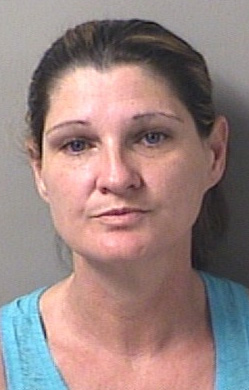 Trisha Michelle Milstead, 43, was charged one felony count of insurance fraud by the Florida Department of Financial Services Insurance Fraud Division. She remains in the Escambia County Jail Monday with bond set at $10,000.
According to Assistant State Attorney Greg Marcille, Milstead was involved in a vehicle accident on September 8 of last year, but at that time her vehicle policy had lapsed for non-payment. She allegedly reinstated the policy on September 9, signing a statement that there had been no damage to her vehicle during the period in which the policy was lapsed.
Two days later, she filed a claim for a vehicular accident on Barth Road in Molino and damage prosecutors alleged occurred on September 8 when she had no valid insurance.
Milstead is due in court for an arraignment hearing early next month.