

Driver Overturns At Highway 99 Bridge
September 28, 2015
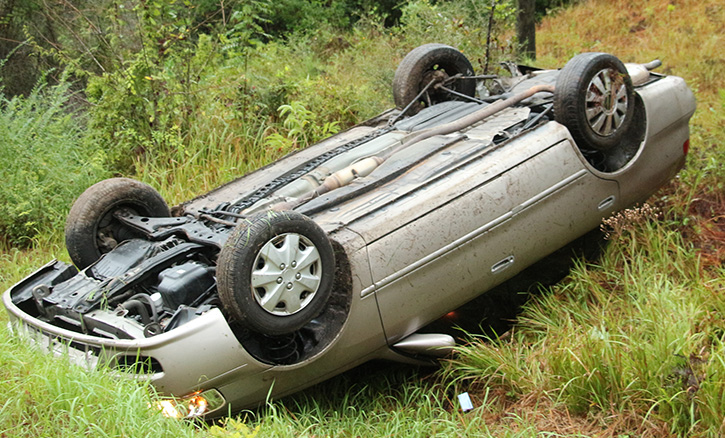
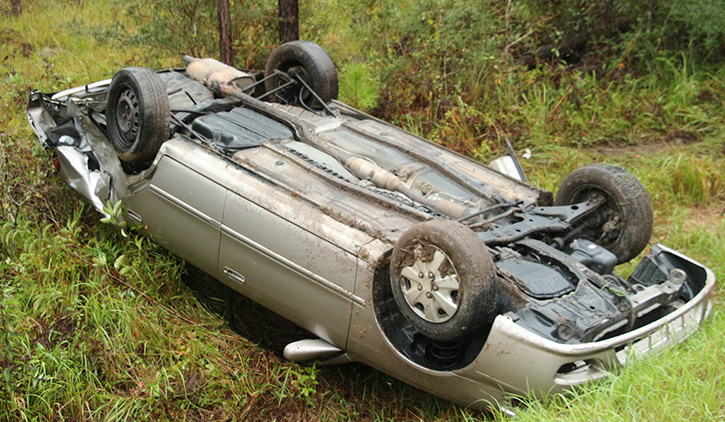
One person was injured in a single vehicle rollover accident Monday morning at a bridge.
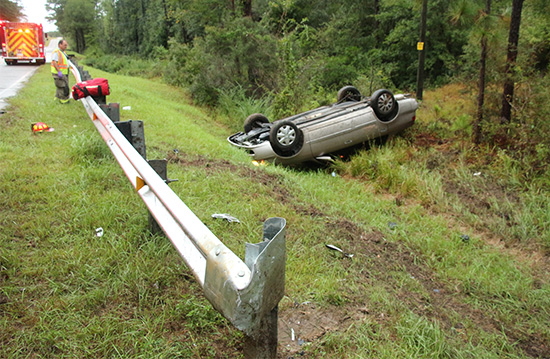
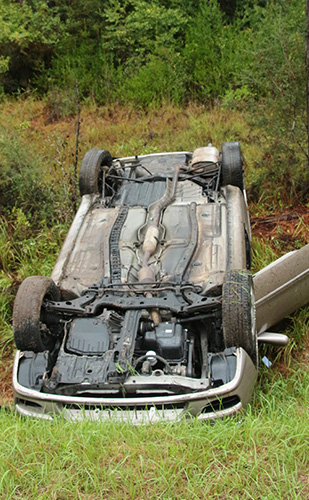 The accident was reported just after 8 a.m. on County Road 99 about a mile north of Crabtree Church Road in a remote area outside Molino. The driver was apparently northbound on Highway 99 when he lost control just past a curve, ran off the roadway, struck a guardrail on a bridge approach and overturned into a ditch.
The 55-year old male was transported in stable condition by Escambia County EMS to Atmore Community Hospital with injuries that were not considered life threatening.
The accident remains under investigation by the Florida Highway Patrol; further details have not been released. The Molino and Cantonment stations of Escambia Fire Rescue also responded to the crash.
NorthEscambia.com photos, click to enlarge.
Apply Saturday For Salvation Army Christmas Assistance
September 28, 2015
Christmas is just around the corner, and the Salvation Army is getting ready to help North Escambia residents in need with an application day set for Saturday in Century.
 Applications for assistance will be accepted from 10 a.m. to 1 p.m. on Saturday, October 3 at the Century Ag Building on West Highway 4 at Industrial Boulevard.
For more information call (850) 432-1501 or email escarosa@uss.salvationarmy.org.
The following requirements for assistance were provided by The Salvation Army:
In order for The Salvation Army to process the application for Christmas assistance, applicants must bring the items listed below.
- Driver’s license or ID cards of all persons 18 years and older in houshold
- Social Security Card(s) for everyone in household
- Birth Certificates/Proof of legal custody of all children 17 years and younger
- Proof of all income for household
- TANF/Cash Assistance
- Social Security/SSI/SSDi statements
- Food Stamps statement from Department of Children and Families
- Child Support statement
- Pension statement
- Paystubs or print out for the last 30 days
- If no income, must have a notarized statement
- Proof of all expenses
- Rent/Mortgage (copy of lease or mortgage statement), no receipts accepted
- Homeowners insurance
- Gas/Sanitation bill
- Water/Sewer bill
- Electric bill
- Cable/Satellite bill
- Home telephone/Cell phone bill
- Car payment statement
- Car insurance bill
- Health insurance
- Credit card statements
- Proof of childcare expenses
Failure to have all required information will delay the ability for Christmas assistance. All information is need on the date of application.
Learn How To Do Business With ECUA
September 28, 2015
On Wednesday, September 30, the Florida Small Business Development Center and the University of West Florida’s Procurement Technical Assistance Center (PTAC) Program, will offer a free workshop entitled, “How to do Business with the Emerald Coast Utilities Authority” (ECUA). The event will be held at the SBDC Office, 9999 University Parkway, Pensacola, FL., from 9 a.m. until noon.
 The informational meeting will educate attendees about the potential of doing business with the ECUA, while increasing participation in obtaining future ECUA contracts. Participants will learn about the bidding process, qualification requirements, future business opportunities, and how the ECUA hiring process is conducted.
ECUA speakers will include; Stephen P. Holcomb, ECUA director of wastewater infrastructure, Amy Williamson, ECUA senior purchasing agent, and Frances Webb, ECUA HR generalist.
The workshop is free; however, pre-registration is recommended. For additional information contact Laura Subel, PTAC procurement specialist, via email at lsubel@uwf.edu, or by calling (850) 474-2549.
Ernest Ward Middle Seeks Veteran’s Stories For Program
September 28, 2015
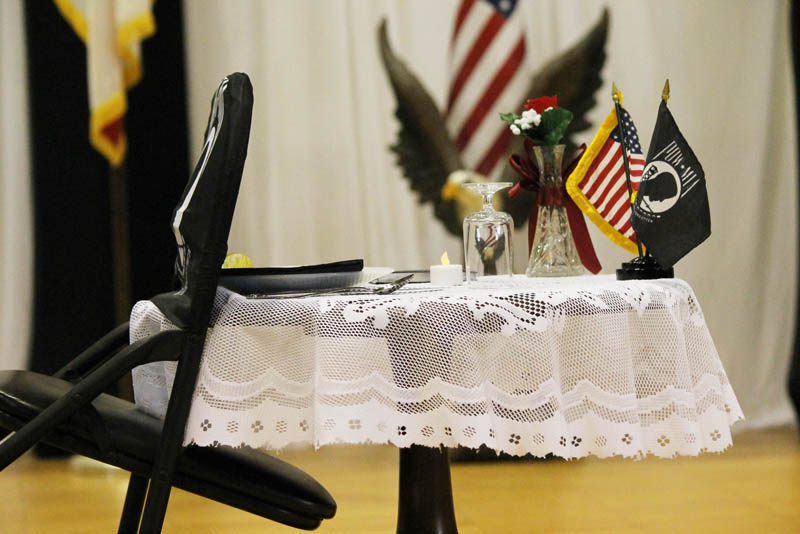
Ernest Ward Middle School is seeking personal stories from veterans in the local community to use as part of their upcoming Veterans Day program.
Veterans with an inspirational or traumatic account of a military service event are asked to email their story to teacher Katie Roley at kroley@escambia.k12.fl.us or contact the school at (850) 327-4283 for information on submitted a handwritten or typed account.
The following information should be included with the submission: The veteran’s full name, dates of service (peace time or specific war), current community of residence and the detailed account of one specific event.
The submission deadline is Friday, October 9.
Pictured: A “MIA Table” presentation at last year’s Veterans Day Program at Ernest Ward Middle School. NorthEscambia.com file photo, click to enlarge.
Animal Rights, Environmental Groups Join Effort To Stop Bear Hunt
September 28, 2015
Eleven Florida and national animal-protection and environmental groups jointly filed a “friend of the court” brief Friday that sides with a Seminole County organization seeking to block the state’s upcoming bear-hunting season.
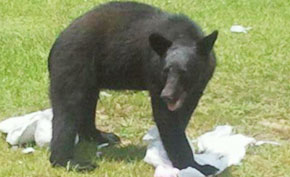 Leon County Circuit Judge George Reynolds III on October 1 will hear a legal challenge by Speak Up Wekiva to the hunt, which was approved by the Florida Fish and Wildlife Conservation Commission.
The season is scheduled to begin October 24 and last two to seven days. It is the first bear hunt in the state in more than two decades. The state agency’s goal is to reduce the bear population in Florida by 320.
As of Friday morning, 2,279 bear hunting permits had been purchased.
The groups backing Speak Up Wekiva were the Animal Legal Defense Fund, Animal Hero Kids, the Animal Rights Foundation of Florida,the Animal Welfare Institute, the Center for Biological Diversity, CompassionWorks International, Environmental Action, the Jungle Friends Primate Sanctuary, Lobby for Animals, the South Florida Wildlands Association and Stop the Florida Bear Hunt.
by The News Service of Florida
Free Hunter Safety Class Offered In Molino
September 28, 2015
The Florida Fish and Wildlife Conservation Commission (FWC) is offering a free hunter safety courses in Molino next month.
 The class will be held at the Molino Community Center, 6450 Hwy. 95A, Molino. Instruction is from 6 to 10 p.m. October 15. The range portion of the class will be October 17 from 7 to 10 a.m. Directions to the range will be handed out in class.
For the Internet-completion courses, students must complete the Internet course before coming to class and bring a copy of the final report from the online portion of the course. The final report form does not have to be notarized.
An adult must accompany children under the age of 16 at all times. Students should bring a pencil and paper with them to take notes.
Anyone born on or after June 1, 1975, must pass an approved hunter safety course and have a hunting license to hunt alone (unsupervised). The FWC course satisfies hunter-safety training requirements for all other states and Canadian provinces.
People interested in attending these courses can register online and obtain information about future hunter safety classes at MyFWC.com/HunterSafety or by calling Hunter Safety Coordinator Will Burnett at the FWC’s regional office in Panama City at (850) 265-3676.
Bonus Gallery: NHS Band, Dance, Cheerleaders, NJROTC
September 28, 2015

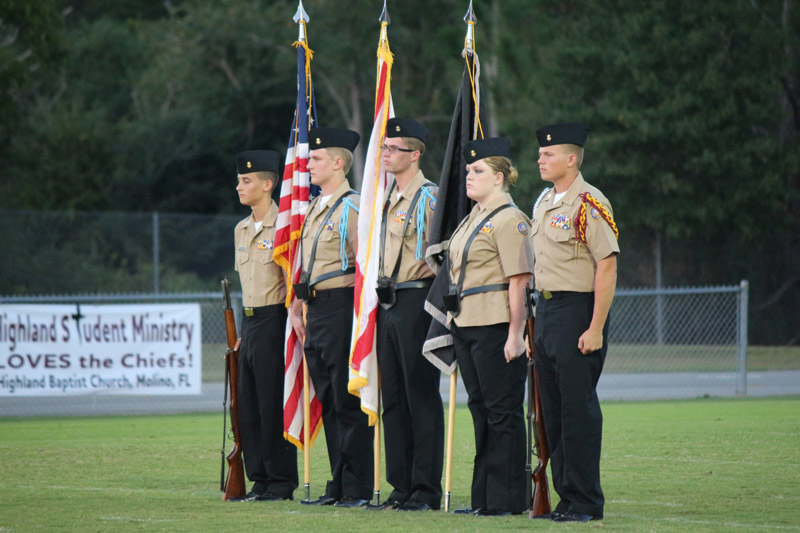
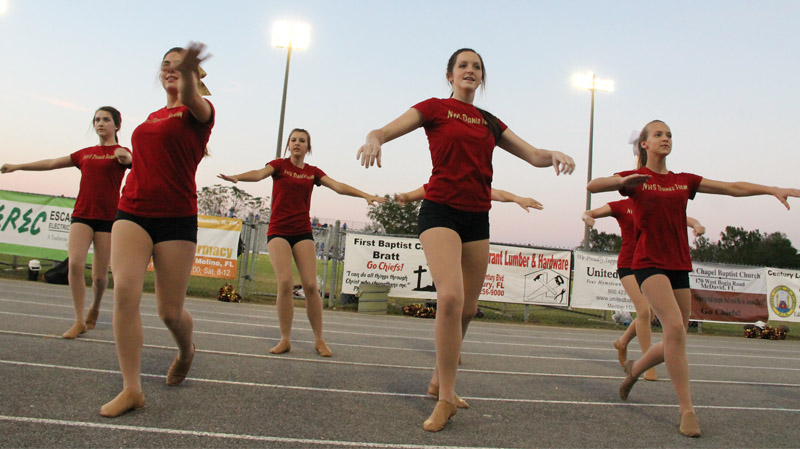
For a bonus photo gallery from last Friday night with the Northview High School Tribal Beat Band, Dance Team, NJROTC and cheerleaders, click here.
For a game action summary and action photos, click here.
NorthEscambia.com photos, click to enlarge.


State GOP Sets Requirements For Presidential Primary Candidates
September 28, 2015
Florida Republicans approved a new rule laying out requirements for GOP presidential candidates to appear on next year’s presidential primary ballot.
The rule, approved by the Republican Party of Florida’s executive board in a 35-1 vote early Friday, would give candidates three options if they want to participate in the state’s winner-take-all GOP primary in March.
Under the new rule, candidates can show up at the state party’s “Sunshine Summit” in November, pay a $25,000 fee before November 23 or gather petition signatures from 3,375 registered Republican voters, including at least 125 registered Republicans from each of the state’s 27 congressional districts.
“The Republican Party of Florida finds it necessary for Republican presidential candidates to make a preliminary showing of substantial support in order to qualify for a place on the presidential preference primary ballot,” the rule’s prelude reads.
State Chairman Blaise Ingoglia originally wanted to require all the GOP candidates to attend the fall event to have their names on the ballot. But Ingoglia’s proposal drew harsh criticism from many of his Republican colleagues. The modified rule, which was floated a day before Friday’s executive board’s vote, “gives clear options to candidates while empowering the grassroots of our great party,” Ingoglia said in a statement.
by The News Service of Florida
Only 14 Projects Submitted So Far For Potential Escambia RESTORE Funding
September 27, 2015
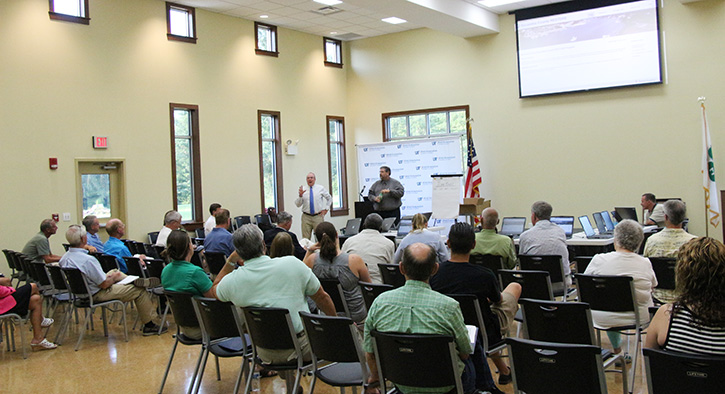
The deadline is Wednesday for interested parties to submit ideas to possibly receive a share of millions of dollars in RESTORE Act funding for Escambia County. The act provides for the allocation and use of funds gained through civil penalties from the Deepwater Horizon blowout and oil spill.
As of Friday, there were 137 current registrations in Escambia RESTORE project submission portal, with 91 active project entries. So far, only 14 projects have been submitted as the Wednesday deadline approaches.
Projects submitted for RESTORE act funding as of Friday were:
- Cantonment Community Center
- Community Gathering Center
- Raise the Homes
- Hampton Lakes Flooding Issue
- Dune Walkover Protection Project
- Brownsville Nature Trail
- G.R.U.B.
- Sidewalks, Bike Lanes, Curbs and Gutters Everywhere
- Bayou Chico Restoration
- Escambia County Regional Sediment Management Plan
- STEM Story
- Digital Radiology at Nemours
- Multi-Purpose Suite of Water Quality Models for Escambia County
- Pedestrian Safety on Main Street
The County’s RESTORE project submission portal website launched on July 1. The submission deadline is September 30.
The Escambia County RESTORE Advisory Committee will meet Tuesday, October 20, at 4 p.m. in the BCC Chambers, 221 Palafox Place, to discuss the submitted projects and the next step in the process. The public is invited and encouraged to attend. The Committee is tasked with reviewing projects and submitting recommendations to the Escambia Board of County Commissioners for consideration.
To submit a project idea today or for more information, visit restore.myescambia.com or contact Shelly Marshall, RESTORE coordinator for Escambia County, at (850) 595-3460 or email restore@myescambia.com.
Pictured: A RESTORE project information meeting held recently in Cantonment. NorthEscambia.com file photo, click to enlarge.
Escambia Man Gets 30 Years For Killing Elderly Man
September 27, 2015
An Escambia Count man has been sentenced to 30 years in prison for the second degree murder of an elderly man.
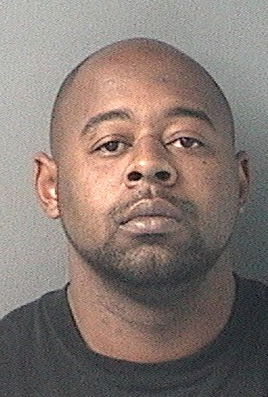 Marcus Ferrell Toler, 37, pleaded guilty to beating 76-year-old Ben Stallworth to death in 2014. He later attempted to change his guilty plea, but that motion was denied by a judge.
In March 2014, deputies responded to a disturbance in the 1700 block of West Lakeview Avenue where they found Stallworth was sitting on his couch with obvious injuries. He was transported to a local hospital by ambulance were he was pronounced deceased.