

Grand Opening Tuesday For Ernest Ward Middle School
October 5, 2015

An official grand opening ceremony for Ernest Ward Middle School will be held on Tuesday, October 6 at 10 a.m. The even will include remarks from school district officials, the architect and construction company. NorthEscambia.com photo.
Bonus Photos: NHS Band, Dance Team, NJROTC, Cheerleaders
October 5, 2015

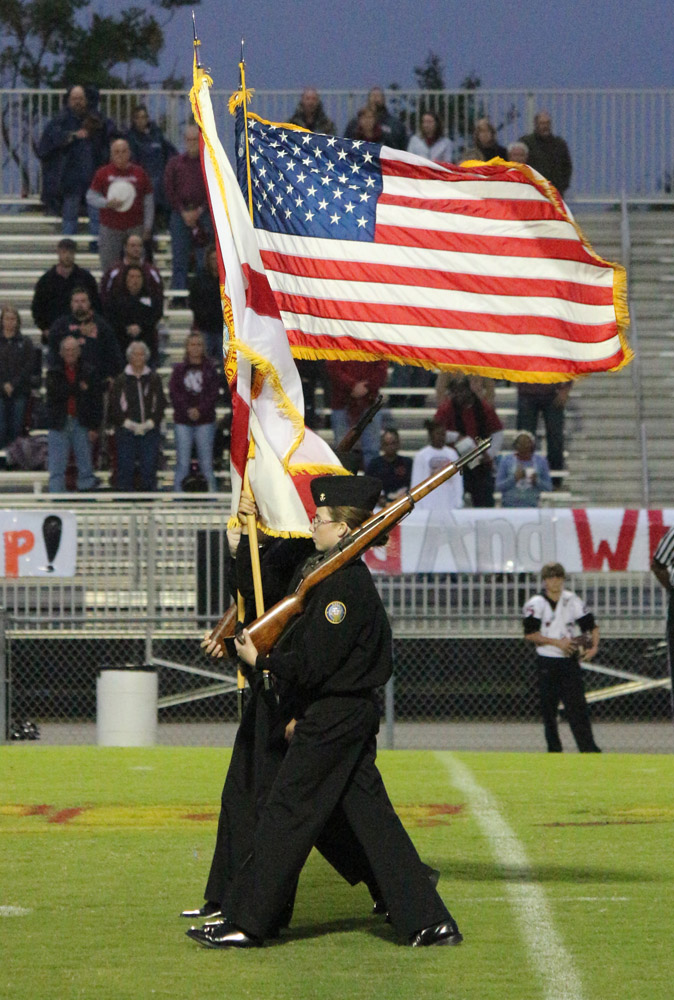
For a game action photo gallery, click here.
NorthEscambia.com photos, click to enlarge



Jay Peanut Festival Draws Thousands (With Two Photo Galleries)
October 5, 2015
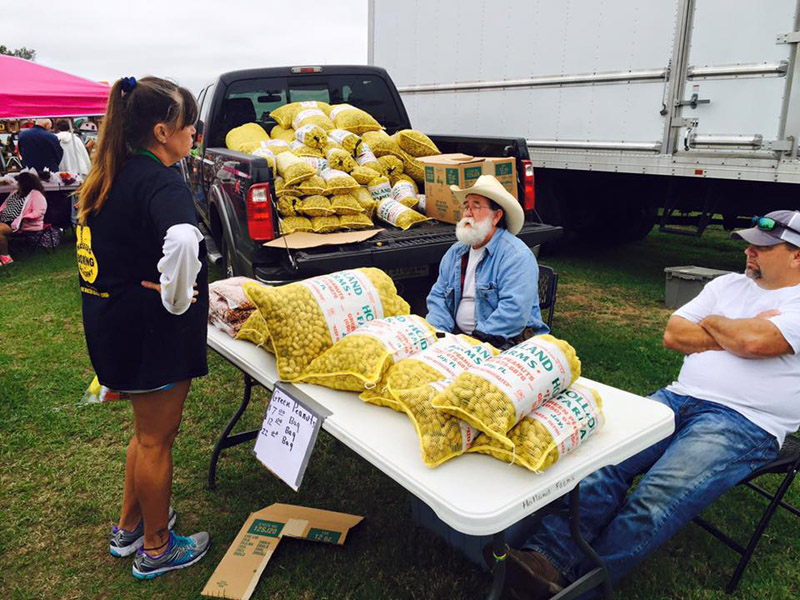
The annual Jay Peanut Festival attracted thousands to the Gabbert Farm Saturday and Sunday.
For more than 20 years, The Jay Peanut Festival at the Gabbert Farm has been a fall tradition on the Gulf Coast, showcasing the history, agriculture, food and fun of Santa Rosa County. What started as a chance for local kids and farmers to show off their best of the season has become an annual event covering 15 acres and drawing about 70,000 people to the Gabbert farm over two days.
The event included tours of the 1930s Farm Museum, food booths, dozens of arts and crafts vendors, pony rides, games and fun. The Jay Peanut Festival was also a chance to try all varieties of peanuts – boiled, green, fried, candied and more.
For a photo gallery, click here. Photos by Michael Pevahouse.
For a second photo gallery, click here. Photos by Michele Gibbs.
Pictured: Lots of peanuts were available at the Jay Peanut Festival. Pictured below: Visitors stroll through vendor booths. Photos by Michael Pervahouse for NorthEscambia.com, click to enlarge.

Feds, Pharmacies Grapple With Pain Pill Dilemma
October 5, 2015
Susan Langston wiped away tears as she spoke of a 40-year-old woman who had struggled with cancer for a decade before a Fort Myers pharmacy refused to fill a prescription for pain medication.
The prescription was rejected because it was written by a doctor at the Cleveland Clinic, a facility 100 miles away from the woman’s home and where she sought cancer treatment after her own doctors told her she was going to die.
But, according to the chain pharmacy’s policies, the prescription was flagged because it wasn’t ordered by the woman’s regular doctor, the woman traveled a long distance to obtain the prescription, and it came from South Florida, a part of the state once considered the pill-mill capital of the nation.
According to Langston, the pharmacist quit.
The cancer patient’s plight is one of many stories Langston has fielded in her job as the U.S. Drug Enforcement Administration diversion program manager in the Miami office.
“This girl is being labeled a drug seeker, a doctor shopper. She went to a different doctor. She got a different pain medicine. She drove a long distance, and she paid cash. But she also walked in there with a bald head to a pharmacist that she’s been going to for 10 years, who knows she’s none of those. And that’s awful. That’s not what we’re about. No one has ever gotten in trouble with the DEA in Florida from filling a cancer person’s prescription,” an emotional Langston said in an extended interview this week via Skype with The News Service of Florida.
Florida patients like the Fort Myers woman are caught in the crosshairs of a state and national crackdown on prescription pill abuse that’s morphed into a dreaded “pharmacy crawl” by people suffering from cancer, chronic pain and other illnesses but who can’t get their doctors’ orders for pain medications filled.
Pharmacists blame an overzealous Drug Enforcement Administration for the problem. Doctors — and the DEA — point the finger back at the pharmacists charged with filling prescriptions or at the corporations that have developed checklists to screen out dubious patients.
Meanwhile, some patients are checking into hospice care early — or even committing suicide — in search of relief.
The dilemma has reached such proportions that the Florida Board of Pharmacy is considering changes to its rules regulating the dispensing of pain medications, switching from a focus on detecting fraudulent prescriptions to ensuring that legitimate patients get the drugs they need.
But most of the players involved in Florida say the proposed rule change, scheduled for a vote Monday by a pharmacy board committee, alone will likely do little to alleviate the situation.
The rule change won’t have any effect on the policies of corporations like Walgreens and CVS, or on the policies of distributors who control the supply of drugs that flow into pharmacies.
“So it doesn’t really matter what the state of Florida says, or the DEA, or anyone else, as long as the corporation says, this is what we think,” Langston said.
Pharmacy chains won’t reveal their checklists for which patients pass muster.
When asked whether CVS has such a policy, company spokesman Mike DeAngelis referred to guidelines laid out in an industry paper released this summer, endorsed by more than a dozen associations representing doctors’ groups, chain pharmacies, pharmacists and distributors.
The “Stakeholders Challenges and Red Flag Warning Signs Related to Prescribing and Dispensing Controlled Substances” includes myriad items related to how people behave when they present prescriptions to be filled, as well as to the prescriptions themselves. One trigger is whether the patient “presents prescriptions for highly abused controlled substances,” something common for patients with chronic pain or cancer.
“Our corporate office will look into any complaint we receive from a patient who believes they are being denied a legitimate prescription, but our pharmacists do a great job in using their professional judgment to determine whether a controlled substance prescription was issued for a legitimate purpose,” DeAngelis said in an email.
One major concern for pharmacists involves an unwritten “30 percent rule” — the amount of pharmacies’ prescription drug orders made up of controlled substances — that many believe triggers scrutiny by the DEA.
But Langston denied that such a rule exists.
“There’s no number, officially, that triggers anything,” she said.
DEA probes are sparked by a “totality of circumstances,” Langston said.
“Volume, amount ordered, amount received by a pharmacy is only one of those circumstances. But we know that volume alone does not always tell the whole story. We’re very aware of that,” she said.
Langston is frustrated at the blame being placed on her agency.
“We want all pharmacists, patients, doctors and the public to know that the DEA does not want to interfere in any way with legitimate medical care. That would be morally wrong. We want legitimate patients to get the help and the medications that they need,” she said.
But a report from the U.S. Government Accountability Office this summer, based on surveys with industry professionals and DEA officials, found that over half of DEA registrants — pharmacies and distributors — have changed certain business practices based on the result of the agency’s enforcement actions.
More than half of distributors have placed stricter limits on quantities of controlled substances that their customers can order, the report found.
And more than half of individual pharmacies and chain pharmacies reported that the stricter limits “have limited to a ‘great’ or ‘moderate extent,’ their ability to supply drugs to those with legitimate needs,” according to the report.
In contrast, DEA officials “said they generally did not believe that enforcement actions have negatively affected access.”
Cardinal Health, one of the country’s largest distributors, referred questions about its policies to June testimony from one of the company’s top executives at the Florida Board of Pharmacy’s Controlled Substances Standards Committee.
The DEA has instructed distributors not to ship suspicious orders to pharmacies and to report them to the federal authorities. Failure to do so could result in the loss of the distributors’ DEA registration, Gary Cacciatore, the company’s vice president of regulatory affairs, told the committee.
Cardinal Health has placed “individualized limits on each controlled substance drug family,” imposed limits on particular drug strengths within a drug family and scrutinizes the drugs that the DEA has identified as being widely diverted, such as oxycodone and alprazolam, he said.
“These factors and many others play a role in our decisions to service customers and in setting limits on the distributions of controlled substances,” Cacciatore said.
The DEA’s actions may have had an even greater impact on the behavior of distributors and pharmacies in Florida.
In a 2012 settlement agreement, Cardinal Health was banned from shipping and selling narcotics from its Lakeland facility for two years.
Walgreens agreed to a historic $80 million penalty in 2013 related to dispensing of highly addictive narcotics.
And, earlier this year, CVS agreed to pay $22 million in fines after DEA investigators revealed that employees at two of the chain’s Sanford stores were doling out controlled substances without legitimate prescriptions. Three years ago, federal authorities stopped the stores from dispensing a number of highly addictive controlled substances, including oxycodone.
According to the Government Accountability Office report, the number of DEA complaint investigations jumped nationally from 907 in 2009 to 1,428 in 2013, as state and federal authorities grappled with a prescription drug-abuse epidemic that earned Florida the dubious distinction as the epicenter of the problem.
At the urging of Florida Attorney General Pam Bondi in 2011, state lawmakers imposed strict regulations on doctors and pharmacies about dispensing highly addictive pain medications. The effort was aimed at shutting down rogue clinics that had popped up in areas like South Florida and had drawn addicts and traffickers from states hundreds of miles away.
The law barred doctors from dispensing powerful narcotics from their offices, and shuttered almost all of the pill mills where doctors wrote hundreds of prescriptions for pain medications each day.
But the pill-mill problem hasn’t gone away, Langston said.
“Those same lines of people — those people shooting up in their cars, urinating, buying and selling urine, buying and selling pills — they ended up at pharmacies,” she said.
While most pharmacists turned those patients away, “we had a lot of bad pharmacists that turned a blind eye,” Langston said.
“When you have people shooting up in your parking lot, there’s a problem. These aren’t cancer patients or surgery patients doing this. And it’s awful that people like that are having to suffer,” she said.
Langston said she was in a pharmacy earlier this month when a homeless man paid $800 in cash for powerful narcotics. That pharmacy is now under investigation, she said. She watched as the man placed the $20 bills into stacks on the counter.
“It was really sad. I couldn’t believe that pharmacist took that money,” she said.
The DEA has no control over pharmacies’ pricing of drugs, Langston said.
“They can charge what they want. That’s not against the law. But when a pharmacist will do that, it’s very telling. Very telling,” she said.
by Dara Kam, The News Service of Florida
Tate Grad Racks Up Career High Game Rushing Yards For Wofford
October 5, 2015

Tate graduate Lorenzo Long had a career-high 187 yards rushing and a touchdown Saturday was the Wofford College football team beat Mercer University 34-33 in overtime.
Long, now a junior at the South Carolina school, ran for first downs to reach the red zone in the fist quarter, while in the second quarter had a run fall short on fourth-and-one before Wofford turned the ball over on downs.
Wofford used a 60-yard run by Long to set up a 27-yard field goal attempt that was blocked to end the first half.
An interception by the Terriers was dropped and Mercer went on to score on a two-yard touchdown run to make it a 20-17 game with 36 seconds left in the third quarter. Wofford wasted little time in responding, as Long went 53-yards up the middle for a touchdown. The Terriers had a 27-17 lead with 14:28 on the clock in the fourth quarter.
Of Long’s career-high 187 yards rushing n a game, 121 came in the first half before a crowd of 10,489 at Mercer University in Macon, GA. It was his first 100-yard game this season and the sixth of his career.
Long, a 2013 Tate graduate, had 3,227 rushing yards on 423 carries, 37 touchdowns, and 3,826 all-purpose yards while in high school.
Over 100 RESTORE Project Ideas Submitted; Five Specifically Benefit North Escambia
October 4, 2015
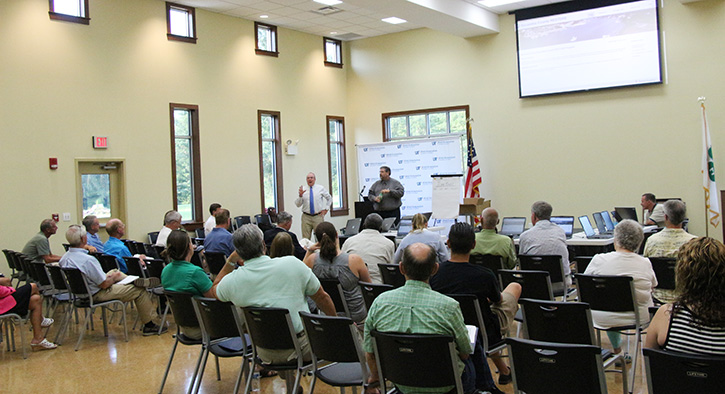
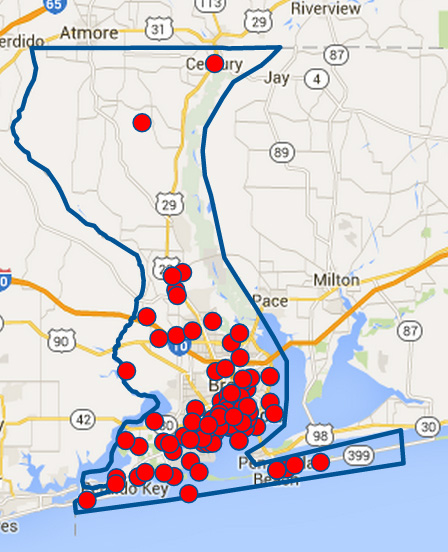
Over 100 projects were submitted by the deadline to possibly receive a share of millions of dollars in RESTORE Act funding for Escambia County. The act provides for the allocation and use of funds gained through civil penalties from the Deepwater Horizon blowout and oil spill.
While projects across Escambia County will receive equal consideration, only five projects specifically benefiting some portion of the North Escambia area (north of Muscogee Road) were submitted. Those projects were:
 Century Water Quality Improvements — The project would install a lime addition system to lower the pH of the waste water discharged into the Escambia River. Aging lift stations and other portions of the sewage system would be replaced to prevent overflows and eventual infiltration into the Escambia River. The project would also include $198,000 requested by the town from the legislature and a loan of $30,000 to provide fire protection to the Carnley Road area.
Lambert Bridge Road – The section of Lambert Bridge Roadd immediately north of the intersection of Pine Barren Creek (approx. 1/2 mile) has been a source of sedimentation into Pine Barren Creek for many years. This section of road needs to be graded and paved with stabilization of associated ditches to prevent sedimentation of Pine Barren Creek. The section of this road south of the creek was addressed in the same manner a number of years ago.
Cantonment Sportsplex - The project would include the complete restoration of the Cantonment Sportsplex to provide a park offering multiple sports outlets to all youth and families in Cantonment and surrounding areas.
Cantonment Community Center – The project would include a community center for the Cantonment CRA as identified in the Cantonment Redevelopment Plan adopted by the Escambia County Commission in early 2014. The multi-function community center would serve as a job training center, library, adult education center, center for tutoring, senior citizens center, recreation center and housing assistance center.
Cottage Hill Water Works Infrastructure Update and System Improvements – This proposed project would include the replacement of approximately four miles of existing asbestos concrete water main (located on Williams Ditch Road, Phalrose Lane, Highway 95A, Welcome Road and from two wells out to Williams Ditch Road. The project would also include the construction of a new well and storage tank on the northwest end of the franchise near the Central Commerce Park for future growth. There are currently three wells on the system, but one is reaching the end of its useful life.
The Escambia County RESTORE Advisory Committee will meet Tuesday, October 20, at 4 p.m. in the BCC Chambers, 221 Palafox Place, to discuss the 123 submitted projects and the next step in the process. The public is invited and encouraged to attend. The Committee is tasked with reviewing projects and submitting recommendations to the Escambia Board of County Commissioners for consideration.
Pictured top: A RESTORE project information meeting held recently in Cantonment. NorthEscambia.com file photo, click to enlarge .Pictured inset: This map shows the location of submitted RESTORE projects in Escambia County.
Local Airman Among Those Killed When C-130 Crashes In Afghanistan
October 4, 2015
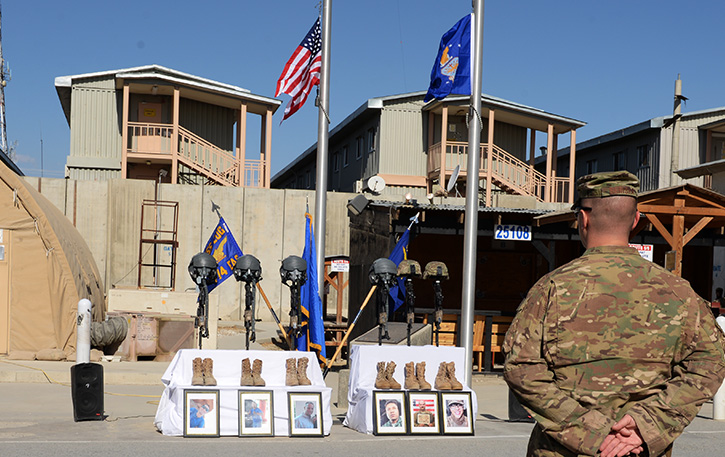
A local airman was among six Americans who died Thursday when a C-130J Super Hercules aircraft crashed shortly after take-off from Jalalabad Airfield, Afghanistan.
 Senior Airman Nathan C. Sartain, 29, of Pensacola, and Airman 1st Class Kcey E. Ruiz, 21, of McDonough, GA, were identified Saturday by the Department of Defense.
Both Airmen were deployed to the 455th Air Expeditionary Wing in Afghanistan. Members of the 66th SFS routinely deploy to assist with security operations around the globe. Both Ruiz and Sartain were installation entry controllers and also armorers at Hanscom Air Force Base in Massachusetts.3
They ensured that only authorized personnel accessed the installation, and they provided a proactive deterrent and first line of defense against any threats to the installation, its personnel and its mission, according to 66th Security Forces Squadron Commander Maj. Joseph Bincarousky.
While deployed to Afghanistan, they performed fly-away security team, better known as FAST, missions, meaning they flew on aircraft and were protecting the aircraft itself, the aircrew, passengers, and cargo, as these aircraft flew from one location to another.
Both Airmen were phenomenal young leaders and were nominated for early promotion, Bincarousky said.
“These Airmen were rock stars,” he said. “Their enthusiasm and dedication inspired peers and unit leadership alike. This is the type of young Airman the Air Force needs more of; their absence is palpable. Now it’s incumbent upon us as leaders to take the example they’ve given us and impress it upon others. They’ll be sorely missed by their fellow defenders here, and I’m extremely grateful for and humbled by their service. My heart goes out to their families and loved ones.”
Leaders at their deployed location in Afghanistan also lauded the Airmen.
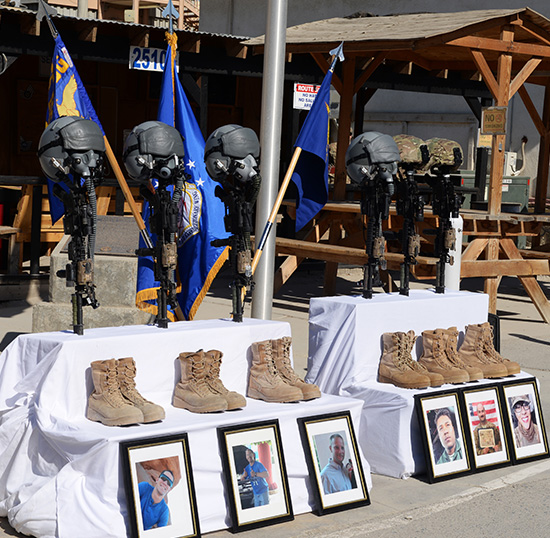 “Senior Airman Nathan Sartain and Airman 1st Class Kcey Ruiz were critical to our mission here of delivering airpower on the combat frontier, and both were topnotch performers,” said Chief Master Sgt. Derick Stepp, 455th Expeditionary Security Forces Squadron manager. “They were consummate professionals and their loss is a loss for our squadron, their home station units, and our Air Force. They were the very finest of Airmen and their loss has impacted those who worked with them here and at their home station. They will always be a part of our family.”
Also killed in the crash were Capt. Jonathan J. Golden, 33, of Camarillo, CA; Capt. Jordan B. Pierson, 28, of Abilene, TX; Staff Sgt. Ryan D. Hammond, 26, of Moundsville, WV; and Senior Airman Quinn L. Johnson-Harris, 21, of Milwaukee, WI.
The remains of these fallen heroes will be flown back to the U.S. via Dover AFB, Delaware, at a yet-to-be-determined date.
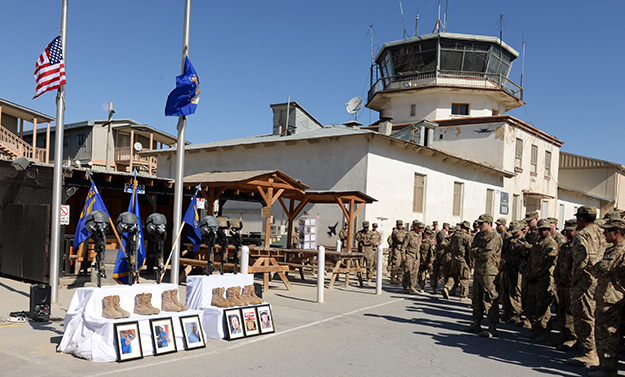
Pictured: U.S. Air Force Maj. Met Berisha, 455th Expeditionary Security Forces Squadron commander, stands at parade rest during a fallen comrade memorial ceremony held in honor of six Airmen Oct. 3, 2015, at Bagram Air Field, Afghanistan. Pictured below: Airmen of the 455th Air Expeditionary Wing pay their respect and mourn the loss of six Airmen during a fallen comrade memorial ceremony at Bagram Air Field. U.S. Air Force photos by Senior Airman Cierra Presentado for NorthEscambia.com, click to enlarge.
Thousands Attend Jay Peanut Festival (With Photo Gallery)
October 4, 2015

The annual Jay Peanut Festival attracted thousands to the Gabbert Farm Saturday.
For more than 20 years, The Jay Peanut Festival at the Gabbert Farm has been a fall tradition on the Gulf Coast, showcasing the history, agriculture, food and fun of Santa Rosa County. What started as a chance for local kids and farmers to show off their best of the season has become an annual event covering 15 acres and drawing about 70,000 people to the Gabbert farm over two days.
The event included tours of the 1930s Farm Museum, food booths, dozens of arts and crafts vendors, pony rides, games and fun. The Jay Peanut Festival was also a chance to try all varieties of peanuts – boiled, green, fried, candied and more.
Admission is free from 9 a.m. until 6 p.m. on the finale day of the festival on Sunday. The Gabbert farm is located at 3604 Pine Level Road.
NorthEscambia.com photos by Michele Gibbs, click to enlarge.


House Considers Shielding Churches After Marriage Ruling
October 4, 2015
With the U.S. Supreme Court ruling in June that same-sex marriage is legal across the country, a Florida House panel next week will take up a bill that seeks to shield churches and clergy members if they refuse to perform marriages that violate their beliefs.
The House Civil Justice Subcommittee on Wednesday is scheduled to take up the measure (HB 43), sponsored by Rep. Scott Plakon, R-Longwood, and Rep. Bob Cortes, R-Altamonte Springs. Under the proposal, clergy members, churches and religious organizations would not be required to perform marriages or provide related services “if such an action would cause the church, organization, or individual to violate a sincerely held religious belief of the entity or individual.”
The proposal would provide a shield from criminal or civil liability and also would provide protections for religious organizations’ tax exemptions, government contracts, grants and licenses.
Sen. Aaron Bean, R-Fernandina Beach, has filed an identical bill (SB 110) in the Senate. But critics say the proposals are unnecessary, as ministers can already refuse to marry gay couples.
In July, Nadine Smith, executive director of the advocacy group Equality Florida, called the issue an “ugly show of animosity toward gay people.”
by The News Service of Florida
UWF Pre-Vet Society Volunteers At Panhandle Equine Rescue
October 4, 2015


The University of West Florida Pre-Vet Society volunteered at Panhandle Equine Rescue in Cantonment Saturday morning. The students spent the morning working on grooming and barn chores.
The only horse rescue in Escambia County, Panhandle Equine Rescue was founded by a small group of concerned citizens with a mission to rescue, rehabilitate and provide adoption services for abused, neglected and abandoned equines. PER is authorized by the court system to investigate equine cruelty in Escambia County.
For more information on Panhandle Equine Rescue and how to donate to the organization contact Diane Lowery at rlowery@panhandle.rr.com or visit www.panhandleequinerescue.org to print a foster application.
Photos for NorthEscambia.com, click to enlarge.