

Atmore Man Killed In Single Vehicle Crash
October 6, 2015
A single vehicle accident north of Atmore claimed the life of an Atmore man Monday night.
 According to Alabama State Troopers, 19-year old James Bradley Tolbert was killed when he was thrown from the bed of a pickup truck in which he was a passenger. He was pronounced deceased on the scene of the 8:45 pm. crash on Butler Street, about eight miles north of Atmore.
The driver of the 2003 Dodge Ram, 29-year old James Patrick Godwin of Atmore was not injured.
Further details have not been released as Alabama State Troopers continue their investigation.
Tate High Graduate Appears On ‘Who Wants To Be A Millionaire’
October 6, 2015

Tate High School graduate Matthew Bailey appeared during ” on “Who Wants To Be A Millionaire” Monday night. He didn’t bring home the million, but did win $20,000. Bailey is a 2013 honors graduate from Tate High School. Images courtesy @MillionaireTV for NorthEscambia.com, click to enlarge.

New Assisted Living Facility May Bring New Jobs To Century
October 6, 2015

A new assisted living facility and the jobs it may bring to Century have Mayor Freddie McCall excited.
The owners of The Terrace At Ivy Acres in Jay, also an assisted living facility, have plans in the works to open a similar facility in in the Century Industrial Park. McCall told the Century Town Council Monday night that he was not sure how many beds the facility would operate, but it would bring 20-30 much needed jobs to the town. “That’s the part (the jobs) I remember and the part I’m happy about,” he said.
The front lots in the industrial park, just off West Highway 4, are already zoned for medical services and already occupied by medical-related facilities such as the Century Health and Rehabilitation Center, Lakeview Center and an Escambia County EMS post.
There is a lot just under 2.5 acres available in the area zoned for medical facilities, McCall said, but the new assisted living facility might not fit on the property. In that event, they are considered a lot further back in the mostly unoccupied industrial park, but it’s not properly zoned, he said.
Changing the zoning and amending the town’s comprehensive plan for the assisted living facility to locate elsewhere in the park would be a 3-6 month process, McCall said. The town took the first step in that potential process Monday night by voting to spend $1,300 for wetlands survey on four lots in the industrial park.
There’s no word on any timetable for opening the assisted living facility in Century, if project developers move forward.
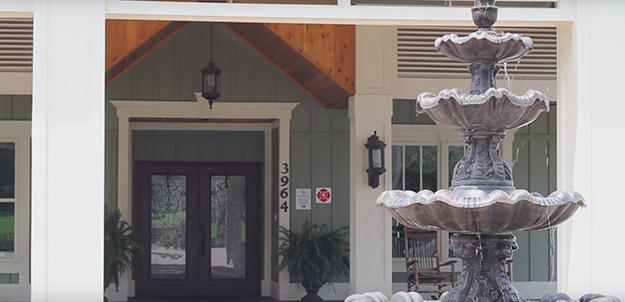
Pictured: The Terrace at Ivy Acres in Jay. Courtesy photos for NorthEscambia.com, click to enlarge.
North Barth Road To Be Closed Wednesday
October 6, 2015
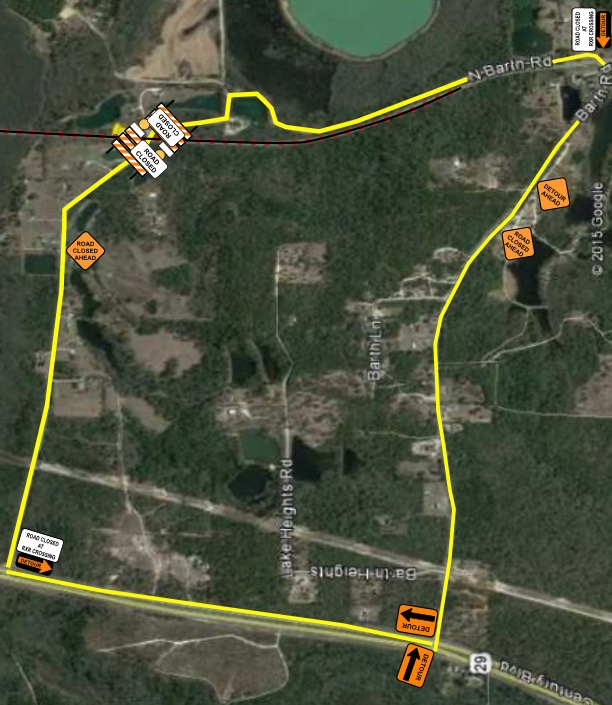
CSX Railroad is scheduled to close North Barth Road at the railroad crossing until Wednesday, October 7, for repairs to the crossing. All maintenance and repair activities are weather dependent and may be delayed or rescheduled in the event of inclement weather.
Alabama Recycling Facility Shuts Down, ECUA Searching For Solution
October 6, 2015

The Montgomery, AL, recycling facility that processes recycled materials for ECUA has temporarily shut down.
 A majority of the recyclables collected by ECUA are trucked to the Advanced Mixed Materials Recovery Facility operated by Infinitus Energy. It’s an arrangement that was profitable for ECUA.
But the plant temporarily ceased operations last week because of falling prices for their recycled products.
“One key element of a successful materials recycling program is the ability to sell recovered material at a price that will support the recycling process,” said Kyle Mowitz, Infinitus CEO. “While our customers have been satisfied with the material we have reclaimed, unfortunately the market price for these materials has dropped dramatically.”
Now, ECUA is looking at other options, and Infinitus is looking to the city of Montgomery for help. The company also processes recyclables for Montgomery.
“The proposed plans will require cooperative efforts on all fronts, to deal with current market pricing issues. However, it is possible to minimize the impact these temporary conditions will have on the City’s long term goals of recycling and diversion, by keeping the facility in operation and working together until the markets improve,” the Infinitus said in a prepared statement.
Pictured: Infinitus Energy in Montgomery, AL. Courtesy photos for NorthEscambia.com, click to enlarge.
State Awards Century $50K for New Showalter Park Splash Pad
October 6, 2015

The Florida Department of Environmental Protection has officially announced funding for a new splash pad in Century.
The $50,000 Florida Recreation Development Assistance Program grant to install a splash pad at Showalter Park was announced Monday. That amount will fund the installation of the watery playland, but not associated costs such was water and sewer.
At a July council meeting, Mayor Freddie McCall expressed concerns that the splash pad might cost the town too much to operate.
The splash pad that Century can afford won’t recycle water — that feature would cost the town another $50,000 plus, McCall said. The splash pad that Century can purchase with grant money will use hundreds of gallons of water in just minutes. At an August council meeting, McCall said the cost to operate the splash pad could reach an affordable average of $184 per week — calculating water and sewer expenses at the town’s cost since they operate their own water and sewer system. The splash pad will not be operational during the colder months of the year.
In August, council voted to move forward, accepting the splash pad grand and agreeing to pay the water and sewer costs.
McCall said the town will also install a restroom near the splash pad at Showalter Park, next to new playground equipment recently installed with a previous state grant.
More than $5.4 million was announced Monday for 110 recreational development projects in local communities across the state. Century’s splash pad project was the only grant recipient in Escambia County. The competitive grant program provides state funds to develop lands for public outdoor recreational use, such as building or renovating sports facilities or playgrounds.
“The Florida Department of Environmental Protection is committed to funding projects that directly benefit natural resources and local communities,” said DEP Secretary Jon Steverson. “This grant funding will support projects such as athletic fields, picnic facilities, fishing piers and playgrounds – projects that provide taxpayers additional recreational opportunities.”
Pictured: The Town of Century has been awarded a state grant to purchase this model splash pad. Courtesy images for NorthEscambia.com, click to enlarge.

Jay Royals Name Homecoming Court, Set Activities
October 6, 2015

It’s homecoming week for the Jay High School Royals.
Named to the homecoming court were: (L-R) Hannah Vaughn, junior; Kennedy Salter, senior; Alaina Smith, senior; Savannah Dubose, senior; Jenna Thornton, senior; Anna-Grace Smith, sophomore; and Maci Holt, freshman.
The schedule of events for the week includes:
- Lion’s Roar – Thursday, 9:30 a.m., auditorium. Queen will be crowned at this event.
- Pep Rally – Thursday, 1 p.m., Merle V. North Stadium.
- Parade – Friday, 2 p.m., Downtown Jay
- Pre-Game Festivities – Friday, 6 p.m., stadium
- Game – Friday, 7 p.m., Theme: “Wipe Out the Hornets!”
- Dance – Saturday, 8-11 p.m., Jay Community Center
- Powder Puff Football Game – Monday, October 12, 7 p.m., stadium
Photo courtesy Junia Fischer, Photos by Fischer for NorthEscambia.com, click to enlarge.
Molino Park Community Helpers Day (With Photo Gallery)
October 6, 2015

 Molino Park Elementary School held a “Community Helpers Day” recently for students to learn about some of people that are hard at work, often behind the scenes, in the Molino area.
The event includes personnel and equipment from Escambia County EMS, the Escambia County Sheriff’s Office K-9 Unit, the Pensacola Police Department, the Molino Station of Escambia Fire Rescue, LifeFlight, and J. Miller Construction Company.
Pictured top: Escambia County Deputy Jason Land and his K-9 Edo answer questions during Community Helpers Day at Molino Park Elementary. Pictured: An Escambia Fire Rescue firefighter from Molino’s Station 18 answers questions and give a truck tour. Photos by Kayla Bedell for NorthEscambia.com, click to enlarge.

FWC Law Enforcement Report
October 6, 2015
The Florida FWC Division of Law Enforcement reported the following activity during the weekly period ending October 1 in Escambia and Santa Rosa counties.
ESCAMBIA COUNTY
 Officers Manning and Cushing were on patrol over the weekend on the FinCat. They conducted 12 fisheries inspections in both state and federal waters. Three federal boarding’s revealed violations for possession of red snapper during a closed season. Prior to boarding one of the vessels in federal waters, one of the fishermen asked if gray triggerfish was in season before admitting to having some in the cooler. During the inspection, Officer Manning discovered gray triggerfish, undersized greater amberjack and red snapper. The violations were documented and turned over to National Marine Fisheries Service.
SANTA ROSA COUNTY
Lieutenant Hahr was patrolling at Keyser Landing in the Escambia River Wildlife Management Area when he observed a truck heading towards the landing. This area has been vandalized several times recently, so Lieutenant Hahr followed the vehicle. The truck was being driven erratically and the driver spun the tires unnecessarily on the roadway. When Lieutenant Hahr stopped the truck, he observed two open containers of beer and the driver showed signs of impairment. The driver performed very poorly on field sobriety tasks and was arrested for DUI. The man later provided a breath sample of .162g/210L. The driver and a passenger were also cited for open container.
This report represents some events the FWC handled over the past week; however, it does not include all actions taken by the Division of Law Enforcement. Information provided by FWC.
Court Reverses Course, Rules Against Slot Machines At Poarch Creek Track
October 5, 2015
In an unusual legal move that sent ripples throughout the state’s pari-mutuel industry, an appellate court reversed itself and decided that a Northwest Florida racetrack operated by the Poarch Creek Indians of Atmore` cannot have slot machines without the authorization of the Legislature.
The ruling by a three-judge panel of the 1st District Court of Appeal sided with Attorney General Pam Bondi and Gov. Rick Scott’s administration, which sought a rehearing after a 2-1 ruling this spring in favor of Gretna Racing in Gadsden County.
 As they did in the earlier opinion, the judges Friday asked the Florida Supreme Court to weigh in on the issue of whether pari-mutuels can have slot machines if local voters approve, or if the games require the express say-so of the Legislature.
Rehearings are commonly sought by lawyers on the losing sides of issues but are rarely granted.
The Gretna case is even more unusual because Judge Nikki Ann Clark, who joined Judge Robert T. Benton in May’s majority opinion, retired while the request for rehearing was pending. The May ruling would have given the small Northwest Florida facility permission to add slot machines after Gadsden County voters approved them.
The court decided against granting Bondi’s request for an “en banc,” or hearing before the full appeals court, in favor of a rehearing before a three-judge panel with a new member. Judge Ross L. Bilbrey on Friday joined the 32-page majority opinion authored by Judge Scott Makar, who wrote a scathing dissent in May.
The case hinges on a semantic analysis of a 2009 law establishing eligibility for slot machines at pari-mutuels. The 2009 law, which went into effect the following year, was an expansion of a 2004 voter-approved constitutional amendment that authorized slot machines at seven existing horse and dog tracks and jai-alai frontons in Broward and Miami-Dade counties.
The 2009 change allowed a Hialeah track, which wasn’t operating at the time the amendment was approved, to also operate the lucrative slots. The law in question consists of three clauses, including one that deals with counties outside of Broward and Miami-Dade.
State regulators last year denied the Gretna racetrack a slots license, arguing the Department of Business and Professional Regulation was “not authorized to issue a slot machine license to a pari-mutuel facility in a county which … holds a countywide referendum to approve such machines, absent a statutory or constitutional provision enacted after July 1, 2010, authorizing such a referendum.” The agency justified its decision with a non-binding opinion by Bondi.
Lawyers for Gretna argued that the statute does not include the word “enacted,” and other counties do not need prior authorization from the Legislature to get the requisite voter approval for slots.
But, in Friday’s ruling, Makar wrote that Bondi’s interpretation of the law was “spot on.”
“The alternative view, which would restructure the statute and change its meaning to allow slot machines to be deployed on a statewide basis without any clear authority to do so, is inconsistent with principles of statutory and constitutional construction, legislative intent, and the history of laws prohibiting slot machines in the State of Florida,” he wrote.
Makar also raised the question of whether the Legislature has the authority to approve slot machines outside of Broward and Miami-Dade counties, based on a previous Florida Supreme Court ruling in a case known as “Greater Loretta.” That opinion, which dealt with an interpretation of Florida’s 1968 Constitution, found that “all other lotteries — including bolito, cuba, slot machines, etc., are prohibited.” Makar asked the Supreme Court for guidance.
“So which is it? Are slot machines a form of lottery that only the people may approve via constitutional amendment? Or are slot machines not prohibited as lotteries under (the state Constitution’s) article X, section 7, which may be legislatively authorized statewide without constitutional authority?” Makar wrote.
Makar also asked the court to settle the issue of the 2009 law. Voters in five other counties — Brevard, Lee, Hamilton, Palm Beach, and Washington — have also approved referendums authorizing slots at local pari-mutuels. State regulators have denied applications for slots in four counties, and the Palm Beach Kennel Club has an appeal pending. Tracks in Lee and Brevard counties are likely to appeal as well.
In an opinion concurring in part with Makar, Bilbrey wrote that he ended up on the three-judge panel thanks to “the luck of the draw.” The former Pensacola circuit judge joined the appeals court in January after being appointed by Scott.
Addressing the circumstances surrounding the rehearing, Bilbrey acknowledged that “the judgment of a retired colleague is entitled to some deference.” But, he wrote, “a successor judge is not required to always vote identically to the predecessor on rehearing.”
The Gretna facility, owned by the Poarch Creek Indians and a handful of investors, has been mired in controversy since its inception. Florida officials granted the track the country’s first pari-mutuel license for rodeo-style barrel racing, but a court later decided that gambling regulators erred when they awarded the license.
“We are disappointed with this reversal, and we look forward to a review from the Florida Supreme Court where we feel this issue will be resolved in our favor,” the tribe said in a statement following Friday’s ruling.
In his dissent Friday, Benton argued that gambling regulators’ interpretation of the law “would render superfluous the entire third clause” of the statute that deals with “any licensed pari-mutuel facility in any other county.”
The agency’s interpretation would mean that a referendum authorizing slots could only be held if the Legislature passed another law, Benton pointed out.
“But that was the status quo” before the 2009 law was enacted, Benton wrote. “There was no need or purpose in enacting a statutory provision to state the obvious,” he wrote.
David Romanik, a lawyer who represents Gretna and is a part owner of the facility, said he was disappointed in the court’s decision to “overrule its own very well-reasoned original opinion, but grateful that the Supreme Court will have the opportunity to review this issue of great statewide importance.”
But an association that represents horse breeders and trainers lauded the ruling.
“Justice has been served today in Florida. Simply, the 2012 Gadsden County slot referendum never should have been approved, inasmuch as it was based upon the pretext of ‘pari-mutuel barrel racing’ — the licensing of which was ultimately ruled in 2013 to be an overstep of regulatory authority,” Florida Horsemen’s Benevolent and Protective Association President Bill White said in a statement.
by Dara Kam, The News Service of Florida, with contribution by NorthEscambia.com