

Gracie Ann Carnley
June 3, 2018
Ann Carnley a native of Escambia Cty., FL and resident of Lenoir City, TN passed away on May 29, 2018 at the age of 73. She was a graduate of Tate High School Class of 63”.
Ann loved spending time with her family, friends, and her dogs. In her free time she enjoyed making jewelry and sewing.
She is preceded in death by her husband, Lamar F. Carnley; mother, Gracie Andrews Phillips; father, Lee C. Phillips; brother and sister-in-law, Bobbie Lee (Mildred E.) Phillips; niece, Gracie E. Phillips; sister and brother-in-law, Carolyn (Pierce) Moye; and brother and sister-in-law, Johnny (Gloria) Carnley.
Ann is survived by her daughter and son-in-law, Leann (Jason) Carnley; granddaughter, Erica Carnley; brother and sister-in-law, Robert Westley (Mary Ann) Phillips; and numerous nieces, nephews, and friends.
Funeral services will be held at 10AM on Saturday, June 2, 2018 at Faith Chapel Funeral Home North. Burial will follow services in McCurdy Cemetery, Century, FL.
The family will receive friends from 5PM to 7PM on Friday, June 1, 2018 at the funeral home.
Joseph “Buddy” Carlton Sands
June 3, 2018
Mr. Joseph “Buddy” Carlton Sands, age 70, passed away on Thursday, May 31, 2018 in Mobile, Alabama.
Mr. Sands was born in Key West, Florida and lived most of his adult life in the Atmore, Alabama area. Mr. Sands was a 1966 graduate of Ernest Ward High School. To date, he is the only All State Linebacker to come out of Ernest Ward High School weighing in at only 155 lbs. He retired from Frontier Communications as the Facilities Supervisor of the Southeastern District, serving a total of 42 years. He was a long time member of The Atmore Church of Christ. He is preceded in death by his father, Joseph R. Sands and mother, Rosa Lee Roach Sands of Bratt, FL.
He is survived by his wife, Jean Parsons Sands of Atmore, AL; brother, David C. Roach of McDavid, FL; sister, Marsha Sands Gibson of Walnut Hill, FL; daughters, Gia J. Sands of Metairie, LA, Jeanna Sands Encalade and son-in-law, Villie P. Encalade, III of Beaufort, SC and Shelley Sands Henderson and son-in-law, Joseph Henderson of San Diego, CA; mother-in-law, Irene S. Parsons of Uriah, AL; twelve grandchildren; seven great grandchildren; many nieces and nephews and a special little brown creature, Sweet Pea.
Funeral services will be held Monday, June 4, 2018 at 11:00 AM at the Atmore Church of Christ with Brother Norman Newberry officiating.
Visitation will be held Sunday, June 3, 2018 from 4 to 6 PM at the Petty-Eastside Chapel Funeral Home.
Pallbearers will be CJ Powell, Michael Powell, Lauren Smart, Annie Winsor, Caleb Comer, Villie Encalade and Joe Henderson.
Willie Jewel Kirkland Burch
June 3, 2018
Willie Jewel Kirkland Burch of Pensacola, Florida passed away on May 31, 2018. Mrs. Burch was born in Milton, Florida on December 26, 1925 and grew up in Baker. She graduated from Baker High School and Twentieth Century Business College and later worked at both the “old” Sacred Heart Hospital on Twelfth Ave. and Sacred Heart Hospital on Ninth Ave. She retired as an administrative assistant from the Florida Board of Medical Examiners in Tallahassee.
Mrs. Burch is preceded in death by her parents Garrett F. Kirkland, Sr. and Sula Barnett Kirkland; husband, Thomas Burch; son, Sidney A. Gill; two sisters, and seven brothers. Left cherishing memories are daughters, Gloria G. Fox (Kent), Mt. Juliet, TN; and Sheryl G. Pomeroy (Jeff), Pensacola; grandchildren, Julie G. Thompson, Greg Gill (Sidney), Dana G. Chase; Michael Morrell, Jonathan Morrell (Alison); Garrett Cox (Evie), Rebecca Kirchharr (Matt); eleven great-grandchildren; a special niece, Margaret Hamm; brother, Randall Kirkland; numerous nieces and nephews, and all-time favorite, Bo the Pomeranian.
Visitation will be from 9:30-10:30 on Wednesday, June 6, 2018 at Faith Chapel Funeral Home North. Celebration of Life will follow at 10:30. Interment will take place at 2:00 pm, Shady Grove Community Cemetery, 1189 Shady Gove Church Road, Baker, and Florida.
The family wishes to thank the staff of Clarity Pointe, Covenant Hospice, and Dr. Manning Hanline, Baptist Hospital. In lieu of flowers, donations may be made to the Pensacola Humane Society, 5 North Q Street, Pensacola, FL 32505 or the charity of your choice.
Tragic Tractor Accident Claims Life Of Cantonment Man
June 2, 2018
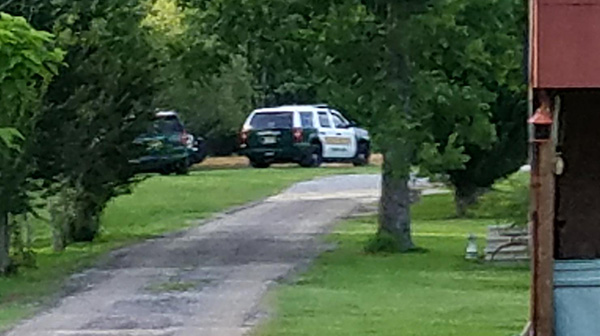
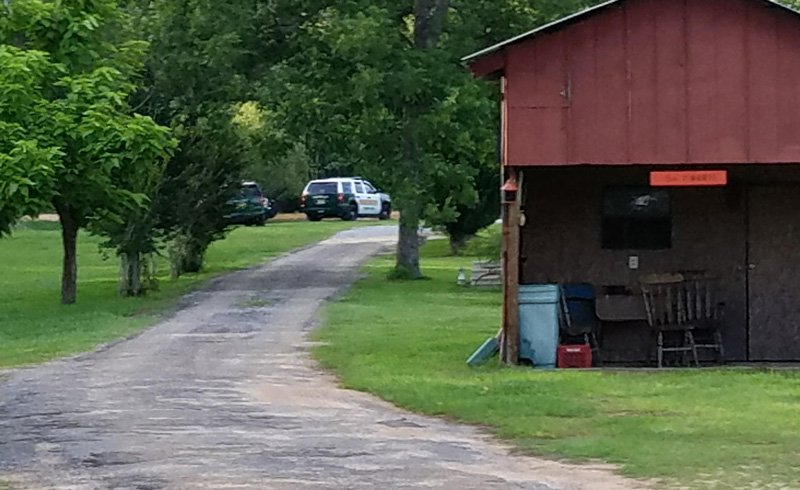
A tragic accident claimed the life of a man in Cantonment Friday afternoon.
About 5:30 p.m., the Escambia County Sheriff’s Office and emergency personnel responded to the 200 block of Cedar Point Road where a man had flipped a tractor into a pond.
“A 74-year old male was pinned under the tractor in the water and drowned,” according to Deb Henley, spokesperson for the Escambia County Sheriff’s Office.
The man’s name has not been released.
NorthEscambia.com photo by Kristi Barbour, click to enlarge.
Weekend Trip: Explore The Blackwater State Forest
June 2, 2018
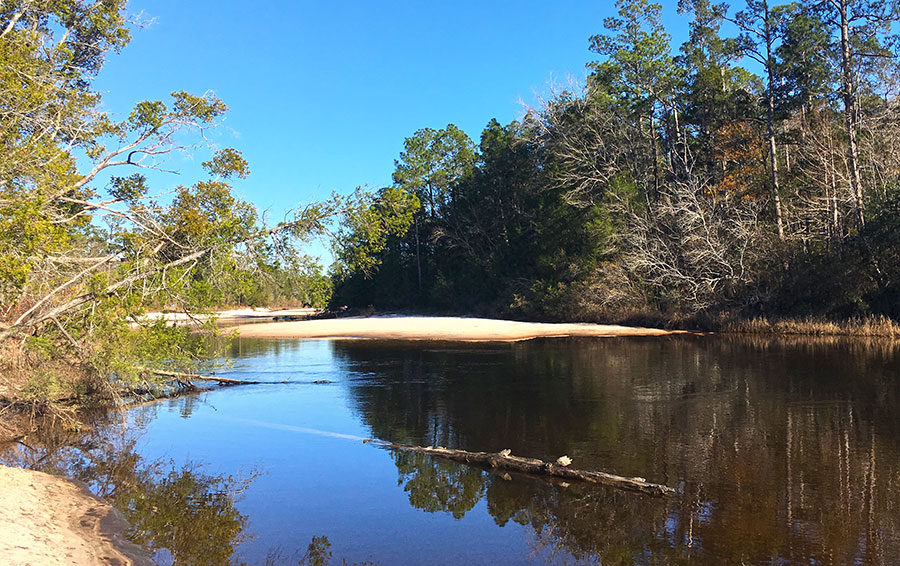
It’s time to get outside and explore the local area. In neighboring Santa Rosa County, a terrific destination for a variety of outdoor activities is the Blackwater River State Park.
Visitors can canoe, kayak, tube, fish and swim the river. Hikers can enjoy trails through nearly 600 acres of undisturbed natural communities. Bring a picnic and hang out at one of several pavilions or white sand beaches that dot the river (restroom facilities available). Near the pavilions, stop and see one of the largest and oldest Atlantic white cedars, recognized as a Florida Champion tree in 1982. The park also offers 30 campsites for tents and RVs. Park entry is $4 per car, payable at the ranger station or via the honor system with exact change.
 The Blackwater River is considered one of the purest and pristine sand-bottom rivers in the world. The water is tea-colored from the tannins and organic matter that color the water as it weaves through the predominantly pine forest. The river is shallow with a beautiful white sandy bottom, a nice feature for those tubing or paddling the trail. The river flows for over 50 miles and is designated as a Florida canoe trail. Multiple small sand beach areas line the river and provide plenty of space to hang out, picnic, or throw a Frisbee. Blackwater eventually flows into Pensacola Bay and the Gulf of Mexico bringing high quality freshwater into this important estuary.
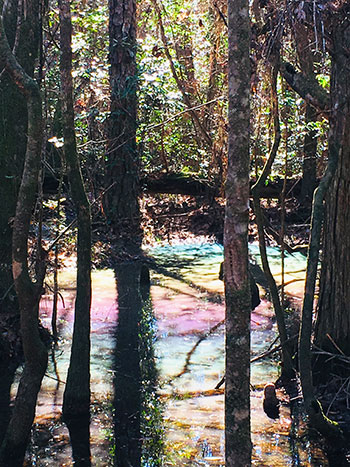
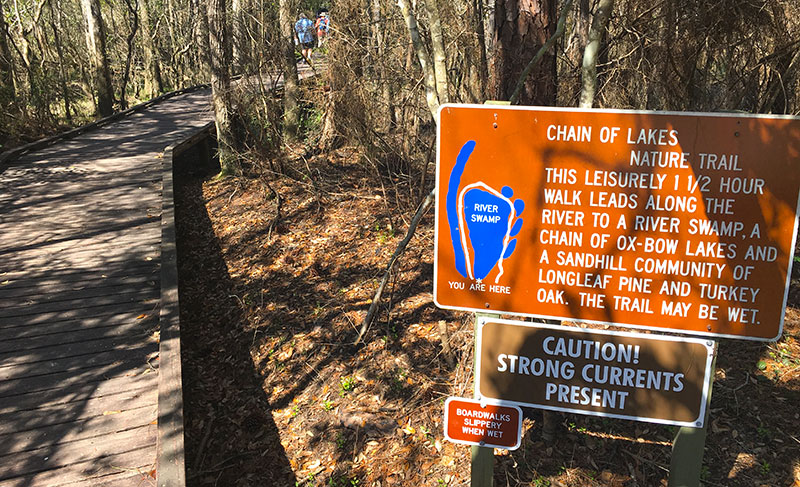
A favorite trail in the Park is the Chain of Lakes Nature Trail. Parking for this 1.75 mile loop trail is at South Bridge on Deaton Bridge Road. The trail head is well marked and has a boardwalk that leads into the floodplain forest. The trail winds through a chain of shallow oxbow lakes and swamp that dot the former route of the river. On a clear, blue-sky day, you may see a beautiful rainbow effect as the sun hits the water. It’s called the pastel swamp rainbow effect. This is a result of the natural oils from the cypress cones settling on the surface of the water and associated trapped pollen.
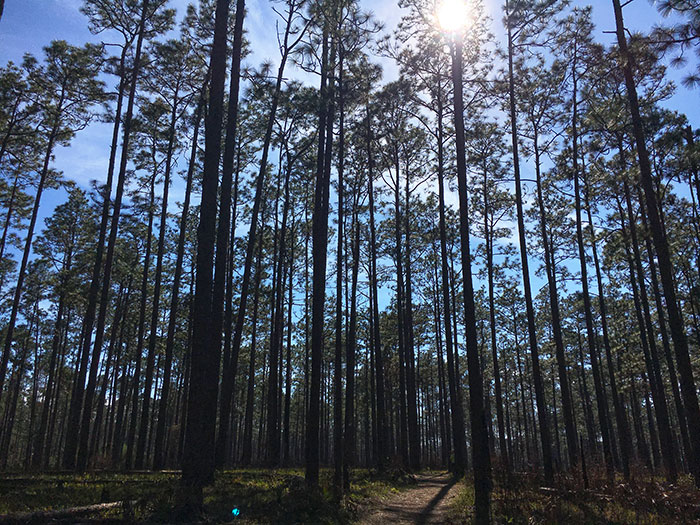
The trail then turns to sneak through the sandhill community in the park with giant longleaf pines, wiregrass and turkey oak. Evidence of prescribed burning shows management efforts to maintain the forest. Cinnamon ferns, bamboo and other natives appear in pockets along the trail. The trail in this section is blanketed with a mosaic of exposed root systems, so be careful as you step. Bug spray and a water bottle are recommended.
by Laura Tiu, UF/IFAS
Many Nursing Homes, ALFs Don’t Meet Generator Requirements
June 2, 2018
Months after Gov. Rick Scott promised a hard line against nursing homes and assisted living facilities in the aftermath of Hurricane Irma, much of the industry is not in compliance with new rules as the state heads into the 2018 hurricane season.
Scott pushed to require that nursing homes and assisted living facilities have backup power systems to make sure that residents can remain cool for 96 hours in case buildings lose electricity.
The Agency for Health Care Administration this week released data showing that nearly 66 percent of nursing homes in the state have complied with the new rules but that only 18 percent of assisted living facilities have done so.
Mallory McManus, a spokeswoman for AHCA, said the state expects full compliance with the rules, which required special approval from the Legislature because of the steep costs for businesses. The state will cite facilities that aren’t in compliance, which could lead to fines, she said.
“AHCA will stop at nothing to ensure assisted living facilities and nursing homes are following this important rule,” AHCA Secretary Justin Senior said in a statement. “We will hold all facilities accountable.”
But compliance doesn’t necessarily mean that facilities have equipment, such as generators, and fuel in place to meet the requirements, which call for being able to keep buildings at 81 degrees Fahrenheit for 96 hours. That’s because nursing homes and assisted living facilities that requested six-month extensions to meet the mandates also are considered compliant, McManus said.
A review of the data shows that 102 nursing homes can meet the requirements and that 348 facilities have asked the state for more time. There are 686 nursing homes in Florida.
The data is as of May 25, a week before the requirements took effect Friday with the start of hurricane season.
Florida Health Care Association spokeswoman Kristen Knapp said nursing homes that requested extensions could face challenges at the local level such as delays in zoning approvals.
“I don’t believe it’s fair to say that if a facility submitted a request for an extension it doesn’t mean they won’t be ready,” she said in an email.
Likewise, 205 assisted living facilities have proper equipment to meet the mandates. Another 344 are deemed in compliance because they have approved extensions or have submitted extensions. Six requests for extensions have been denied.
Unlike nursing homes that will be able to offset the costs of equipment with Medicaid funding, there is no assistance for the 3,102 assisted living facilities in the state.
Skip Gregory, who served as Florida’s chief of health care facility plans and construction for 17 years, said the industry is moving to comply with the new rules but that it takes time.
“It’s not as simple as snapping your fingers and saying. ‘Let there be air conditioning at all nursing home and ALFs,’ ” he said.
But Gregory said there still are “gray areas” regarding the rules and rattled off a number of issues such as long-term storage of diesel fuel and the use of natural gas for generators.
He also warned that allowing assisted living facilities to use gasoline generators to meet the requirements is a mistake.
He predicted that it would take 100 gallons of fuel to keep the generators powered for 96 hours and said owners of small ALFs would stockpile five-gallon gas tanks.
“I just don’t think that’s a good idea,” Gregory said. “That’s like a bomb waiting to go off.”
The rules are not what Scott initially sought in 2017 after the deaths of residents at The Rehabilitation Center at Hollywood Hills in Broward County following Hurricane Irma. The hurricane knocked out the nursing home’s air-conditioning system, leaving residents in sweltering conditions for three days. Authorities have attributed 12 deaths to the problems at the nursing home.
The Scott administration initially issued emergency rules that required facilities to have generators installed. But the emergency rules sparked successful legal challenges from some industry groups concerned about the potential costs. The state appealed the decision and continued to enforce the rules but also worked with Republican legislative leaders on codifying a pair of permanent rules.
The new rules don’t require that the equipment be installed, which indicates it could be portable, and don’t mandate a generator be used to keep air temperatures cool. They instead suggest generators but allow for each provider to determine the most appropriate equipment to meet their facility needs.
Moreover, the new rules require facilities to be able to cool off a set amount of square feet based on the number of residents. Nursing homes are required to cool at least 30 square feet per resident, and assisted living facilities are required to cool 20 net square feet per resident.
“By June 1, 2018, facilities must have access to an emergency power source such as a generator for use during a power outage, have arrangements to bring a power source onsite when an emergency is declared, or evacuate if the facility is in an evacuation zone,” AHCA said in a news release.
Justice for Aging attorney Eric Carlson supported Scott’s original rules but was more reserved in his support of the new ones, noting that the square footage requirements were “pretty tight.”
“They’ve been watered down,” he said.
by Christine Sexton, The News Service of Florida
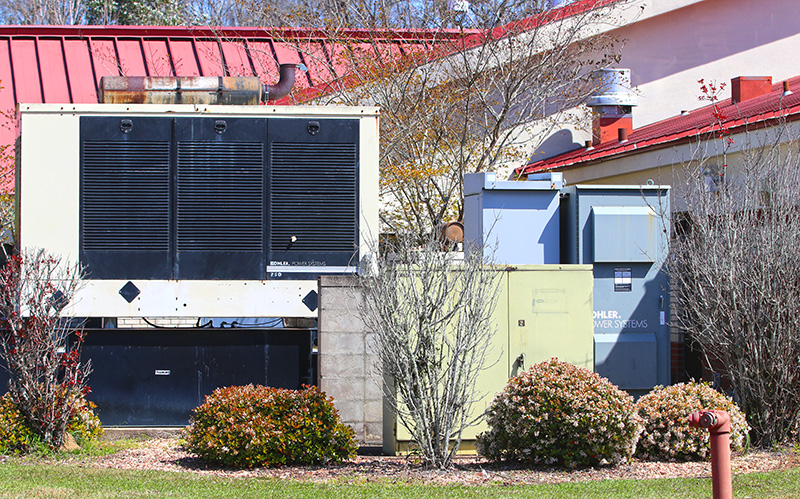
Pictured. Generator at Century Health & Rehabilitation, which meets the state requirements. NorthEscambia.com photo, click to enlarge.
UF/IFAS: Test Your Well Water At Least Once Per Year
June 2, 2018
by Andrea Albertin, UF/IFAS
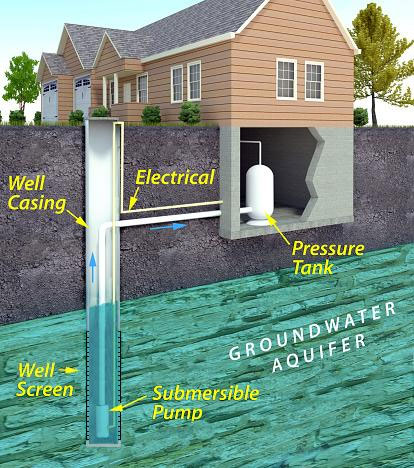
An estimated 2.5 million Floridians (approximately 12% of the population) rely on private wells for home consumption, which includes water for drinking, cooking, bathing, washing, toilet flushing and other needs. While public water systems are regulated by the U.S. Environmental Protection Agency (EPA) to ensure safe drinking water, private wells are not regulated. Private well users are responsible for ensuring the safety of their own drinking water.
How can well users make sure that their water is safe to drink?
It’s important to have well water tested at a certified laboratory at least once a year for contaminants that can cause health problems. According to the Florida Department of Health (FDOH), the most common contaminants in well water in Florida are bacteria and nitrates.
Bacteria: Labs generally test for Total coliform bacteria and fecal coliforms (or E. coli specifically) when a sample is submitted for bacteriological testing. This generally costs about $25 to $30, but can vary depending on where you have your sample analyzed.
Coliform bacteria are a large group of different kinds of bacteria and most species are harmless and will not make you sick. But, a positive test for total coliforms indicate that bacteria are getting into your well water. Coliforms are used as indicator organisms – if coliform bacteria are in your well, other pathogens (bacteria, viruses or protozoans) that cause diseases may also be getting into your well water. It is easier and cheaper to test for total coliforms than a suite of bacteria and other organisms that can cause health problems.
Fecal coliform bacteria are a subgroup of coliform bacteria found in human and other warm-blooded animal feces. E. coli are one species of fecal coliform bacteria. A positive test for fecal coliform bacteria or E. coli indicate that water has been contaminated by human or animal waste.
If your water sample tests positive for only total coliform bacteria or both total coliform and fecal coliform (or E. coli), the Department of Health recommends that your well be disinfected. This is generally done through shock chlorination. You can either hire a well operator in your area to disinfect your well or you can do it yourself. Information for how to shock chlorinate your own well can be found
Nitrates: The U.S. EPA set the Maximum Contaminant Level (MCL) for nitrate in drinking water at 10 miligrams per liter of water (mg/L). Values above this are a concern for infants who are less than 6 months old because high nitrate levels can cause a type of “blue baby syndrome” (methemoglobinemia), where nitrate interferes with the capacity of hemoglobin in the blood to carry oxygen. It is particularly important to test for nitrate if you have a young infant in the home that will be drinking well water or when well water will be used to make formula to feed the infant.
If test results come back above 10 mg/L, never boil nitrate contaminated water as a form of treatment. This will not remove nitrates. Use water from a tested source (bottled water or water from a public supply source) until the problem is addressed.
Nitrates in well water come from fertilizers applied on land surfaces, animal waste and/or human sewage, such as from a septic tank. Have your well inspected by a professional to identify why elevated nitrate levels are is getting into your well water. You can also consider installing a water treatment system, such as reverse osmosis or distillation units to treat the contaminated water. Before having a system installed, make sure you contact your local health department or a water treatment contractor for more information.
Where can you have your well water tested?
Most county health departments accept samples for water testing. You can also submit samples to a certified commercial lab near you. Contact your county health department for information about what to have your water tested for and how to take and submit the sample.
Contact information for county health departments can be found on this site: http://www.floridahealth.gov/programs-and-services/county-health-departments/find-a-county-health-department/index.html
You can search for laboratories near you certified by FDOH here: https://fldeploc.dep.state.fl.us/aams/loc_search.asp This includes county health department labs as well as commercial labs, university labs and others.
You should also have your well water tested at any time when:
- The color, taste or odor of your well water changes or if you suspect that someone became sick after drinking your well water.
- A new well is drilled or if you have had maintenance done on your existing well
- A flood occurred and your well was affected
Remember: Bacteria and nitrate are by no means the only parameters that well water is tested for. Call your local health department to discuss your water and what they recommend you should get the water tested for. The Florida Department of Health (FDOH) also maintains an excellent website with many resources for private well users: http://www.floridahealth.gov/environmental-health/private-well-testing/index.html . This site includes information on potential contaminants and how to maintain your well to ensure the quality of your well water.
Hot, Humid And Thunderstorms For The Weekend
June 2, 2018
Here is your official North Escambia area forecast:
This Afternoon: Showers and thunderstorms likely. Partly sunny, with a high near 91. Southwest wind 5 to 10 mph. Chance of precipitation is 60%. New rainfall amounts between a quarter and half of an inch possible.
Tonight: A 20 percent chance of showers and thunderstorms. Partly cloudy, with a low around 75. Southwest wind around 5 mph becoming calm in the evening.
Sunday: Showers and thunderstorms likely, mainly after 1pm. Partly sunny, with a high near 93. West wind around 5 mph. Chance of precipitation is 60%. New rainfall amounts between a tenth and quarter of an inch, except higher amounts possible in thunderstorms.
Sunday Night: A 30 percent chance of showers and thunderstorms before 1am. Partly cloudy, with a low around 69. West wind around 5 mph becoming north after midnight.
Monday: Sunny, with a high near 90. North wind around 5 mph.
Monday Night: Mostly clear, with a low around 64. North wind around 5 mph becoming calm.
Tuesday: Mostly sunny, with a high near 91. Calm wind becoming northwest around 5 mph in the afternoon.
Tuesday Night: Partly cloudy, with a low around 67. Northwest wind around 5 mph becoming calm in the evening.
Wednesday: A 20 percent chance of showers and thunderstorms. Mostly sunny, with a high near 94. Calm wind becoming north around 5 mph.
Wednesday Night: Mostly clear, with a low around 69.
Thursday: A 20 percent chance of showers and thunderstorms. Sunny, with a high near 95.
Thursday Night: Mostly clear, with a low around 69.
Friday: A 20 percent chance of showers and thunderstorms. Sunny, with a high near 93.
Apply Now For Southern Pine Beetle Assistance And Prevention Program
June 2, 2018
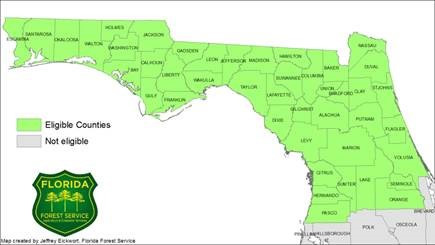
To help combat the invasive Southern Pine Beetle, which is currently present in 52 infestation sites throughout six Florida counties, the Florida Forest Service is accepting applications for the 2018 Southern Pine Beetle Assistance and Prevention Program from non-industrial, private forest landowners through June 29, 2018. The program is limited to 44 northern Florida counties, the known range of the southern pine beetle.
 The southern pine beetle is one of the most economically devastating forest pests of the southeast, with periodic outbreaks leading to deaths of millions of pine trees. In 2017, 260 SPB infestations were reported in Florida, killing trees on 1,768 acres. This pales in comparison to the last major outbreaks between 1999 and 2002, which caused an estimated $59 million in timber losses. Since it was first offered in 2005, the program has been implemented on more than 183,000 acres and helped thousands of landowners.
“These small infestations average less than an acre now, but they have the ability to expand rapidly this time of year,” said Jim Karels, State Forester and Director of the Florida Forest Service. “It’s imperative that we remain vigilant to keep this invasive pest at bay.”
The Southern Pine Beetle Assistance and Prevention Program, supported through a grant by the United States Forest Service, provides incentive payments for landowners who conduct a first pulpwood thinning and offers partial cost reimbursement for activities, such as prescribed burning, mechanical underbrush treatments, and the planting of longleaf or slash pine rather than the loblolly pine, the beetle’s preferred species. Qualified landowners can apply for up to two different practices per year, and funding requests may not exceed $10,000. All qualifying applications received during the submission period will be evaluated and ranked for approval.
To obtain an application or to learn more about the Southern Pine Beetle Assistance and Prevention Program, visit FreshFromFlorida.com/SouthernPineBeetle/Prevention.
Shrimp Beat The Wahoos
June 2, 2018
The Jacksonville Jumbo Shrimp got out to a fast start with three first inning runs against Blue Wahoos starter Vladimir Gutierrez (L, 1-8) and never looked back on their way to a 4-0 win Friday night at the Baseball Grounds of Jacksonville.
 The first four Shrimp reached in the first inning before Gutierrez struck out Eric Jagielo for the first out of the inning. Isan Diaz singled home Kyle Barrett for the first run, then Monte Harrison scored on a fielder’s choice before Diaz come home on a single from Brian Schales.
They added another run in the third with Sharif Othman hit a long single to centerfield which scored Jagielo from second. Gutierrez struggled with his control throughout his 2.1 innings on the hill for the Wahoos. He finished with four walks and a hit batter. Two of the walks and the hit batsman scored to account for three of the Jacksonville four runs. The Wahoos starter did get five strikeouts and allowed just three hits. Four Blue Wahoos pitchers combined to strike out 10 Jumbo Shrimp batters over the seven-inning game.
Kolton Mahoney and Major League rehabber Brett Graves (W, 1-1) worked seven scoreless innings with nine strikeouts. Graves pitched the final three innings for the win.
The contest was supposed to be the first game of a doubleheader, but the start was delayed for nearly three hours forcing the second game to be moved to Saturday as part of a doubleheader.
Saturday’s twin-bill will start at 4:05 c.t. when RHP Wyatt Strahan (4-4, 6.70) takes the hill against RHP Robert Dugger (0-0, 5.40). Game two will feature LHP Seth Varner (2-0, 3.33) against RHP Max Duval (1-5, 6.45).