
Scott’s Budget Proposal Under Heavy Scrutiny
February 9, 2011
Rick Scott’s $65.9 billion proposed budget drew reviews Tuesday ranging from tepid to downright mean as legislative committees dominated by fellow Republicans got their first look at the new governor’s first spending proposal.
House education, transportation and health care panels grilled Scott budget office staff dispatched to present portions of the budget rolled out Monday by the state’s chief executive at a Tea Party rally in Central Florida. For many lawmakers, the staff outlines were their initial look at the plan, with several pointing out the difficulties they faced in viewing a Web posting that has proved impossible to fully access for two consecutive days.
For a governor elevated by a campaign theme of ‘let’s get to work,’ his difficulties in conquering the Internet may pale against getting a wary Legislature to sign-off on his self-described ‘jobs’ budget.
Lawmakers who usually refuse to endorse even their own budget plans until they view county-by-county education financing, voiced deep concerns about Scott’s plan to slice per-pupil school spending by an average of at least $298 – part of an overall $3.3 billion cut to education spending.
A health care panel later held Scott’s budget up to the light, with lawmakers from both parties challenging his push to privatize three state mental hospitals and Florida’s half-dozen veteran’s nursing homes, with local governments left to pick-up services the state would no longer perform.
Jane Johnson, policy coordinator for Scott’s budget office, defended the governor’s spending choices saying, “government can’t do everything in the Health and Human Services sector that we would like it to do.”
But Rep. Daniel Davis, R-Jacksonville, said Scott’s approach will likely lead to thousands of Floridians losing health and social services completely, since local governments are in no position to close the gap.
 “Do you realize that at the local level there’s not going to be any funds for some of the services you say need to be funded at the local level?” said Davis, who until his election last fall, served seven years on the Jacksonville City Council. “We need to be honest with ourselves and the local community.”
Scott budget officials are saying that the loss of federal stimulus dollars will result in that $298-per-student cut if expected pension savings are ploughed back into education and if school districts socked aside some federal jobs fund money that the Scott administration said could be used. But if pension savings aren’t realized, or the jobs money wasn’t reserved, some counties could lop off as much as $700 per student, a dramatic 10 percent cut.
Even Republicans blanched at that.
Rep. Marti Coley, chairwoman of the House Prek-12 Education Appropriations Subcommittee, said lawmakers have known they’d have to make cuts with the end of the stimulus that has bailed them out the last couple years.
But “10 percent is pretty steep,” said Coley, R-Marianna. “So we will consider his proposals and we will make our own proposals as well.”
Democrats were more blunt.
“He’s a new governor and he’s new at a lot of this and I hope that as he matures as governor, he starts getting a better understanding of how important it is to provide our children with the best and most fully funded education possible,” said Rep. Marty Kiar, D-Davie.
Scott staffers generally stood their ground under the tough questioning from lawmakers. Johnson, of the budget office, began her remarks by pointing out that “there were no sacred cows,” in the governor’s approach to spending.
The governor’s iconoclastic view of budgeting has led him to recommend cutting 8,681 state jobs, draining $8.5 billion from 124 state trust funds for use across all areas of government, while also laying the groundwork for a 2012-13 spending plan that’s even smaller — $63.3 billion.
About $1.7 billion in tax cuts also would be handed out – part of a $4.1 billion, two-year reduction that also leaves about $700 million in reserves next year. Part of the 2012-13 budget trimming will be powered by an anticipated $1.2 billion reduction in Medicaid spending – savings earned by pushing Florida’s 2.7 million Medicaid recipients into managed care programs that Scott and lawmakers would still have to design and win approval for from the federal government.
“This is basically a visionary budget,” Rep. Gayle Harrell, R-Port St. Lucie, told Johnson. “You envision these reductions occurring.”
Few budget areas were spared Scott’s cutting. But just as the governor beefed up economic development efforts – spending $800 million over two years – Scott was relatively generous toward transportation efforts, a potential job-creator.
Overall transportation spending would drop from just under $10 billion this year to $9.3 billion next year and then just under $8.8 billion the next year. But it allows the state’s five-year work program to remain fully funded the next two years – drawing some of the few words of praise Tuesday for Scott’s budget.
“By investing additional dollars in economic development, by preserving the transportation trust fund, I think (that) shows that he’s got an interest in job creation,” said Rep. Mike Horner, R-Kissimmee, chairman of the House Transportation & Economic Development Appropriations Subcommittee.
Horner, however, was concerned about Scott’s proposal to eliminate nearly 40 highway patrol positions, because it could cost the state revenue, and maybe even lives.
“I think we need to be aware of the impact that these recommendations might have on the street, that’s my concern,” Horner said. “The rationale given was that the good news is that traffic fatalities are way down in Florida. We’ve done a great job. I think we need to be careful that we continue that path.”
Scott has also proposed to roll back about $235 million in increased driver fees that lawmakers used to prop up the sagging state budget two years ago. Horner conceded that the fee hikes have proved unpopular, but he said lawmakers are wary about committing to reducing them while struggling to close a budget shortfall of at least $3.6 billion.
Keith Laing and Kathleen Haughney of the News Service Florida contributed to this report.
Mardi Gras Masquerade Planned
February 9, 2011

You can celebrate Mardi Gras and help the American Cancer Society at the same time later this month.
Century’s Relay for Life team will hold a Mardi Gras Masquerade on Saturday, February 26 from 7-11 p.m. at the town’s Ag Building on West Highway 4. The featured entertainment will be the Will Inspire Band, a local favorite group with previous appearances at the 2009 Century Relay and the Teaspoon Festival.
The event will include red beans and rice, photo opportunities and a silent auction. Attire is Mardi Gras formal or costume. This is an adults-only event, but no alcohol is allowed on the community center property.
Tickets are $20 per person. Businesses or individuals can reserve a table for eight for $150. Tickets are available from any Relay for Life Century team, the Century Branch Library or the Century Town Hall. Tickets are limited.
For more information, call (850) 256-3842.
Pictured above: The Will Inspire Band. Courtesy photo for NorthEscambia.com, click to enlarge.
Register Now For The 2011 Gulf Coast Agribusiness Conference
February 9, 2011
The 2011 Gulf Coast Agribusiness Conference will be held Thursday, February 17 at the Chumuckla Farmers’ Opry.
Speakers from the Southeast will provide farmers with ideas for new crops and business models. A trade show will be held at the conference, with space for vendor booths and equipment displays.
The target audience for this conference includes producers of all types of livestock and specialty crop production in the Western Panhandle of Florida and Baldwin and Escambia counties in Alabama. The conference is also an informational seminar for existing and prospective ranchers and specialty crop producers.
Conference topics will include “Keys to Successfully Choosing Enterprises That Suit Your Small Farm,” “Small Farm Livestock Production,” “Beef Cattle and Goat Production,” “Small Farms Poultry Management,” and “High Tunnel Production”.
For more information, contact Robin Vickers at rvickers@ufl.edu or (850) 983-5216, Ext. 113. For a schedule and registration form, click here.
Drivers Beware: Smoke Possible On Area Roadways
February 8, 2011
Officials with Florida Division of Forestry’s Blackwater Forestry Center are advising motorists in Santa Rosa and Escambia counties to use caution if they should experience smoky conditions on local roads Wednesday morning.
An 1,100-acre prescribed fire 10 miles north of the state line near Brewton, Ala. has been identified as the source of smoke. Overnight conditions will continue to push smoke from the burn toward our area and there could be pockets of more dense smoke, especially in low-lying areas. The smoke has been reported as far south as I-10 and Milton.
If drivers do find smoke, the Division of Forestry urges the following steps:
- Slow down.
- Turn on low-beam headlights.
- If the smoke or fog is too thick to continue driving, pull all the way off the pavement and stop.
- The space between your vehicle and the roadway should be enough to allow you to safely exit the vehicle.
Hit And Run Crash Cuts Power
February 8, 2011
The Florida Highway Patrol is investigating a hit and run crash in Century Tuesday morning that left an unknown number of Gulf Power customers in the dark.
Witnesses told authorities that a full size maroon pickup truck with tinted windows hit a power pole on North Century Boulevard near the Food Giant about 11:40 a..m. Witnesses said the truck with a Texas tag then fled the scene, headed south on North Century Boulevard.
The accident is under investigation by the Florida Highway Patrol.
Century Seeks To Expand Code Enforcement Agreement
February 8, 2011
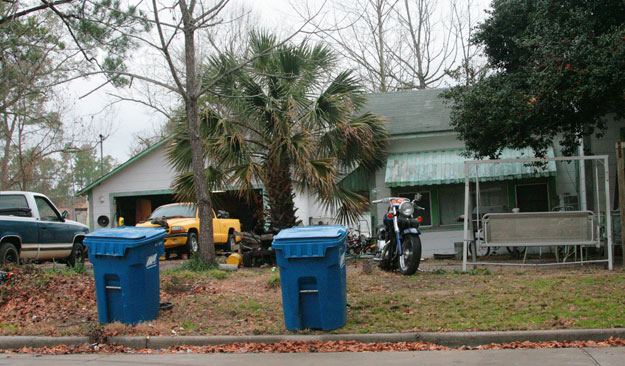
The Town of Century is looking to expand the agreement that allows county code enforcement to operate in the town.
Two weeks ago, the council instructed Mayor Freddie McCall to contact Escambia County’s Code Enforcement and seek a cease and desist order against George William Philyaw and the alleged “business” he operates from his home at 120 Front Street.
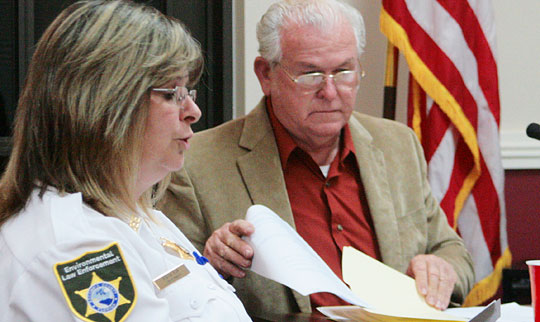 But Sandra Slay, director of Escambia County Code Enforcement, said the current inter-local agreement between Century and Escambia County does not allow for the enforcement of issues like zoning, solid waste violations and stormwater.
The council voted Monday night to have attorneys for Century and Escambia County draft an amendment to their agreement to allow the county to pursue zoning violations.
At issue with 120 Front Street, according to the town, is whether or not Philyaw is operating a business on property that is zoned residential.
In July 2009, the council voted to deny Philyaw’s request to rezone his property from residential to commercial so he could operate what the town’s consultant, Debbie Nickles, called a “junkyard”. During his rezoning hearing, Philyaw told the town council that he simply collects metal for recycling until he has a “load” and then it is sold.
Pictured top: The property at 120 Front Street in Century. Pictured inset: Escambia County Code Enforcement Director Sandra Slay addresses the Century Town Council Monday night. Also pictured: Mayor Freddie McCall. NorthEscambia.com photos, click to enlarge.
Three Charged With Dumping Half Ton Of Trash Along Perdido River
February 8, 2011

Three people are facing charges for dumping a half ton of garbage along the Perdido River in North Escambia.
Florida Fish and Wildlife Conservation Commission Lt. Dan Hahr located a large amount of household garbage that was dumped along the road to The Pipes in Perdido River Wildlife Management Area. After going through the pile, he identified the residence in Pensacola that the garbage came from by old mail that was in the pile. Upon further investigation, Lieutenant Hahr determined the tenants of the house had moved and the owner had paid someone to haul off the garbage and leftover belongings.
Melih Saklivan, a 49-year old legal alien from Turkey, 25-year old Kimberly Margaret Hudgins, of Pensacola; and Patrick Stephen Murphy, 26, of Lillan, Ala;, are all facing felony charges of commercial littering — a third degree felony.
The owner of the home where the trash originated told FWC officers that he had found a man named “Patrick” on Craigslist and hired him to haul off the trash and personal belongings left by tenants in his rental house. The homeowner produced receipts where he paid Hudgins $100 to clean the house and $65 to “I Stand Alone Hauling” for the trash removal.
Hudgins told the FWC officer that they transported the first load of trash back to her trailer park where they filled a dumpster with a mattress and other items. The second load was taken to the Pipes landing area along the Perdido River, near Jacks Branch Road in Cantonment.
When the FWC and Baldwin County (Ala.) Sheriff’s deputies located Murphy at his home in Lillian, Ala., he admitted that he was hired off Craigslist to remove the trash for $65, and that it was his idea to dump it in the area of The Pipes.
Sakilvan told the FWC officer that he was “held hostage” by Murphy and had no other option but to go along with the plan. He expressed concern that charges would cost him the chance to obtain U.S. citizenship, and he volunteered to clean up the trash “to ease his conscience”. Officers verified that Sakilvan had indeed removed the rubbish and paid to dump 1,060 pounds at the Perdido landfill.
Sakivan and Hudgins were released from the Escambia County Jail on $2,000 bond each. Murphy was arrested in Baldwin County on an outstanding parole violation warrant. Murphy remains in the Baldwin County Corrections Center without bond.
Florida Schools To Take $3 Billion Hit Under Scott Budget
February 8, 2011
Florida’s public schools and universities will take a more than $3 billion hit under the budget proposed Monday by Gov. Rick Scott, with public elementary through high school spending dropping by nearly $300 per student.
Scott said, essentially, that’s not really his fault. He isn’t cutting state money to public schools, he simply is choosing not to replace federal stimulus money that is no longer available.
Former Gov. Charlie Crist and lawmakers used stimulus dollars to prop up the state’s budgets the past two years, and now that money is gone. Trying to find a new one-time source of cash to replace it doesn’t make sense, the governor said, likening that to a Lottery winner spending all his winnings on the assumption that he’d win again next year.
“We’re not going to take federal money and believe it’s going to be there forever,” Scott said.
Budget officials in the governor’s office said the loss of federal stimulus money accounted for some of the cuts to education, but didn’t provide details on how the governor planned to achieve all of them.
Scott said repeatedly on the campaign trail that he wanted Florida students to receive a “first class education,” advocating for the state to better invest in its education system, provide school choice and create a merit pay system for teachers. Lawmakers are already working on a merit pay system, but have been slower to take up a voucher expansion.
Under Scott’s proposed spending plan, per pupil spending in K-12 would drop by $298 to $6,600 per student.
The House Prek-12 budget subcommittee chair, Rep. Marti Coley, R-Marianna, has said she hopes to protect the per pupil spending level at the current year amount.
Scott’s overall budget – just shy of $66 billion – gained kudos from business groups around the state, who praised him for a budget that didn’t raise taxes and focused on job creation.
“Cuts to education and health care will inevitably raise concerns among some, but in the midst of a recession, government must cut expenses because raising taxes is a death knell for job creation,” said Associated Industries of Florida President Barney Bishop.
Getting school spending to the $6,600 per student level would still rely in part on Washington, having local school boards reserve dollars from a federal education jobs fund from this year.
Education advocates argued that a $300 per student cut still will result in layoffs and make things worse for the public school system, not better.
FundEducationNow.org, an Orlando grassroots education advocacy organization that says it was created by parents of public school children, called the proposed cuts “catastrophic.”
“Florida’s children are the key to our long term economic stability. High-quality public education is a job creator not a funding burden,” said group co-founder Linda Kobert. “Gov. Scott must embrace his paramount duty to invest in the real future of this state – the students.”
The governor’s office released details of the budget on a Website that got so many hits Monday afternoon that it crashed. That made it hard for some advocates to evaluate the proposal. Officials at the Board of Governors said they couldn’t comment on proposed cuts to higher education, because they hadn’t been able to read the budget recommendation.
The Board of Governors could face a substantial reduction if stimulus dollars from last year are not replaced. Twenty out of 53 positions were paid for by stimulus money.
Century’s Budget Looking Good
February 8, 2011
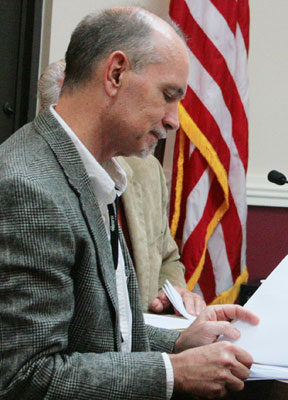 A little good news for the town of Century — the budget for the first quarter of the year is in good shape.
Robert Hudson, the town’s accountant, told the Century Town Council that they ended the quarter and calendar year with revenue just over budget and expenditures under budget.
“So we are on the plus side…we are doing real well,” Hudson said. “We took a very conservative approach.”
Pictured above: Robert Hudson, the accountant for the Town of Century, discusses Century’s budget Monday night. NorthEscambia.com photo, click to enlarge.
Tate Aggies Softball Regular Season Begins
February 8, 2011

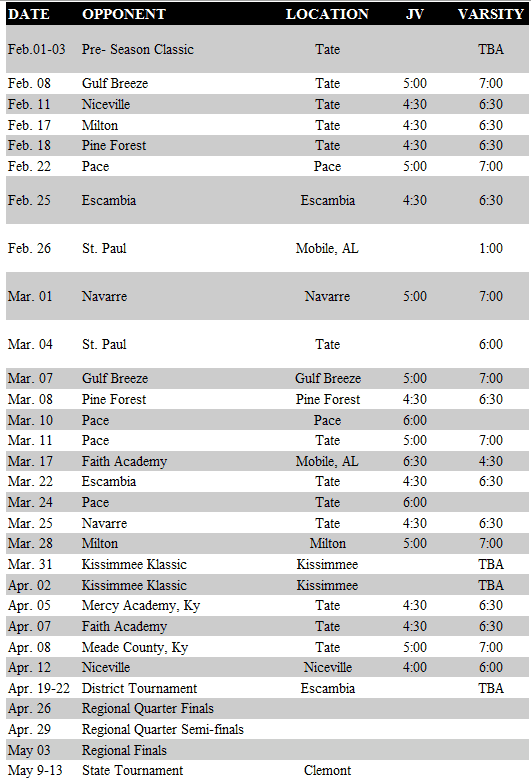
The Tate Aggies will begin their regular softball season today. Here is the complete schedule for both the varsity and junior varsity programs: