

Photo Gallery: Ernest Ward Middle Holds Annual Sports Banquet
February 19, 2011

The fifth annual Ernest Ward Middle School Sports Banquet was held Friday night. Students were honored for their participation in football, cheerleading, volleyball, basketball and swimming.
For a NorthEscambia.com photo gallery from the event, click here.
The students honored included:
Football
- MVP Offense: Jaran Myles
- MVP Defense: Cameron Newsome
- Coaches Award: Aaron McDonald
- The entire team was honored for an undefeated season.
Boys Basketball:
- MVP: Cameron Newsome
Girls Basketball
- Team Members: Angel Lathan, Annie Bobo, Samantha Sharpless, Allison Woodfin, Jada Tucker, Jensyn Warner, Haley Brown, Mallory Ryan, Abbie Johnson, DeAsia Fountain, Penny Banda, Autumn Albritton, Brianna Parker and Teamber Moorer.
- MVP: Angel Lanthan
Volleyball
- Best Server: Kyndall Hall (62 points)
- Team Captain/Leadership Award: Mallory Ryan
- Best All Around: Reagan Bell
- Most Improved: Mallory Gibson
- Team Members: Mallory Ryan, Leah Fischer, Reagan Bell, Kristen Byrd, Brianna Parker, Kyndall Hall, Peighton Dortch, Kendal Cobb, Jadlyn Bodiford, Domonique Brown, Mallory Gibson, Lorri Harrell, McKenzie Nasser, Autumn Albritton, Courtney Grim, Deandre Johnson and Kaitlyn Abbott.
Cheerleading
- Most Outstanding Performer: Danielle Robinson
- Best All-Around: Hannah Gibson
- Most Improved: BrittneyWard
- Team Members: Hanna Gibson, Morgan Ward, Reagan Bell, MalloryRyan, Kendal Cobb, Kristen Byrd, Jessica McCollough, Kamryn Brock, Kaitlyn Abbott, Jadlyn Agerton, Dariane Guy, Brittney Ward, Danielle Robinson and Jamia Newton.
(Names and sports provided by the coaches.)
NorthEscambia.com photos, click to enlarge.
Young Murderer Alex King Arrested For Probation Violaton
February 19, 2011
A day after being arrested on traffic charges, convicted murdered Alex David King of Cantonment has been arrested for violating his probation.
 King, 21, was booked into the Escambia County Jail without bond Friday afternoon.
King was 13 when he and his 14-year old brother, Derek King, were convicted as adults on second degree murder charges for the death of their father in 2001 . Both boys pleaded guilty to arson for setting fire to their Cantonment home. King was released from prison in October, 2008, while his brother Derek was released in 2009.
Alex King is on probation until 2012 for the death of his father.
Alex King was arrested Thursday by the Florida Highway Patrol and charged with violation of right of way, leaving the scene of a crash and violation of a driver’s license restriction following a traffic crash in Pensacola. He was released from jail Thursday on $1,000 bond.
According to the Florida Highway Patrol, King was traveling north on Lanier Drive in a 2003 Dodge Neon early Thursday morning when he pulled into the path of a 1999 Chevrolet van driven by Candace T. O’Conner of Pensacola. After the 12:50 a.m. Crash, King fled the scene on foot, according to the FHP. He was located a short time later by Pensacola Police and taken into custody by the FHP.
A passenger in King’s vehicle, 20-year old Jonathan Aeppli of Milton, was not injured. O’Conner was not injured, while her 14-year old passenger received minor injuries and was transported to Sacred Heart Hospital. A third passenger in O’Conner’s vehicle, a 16-year old female, was not injured.
U.S. Marshals Seek Violent Fugitive That May Be In Escambia Area
February 19, 2011
The U.S. Marshals Florida Regional Fugitive Task Force is asking for help in locating a man wanted for aggravated battery, kidnapping to inflict bodily harm, robbery, and grand theft of a motor vehicle. Marshals say he may be in the Escambia County area.
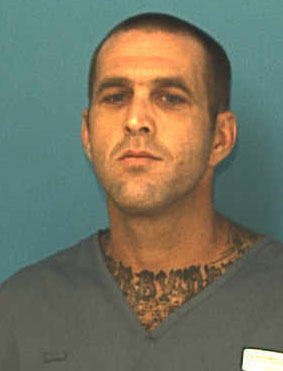 Bradley Scott Bruce allegedly beat his girlfriend to the point of being unrecognizable and fled into the woods near Gretna, Fla. nearly a week ago. It is thought that Bruce may have traveled to the Escambia County area recently and may be frequenting Pensacola area hotel or motels.
Bruce’s upper body is covered with tattoos with several relating to views of white supremacy. Bruce is a registered career criminal in the state of Florida with an ultra violent criminal history, according to law enforcement. Bruce is a white male, approximately six feet tall, weighing about 180 pounds with blue eyes, and brown hair.
Bruce is thought to be armed and dangerous and should not be approached if thought to be seen. If anyone has information on Bruce’s whereabouts, they are asked to immediately contact the U.S. Marshal’s Florida Regional Fugitive Task Force investigators at (850) 527-9395 or (850) 554-6602 or local law enforcement.
Flomaton Hurricanes Fall In Sub-Regionals By Single Point
February 19, 2011

A heartbreaking loss for the Flomaton Hurricanes Friday night — the ‘Canes lost by one to Elba in the 2011 AHSAA Class 2A boys state basketball playoff sub-regionals in Flomaton.
Elba defeated the Canes 82-81.
The area champion Flomaton Hurricanes went into Friday night’s game off a playoff 66-37 win over Mobile Christian and a 60-58 win over Cottage Hill.
Pictured: The Flomaton High School Hurricanes. Submitted photo Mike Newton Photography for NorthEscambia.com, click to enlarge.
Police, Fire Officials Blast Pension Bills
February 19, 2011
Police and fire union representatives filled a Senate workshop Friday to criticize a pair of bills dramatically overhauling public pensions in Florida, a key cost-saving plan pushed by Gov. Rick Scott and top lawmakers.
A couple dozen speakers generally blasted the legislation by Sen. Jeremy Ring, D-Margate, whose Governmental Oversight and Accountability Committee rolled out the legislation (SB 1128, 1130) earlier this week.
Friday’s four-hour hearing was designed to gauge opinion of the measures. It was clearly divided, with union officials blasting the proposals and city commission representatives mostly endorsing Ring’s approach.
“I don’t think anyone can say we’re rushing this process through,” Ring said. “This is a critical issue.”
Under the legislation, new employees in both the Florida Retirement System and local pension plans would be required to join 401(k)-style investment plans, with the legislation clearly aimed at phasing-out traditional pension plans.
Base salary – no overtime or other compensation – would be used to determine an employee’s pension benefits under both city and state plans. The legislation affecting the FRS (SB 1130) also would require a still-to-be determined contribution from the plan’s 655,000 government employees, ending full state payments which have endured since 1974.
Ring acknowledged that not having a contribution level set, “creates a lot of angst.” But he said the contribution rate will be determined later – when the state budget is compiled and lawmakers look to close a more than $3.6 billion budget hole.
Scott has proposed a 5-percent employee contribution, which would save $1.3 billion.
But Steve Clelland, representing the Orlando Professional Firefighters union, told the Senate panel that lawmakers should not be revamping the standards for pension agreements negotiated with local governments.
“These are local plans,” Clelland said. “But if you do this, city officials will stand back and say `we didn’t do that – they did, the Legislature.’ But if collective bargaining still exists in Florida, I’m not sure you can even do that.”
Most of the union representatives urged lawmakers to leave local pensions alone, although Ring said financial obligations faced by cities was reaching a crisis.
“Every city is not in crisis,” said Jim Tolley, lobbyist for the Florida Professional Firefighters Association. “Some are in good shape.”
Kissimmee Mayor Jim Swan told the committee cities generally support help with easing pension benefits, but want to assure, “flexibility is given for us to negotiate pension benefits.”
The legislation eases requirements on municipalities that dollars accumulated under the insurance premium tax be used solely to cover enhanced pension benefits, a provision sought by the Florida League of Cities. Instead, the bill (SB 1128) lets cities deploy this money to ease liabilities in current pension plans.
Start Your Battle With Summer Weeds Now
February 19, 2011
 Weeds are problematic in most landscapes. Even if you do everything right, a weed is going to pop up occasionally in the lawn. Although most of our lawns are still dormant, it’s time to decide if you need to apply a pre-emergence herbicide (weed preventer).
Weeds can be less of a problem if you maintain a healthy lawn through proper cultural practices. Watering correctly, using appropriate fertilizers and maintaining a high mowing height will ensure your lawn is at its peak and can compete with the weeds.
However, if year after year you have an abundance of weeds during the summer, a pre-emergence herbicide may help you in the battle against weeds.
 Pre-emergence herbicides are applied before weed seeds germinate. Therefore, it’s critical that these chemicals be applied at the proper time.
In Northwest Florida, timing of a pre-emergence herbicide application for summer annual weeds, such as crabgrass, should be between February 15 and March 5 or when day temperatures reach 65 to 70 degrees F for four to five consecutive days. This generally coincides with the blooming of azaleas and dogwoods.
Some pre-emergence herbicides to look for include:
- dithiopyr (Dimension)
- isoxaben (Fertilome Broadleaf Weed Control with Gallery)
- pendimethalin (Lesco PRE-M or Scotts Halts Crabgrass Preventer)
- benefin (Hi-Yield Crabgrass Control)
Be sure to apply any product according to the label directions. Even, consistent coverage is essential with pre-emergence herbicides. Any gaps in coverage will allow weeds to emerge.
Once applied, be sure to water-in the product. Do not apply before a rain event. It’s hard to know how much rain will fall at any one time. Too much rain can send your weed killer down the storm drain.
 Pre-emergence herbicides are generally effective in controlling weeds from six to twelve weeks following application. Most will begin to degrade when exposed to the environment. Therefore, to obtain season-long control, an additional application should follow six to nine weeks after the initial one.
It is possible to use too much pre-emergence herbicide. Some pre-emergence herbicides have a root-stunting effect on established turf and can thus be detrimental to the health of your lawn if applied at too high of a rate or applied too many times during a season. It is best to time applications when they will be most effective, and to further prevent weeds by maintaining a dense, healthy stand of turf.
It is difficult to find a good time to apply “weed-n-feed” products. Weed control using pre-emergence products should be applied from mid-February to early March. Fertilization should wait until your lawn if fully out of dormancy and actively growing. In our area, that is sometime in April.
When nitrogen-containing fertilizer is applied too early to warm-season grass, it may stimulate the lawn to grow much too soon. If we have a couple of weeks of warm weather followed by a late frost, damage can occur to over stimulated lawns. My recommendation would be to apply your pre-emergence herbicide separately from your nitrogen-containing fertilizers.
If weeds have been a major problem in your landscape consider using pre-emergence herbicides. If applied at the proper rate and at the proper time, the benefits can be tremendous.
Theresa Friday is the Residential Horticulture Extension Agent for Santa Rosa County.
Earthquake Just Off Coast
February 18, 2011
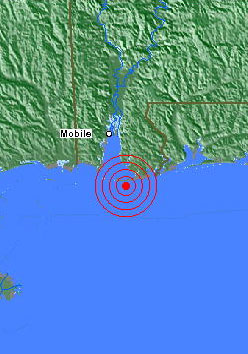 A 3.5 magnitude earthquake was reported off the coast of Baldwin County Friday evening.
The earthquake, confirmed by the U.S. Geological Survey, was centered less than 10 miles off the coast in the Gulf of Mexico at 5:15 p.m. The quake center was about 35 miles from Mobile, 40 miles from Pensacola, or about 48 miles from Molino.
According to reports to the USGS, the quake was felt not only in nearby locations like Gulf Shores and Orange Beach, but also Mobile, Pensacola and McDavid.
It was at a depth of about 3.1 miles. According to the USGS, a minor earthquake of 3.5 is often felt but rarely causes damage.
No damage was immediately reported from Friday’s quake off Baldwin County.
Pictured: This map from the U.S. Geological Survey shows the center of Friday’s earthquake.
Fire Damages Bulldozer
February 18, 2011


Fire damaged a bulldozer Friday afternoon at a work site in Walnut Hill. The fire, which was reported about 3:30, was out before the first firefighters arrived on scene. There were no injuries reported.
An excavator burned at the same location at the intersection of South Highway 99 and Tungoil Road Monday morning.
The Walnut Hill and Molino stations of Escambia Fire Rescue responded to Friday afternoon’s blaze.
Pictured top: The reported bulldozer fire was out before firefighters arrived. Pictured inset: Firefighters wet down the bulldozer to ensure the fire was out. Note: The smoke seen in both photos above is from a pile of brush behind the bulldozer. Pictured below: An excavator burns at the same work site Monday morning. NorthEscambia.com photos, click to enlarge.

Feinburg Takes Heat From Florida Business
February 18, 2011
usiness owners affected by the BP spill continued to vent to lawmakers on Friday about not having been paid quickly enough and getting little feedback on why some claims are denied.
BP claims overseer Ken Feinberg answered a call to appear before the House Economic Affairs Committee, and while acknowledging some problems exist he said the reimbursement process is working. It has been slowed by the sheer volume of claims, now exceeding 500,000, which have flooded into claims offices throughout the Gulf region, he said. To date, Feinberg said the Gulf Coast Claims Facility has paid more than $3.5 billion in claims, including $1.3 billion in Florida.
“We’re doing something right,” Feinberg said. “I believe that there is no comparison between the Gulf Coast Claims Facility and BP, which came before.” Before the federal office was set up to handle the money that BP paid to reimburse those who lost business because of the spill, the oil giant itself handled the claims.
Feinberg told lawmakers that formal rules would be released later in the day to address many concerns about a lack of transparency in the process but some business owners who also came before the committee said they don’t believe Feinberg because they’ve heard similar assurances before and are still waiting to get paid.
Feinberg, appointed by President Barack Obama to make payments to thousands of individuals and businesses affected by the spill, has been the target of increasing criticism by hotel owners, commercial fishers and other tourism-reliant businesses affected by the April 20 explosion and subsequent spill from the BP Deepwater Horizon oil rig.
“The perception is that the current process is broken,” said Rep. Gary Aubuchon, R-Fort Myers. “And to the people who have not been paid at all or who have been denied without explanation, many of whom are in the audience today, it is not a perception. It is a reality.”
The biggest problem, Feinberg contended, remains that many of the claims have been “woefully lacking” in corroborating information. More than 50,000 claims for interim and final payments, for example, have come in with no documentation at all.
“I’m not trying to hold back money,” Feinberg said. “I just want to make sure the claimant has the information needed to justify the claim.”
To speed up the process, Feinberg said he would be dispatching more accountants to the local claims centers. The new rules will also spell out in more detail the information needed to process claims.
Feinberg met Thursday with Gov. Rick Scott and Friday morning with Attorney General Pam Bondi.
Feinberg also met Thursday evening with Rep. Doug Broxson, R-Gulf Breeze, who said Feinberg told him to “back off” his criticism of the GCCF, a request Broxson said he could not fulfill.
“I told him I’ll continue to represent my constituents,” Broxson said Friday.
Friday’s meeting was attended by dozens of hotel owners who said the claims process has been completely unresponsive to the losses incurred at their hotels, many of which are now in foreclosure.
“The spill has cost our industry hundreds of millions of dollars.” said Nash Patel, a hotel owner from Pensacola. “We are still waiting.”
Angered over Feinberg’s comments Friday, Patel and some others walked out of the meeting.
Speaking to reporters, Art Rocker, a representative of the Southern Christian Leadership Conference, said the civil rights group, with Fienberg’s blessing, enlisted the help of 400 pastors along the Gulf coast and collected claims from 15,000 residents whose losses have yet to be paid.
“These are real people we’re talking about here,” Rocker said. “They’re poor people. They’re the ones who clean the rooms and who fish in the Gulf to feed their families and make a little extra.”
By Michael Peltier
The News Service Florida
Escambia Approves Student Drug Testing
February 18, 2011
Escambia County middle and high school students who participate in extracurricular activities, athletics or drive onto campus will be subject to random drug tests beginning next school year.
The Escambia County School Board unanimously approved the new random drug testing policy at a special meeting Thursday night. Parents will be required to sign a permission form to allow their child to be tested. Without consent from parents, students will not be allowed to participate in the activity or drive onto campus.
Several parents spoke out against the policy during the public forum, including Kathy Fellgren, parent of a 14-year old student.
“This policy bothers me a lot,” she said. “She’s an excellent student. She would be mortified to be randomly called out of class and told she had to go pee in a cup…Why are your putting on the backs of kids that are good?”
District 5 board member Bill Slayton made a motion to amend the policy to test only high school students, expressing concerns that many middle schoolers would not be comfortable or understand the testing.
 Ernest Ward Middle School Principal Nancy Perry spoke out in favor of the drug testing policy, including at the middle school level. “Middle school is the time of experimentation. Middle school is the time that peers influence peers,” she said.
Slayton’s motion failed 1-4, as he cast the only vote in favor of skipping testing for middle school students.
Others expressed more technical and logistic concerns over the testing, including Susan Watson, local ACLU representative. She likened the random drug tests to “government bullying”, and also expressed concern that common medications or foods could cause false positives, potentially damaging the reputation of a middle or high school student.
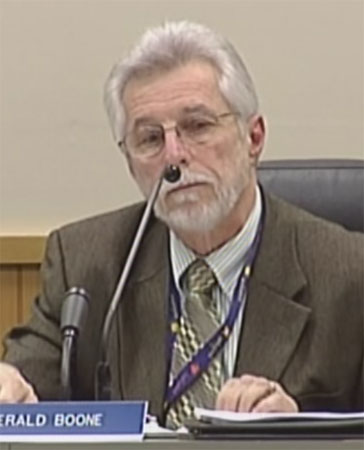 Board member Gerald Boone said he supported the policy, but felt reservations about taking on what he called a parenting role. “I don’t really want to take the role of the parent. I just wish that there was more parenting out there, and there’s not in this day and time,” he said.
The school board will next review the policy and its procedures for it is implemented in August with a committee of parents, officials and students.
As the policy currently stands, students that participate in athletics, extracurricular activities or park on campus would be subject to the random urine tests. A signed parental consent form would be valid during the entire school year, not just for the duration of the athletic season or extracurricular activity period.
Students whose parents do not consent to the tests would not be allowed to participate in the activities — including any practice, tryout, rehearsal or even sit with the team, club or organization at a game or pep rally.
The drug tests will be conducted by the school health nurse or technician under the plan. If there is a positive result, the student would be required to take a follow-up drug test at a District-approved licensed laboratory within 24 hours. Failure to take the follow-up test would be considered a positive result, according to the proposed plan.
 If a student refuses to participate in a random drug test, it will be considered a positive result.
A positive result would result in the student being removed from all extracurricular and athletic activities, including practices, for at least 30 days and would be suspended from driving on the school campus. The student would be referred to a District-approved drug assessment and rehabilitation program.
A student with a positive drug test result would be required to pass a second drug test before participation in future activities at the expense of their parents. They would be subject to additional random drug tests, and they would remain on probation for the rest of their school years in the Escambia County School District. The student would not be allowed to return to any leadership position — such as captain of a squad, club officer or class officer — for the remainder of the school year.
A second positive result would prohibit a student from participation in all athletics and extracurricular activities and from driving on campus for one full calendar year.
Pictured top inset: Ernest Ward Middle School Principal Nancy Perry addresses the Escambia County School Board Thursday night. Pictured middle inset: Board member Gerald Boone. Photos courtesy WEAR 3 for NorthEscambia.com, click to enlarge.