

Northview Seeks Advertisers For Football Program, Field Signs
July 28, 2011

The Northview High School Chiefs are wrapping up ad sales this week for their football program and signs on the football field, and they are looking for both business and personal Chiefs supporters.
- For information on ads in the Northview Football Program or football field ads, click here.
- For information on Northview Quarterback Club membership and personal ads, click here.
For more information, email vicki@baggettsolutions.com or call (850) 327-6776.
NorthEscambia.com file photo.
Escambia Set To Increase Fire Services Fee
July 28, 2011

 Escambia County is set to increase the special assessment property owners pay for fire services and has scheduled a public hearing.
The Municipal Services Benefit Unit (MSBU) has been at $75 for each residential dwelling since 2003. As part of the budget process, the Escambia County Commission will consider an increase in the fire fee by $5 in 2011 and an additional $5 in 2012 for homeowners. If passed, commercial properties and acreage will also be increased.
The fee is assessed in the entire county, with the exception of Pensacola and Santa Rosa Island. The assessment also applies in the Town of Century, once approved by the town council.
Notices were recently mailed to all Escambia County property owners outlining the proposed MSBU increase.
A public hearing on the MSBU changes will be held September 13 at 5:02 p.m. in the Escambia County Board Chambers, 221 Palafox Place, first floor.
NorthEscambia.com file photo.
Photos: Mission Molino
July 28, 2011

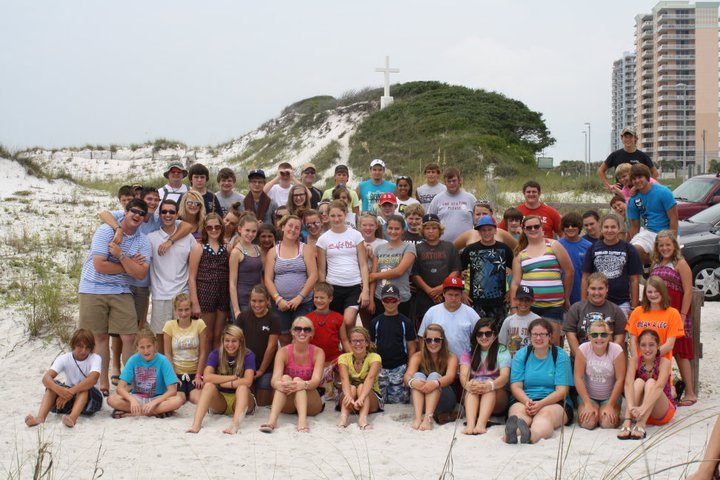
 There’s a group of youth in Molino that are on a mission this week.
The youth from Highland Baptist Church have been joined by youth from Friendship Baptist Church from Cleburne, Texas, for “Mission Molino”.
Monday, about 60 youth along with adult volunteers worked to paint and do yard work for eight widows in Molino. Tuesday, they headed to Pensacola Beach to pass out water bottles and Salvation bracelets. During the remainder of the week, they will volunteer at the Florida Baptist Children’s Home and create activity packs for children at Sacred Heart Children’s Hospital.
For a photo gallery, click here.
Pictured above: Youth involved in Mission Molino did yard work for eight widows on Monday. Pictured below: The students took part in a Mission Molino project on Pensacola Beach. Submitted photos for NorthEscambia.com, click to enlarge.
Tropical Storm Don Forms In Gulf
July 27, 2011
![[Image of 5-day forecast and coastal areas under a warning or a watch]](http://www.nhc.noaa.gov/storm_graphics/AT04/refresh/AL0411W5_NL+gif/205313W5_NL_sm.gif)
Tropical Storm Don formed in the Gulf of Mexico near the Yucatan Peninsula Wednesday afternoon. The current forecast takes it to the Texas coast by late Friday or early Saturday. Don is not expected to reach hurricane strength.
The latest information on Tropical Storm Don is in the graphic above, click to enlarge.
County Crew Knocks Down Pole; Hundreds Without Power
July 27, 2011

Hundreds of Escambia River Electric Cooperative customers in and near Century, Bratt and Byrneville were without power for several hours this morning.
An EREC spokesperson said the Escambia County Road Department knocked down a three-phase pole that serves EREC’s Bratt Substation.
The county worker mowing with a tractor and Bush Hog was unable to see a guy wire on the pole on West Highway 4 near Raines Road. The collision snapped the pole in half. The worker was not injured.
Power was restored just after noon.
Arson: Early Morning Fire Destroys Century Mobile Home
July 27, 2011

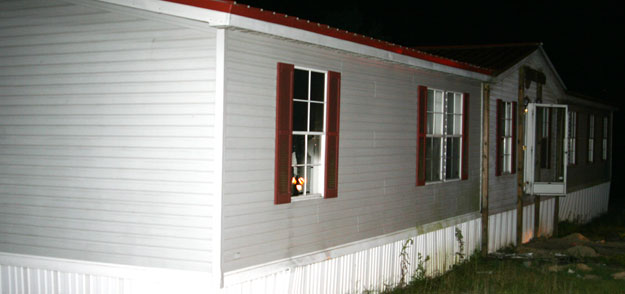
 Fire destroyed a mobile home in Century early this morning, and firefighters believe it was the work of arsonist. It was the second attempt at burning the trailer in the last couple of months.
Escambia Fire Rescue was dispatched to the abandoned double-wide mobile home on Hilltop Road, just west of North Century Boulevard, about 4:30 a.m. Wednesday. The trailer was already burned to the ground when firefighters arrived. There were no injuries reported.
Preliminary information indicated the fire was arson. Back on June 10, firefighters responded to another fire at the mobile home and found a small fire in a bedroom. That fire was quickly extinguished using just a fire extinguisher; damage to the home was minimal.
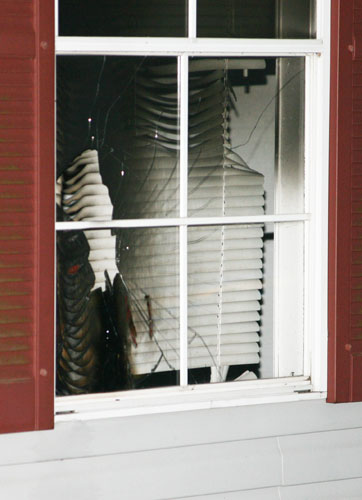 Authorities said the June fire was intentionally set near a broken bedroom window. They also discovered that items and copper wiring had been removed from the home, but it was not clear when the items were removed.
The power had been disconnected from the mobile home since the June fire, and there was no natural gas service.
Both blazes are under investigation by the Florida State Fire Marshal’s Office, and the stolen items are being investigated by the Escambia County Sheriff’s Office.
Pictured top two photos: The apparent work of an arsonist destroyed a Century mobile home early Wednesday morning. Pictured bottom inset and below: A fire, ruled to be arson, damaged the mobile home on June 10. NorthEscambia.com photos, click to enlarge.
Arrest Made In Weekend Homicide
July 27, 2011
 Escambia County deputies have arrested a 25-year old man in connection with a weekend homicide on Mitchell Lane in the Bellview community.
Christopher Eugene Stallworth was arrested on suspicion of homicide in connection with the beating death of a 65-yearold man.
Stallworth was arrested Tuesday night after he was interviewed by investigators.
On Sunday at around 9:48 p.m. deputies were called to a home in the 5000 block of Mitchell Lane after a brother-in-law found the victim lying on the living room floor.
When officers arrived, they found the badly beaten body of Jerry Wayne Ledden.
“The autopsy revealed that Mr. Ledden suffered blunt force trauma,” said sheriff’s office spokesman Deputy Chris Welborn. “He was badly beaten during what appears to be a home invasion robbery.”
According to investigators, Stallworth is also a suspect in a burglary to Ledden’s residence two months ago where several guns were stolen. In the most recent burglary Stallworth stole Ledden’s Cadillac and is believed to have taken another gun and Ledden’s cell phone.
 The Pensacola Police Department has arrested Donna Faye Anderson for fraud after she tried to use Ledden’s bank card at Wal-Mart on July 23. Deputies say Anderson, 37, traveled to Wal-Mart with Stallworth in Ledden’s vehicle.
“This case is still under investigation,” said Welborn. “Both Stallworth and Anderson are expected to face additional charges.”
Search Warrant In Molino Turns Up Drugs, Guns; One Arrested
July 27, 2011
 A search warrant served in Molino turned up guns and drugs, and landed a Molino man behind bars.
The Escambia County Sheriff’s Office Special Investigations/Narcotics Unit executed a search warrant at the residence of 26-year old Thomas Sheffield in the 9000 block of Gibson Road.
Sheffield told deputies that all of his drugs were on the back porch. That’s were deputies found over 20 grams of marijuana and a 9mm Glock handgun, according to the arrest report. Inside the house, deputies reported finding more marijuana, questionable prescription medication, a .22 caliber handgun, a SKS rifle and $1,725 in cash located on the top of the fireplace.
Sheffield was charged a felony count of marijuana possession with intent to sell and felony possession of a controlled substance without a prescription. He was released from the Escambia County Jail on a $10,000 bond.
In Depth: State Corrections Boss On Prison Privatization
July 27, 2011
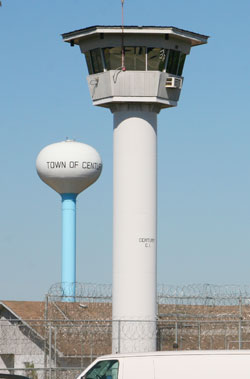
The mass privatization of prisons in the southern third of the state should at least temporarily stop the drive to hand prisons over to corporations, the head of the Department of Corrections said Tuesday.
“I think in terms of private prisons, this is as far as Florida should go,” Corrections Secretary Ed Buss said in an interview. “This wasn’t my decision, this wasn’t Gov. Scott’s decision, this was the Legislature’s decision.”
Buss talked about the privatization drive a day after the state released a request for proposals calling for a five-year contract with a single bidder to run 29 facilities associated with 11 South Florida correctional institutes. The privatization proposals are in line with the budget approved by the Legislature during its spring session, though one of the state’s main law enforcement unions has sued to try to block the move.
That contract should allow the state to assess how a widespread system of private prisons would work in comparison to public facilities, Buss said. That would include a look at how well private prisons work to reduce recidivism, one of Buss’ top goals as corrections secretary.
 “This will provide some competition so that the public and private sector can go head-to-head,” he said. “But until — and it takes three to five years to get any meaningful data on recidivism — I wouldn’t recommend any future private prisons until we get the data and we see if it does actually work.”
Under the budget approved by lawmakers, Buss’ agency could have bid out the privatization contract in several pieces. But the secretary said he believes taxpayers will get a better deal if corporations like the GEO Group, Utah-based Management & Training Corporation and Tennessee-based Corrections Corporation of America are forced to strive for a single deal.
“It’ll make for fierce competition,” he said. “You get nothing for second place.”
Buss also said giving the contract to a single company will make it easier to measure a company’s performance, since inmates often move from prison to prison, and help corrections employees who decide to stay in South Florida an easier time finding jobs and earning promotions.
As for employees who want to remain in the state system, Buss said they could move to a job in other parts of the state. About 3,000 positions are open, he said, part of an effort by the agency to make sure it could accommodate employees who are willing to move. That should alleviate some concerns about whether privatization will result in mass layoffs, Buss said.
“I think that we’ll be able to take the majority of staff who want to move,” he said. “The other staff that want to stay, I think they’re going to have ample opportunity to move on with the company.”
The Florida Police Benevolent Association has filed suit in Leon County Circuit Court, looking to block the changes and saying they “would result in the loss of jobs, job security and job benefits for numerous state correctional officers who are members of the … PBA.”
Buss also explained an order cracking down on pornographic materials in state prisons. Buss, who until coming to Florida oversaw state prisons in Indiana, said the Sunshine State was not alone in allowing inmates access to the materials, but that he wanted to put an end to it.
“I don’t think sex offenders, rapists, child molesters should have access to pornography,” Buss said.
He also suggested that even some inmates are likely uncomfortable about seeing sex offenders look at explicit materials.
“It would give them a lot of pause to know that they were viewing materials like this,” Buss said. “I don’t think my female staff working the prisons should be subjected to those type of materials, as well.”
By Brandon Larrabee
The News Service of Florida
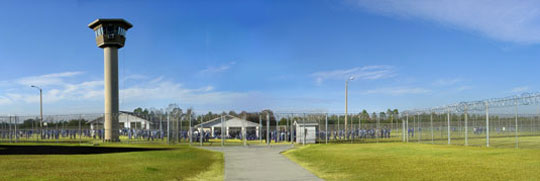
Pictured: Century Correctional Institution. NorthEscambia.com file photos.
Postal Service Studies Closing Local Offices
July 27, 2011
The U.S. Postal Service has released a list of retail outlets that could be closed, but North Escambia area post offices appear to be spared.
The Postal Service said it will consider the fate of about 3,700 local offices, branches and stations around the country. There are no post offices on the list in Escambia or Santa Rosa counties in Florida, or in Escambia County, Alabama.
There are 34 post offices in Florida and 52 in Alabama on the possible closure list released Tuesday. But not all of those on the list will close, according to officials.
Many of the post offices are in rural areas and have a very low volume of business.