

Scott Highlights Job Growth During Panhandle Visit
November 1, 2012
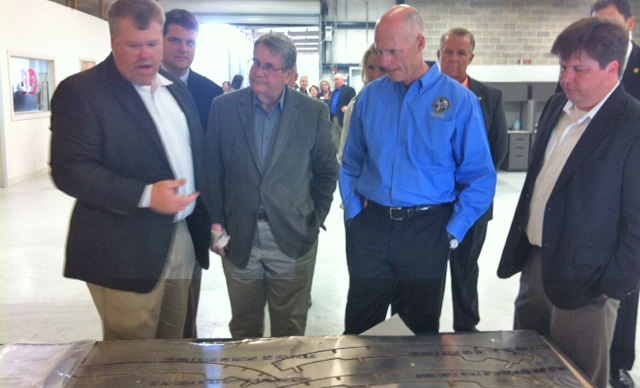
Gov. Rick Scott says job creation is on the rise in Florida. During a tour of L-3 Crestview Aerospace Wednesday, he highlighted a decrease in unemployment for veterans in Florida and highlighted the region as having the best unemployment rate in the state.
 “I have made job growth my top priority, and today’s tour was an incredible opportunity to meet and interact with the folks who are finding great jobs in our communities. L-3 Crestview Aerospace is an example of a company that has invested in Florida and expanded job opportunities for our veterans,” Scott said. “In their most recent expansion, they hired more than fifty veterans, providing their business with a quality workforce – and giving these men and women who served our nation a second career. We’ve worked to improve Florida’s job climate for our veterans. In fact, since September 2011, our veterans’ unemployment rate went from 15 percent to 6.8 percent – an 8 percent decrease.”
During the tour, the governor highlighted a number of indicators that he said demonstrate Florida is creating more jobs and opportunities for businesses:
- The Crestview / Ft. Walton Beach / Destin region had the lowest unemployment in Florida of 5.9 percent.
- Unemployment statewide has dropped for 22 consecutive months.
- 156,800 private sector jobs have been created since December 2010.
- Florida has had the largest drop in unemployment in the nation since December 2010.
L-3 Crestview Aerospace is a division of L-3 Integrated Systems, an aircraft modification, aero structure fabrication and assembly facility.
L-3 Crestview Aerospace has invested more than $6 million in improving their Northwest Florida facilities, where projects range from manufacturing engine firewalls to complete helicopter cabins. As part of its ongoing growth, L-3 Crestview Aerospace works closely with the Workforce Development Board of Okaloosa and Walton Counties and its JobsPlus One-Stop Career Centers. JobsPlus has helped L-3 Crestview Aerospace find and recruit 71 new employees since January 2011 – 57 of them veterans.
Pictured: Gov. Rick Scott toured a Crestview manufacturing company Wednesday, highlighting job grown. Courtesy photos for NorthEscambia.com, click to enlarge.
Investigation Launched Into How Murder Suspect Escaped From Jail
October 31, 2012
An investigation has been launched into exactly how a murder suspect and convicted sex offender was able to escape from jail Saturday.
 Cedric Jerome Floyd escaped from the Escambia County Detention Center in Brewton, Ala., about 10:15 Saturday morning. He was arrested about 4:20 p.m. Sunday as he was walking near Pace Boulevard and Clarinda Lane, just south of the Pace-Palafox split, in Pensacola and transported to the Escambia County (Fla.) Jail.
Floyd is back in Alabama today, but he won’t get another chance to escape from the Brewton jail. This time, Floyd is being held in the Baldwin County Jail in Bay Minette, Ala., as he awaits trial.
Escambia County (Ala.) Sheriff Grover Smith has launched an internal investigation into the escape to determine exactly how Floyd gained freedom, Chief Deputy Mike Lambert confirmed Tuesday. Criminal charges are possible if the investigation determines that a member of the jail staff assisted with the escape.
Trustees have escaped before in Escambia County, Ala., but Floyd was the first felon to escape without access to the outside world.
Floyd was awaiting trial for the January 2, 2012, murder of Tina Roshell Jones, 43, inside her 5th Avenue residence in Atmore. Floyd is also a registered sex offender, convicted in 2003 in Escambia County, Ala., of first degree rape and first degree attempted sodomy on a 14-year old female.
In His Own Words: Deputy Jeremy Cassady, Shot Two Years Ago, Retires
October 31, 2012
Former Escambia County Sheriff’s Deputy Jeremy Cassady, who was shot in the line of duty, has announced his retirement.
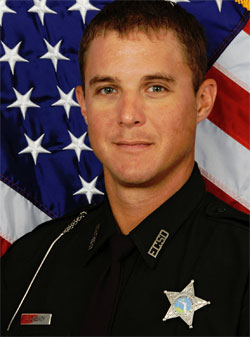
He made the announcement Monday on his Facebook page, two years to the day he was shot. Two other deputies and a female were shot that day on Baywind Circle. Phillip Monier was found guilty on eight counts including attempted murder, assault and kidnapping. Cassady later received a kidney and pancreas transplant.
“I am, however, convinced that I survived for a reason, God has a plan for me and I am anxious to see what the future holds,” Cassady wrote.
Below, Cassady explains his retirement decision, in his own, unedited words….
As everyone knows two years ago today my life, as well as my families life was altered forever. Due to the extent of my injuries suffered from that day, I was forced to take a medical retirement and today is my last day as a law enforcement officer. I just would like to say that if I could go back and change anything about that day I wouldn’t. I made a conscience decision to protect my fellow officers that day, as well as an unknown “citizen”. That was the oath I took and growing up in law enforcement helped me Carry out this act. I knew when I stepped into that bedroom that day that it wasn’t going to end well and I did everything I could possibly do to protect everyone in that room, so I rest easy.
Also while I’m at it I have to thank god. I thank god, not for sparing my life that day. But for putting things in order and not harming anyone else more than they were hurt. That day was perfect, my team got me out of the storm, straight to ems, who got me straight to the trauma surgeon who was waiting on me when I arrived. Everything fell into place, and as a law enforcement office our goal is to go home when it’s all said and done. Well I’m not gonna say that it has been an easy two years but I eventually made it home, so I would say I completed my mission. I am however convinced that I survived for a reason, god has a plan for me and I am anxious to see what the future holds.
I could actually go on for days about the appreciation that I felt when I woke up and saw the love and support that the community provided towards my family, and myself I could not fail. At the emergency room it made me feel good that governor Crist was their alongside one of the poorest lady’s on Erres blvd, praying for god to save me. Yes people I will now join the ranks of the old timers, as well as the injured, tube I ain’t gone. I will jump in a cruiser with someone and still go visit my secret snitches, as well as irritate those that need it.
We won that day, but it was a great sacrifice, well worth the effort. You guys need to stop and take the time to realize what you have and how simple life really is, try not to take things for granted so much. On any given day you could end up like me. Appreciate what you have.
I have spent most of this day thinking about the team that day that did what was necessary to save my life, Josh, Kelly, Rick Vinson, and some poor trainee that was crying all over me as she clinched her gun shaking as the shooting continued, I remember and will always be in debt to you guys. Sam, Chad, Melody, Josh, we are not hero’s, but we are all Warriors that did what we had to do that day. Thank you all! What a great family we are at ECSO!!
To the family friends and unknown, I will never be able to say thanks enough for seeing my family, and friends through this tough time. I appreciate everyone that extended a hand in prayer, as well as provided a shoulder for my Wife, family and close friends to lean on when things looked so grim.
To my wife and family, I love you all, and frankly this is what we do! We are tough and we never walk alone into battle.
Alabama Police Chase Ends With Century Manhunt
October 31, 2012
An over 30-mile police chase came to an end with a manhunt in Century.
 During the early morning hours Monday, an officer from the Poarch Creek Police Department attempted to stop a vehicle on the Poarch Creek Reservation. The vehicle was wanted by the Atmore Police Department in connection with a felony theft.
The vehicle came to a stop on Jack Springs Road. As the officer approached the vehicle, the black male driver took off and was pursued onto I-65 by the Poarch officer, according to Sharon Delmar, spokesperson for the Poarch Band of Creek Indians.
The Poarch officer continued his pursuit on I-65 to the Flomaton exit, south on Highway 113 to Flomaton and then into Florida on Highway 29. The vehicle continued onto Pond Street in Century, where the black male driver bailed out at the McMurray Park. A female inside the vehicle was detained and questioned before being released.
The Escambia County (Fla.) Sheriff’s Office responded to the park to assist in a search involving a K-9 unit with the Century Correctional Institution. The driver was not located and there were no arrests made Monday morning, according to Sgt. Mike Ward, spokesperson for the Escambia County Sheriff’s Office.
Delmar said evidence related to the theft was recovered inside the vehicle. The Atmore Police Department is expected to seek an arrest warrant for the female.
Need Christmas Assistance? Toys For Tots Kicks Off November 1
October 31, 2012
Applications will be accepted beginning Thursday for those needing assistance from the annual Marine Corps Reserve Toys for Tots campaign.
The drive strives to provide holiday toys for struggling families in Northwest Florida. Through partnerships with local charitable organizations and community donations, the Toys for Tots team hopes to provide three to five toys per child. Applications will be accepted November 1 through December 10.
To qualify for the local program, children must be ages 1-14 and reside in Escambia or Santa Rosa counties.
In Escambia County, applicants should call 211 or (850) 434-3157.
In Santa Rosa County, applications will be accepted in person at the following locations:
- Jay: Jay Town Hall (3695 Hwy 4) (850) 675-4556
- Gulf Breeze: Early Learning Coalition (3188 Gulf Breeze Pkwy.) (850) 916-5422
- Milton: United Way of Santa Rosa County (6479-A Caroline St.) (850) 983-7200
Applicants will need the following documentation:
- Valid photo ID (driver’s license, college ID, etc.)
- Proof of residency if not on ID (utility bill in client’s name, government letters)
- Proof of income (check stub, bank statement, letter of determination from government)
- Proof of each child’s age (birth certificate, shot record stating birth date, letter from school)
Toys will be distributed to families in need on December 17 and 18 in Escambia County and December 19 in Santa Rosa County. Distribution site locations and times will be provide to clients upon application approval.
Century Proclamation Honors The Life Of Late Rev. Willie Carter
October 31, 2012
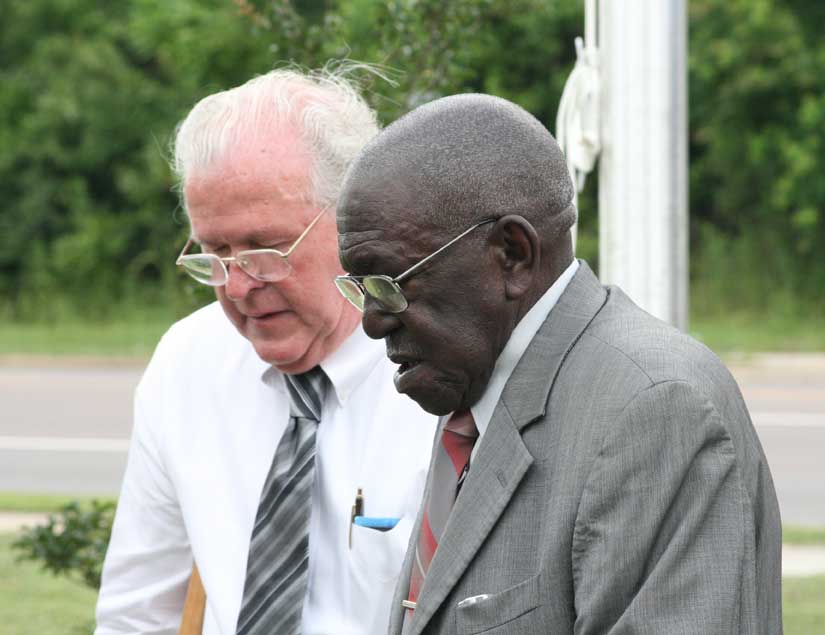
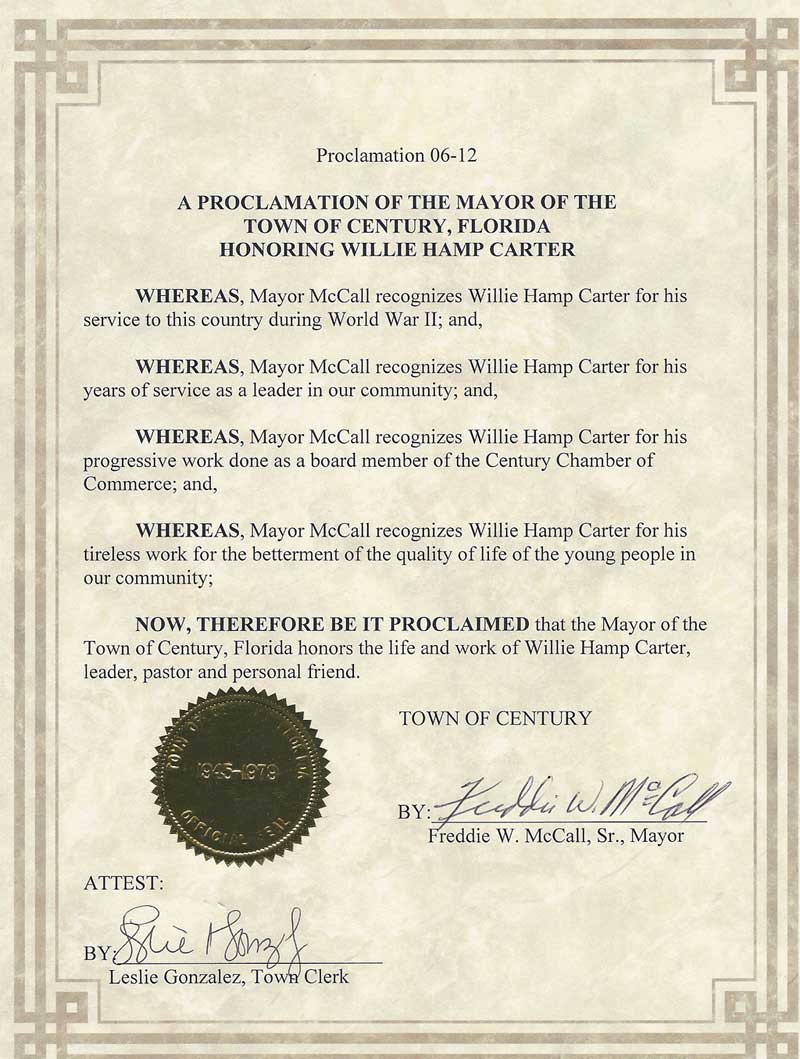
The Town of Century has issued a proclamation honoring the life of retired educator Rev. Willie H. Carter who passed away October 7.
The proclamation honored Carter’s service in the community, service to the Century Chamber of Commerce and for “his tireless work for the betterment of the qualify of life of the young people in our community”.
Read the entire proclamation by clicking here.
To read more about Carter’s life, click here for an earlier story.
Pictured top: Rev. Willie Carter (right) prays with Mayor Freddie McCall during a community even in Century. NorthEscambia.com file photo, click to enlarge.
Gulf Power Sends More Crews To Help With Sandy Restoration
October 31, 2012
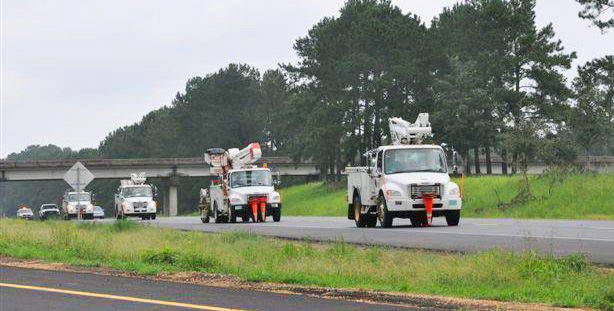
A Gulf Power Company storm restoration team left Fredericksburg, Va., Tuesday morning and headed to Plymouth Meeting, Pa.,just north of Philadelphia.
The 70-person team, including 48 line personnel and 22 support personnel, will assist Philadelphia Electric Company once they arrive this afternoon. As of Tuesday morning, PECO was reporting almost 600,000 customers without power.
Advocates Make Suggestions To Expand KidCare
October 31, 2012
With a new crop of lawmakers soon to arrive in Tallahassee, children’s advocates Tuesday released a plan to expand health care coverage to the hundreds of thousands of Florida kids who don’t have it.
The “KidCare Toolbox” includes a history of the program and an explanation of gaps in coverage that advocates have long sought to plug – along with policy tools for fixing them.
“None of this effort is really new,” said Karen Woodall of the Florida Center for Fiscal and Economic Policy. “This is just putting it together all in one place and including families who are impacted, along with advocates and policymakers.”
Last year, just three states had a higher percentage of uninsured children than Florida. In 2011, about 579,000 children statewide were uninsured, including 358,000 low-income children who were qualified for coverage.
Working with private carriers, KidCare cut the percentage of low-income, uninsured children to about 19 percent last year, the lowest since the state began keeping track. But that was higher than the national 9.7 percent rate.
So children’s advocates are offering policy proposals that they say would help solve problems that make it harder for families to enroll or stay enrolled.
KidCare has four main components – Medicaid for children, Florida Healthy Kids, MediKids and Children’s Medical Services – administered by multiple state agencies. That makes it easy for children to fall through the cracks if their ages or family incomes change.
“That transfer does not happen smoothly,” said Diana Ragbeer of The Children’s Trust. “We have been struggling with that disjointedness for years.”
On Tuesday, the advocates outlined proposed policy changes such as making eligibility continuous for 12 months, which would allow children to stay enrolled that long. Also, the changes would make eligibility presumptive, granting coverage to children who qualify but don’t have their paperwork in hand yet.
“We’re using the theme of tools that, if used, would chip away at the number of uninsured kids in the state,” said Woodall, a longtime member of KidCare’s advisory council. “It’s a renewed commitment to pulling in that quality health care and filling in the gaps.”
Katie Betta, a spokeswoman for incoming Senate President Don Gaetz, said in an email that the Niceville Republican “has and will continue to be supportive of KidCare,” though he has not been approached about the initiative announced Tuesday.
Woodall and Ragbeer said the advocates will soon reach out to legislative leaders.
“For the first time in four years, we’re no longer looking at a (budget) deficit situation,” said Ragbeer. And given state leaders’ emphasis on education, she said, health care is a vital support. “Sick children can’t learn.”
“We think there’s a bipartisan consensus,” agreed Woodall. “We believe that if given the tools to move forward, we’ll be able to make some progress in this legislature.”
By Margie Menzel
The News Service of Florida
Photos: Hundreds Attend Flomaton Fall Festival
October 31, 2012

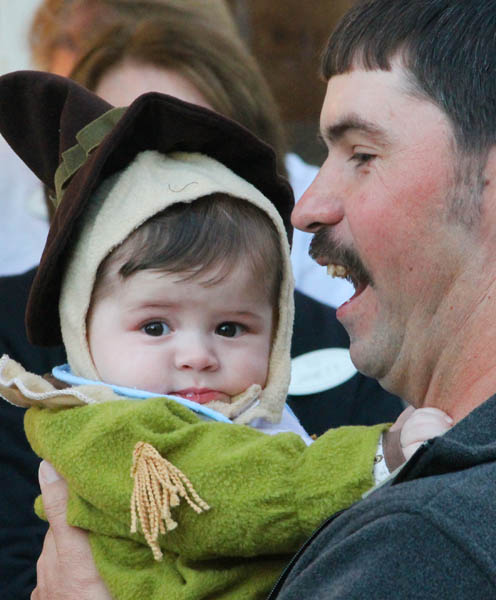
Hundreds of people from Flomaton, Century and across the area attended the annual Fall Festival in Flomaton Tuesday evening.
For a photo gallery, click here.
Pictured: Scenes from the Flomaton Fall Festival Tuesday night in Flomaton, Alabama. NorthEscambia.com photos, click to enlarge.

Wednesday Is Final Day To Request Mailed Absentee Ballot
October 30, 2012
Wednesday is the final day for voters to requested an absentee ballot be mailed to them, according to Escambia County Supervisor of Elections David Stafford.
Voters can make their request by contacting the Supervisor of Elections by mail, phone at (850) 595-3900, fax at (850) 595-3914, email to absentee@escambiavotes.com, or by using an online form at EscambiaVotes.com. Requests must include the voter’s date of birth and address. Absentee voters may track the status of their ballot by clicking Track My Ballot at EscambiaVotes.com.
After Wednesday, a voter may still pick up an absentee ballot in person from the Elections Office. Voted absentee ballots must be received in the Elections Office (not at a polling
location) no later than 7:00 p.m. on Election Day, Tuesday, November 6.
In addition to absentee voting, early voting is being offered from 7 a.m. until 7 p.m. daily through Saturday at five area locations:
- Supervisor of Elections Annex, 292 Muscogee Road, Cantonment
- Tryon Branch Library, 1200 Langley Avenue
- Supervisor of Elections Main Office, 213 Palafox Place, Second Floor
- West Florida Public Library, 200 West Gregory Street
- Southwest Branch Library, 12248 Gulf Beach Highway
Voters can also vote in person at the precinct on Election Day, November 6 from 7 a.m. until 7 p.m.