

Convicted: Man That Robbed Bank, Got Change To Pay Taxi Driver
June 1, 2013
A man that used a cab as his getaway vehicle — and stopped along the way to get change to pay the driver – has been convicted of robbing a Nine Mile Road bank.
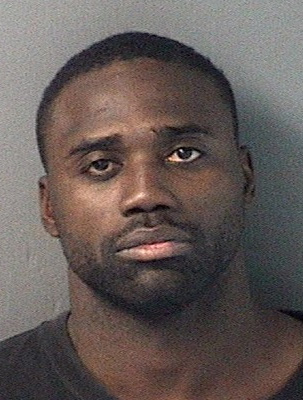 Terry Dewayne Gideon was convicted of robbery without a weapon by an Escambia County jury.
The charges stem from the October 2, 2012, robbery of the Bank of America on Nine Mile Road. Gideon took a Yellow Cab to multiple banks before robbing the Bank of America. Gideon approached the teller just before closing and handed her a note that demanded cash He left the bank with more than a $1,000, according to prosecutors.
Bank employees were able to identify the cab number and relayed that information to law enforcement. The Escambia County Sheriff’s Office located Gideon a short time later and arrested him. Multiple people were able to identify Gideon and his thumb print was identified on the demand note.
During the investigation, deputies learned that Gideon had gone into a nearby Applebee’s restaurant to get change from the stolen money to pay the taxi driver.
Gideon is scheduled to be sentenced on August 2, 2013, before Judge Scott Duncan. Based on his prior criminal history, the state seek sentencing as a habitual felony offender and a prison releasee reoffender. Under those designations, Gideon faces a minimum of 15 years and up to 30 years in state prison.
Ernest Ward Middle Holds Graduation (With Photo Gallery)
June 1, 2013
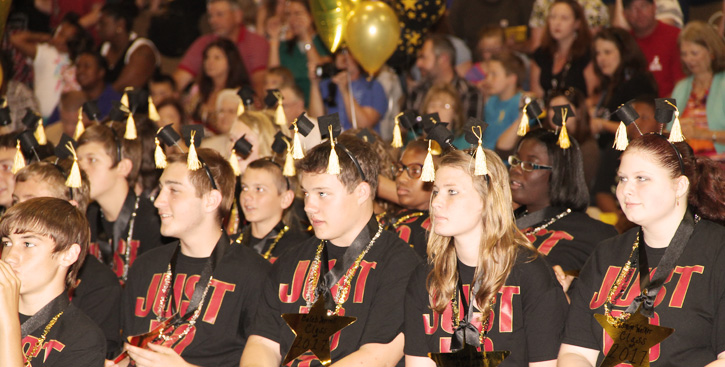
The Ernest Ward Middle School Class of 2013 held a graduation program Friday at the school.
The students took part in the ceremony that had a slightly more casual and fun theme than a traditional high school pomp and circumstance graduation exercise.
For a Facebook photo gallery, click here. (The photo gallery contains a photo of each graduate, compliments of NorthEscambia.com.)
Students participating in the graduation activities Friday at Ernest Ward Middle School were:
TOP TEN
- Alyssa Brianna Borelli
- Kristopher Ian Schneider
- Jada Mona Tucker
- Jessica Lauren Stacey
- Autumn Grace Albritton
- Mitchell James Singleton
- Kayleigh Grace Linam
- Zachary Chase Sheldon
- Savanna Louise Calhoun
- Peighton Danielle Dortch
- Dylan Cole Amerson
- Victoria Anne Amerson
- Carson Riley Bailey
- Caeley Danielle Barrett
- Natalie Grace Barrow
- Alyssa Marie Bell
- Dustin Lee Bethea
- Keithin Morez Blunt
- Christopher O’Neal Boutwell
- Amy Danielle Branch
- Travis James Bridges
- Kylie Brianne Brook
- James Sean Brooks
- Dimonique Regina Brown
- Kaylee Rae Brown
- Keviana Kadaisha Brown
- Devonte Ladarrin Burt
- Eric Derell Carthon
- Tabitha Faye Chavers
- Hanna Nadine Clarke
- Dillon Scott Clary
- Madeline Grace Clemmons
- Kathryn Marie Grace Cmehill
- Khari Adama Codrington
- Hannah Rebekah Coffey
- Kaelyn Marie Coffey
- Logan Hunter Cofield
- Austin Shane Collier
- Makensie Ann Colvin
- Amber Lynn Commalander
- Daryl River Cook
- Dustin Ryan Crumbley
- Jason Glenn Crutchfield
- Ashley Nicole Davis
- Camron Alan Day
- Colby Winston Dees
- Marcel Andrion Diggs
- Hannah Renee Edmonson
- Logan Hunter Edwards
- Jasmine Nicole Elliott
- Ohijie Jzamal Elliott
- Brittney Renae Faberman
- Austin Matthew Faircloth
- Colby Bryant Flurnoy
- De’Asia Ja’Shay Fountain
- Jewel Regina Garner
- Mallory Olivia Gibson
- Lindsey Sue Gindl
- Cody Dewayne Graham
- Taylor Bryanne Grant
- Courtney Nicole Grim
- LaNora Elizabeth Hall
- Michela Francis Hall
- Zipporah Montria Harris
- Gabrielle Laianne Hawkins
- Nathan Allen Hawthorne
- Emily Heard
- Lora Brianne Hicks
- Heather Alyssa Hilton
- Michael Trey Holder
- Beverly Ann Hughes
- Rachael Nickole Irby
- Mary Catherine Jernigan
- Jared Michael Jeter
- Kristen Evelyn Johnson
- Taylor Danyelle Kearley
- Adrian Daniel King
- Amy Ann Kite
- Daysha Lashea Kite
- Nathan Hunter Kite
- Desmone Madre Knight
- John Alex Krochta
- Chase Edward Lewis
- Koriaun Von’Trey Lewis
- De Jaunte Lamond Lowery
- Laxavier Lasedrick Lowery
- Ean Taylor Lundy
- McKayla Ann Macks
- Zachary Glen Maholovich
- Deonte’ Arnez Martin
- Trenton Dewayne Martin
- Destiny Brook Mathis
- Sara Maria McCreary
- Brittanie Nichole McLemore
- Mallory Topanga Merchant
- Preston Gage Milstead
- Contraris Montras Mitchell
- Flenequa Ann Mitchell
- Aalyiah Janay Moorer
- Sha’Kaura Tenae Moorer
- Brianna Delrae’ Morgan
- Morgan Alexis Myrick
- Jamia Marie Newton
- Daniel Francis Nielsen
- Audriene Doreatha Odom
- Charlie Glenn Odom
- Martavious Akino Odom
- Harlan Jackson Parr
- Deidre Danyell Paul
- April Gail Payne
- Zachery Austin Payne
- Morgan Cass Pope
- Shyla Nicole Pope
- Gregory Pressley
- Jasmine Skyy Prock
- Logan Ward Purvis
- Adrianne Leighanne Reaves
- Kyle Douglas Reaves
- Tre’Darius Ty’Rae Redmond
- Mallarie Rae Rigby
- Yotiannia O’Nesha Robbins
- Quentin Lee Sampson
- Charles Douglas Schachle
- Gaten Tyree Scott
- Shianne Elizabeth Sheedy
- Adam Clay Smith
- Brianna Morgan Smith
- Cody Allen Smith
- Matthew Thomas Smith
- Megan Shyanne Snyder
- Brandon Ty’Bree Spencer
- Devin William Stabler
- Troy Austin Stuckey
- Caleb William Therrell
- Brittanee Somer Thomas
- Jasmine Marie Walker
- Luke Carlton Ward
- Chelsea Ann Waters
- Jacob Henry Weaver
- Marshall Cameron Welford
- James Coleman White
- Tatyanna Monticia
- Tylia Lynett White
- Krystal Inez Whitehead
- Alston Sylvester Wiggins
- Roquan Devon Wiggins
- Leigha Nicole Wilson
- Robert Tyler Wilson
- Hadley Marie Woodfin
- Elizabeth Paige Wright
NorthEscambia.com photos, click to enlarge.
Dollar General Robbery Caught On Camera
June 1, 2013
The Escambia County Sheriff’s Office is looking for a Dollar General bandit caught on camera last week.
During the early evening of May 21, the man entered the Dollar General Store in the 4000 block of Mobile Highway. He asked for a carton of cigarettes and then displayed a firearm, taking an undisclosed amount of money and the carton of cigarettes before fleeing the area on a blue bicycle.
The man was described as being about 5-foot 7-inches tall and about 40-50 years old. At the time of the incident, the suspect was wearing a white shirt, sunglasses and a blue WalMart hat.
Anyone with information on the suspect is asked to call the Escambia County Sheriff’s Office at (850) 436-9620 or CrimeStoppers at (850) 433-STOP.
7A Matchup: Tate, Niceville Meet In Spring Game
June 1, 2013
The Tate Aggies had a chance to take on their one of their new 7A opponents Niceville Friday night in a spring football game. The Aggies came up short, 21-7, on the road.

The game was tied scoreless up until about 8:30 in the fourth, when Niceville scored on a 5-yard run. Niceville scored again with 3:30 to go on a 1-yard run, and again in the final moments on a 29-yard touchdown pass for a 21-0 lead.
With just a couple of seconds on the clock, Sawyer Smith found Lavontoe Samuel for a 66-yard touchdown run for a 21-7 final.
The Tate Aggies are part of a new three-team Class 7A district with Niceville and Crestview for the upcoming regular season, their first under new Head Coach Ronnie Douglas, a Tate grad.
The fall season will open for Tate with a home game on August 22 against the Gulf Breeze Dolphins. They won’t face their first 7A district opponent until the end of a five-game stand on October 4 against Niceville. The only other district game will come on the road against Crestview on October 18.
Toddler Shooting Suspect Pleads; Expected To Testify Against Pinestraw
June 1, 2013
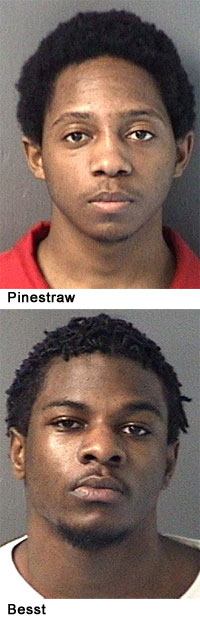 A toddler shooting suspect entered a plea Friday, and he is expected to testify against a Cantonment man previously profiled on TV’s “America’s Most Wanted”.
Shaquill Besst, 20, pleaded no contest to a lesser charge of second degree murder and now faces a maximum 20 years in prison. Trial begins next week for his co-defendant, 21-year old Dwayne “Money” Pinestraw, who faces up to life in prison.
The two were charged with the shooting death of 19-month old Ty’Quarius Moultrie and first degree attempted murder for the shooting of 23-year old Vincent Dennis. Pinestraw allegedly shot the child and Dennis on July 15, 2011, when he fired a .45-caliber gun through the window of a Pensacola Village apartment. He was arrested in Texas in December 2011, hours after being featured on the television program American’s Most Wanted.
Wahoos Shut Down Suns 2-1
June 1, 2013
Josh Smith scattered seven hits over 6.2 innings and led the way as the Pensacola Blue Wahoos knocked off the Jacksonville Suns 2-1 on Friday night at Pensacola Bayfront Stadium.
 Smith (4-5) picked up his first win since April 29 by allowing just one run on seven hits in his outing. The righthander struck out seven and continued his dominance of Jacksonville. In three starts against the Suns this year, Smith is 2-0 with a 1.53 ERA, striking out 20 in 17.2 innings. The only run he allowed was a fourth inning single from Zack Cox that scored Kyle Jensen.
Pensacola jumped out on top early against Jacksonville starter Bryan Evans (0-3). With two outs, Tucker Barnhart singled and came home on a double by Bryson Smith to give the Blue Wahoos a 1-0 lead.
After Jacksonville tied the game in the fourth, the Wahoos retook the lead for good in the fifth. Ryan LaMarre stepped to dish with runners on second and third and slapped a single through the drawn-in infield to score Devin Lohman. The base knock snapped an 0-for-14 skid for LaMarre.
Lee Hyde and Loek Van Mil combined for 2.1 scoreless frames out of the bullpen with Van Mil picking up his third save of the year by retiring the final four batters of the game, including a 12-pitch strikeout of Jake Marisnick to end the contest.
The Blue Wahoos look for the series win in the six-game series on Saturday at 6:35 p.m. Tim Crabbe (2-4, 3.74) will get the ball for Pensacola against Jacksonville’s Adam Conley (4-2, 4.72).
story by Kevin Burke
Downed Pole Sparks Fire At Cantonment Pharmacy
May 31, 2013
A downed power pole and transformer sparked a minor fire at the Cantonment Pharmacy this afternoon.
A tractor operating a Bush Hog reportedly broke the pole, sending a sparking power transformer onto the building and starting small blaze. The fire was quickly extinguished by the first Cantonment fire unit on scene. There was no major damage, and the pharmacy was reported to be back open for business.
Deputy’s Cruiser Vandalized In Cantonment
May 31, 2013
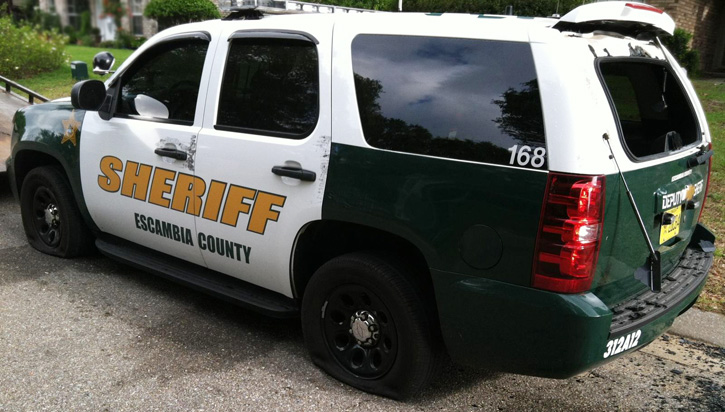
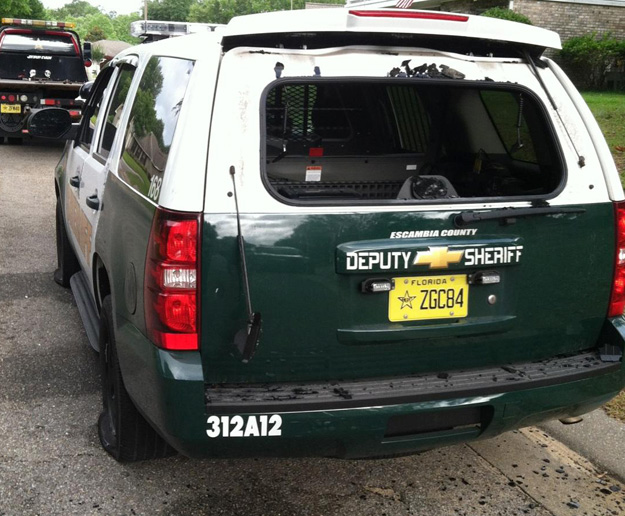
An Escambia County Sheriff’s Office SUV was vandalized overnight in Cantonment.
The deputy discovered the damage this morning to the cruiser parked in front of his house in the Turnberry Place subdivision off East Kingsfield Road. The back window had been shattered, and tires were flattened. Nothing was reported missing from the vehicle.
The incident is under investigation by the Escambia County Sheriff’s Office. A crime scene unit was called to the scene to check the vehicle for fingerprints and any other clues. Anyone with information on the incident is asked to call the Sheriff’s Office at (850) 436-9620.
Pictured: An Escambia County Sheriff’s Office SUV was vandalized in Cantonment. Photos by Chris Johnson, WEAR 3, for NorthEscambia.com, click to enlarge.
Northview Names Valedictorian, Salutatorian; Seniors Receive $800K
May 31, 2013

Well over $800,000 worth of confirmed scholarships were presented Thursday night to members of the Northview High School Class of 2013, and the school also named its valedictorian and salutatorian.
Jazzlyn Franklin was named the Northview High School Class of 2013 valedictorian, while Winston Riley was named salutatorian (pictured top).
Also during Senior Honors Night, seniors were recognized for college scholarships that they have received. The NHS Class of 2013 earned over $810,000 in scholarship money. Additional scholarships awards are expected to be confirmed.
For a photo gallery, click here.
Editor’s note: A list of honors graduates and academic awards presented Thursday night was not immediately available. The lists will be published at a future date.
The following students were recognized Thursday for scholarships received:
Corry Baggett
Gold Seal Vocational (Bright Futures) – $3,384
International Paper Pensacola Employees Scholarship – $1000
Solon Gandy Memorial Foundation Scholarship – $500
Jessica Baldwin
Florida Medallion Scholar (Bright Futures) – $9000
2+2 Pensacola State College/University of Florida – Institute
of Food & Agricultural Science Scholarship – $8,275
Pensacola Interstate Fair Grant – $1000
Walnut Hill Ruritan – $500
Thomas E. Weaver Memorial FFA Scholarship – $500
FFA Alumni Scholarship – $500
Glynn C. Key Scholarship – $500
Atmore Rotary Academic All Stars – $500
Alison Bardin
University of Mobile Dean’s Scholarship – $28,000
Florida Medallion Scholar (Bright Futures) – $9000
MIRA Book Award – $200
Atmore Rotary Academic All Stars – $500
Laura Clemmons
University of Mobile Center for Performing Arts – $4000
Dillian Crutchfield
McDonald’s National Employee Scholarship – $2500
FFA Alumni Scholarship – $500
Walnut Hill Ruritan Scholarship – $50
Hannah Fiellin
Atmore Rotary Academic All Stars – $500
Florida Medallion Scholar (Bright Futures) – $9000
Jazzlyn Franklin
Florida Academic Scholar (Bright Futures) – $12000
Florida State University Freshman Scholarship – $2400
Omega Psi Phi Scholarship – $TBD
Delta Sigma Theta – $300
Atmore Academic All-Stars – $750
Charles and Alice Mayson Scholarship – $17,400
La’Derious Franklin
Florida Medallion Scholar (Bright Futures) – $9000
Randolph Luttrell, Sr. Rotary Club Memorial Scholarship – $2,000
Tri-City Rotary – $500
Omega Psi Phi Scholarship – $TBD
Atmore Rotary Academic All Stars – $500
Ashton Gibbs
University of Mobile Dean’s Scholarship – $28,000
University of Mobile Center for Performing Arts Scholarship – $1,800
MIRA Book Award – $200
Atmore Academic All-Stars – $500
Georgia Goetter
Florida Medallion Scholar (Bright Futures ) – $9000
Alisha Grice
Reid State Technical College – $4000
PSC Outstanding Minority Scholarship – $1,600
MIRA Book Award – $200
Justin Halteman
Hermann Johnson EREC – $4000
PSC Principal’s Scholarship – $1600
Florida Academic Scholar (Bright Futures) – $12000
UWF Argonaut Scholarship – $3000
UWF Nautilus Scholarship – $4000
Atmore Rotary Academic All Stars – $500
Melanie Heard
Mississippi State University – $56752
Ariel Holland
Thomas E. Weaver Memorial DCT Scholarship – $500
Faulkner State College Cheerleading Scholarship – $18000
Marcus “Trey” Johnson
Gold Seal Vocational (Bright Futures) – $3,384
Pensacola Civitan Citizen of the Year – $TBD
Atmore Rotary Academic All Stars – $500
Zachary Johnson
University of South Alabama Presidential Scholarship – $14,000
Quinton D. & Mary P. Studer Charitable Giving – Gwen Applequist
Difference Maker Award – $1000
MIRA Book Award – $200
Atmore Academic All-Stars – $750
Courtney Lambert
Florida Medallion Scholar (Bright Futures) – $9000
MIRA Book Award – $200
Atmore Rotary Academic All Stars – $500
Henry H. Reichold Scholarship – $14000
Jessica Mahon
Take Stock in Children Scholarship – $12,382
Joshua Blake McCall
Jackson State university Football Scholarship – $105,000
Ashley Mooney
Take Stock in Children Scholarship – $12,382
Gold Seal Vocational (Bright Futures) – $3,384
MIRA Book Award – $200
Atmore Rotary Academic All Stars – $500
Shelly Mothershed
Fred L. McGhee First Generation Scholarship – $25,000
Maranda Moye
Florida Medallion Scholar(Bright Futures) – $9,000
MIRA Book Award – $200
Jody Paramore
Florida Medallion Scholar (Bright Futures) – $9000
Dustin Parker
Atmore Rotary Academic All Stars – $500
Luiseño Indian Scholarship – $70,000
Morgan Payne
Jefferson Davis Community College Volleyball Scholarship – $10000
Timothy Rackard, III
Florida Medallion Scholar (Bright Futures) – $9000
Winston Riley
University of South Alabama Presidential Scholarship – $14,000
University of West Florida Nautilus Scholarship – $2,000
Atmore Rotary Academic All Stars – $500
Thomas E. Weaver Memorial Baseball Scholarship $500
Florida Medallion Scholar (Bright Futures) – $9000
Stephanie Roach
PSC Wind Ensemble Scholarship – $500/semester
MIRA Book Award – $200
Morgan Taylor Roberson
Jefferson Davis Community College Volleyball Scholarship – $10000
Neiko Robinson
Penn State Football Scvholarship – $150,000
Tyler Roley
Faulkner State College Presidential Scholarship $13,000
Atmore Rotary Academic All Stars – $500
Morgan Smith
Jefferson Davis Community College Volleyball Scholarship – $10000
Johnnie Smith
MIRA Book Award – $200
Julia Thorpe
Florida Academic Scholar (Bright Futures) – $12000
MIRA Book Award – $200
Atmore Rotary Academic All Stars – $500
Jessica Warner
Florida Medallion Scholar (Bright Futures) – $9000
NorthEscambia.com photo, click to enlarge.
Two Arraigned In Molino Related Murder
May 31, 2013
 Two people were arraigned Thursday in connection with a Molino-related murder.
Zachary Greer and Debra Burge, both 22, pleaded not guilty to first-degree murder charges in the death of Harvey Ray Smith. They are set for trial in August.
The body of Smith, age 43 of Pace, was found stuffed into a trunk behind a Motel 6 on Davis Highway the morning on May4. Smith had been reported missing in Santa Rosa County. Family members located his vehicle at the motel and then discovered the body.
Reports state Burge and Greer conspired to rob Smith. Burge allegedly lured Smith, her acquaintance, to her home in the 3900 block of Highway 97 in Molino. She told deputies she went inside while Smith and Greer remained outside. When she later exited the home, she found Smith on the ground of the Molino home bleeding. She told Sheriff’s investigators that Greer told her he stabbed Smith and put his body in the trunk of the car that was later driven to the Motel 6 on Davis Highway in Pensacola.