

Additional Defendant Sentenced On Federal Meth Related Charges
September 4, 2013
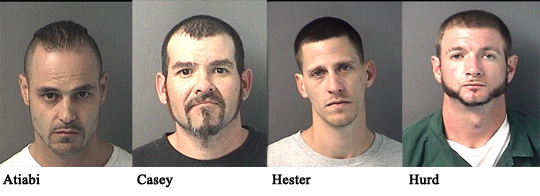
Another defendant arrested back in April on methamphetamine and pseudoephedrine related conspiracy charges has been sentenced in federal court, while four additional defendants have had their sentencings delayed until November. All either previously pleaded guilty or were convicted.
A federal judge convicted 29-year old Jared L. Hester on charges involving a conspiracy to possess and distribute pseudoephedrine, knowing it would be used to manufacture methamphetamine. Prosecutors said Hester was involved in the conspiracy to possess and distribute large amounts of pseudoephedrine in order to manufacture methamphetamine from January 1, 2011, until his arrest in April 2013.
The jury heard from other members of the conspiracy and was shown pharmacy records displaying dozens of pseudoephedrine purchases by Hester during the conspiracy. Many of these purchases overlapped with his co-defendants’ purchases. In all, the conspirators purchased between 350 and 400 boxes of pseudoephedrine, so that it could be manufactured into methamphetamine. All of Hester’s seven co-defendants pled guilty to the charges.
Hester was sentenced to 97 months in federal prison followed by three years supervised release. He has already appealed his sentence.
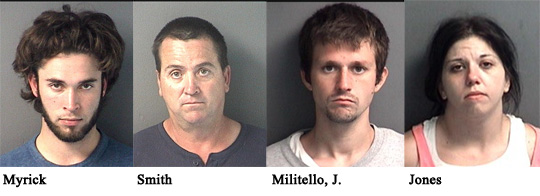
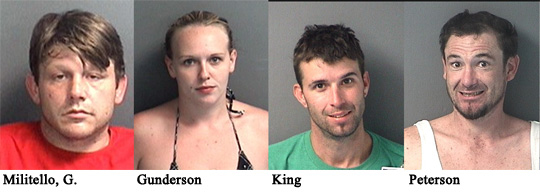
Four more defendants are now scheduled to be sentenced in November: Gregory A. Militello, Kirby Brian Smith, Joshua Paul Militello and Nicole Danielle Jones.
Seven defendants were sentenced earlier this summer:
- Stephanie Ann Gunderson, 26, Cantonment — Four months in federal prison, home detention for 24 months, supervised release for three years. She will be allowed to remain free until she surrenders on or before August 12.
- Shawn Michael King, 34, Cantonment – Federal prison for 51 months, three years supervised released.
- Joseph David Peterson, 33, Cantonment – Federal prison for 168 months, three years supervised released.
- Hunter Grant Myrick, 23, Cantonment – Federal prison for 20 months, three years supervised released.
- James E. Atiabi, 35, Pensacola, — Federal prison for 162 months, three years supervised released.
- John Wyatt Casey, 33, Pensacola — Federal prison for 115 months, three years supervised released.
- Shannon Lee Hurd, 29, Pensacola – Federal prison for 70 months, three years supervised released
Federal prosecutors say suspects were all were involved in a conspiracy to possess and distribute large amounts of pseudoephedrine in order to manufacture methamphetamine from January 1, 2011, until their arrests.
The indictments resulted from an investigation by agents of the United States Drug Enforcement Administration, the Florida Department of Law Enforcement, the Escambia County Sheriff’s Office, and the State Attorney’s Office.
Each defendant faces or faced up to 20 years imprisonment and fines up to $250,000.
Local Governments Win Battle: Judge Nixes Conecuh Woods Landfill
September 4, 2013
An Alabama judge has ruled that approval for the proposed Conecuh Woods Landfill in Repton, AL, is null and void — preventing the construction of a regional landfill in Conecuh County, AL.
 The landfill would have accepted solid waste from over 20 states. Many local governments joined in the lawsuit because the proposed 5,100 landfill would have included a 1,600 acres “disposal cell” to be located near the Big Escambia Creek which flows southward through Flomaton, into North Escambia swamps, then the Escambia River and eventually into Pensacola Bay.
The Conecuh County Commission approved the application of Conecuh Woods, LLC for the landfill in March 2011. Upon the approval of the application, the Town of Repton and its mayor, Terri Carter, filed suit against the Conecuh County Commission and Conecuh Woods, LLC seeking a declaratory judgment that the approval of the application was arbitrary and in violation of applicable state law.
Repton also alleged the Conecuh commission faiiled to ensure adequate public opportunity to comment on the proposed landfill and sought an injunction blocking the construction of the proposed landfill.
In June 2011, Escambia County (FL) joined the litigation. Atmore, Brewton, Flomaton, Orange Beach and Escambia County in Alabama joined the suit, as did Century and the Escambia County Soil and Water Conservation District.
The Escambia County Commission voted to authorize the county attorney’s office to represent Century and the ECSWD at no cost to either entity.
Conecuh Woods still has time to file an appeal.
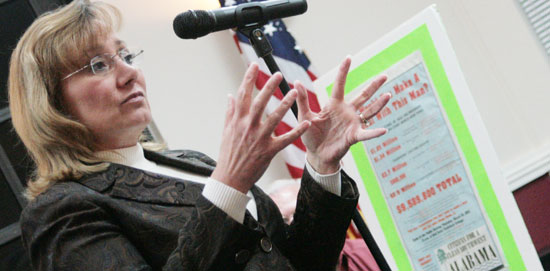
Pictured top: Repton, Alabama, Mayor Terri Carter addressed the Century Town Council in opposition to a proposed 5,100 acre landfill in Conecuh County, AL. NorthEscambia.com file photo, click to enlarge.
During Fugitive Search, US Marshals Find Drugs, $14K In Cash
September 4, 2013
While searching for a fugitive, the U.S. Marshals Florida Regional Fugitive Task Force uncovered drugs and over $14,000 in cash.
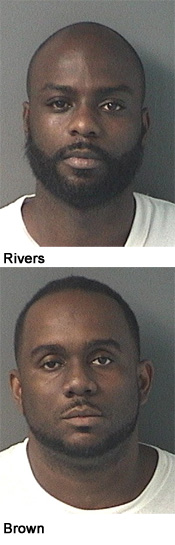 The Marshals arrested two Escambia County men, one a fugitive wanted in two states and another that appears to have been working in the local drug trade.
Kendrell Nashawn Rivers was wanted for probation violation warrants in Escambia County and in Lafayette, Louisiana. Authorities in Lafayette have been searching for Rivers since 2010 and the Marshals there adopted the case in 2012. The Marshals Task Force in Pensacola was asked to help earlier this summer but the 33 year-old had remained elusive until Tuesday.
The other man, Darius Arnell Brown was arrested at his home on the 5700 Block of Keystone Road Tuesday. The Task Force was there searching for Rivers who is Brown’s half-brother. The Task Force repeatedly knocked on the door and Brown would not come to the door. Eventually Marshals and Task Force members from Escambia County were allowed inside but did not find Rivers.
During their search they came across 2.3 pounds of marijuana, 2.4 grams of cocaine and over $14,000 in cash. Brown, 32, was arrested and charged with possession of cocaine and marijuana over 20 grams. Both the drugs and cash were seized by the Sheriff’s Office. Brown was also charged with possession of drug paraphernalia.
After arresting Brown, the Task Force continued their search for Rivers. Rivers eventually surrendered to Task Force Officers at the Sheriff’s Office. Rivers also had three outstanding warrants for not paying child support in Escambia County. Both men were booked into the Escambia County Jail where Rivers was being held without bond and Brown was released on a $5,000 bond.
High School Football Standings, Upcoming Schedule
September 4, 2013

Here is a district by district look at last Friday night’s high school football scores and this week’s schedule. District play has not yet started, so there are no district rankings.

NorthEscambia.com photo, click to enlarge.
Bridge Repairs, Delays To Begin Today On Arthur Brown Road
September 4, 2013

There will be delays at an Arthur Brown Road bridge for the next few days in Walnut Hill.
The bridge over Boggy Creek on Arthur Brown Road between Jack Gibson Lane and Kansas Road will experience intermittent lane closures due to repairs daily from 8 a.m. until 8 p.m. through Friday.
The substructure of the bridge and guardrail system will undergo work, and traffic will be directed by crewmembers.
The bridge is located just west of the Walnut Hill Baptist Church.
Pictured: The Boggy Creek Bridge on Arthur Brown Road. NorthEscambia.com photo, click to enlarge.
Fun, Healthy Lunchbox Ideas
September 4, 2013

The daily routine of packing foods for lunchtime may seem boring, but the food inside those lunchboxes doesn’t have to be. Consider your students’ personality when planning school lunches.
Whether the cafeteria-bound container features Hello Kitty or Justin Bieber, the foods inside should be customized to fit age, activity level and personal style. So how do you get beyond the usual carrots and celery sticks? Noted nutrition expert, award winning food journalist and television personality, Carolyn O’Neil, MS RD LD, advises parents to think about the personality of each child when assembling lunch.
Fix finger foods for young eaters
Overwhelmed little students may do best with tiny bites of finger foods. So, if you have a shy first grader, send them with string cheese sticks, whole grain crackers, baby carrots and cut-up fruit.
Cucumber wheels, red or orange bell pepper strips, and sugar snap peas are also colorful and nutritious finger foods. Add low-fat ranch dressing or individual packs of fiber- and protein-rich hummus for dipping. The oil in these dips actually helps kids absorb more of the veggie’s fat-soluble vitamins, such as vitamin A.
Up the nutrition for those not focused on lunch
What about the teens and tweens focused on anything but the lunch at lunchtime? Older kids focused on friends might prefer a sandwich and a bunch of grapes.
“That table of girls checking out the new guy don’t want to be seen wolfing down large portions,” O’Neil said. “A dainty sandwich cut into quarters or half of a whole-wheat pita sandwich might be a better fit. Choose lean proteins such as sliced turkey, roast beef or deli ham to maximize nutrition and minimize calories. For something sweet, they may prefer to dip grapes, strawberries or pineapple chunks in protein-packed Greek yogurt.”
Pack plenty of food for hungry athletes
Hungry athletes need larger servings of healthy foods for lunch, such as an extra slice of turkey on a sandwich and whole grain tortilla chips with an individual pack of salsa. These energy-burning kids may also need two cartons of cold milk for hydration and nutrition.
For after school, pack a snack to keep your sports star energized. They can refuel before sports practice with fresh fruit or the extra protein in a granola bar with peanuts or other nuts.
No matter what’s on the menu for your students, follow the USDA MyPlate nutrition icon. This visual for good nutrition indicates half of a healthy plate be filled with fruit and vegetables, with the two other quarters occupied by a lean protein and a whole grain starch. To complete the meal, add a cup of fat free or low fat milk.
Photo courtesy Getty Images for NorthEscambia.com, click to enlarge.
Lawmakers Prepare To Tackle Gambling In Florida, Again
September 4, 2013
Slot machines, blackjack and roulette are back on the table as lawmakers prepare once again to tackle the high-stakes issue of gambling in a state that everyone agrees is already one of the industry’s biggest cash cows.
But there’s little else the players and their opponents agree on.
Even as the Legislature awaits a final report on the economic impacts of gambling in Florida, the dog fight over who gets what kinds of gambling — and how much — is already ramping up.
The competing interests are hedging their bets. They’re hiring lobbyists, enlisting public-relations firms and stuffing campaign coffers, even while many privately admit the odds are against anything actually getting passed in 2014, an election year in which Republican Gov. Rick Scott is seeking a second term and legislators throughout the state will be on the ballot.
 But many believe that a looming 2015 end to an agreement with the Seminole Indians that lets the tribe run table games like blackjack could tip the scales in favor of some resolution during the upcoming session.
Most of the players don’t want to wait until Senate President-designate Andy Gardiner, an Orlando Republican whose district is in the shadow of gambling foe Disney, and House Majority Leader Steve Crisafulli, R-Merritt Island, take over the helms of their respective chambers before the 2015 legislative session.
And lawmakers, who paid Spectrum Gaming Group nearly $400,000 for a gambling study, want plenty of time to revisit the Seminole compact, which took two full years — and a Florida Supreme Court opinion — to nail down in 2010 after then-Gov. Charlie Crist initially signed a deal with the tribe without the Legislature’s approval.
The threat of Crist’s return to the governor’s mansion, this time as a Democrat, when the compact must be re-inked or allowed to lapse on July 1, 2015, further complicates the already labyrinthine issue.
As was the case the last time the deal with the Seminoles was in the works, all of the state’s existing track and fronton operators are throwing their wish lists on the table.
They’re divided by geography and confounded by regulators who have made a series of policy turn-arounds as operators and their lawyers exploit loopholes in a patchwork quilt of gambling laws to maximize the pari-mutuels’ reach along with their profits.
“This go-round, like last go-round, will include all the interest-holders or stakeholders,” said Sen. Bill Galvano, R-Bradenton, who serves on the Senate Gaming Committee and oversaw the compact negotiations for the House while serving in the chamber in 2010.
The Senate Gaming Committee will meet Sept. 23, the first day of committee meetings this fall, and hold hearings at four locations across the state late in October and in November.
“You have the 28 pari-mutuels. You have the eight pari-mutuels in Dade and Broward. You have the new interests of the resort destination entities. And this is an industry the participants, in my experience, seem to care more about what the other person doesn’t get than what they can get on their own. That makes it a very difficult group to manage and a difficult backdrop to create policy against,” Galvano said.
Industry lobbyists and lawmakers laid out a variety of possible scenarios.
In-state pari-mutuel operators want lawmakers to help their industry, or at least rein in their competitors, and are seeking lower taxes and more kinds of games, including blackjack and other banked card games. But they’re split on the kinds of permits the state should allow, and where gaming sites should be located.
Out-of-state casino giants hope the Legislature will sign off on at least one “destination resort” and finally bring Las Vegas-style gambling to the Sunshine State.
The Seminole Tribe of Florida is seeking to beef up its flagship Hard Rock enterprise in Tampa Bay, already one of the most lucrative casinos in the world.
The state’s tourism and hospitality industries, backed by conservatives and evangelicals, are pushing lawmakers to put the brakes on continuously-growing gambling options.
One option would bring bingo-like slot machines, or “video lottery terminals,” to all tracks throughout the state. That could be a problem because it might violate the Seminole compact, which gives Indian tribes the exclusive right to have slot machines outside of Miami-Dade and Broward counties. That part of the compact lasts for another 15 years.
Another alternative would give Broward and Miami-Dade “racinos,” which already have slot machines, lower tax rates and more “products.” Regulators have already signed off on slot machines in South Florida that play like roulette and blackjack, but the tracks say they need the banked card games to compete with the nearby Seminole Hard Rock Casino in Hollywood.
The prospect of blackjack and banked games at South Florida pari-mutuels is fueled by speculation that the Seminoles may be willing to give up their monopoly on the games in Miami-Dade and Broward in exchange for certain exclusivity in Tampa Bay, along with the possibility of additional games such as roulette.
The Seminoles also face the threat of lawmakers simply allowing the compact to expire and having to turn instead to the courts, a lengthy and expensive process, meaning they might be more willing to make concessions in South Florida to protect the Tampa Hard Rock.
Tampa Bay Downs wants slot machines so the track can compete with Hard Rock. The horse track wants to use proceeds from the slots along with lower tax rates to boost purses and thereby lure better horses — and the bigger bets that ride along with them — to the track. Another possibility could give the Tampa Bay pari-mutuels the option of video-lottery terminals, something that the Seminoles would likely balk at.
There’s also an ongoing push by dog tracks throughout Florida to “decouple” greyhound racing from cash-rich card rooms. Under current law, dog tracks must run a certain number of races to operate card rooms. They, too, are demanding slot machines to boost a failing industry. The initial report to the Legislature from New Jersey-based Spectrum Gaming estimated that the state’s 13 greyhound tracks lost a total $35 million on dog races.
Also in the mix: scraps over different types of permits and attempts to move them.
Included in the discussion is the possibility of the Department of Business and Professional Regulation canceling or buying back permits that aren’t in use at the existing pari-mutuels.
“The special privileges in the pari-mutuel code have targets on them for repeal, and dormant and underperforming permits are going to be tools for gambling contraction,” said gambling lawyer Marc Dunbar, who successfully convinced regulators to grant a controversial rodeo-style barrel racing permit for a facility in Gretna of which he is part owner. An administrative law judge later said regulators erred in issuing the permit. Dunbar is now in the midst of a legal battle over an attempt to get a Miami-Dade County permit for Gulfstream Race Track, located in Broward County, because the property spans the county line.
That’s just one of 21 gambling-related lawsuits DBPR is involved in, pointing to the need for lawmakers to tighten the statutes.
“We are at a crossroads in our state with regard to gaming,” Galvano said. “To the extent that the Legislature can create a very specific, tight plan for the future, we need to do that. We do not need to have like we do presently a statutory framework that lends itself to a wide variety of interpretations.”
The money the state receives from the Seminoles — $250 million a year for schools — gives the Legislature an incentive to fold on any of the other options that could benefit the existing tracks.
“The one thing I’ve heard repeatedly is that the state’s not going to give up on the Seminole money. In fact they want to increase it,” said Dan Adkins, chief operating officer of Hartman and Tyner, which owns the Mardi Gras Casino in Broward County. “So when you add all that up where does it end? Does the state play a game of roulette with the Indians and roll some big plan out there just to try to get the Indians in line to pay more money? I don’t know.”
Many insiders say the jumbled state of gambling affairs cries out for the creation of an independent gaming commission.
“The Legislature needs to rein in the permit issuances and have a little bit stronger way of implementing policy in reference to gaming so that everything goes through a complete vetting process before anything happens. That requires the creation of a gaming commission. It probably should be done even if there is no parity and even if there is no additional gaming,” said Calder Race Course lobbyist Wilbur Brewton.
House Speaker Will Weatherford, R-Wesley Chapel, who insists he is personally against any expansion of gambling, is playing his cards close to the vest as he waits for Spectrum’s final report, due Oct. 1.
“We’re pretty open. We want to do the right things. We want to be cognizant of the kind of gaming we have in the state of Florida, look at the current regulatory framework that exists, make a determination as to whether or not it’s working and then look at what Florida’s going to look like 20 years from now or what gaming in Florida is going to look at 20 years from now and make sure we’ve got a regulatory structure that’s going to meet the needs of that,” he said.
by Dara Kam, The News Service of Florida
Pictured: Pensacola Greyhound Park. File photo.
ECSO Neighborhood Watch Academy Accepting Applications
September 4, 2013
The Escambia County Sheriff’s Office is training a new generation of Neighborhood Watch leadership as part of their comprehensive approach to preventing crime.
Applications are now being accepted for the 16thNeighborhood Watch Academy to be held Tuesday, September 17 in the ECSO Administration Building at 1700 West Leonard Street in Pensacola.
The free training is being provided to neighborhood volunteers for new and existing Neighborhood Watch programs, or anyone interested in preventing crime.
The one evening seminar begins with a complementary meal at 5:00 pm and ends at 9:00 pm.
Should you wish to start a Neighborhood Watch group or simply make yourself less likely to be a victim of crime, organizers say this class is for you. Much of the curriculum covers basic safety and security tips for the home, anonymous reporting and crime prevention through environmental design.
To register or for more information, contact David Craig in the Community Services Unit at (850) 436-9281 or email gcraig@escambiaso.com.
Dozier School Dig Unearths Two Bodies
September 4, 2013
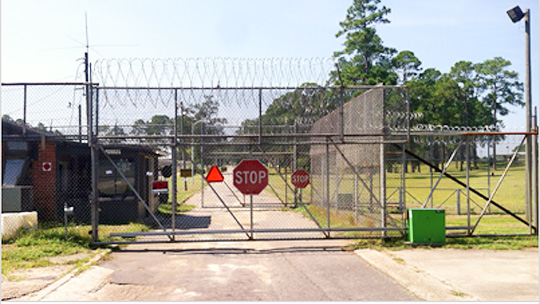
University of South Florida researchers have turned their focus to the arduous task of identifying the remains of two boys exhumed from half-century-old unmarked graves before returning to unearth more bodies from a now-closed Panhandle reform school.
A team of 10 USF researchers and graduate students Tuesday wrapped up a weekend of excavating a burial site that sits just outside the Boot Hill cemetery at the former state-run Arthur G. Dozier School for Boys, which is in the Jackson County community of Marianna.
The remains of the two boys are among at least 50 sent to the school between 1900 and 1952 who were buried in unmarked graves, said Erin Kimmerle, a USF anthropologist who is one of the leaders of the excavation.
Others have claimed the body count could top 100.
“We found coffin hardware, a little bit of coffin wood, that was unexpected given the amount of time that has passed,” Kimmerle said. And “dental and skeletal remains, so we have samples to send off for DNA.”
The researchers intend to return in October or November — the drier the weather the quicker the return — to exhume bodies from unmarked graves in other locations on the once 1,400-acre campus that now sits closed behind chain link fencing topped with barbed wired.
The state hopes to eventually sell the land, a move that has been put on hold. With the approval of Gov. Rick Scott and the state Cabinet, the university researchers have a one-year window to search the grounds for reportedly unaccounted-for bodies.
Questions have arisen about whether boys, who reportedly died of pneumonia and other natural causes, were killed at the school.
The work Tuesday included recovering the coffins. The bones of the two long-dead boys, one identified as having died after the 1930s, have been sent to USF’s secured Forensic Anthropology Laboratory. The hope is to determine who they were.
Finding the additional bodies isn’t expected to be that difficult as much of the ground has already been scanned and locations of potential grave shafts have already been mapped out. But Kimmerle acknowledged that identifying any remains will be a long-shot.
“As children, they didn’t have direct descendants and the parents had their last known address over 50 years ago,” Kimmerle said. “So you really have to find aunts and uncles, and then the cousins and go down a generation or two and find where these people are living today.”
So far, the researchers from the Tampa-based university have received voluntary DNA samples from 10 families that believe they have relatives who died at the reform school.
The Florida Emergency Mortuary Operations Response System provided assistance during the dig, while the search for relatives is being aided by cold-case members of the Hillsborough County Sheriff’s Office.
by Jim Turner, The News Service of Florida
Century Public Hearing To Discuss New Playground For Showalter Park
September 3, 2013

The Town of Century will hold a public hearing next Monday to consider a recommendation from the Century Recreaton Advisory Committee to submit a grant application to renovate the existing playground area at Showalter Park.
The town is submitting two grant applications to the Florida Recreation Development Assistance Program. FRDAP is a competitive program which provides grants to local governments for outdoor recreational projects. The grants are administered by the Florida Department of Environmental Protection.
A public hearing was previously held August 19 on a $125,000 grant application for a splash pad at the Anthony Pleasant Sportsplex.
The public hearing next Monday will be for a grant application for $50,000 to replace playground equipment at Showalter Park. The current equipment is in poor repair and is not designed for disabled users. If the grant is awarded for the playground equipment, no matching local funds will be required.
The public hearing will be held Monday, September 9 at 7:10 p.m. during a regular meeting of the Century Town Council. The hearing and the meeting are open to the public.
Grant applications are due September 30. The 2014-2015 FRDAP grants are contingent upon approval of an annual appropriation by the Florida Legislature.
Pictured top: A conceptual drawing showing a potential splash pad at the Anthony Pleasant Sportsplex in Century. Courtesy graphic for NorthEscambia.com, click to enlarge.