

Banana Spiders Make Big Local Comeback
September 16, 2013
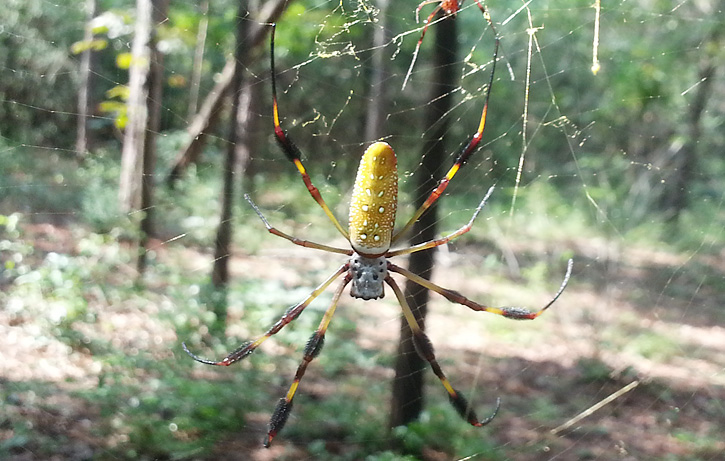
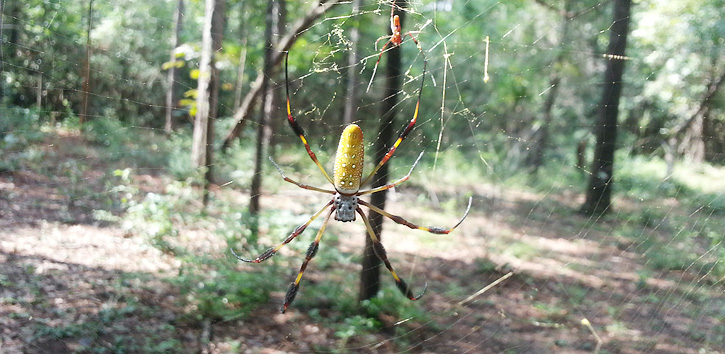
The golden orb weavers are back in greater numbers this year. More commonly called banana spiders, they seemed to have taken a break the past few years, only to return to our woods, trails and around homes with a vengeance this summer.
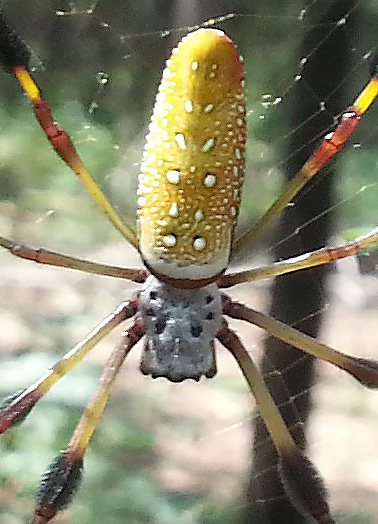 “That’s a cause for justifiable arson,” a commenter wrote on a local’s Facebook photo of a banana spider under the eaves of house, blocking a family’s entire kitchen window.
They can grow to several inches across, which can be scary if you don’t know that they really won’t hurt you physically (mentally is perhaps another story).
Because of its size, people sometimes assume that the banana spider is dangerous to people. The body of the female is 1 to 1 ½ inches long, plus an inch or two more when the legs are included in the measurements. The bodies of the males are much smaller, about ¼ inch, and are dark-brown. They are often found in the webs of females.
In reality, it is a shy spider (as nearly all spiders are). Just know this species is considered medically harmless to humans.
There is little danger to a healthy adult from an encounter with the banana spider. It will only bite if held or pinched and the bite itself will produce a localized pain with a slight redness, which quickly goes away. On the whole, the bite is much less severe than a bee string. It is best avoided, but it won’t kill you.
The banana spider preys on a wide variety of small to medium sized flying insects, which include mosquitoes, grasshoppers, stinkbugs, leaf-footed bugs, bees, butterflies, flies, small moths and wasps. Banana spiders have even been seen feeding on beetles and dragonflies.
The banana spider’s other name, the golden orb weaver, stems from the golden yellow color of their strong silk. Their large webs can typically be found in trees, along trails, under the eaves of houses, or other places where they’re likely to catch a lot of insects.
The University of Florida/IFAS Extension Service contributed to this story.
Pictured: A banana spider at a Bratt home. NorthEscambia.com photos, click to enlarge.
Century Applies For $50K To Renovate Showalter Playground
September 16, 2013
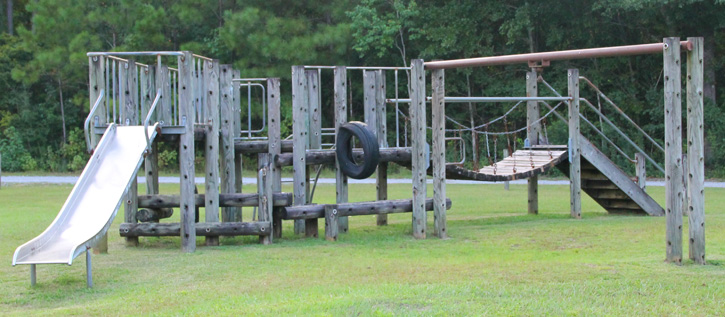
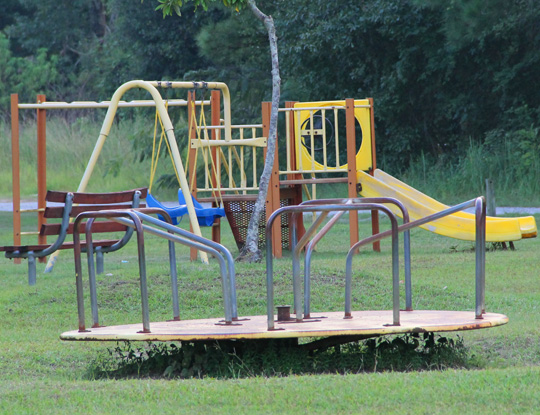
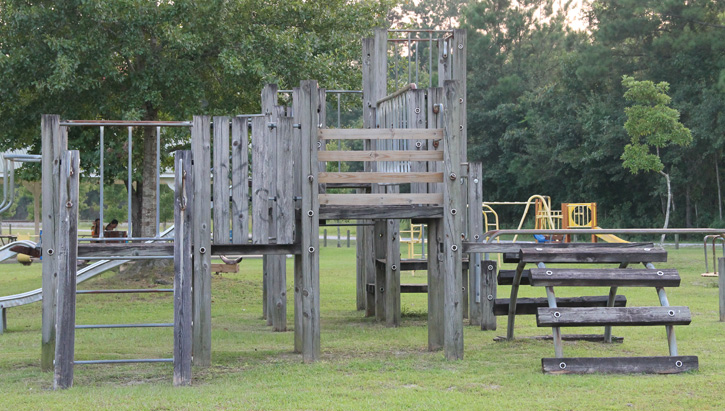
The Town of Century will follow a recommendation from the Century Recreation Advisory Committee and submit a grant application to renovate the existing playground area at Showalter Park.
The town is submitting two grant applications to the Florida Recreation Development Assistance Program. FRDAP is a competitive program which provides grants to local governments for outdoor recreational projects. The grants are administered by the Florida Department of Environmental Protection. In in addition to the Showalter renovation grant, the town is applying for a grant to install a splash pad at the Anthony Pleasant Sportsplex.
The Showalter grant, if awarded, would be for $50,000, and the Splash Pad grand would be for $125,000. Grant applications are due September 30. The 2014-2015 FRDAP grants are contingent upon approval of an annual appropriation by the Florida Legislature.
Pictured: Showalter Park in Century. NorthEscambia.com photos, click to enlarge.
CDC: Floridians Should Eat More Fruits And Vegetables
September 16, 2013
According to a recent report by the Centers for Disease Control, a large number of Floridians can take an important step to improve their overall health simply by changing their dietary habits.
 The agency strongly recommends increasing the consumption of fruits and vegetables.
Nearly 38 percent of all adults in Florida do not eat at least one fruit serving per day, while nearly 23 percent do not have at least one serving of a vegetable daily. Adolescents in Florida even less vegetables than their parents. About 42 percent do not consume at least one vegetable per day.
A diet rich in such foods, notes the report, “lowers the risk of many chronic diseases and can also help with weight management.”
The average fruit and vegetable consumption here matches that for most of the nation, with the exception that Florida adolescents eat fewer vegetables, on average, than their counterparts in other states.
For the complete report, click here.
SNAP Food Stamp Cards Are Working Again
September 16, 2013
Floridians receiving SNAP benefits on EBT cards can once again use their cards to purchase groceries at participating Florida retailers. Their EBT vendor transition was successfully completed this afternoon.
The program that provides food assistance — formerly known as food stamps — to low-income people was temporarily offline today as the Florida Department of Children and Families switched to a new vendor.
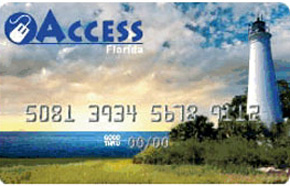
DCF has been working since July on the switch to the new vendor, e-Funds, which will provide electronic-benefits transfer services. It says the switch will lead to $21 million in savings over three years in the food-assistance program known by the acronym SNAP.
Now that the transition is complete, SNAP recipients can continue to use EBT cards. No action is required on the behalf of recipients.
High School Football Standings, Upcoming Schedule
September 16, 2013

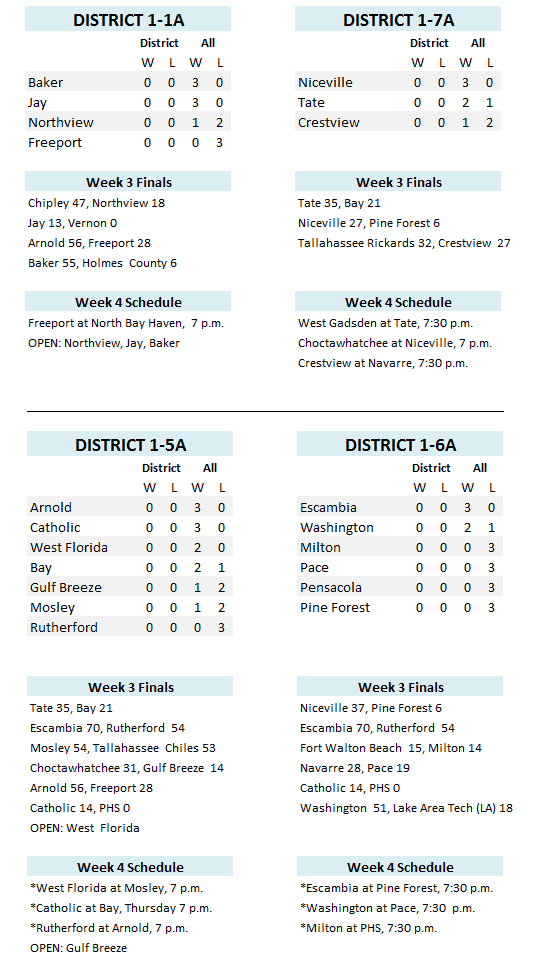
Here is a district by district look at last Friday night’s high school football scores and this week’s schedule. District play begins this Friday night for 5A and 6A teams, while 1A and 7A teams in the area either have an off week or will not play district games.
One Injured In CR 97 Motorcycle Crash
September 15, 2013
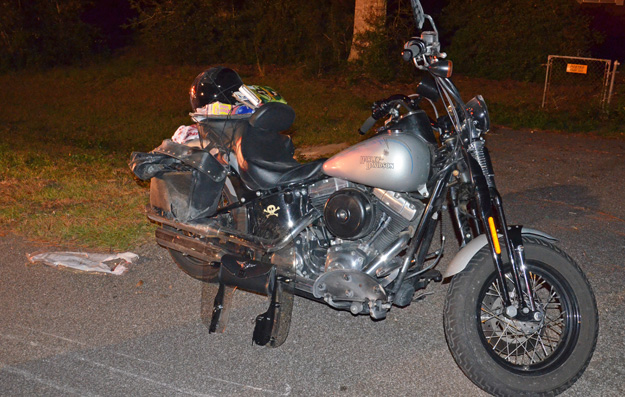

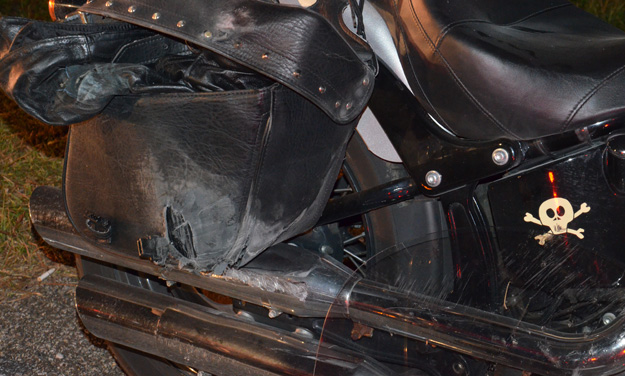
One person was injured in a single motorcycle accident early Sunday morning near the intersection of County Road 97 and Kingsfield Road. The motorcyclist lost control and ejected onto the roadway in the crash, which was reported at 12:05 a.m. The victim was transported to an area hospital by ambulance for treatment; their Harley Davidson was not seriously damaged. Further details have not been released by the Florida Highway Patrol. NorthEscambia.com photos by Kristi Smith, click to enlarge.
Escambia Health Department: Be Prepared For Emergency Situations
September 15, 2013
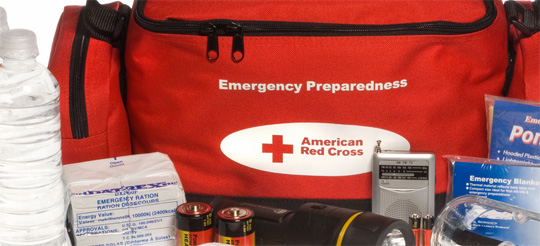
September is National Preparedness Month, and the Florida Department of Health in Escambia County is encouraging households, businesses, and communities to prepare and plan for emergency situations.
The department says Escambia County residents should prepare for an emergency or natural disaster that may create the need to be self-reliant for three days without electricity, water service, access to supermarkets or local services, and even without response from police, fire, or rescue. An emergency preparedness plan can apply to several types of emergencies including natural disasters and terrorism.
The health department recommends these four important steps:
- Be Informed – Remember that hurricanes are not the only natural disasters that occur in Escambia County. Knowing what to do before, during and after an emergency or natural disaster is an essential part of being prepared. Remember to consider safety first.
- Make a Plan – Disasters may strike at any time so it is important to make a communications plan in advance. Remember to include how to contact family members and relocate to safe locations, together or apart. Make plans to respond to different situations.
- Build a Kit – A disaster supply kit consists of basic items that a household may need in the event of an emergency including food, water, medications, and other supplies. An emergency or natural disaster may not allow for time to collect these items, and local officials or relief workers may not be able to reach residents for days. Plan to have supplies that will last for at least 72 hours.
- Get Involved – There are many ways to get involved in emergency preparedness, and to learn how to make your family, home and community safer from emergencies or natural disasters. Volunteer for your local Medical Reserve Corps unit or the Community Emergency Response Team, or start a preparedness project within your neighborhood.
For more information on how to prepare for emergencies and natural disasters, visit www.ready.gov. Business owners in Escambia County can visit the Business section of the Ready website (www.ready.gov/business) to create a plan for his or her business and employees. For more information on public health preparedness in Escambia County, visit www.EscambiaHealth.com.
Trials Delayed In Lottery Store Murder, Robbery
September 15, 2013
 Trial was set to begin Monday for the Alabama men that allegedly robbed and shot a Davisville lottery store owner last November. But now trials for both men accused of the murder have been delayed, according to Assistant State Attorney Greg Marcille.
Jury selection was set to begin Monday morning in the trial of 21-year old Brent Dewayne Lambeth and 25-year old Malcolm McGhee Jr. A continuance was granted Friday by Judge Linda Nobles until November for McGhee. A continuance was also granted for Lambeth, but his new trial date was not immediately reflected in court records.
Lambeth and McGhee remain in the Escambia County Jail without bond, charged with first degree murder and robbery with a firearm for the shooting death of 74-year old Thomas “Tommy” Kroll during a robbery on November 6, 2012, at the State Line O’ Yes Lotto on Highway 97.
Investigators said McGhee and Lambeth targeted Kroll’s business because they had previous purchased “Spice” there and the duo intended on robbing the store of more of the synthetic marijuana.
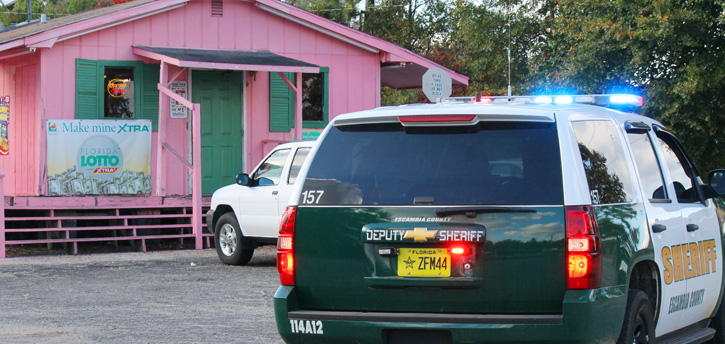
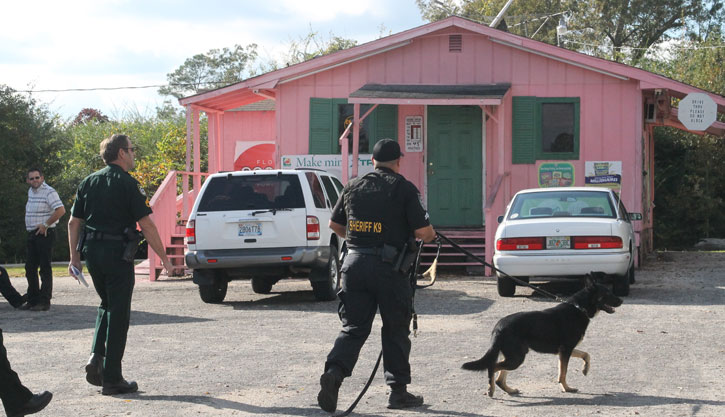
Pictured top and bottom: The scene outside the State Line O’ Yes Lotto on Highway 97 following the murder of store owner Thomas Kroll on November 6, 2012. NorthEscambia.com file photos, click to enlarge.
Lawmaker Says Drop Out Of State Customers From Citizens Insurance
September 15, 2013
Out-of-state residents who own property in Florida may again be the target of legislative efforts to further reduce the number of policies at the state-backed Citizens Property Insurance Corp.
 Rep. Bill Hager, R-Delray Beach, said that lawmakers next year could discuss prohibiting people who don’t live in Florida from being eligible for coverage from Citizens.
“During the 2013 legislative session, my colleagues in the Florida Legislature and I made some necessary, forward progress to reform Florida’s Citizens Property Insurance Corp,” Hager said in a news release. “However, the figures of current out-of-state and out-of-country policies are evidence that there is still more work to be done.”
Hager, vice chairman of the House Insurance and Banking Subcommittee, was responding to the Stronger Safer Florida Coalition, which questioned Florida property owners “subsidizing” nearly 180,000 Citizens policies that are held by people who live out-of-state.
The coalition includes the Florida Chamber of Commerce, Associated Industries of Florida and the Florida Wildlife Federation.
A similar proposal was discussed during the 2013 session but was not included in a final package directed at revamping and reducing the size of Citizens. The state-backed company had 1.22 million policies as of July 31.
by The News Service of Florida
Weekend Gardening: What To Do In September Calendar
September 15, 2013
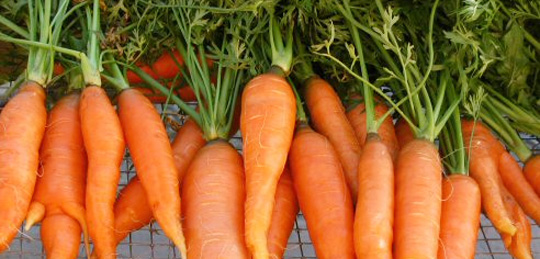
Here’s the September gardening calendar from the UF/IFAS Extension Service.
WHAT TO PLANT
- Bedding Plants — If summer beds need refreshing,try ageratum, celosia, zinnia, and wax begonia for color into fall.
- Bulbs — Add color, texture, and pattern to the garden with the many varieties of Elephant’s Ear (Alocasia) available now. Others to plant now include calla, narcissus, and zephyr lily.
- Herbs — Plant herbs that tolerate the warm temperatures of early fall, such as Mexican tarragon, mint, rosemary, and basil.
- Vegetables — Plant cool season vegetable crops such as radish, carrot, cabbage, and lettuce.
WHAT TO DO IN SEPTEMBER
- Lawn problems — Continue to monitor the lawn for signs of insect damage. Fall armyworms, chinch bugs, mole crickets, and sod webworms are still active this month.
Fertilize lawns — Bahia, Bermudagrass, Zoysia, and St, Augustine lawns should be fertilized this month. Choose one with no or very little phosphorus unless a soil test indicates a need for it. A fertilizer containing controlled-release nitrogen will give longer lasting results. - Lawn Weeds — Healthy grass is the best defense against weeds. Avoid “weed and feed” products; only apply herbicides to areas with weed infestations.
- Flowering perennials — Firebush, firespike, russelia, and other perennials supply nectar for visiting hummingbirds.
- Vegetable gardens — If not done in August, prepare the fall vegetable garden. Using transplants from your local garden center will get the garden off to a fast start, but seeds provide a wider variety from which to choose
WHAT TO DO EVERY MONTH
- Adjust irrigation based on rainfall.
- Deadhead flowers to encourage new blooms.
- Monitor the garden for insects and disease.
- Plant trees, shrubs, and perennials and water until established