

Molino Fire Station Conducts Safety Program At The Molino Library
October 8, 2013
 Members of the Molino Station of Escambia Fire Rescue conducted a children’s fire safety program Monday afternoon at the Molino Branch Library. Children of all ages had a chance to meet their local firefighters and climb aboard a fire engine. They learned about fire safety and what it takes to become a real firefighter. Pictured: Tucker tries on a fireman’s helmet during a fire safety program Monday afternoon at the Molino Branch Library. Submitted photo for NorthEscambia.com, click to enlarge.
Man Charged A Second Time For Murder Of Domino’s Pizza Driver
October 8, 2013
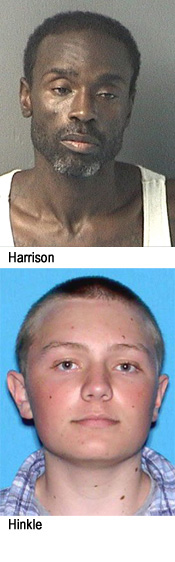 An Escambia County man has been indicted for the second time for the murder of a 19-year old pizza delivery driver outside an Escambia County Domino’s Pizza.
Gary Demeatric Harrison, age 44 of Pensacola, is accused of attacking Tyler John Hinkle, a 2010 West Florida High School graduate, outside the Domino’s Pizza at 27 North Navy Boulevard on September 24, 2011. Hinkle was able to walk into the restaurant to seek help from co-workers before he collapsed and died a short time later at Baptist Hospital.
Harrison was arrested for the crime about nine months later, but charges were dismissed due to a lack of evidence. Two witnesses had provided information to law enforcement during the case, but one recanted his statement and the other refused to cooperate and was unwilling to testify at trial.
Harrison is in the Escambia County Jail without bond.
Northwest Escambia Takes On Excel With Three Eagle Wins
October 8, 2013

The Northwest Escambia Sophomore, Junior and Seniors Eagles beat the Excel Panthers Saturday.
Freshmen
The Northwest Escambia Freshmen lost to Excel 29 -19. Zyonne Wesley put the only points on the board for the Freshmen, scoring three touchdowns and adding one extra point. With a game full of penalties the freshmen battled out a tough game. Aiden Odom, Jackson Simmons and Wesley each had several tackles for a loss. In the end the freshmen came up short, but they still have a chance at playoff action if they records wins for the rest of the season
 Sophomores
The NWE Sophomores defeated Excel 15-6. TJ Wright scored two touchdowns, and Aiden Broadhead scored one extra point for the Eagles. Defense was key for NWE in the game with Nathan Chavers having a sack and recovering a fumble. John Michael Ward made several tackles in the back field ,and Kaden Odom also had several tackles, including one for a safety to end the game. With the win, the Sophomore Eagles moved their record to 5-0 and secured a playoff berth on October 26.
 Juniors
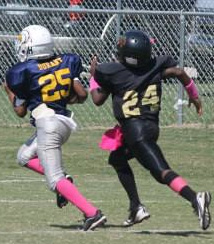
In the Escambia River Conference Game of the Week, the NWE Eagles shut out the Excel Panthers and handed them their first loss in a big way, 45-0. Scoring for the Juniors was Jayden Jackson, Jaheem Durant, Jacob Lee, Jaden Cunningham, Dariontae Richardson and Michael Merchant. The defense made big plays to prevent Excel from scoring. Jackson and Durant each had one interception, one of which Jackson returned for a touchdown. Logan Bryan, Hayden Thrower, Jamarkus Jefferson, Jaheem Durant, Keaundrae Richardson and Ki-Juana Carter all made tackles for a loss. Thrower had two sacks, and Jefferson had two sacks and a fumble recovery. The NWE Juniors have scored at least one defensive touchdown in each game they have played. The NWE Junior Eagles are 5-0 and have clinched a playoff berth for October 26.
Seniors
The Senior Eagles shut out Excel 54-0. Scoring for the seniors was Aunterio Minor with three rushing touchdowns, and Trent Kite with two rushing touchdowns. Seth Killam threw two touchdown passes, one to Tanner Deese and one to Keaton Solomson. Cameron Cloud completed a touchdown pass to Jay Helton. Tyler Kite had a fumble recovery on defense. Javontaye Wright, Keegun Johnston, Wyatt Windham, Jonathan Windham Jason Fayard, Tyrese Smith andTtrent Peebles all played big on defense helping the Eagles earn their fourth shut out of the season.
Northwest Escambia travels to Poarch this Saturday, game times as follows: 2:30 Freshmen, 4:00 Sophomores, 5:30 Juniors and 7:30 Seniors.
Pictured top: Sophomore Nathan Chavers makes a tackle in the backfield. Pictured top inset: Sophomore John Michael Ward forces a fumble. Pictured bottom inset: Junior Jaheem Durant outruns and Excel Panther for a touchdown. Pictured below: Junior Haydeen Thower sacks the Excel quarterback for a loss. Submitted photos for NorthEscambia.com, click to enlarge.

Escambia Man Gets 15 Years For Food Mart Burglary
October 8, 2013
An Escambia County man was sentenced to 15 years in state prison Monday for a convenience store burglary.
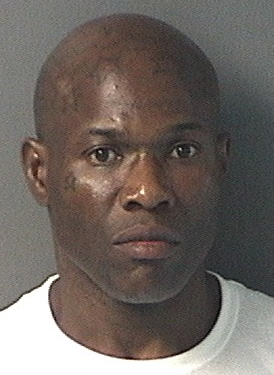 Clarence Henry received the sentence from Judge Terry Terrell for burglary of a structure while wearing a mask and grand theft. Henry was previously convicted in August by an Escambia County jury.
On June 4, 2013, Henry kicked in a side door at the T & C Food Mart on the corner of “A” and Cervantes Street. Henry fled with over $300 worth of tobacco products and money.
He had a towel wrapped around his head to conceal his identity. The towel was located about a block away from the food mart and had blood on it. Blood was also found on the broken glass from the point of entry of the door. DNA analysis linked them both to Clarence Henry.
The store clerk recognized Henry from the surveillance video for being in the store earlier that day and identified him from a photo lineup.
Two Wanted For Skipping Court On Felony Grand Theft Charges
October 8, 2013
Authorities are on the lookout for two Perdido, Ala., residents who failed to show up in the court on charges that they skipped the registers at a Pensacola Walmart with two buggies of items worth over $1,000.
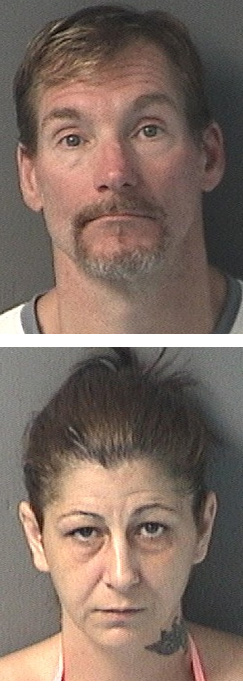 Ronald Eugene Haager, 46, and Anna Trisha Hamric, 35, were both charged with felony grand theft back in June. Haager was also charged with misdemeanor resisting.
According to the Escambia County Sheriff’s Office arrest report, a loss prevention employee at Walmart on Pensacola Boulevard noticed the couple acting strange and then exiting the store without paying for two shopping carts full of merchandise.
The loss prevention officer followed the couple outside and asked them to return to the store. They complied at first, but then Haager took off on foot, the report states. An off-duty officer at a nearby business detained Haager.
The two shopping carts contained 169 items valued at $1,010.28 that were returned to the store.
Judge Joel Boles issued failure to appear warrants for both Haager and Hamric when they were not in court for a set hearing. Anyone with information on their whereabouts is asked to call Crime Stoppers at (850) 433-STOP or their local law enforcement agency.
Solari Named National Merit Commended Student
October 8, 2013
Courtney Solari of Northview High School has been named a Commended Student in the 2014 National Merit Scholarship Program.
 A Letter of Commendation from the school and the National Merit Scholarship Corporation, which conducts the program, will be presented by Principal Gayle Weaver to Solari.
About 34,000 Commended Students throughout the nation are being recognized for their exceptional academic promise. Although they will not continue in the 2014 competition for National Merit Scholarship awards, Commended Students placed among the top five percent of more than 1.5 million students who entered the 2014 competition by taking the 2012 Preliminary SAT/National Merit Scholarship Qualifying Test.
“The young men and women being named Commended Students have demonstrated outstanding potential for academic success,” commented a spokesperson for NMSC. “These students represent a valuable national resource; recognizing their accomplishments, as well as the key role their schools play in their academic development, is vital to the advancement of educational excellence in our nation. We hope that this recognition will help broaden their educational opportunities and encourage them as they continue their pursuit of academic success.”
Former Prison Employee Sentenced For Smuggling Phones Into Facility
October 7, 2013
A former Century Correctional Institution employee has been sentenced for smuggling a cell phone into the facility.
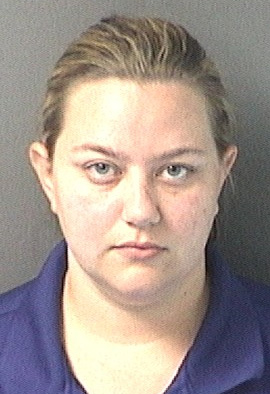 Sara Elizabeth Lowery, age 31 of Flomaton, pleaded no contest to a felony charge of smuggling a contraband cellular phone or communications device and a felony charge of possessing a contraband cellular phone or communications device on the grounds of a state correctional facility.
Judge Ross Goodman withheld adjudication in sentencing Lowery to three years probation and 200 hours of community service.
According to an Escambia County Sheriff’s Office arrest report, Lowery went through a routine check last May as she reported for work. The check revealed Lowery had five packs of unopened cigars, eight AA batteries, two cell phones wrapped in M&M paper, three cans of smokeless tobacco, two lighters, five activation cards, two packs of colored pens, two packs of single cigarettes and $100 worth of $20 bills. All of the items were retained by the prison.
Lawmakers Look To Reduce Vehicle Registration Fees
October 7, 2013
Florida Senate leaders are quickly trying to revive a plan to reduce vehicle-registration fees, with the Senate Transportation Committee scheduled to take it up Wednesday. Appropriations Chairman Joe Negron, R-Stuart, has said the proposal (SB 156), which would roll back fee increases approved in 2009 to help close a budget shortfall, could save vehicle owners about $230 million.
 Senators pushed the fee reductions during the 2013 session, but the proposal died — at least in part because it would have been funded by eliminating a tax break that benefits the politically influential insurance industry. The new bill does not include the insurance-tax issue.
Negron hopes Gov. Rick Scott will include the vehicle-fee reductions in a package of $500 million in tax and fee cuts that would be considered during the 2014 session.
Photos: This Weekend Wreck Was Just Nuts
October 7, 2013


A Saturday wreck in Santa Rosa County was just nuts. Seriously nuts. A peanut wagon apparently came loose from a truck and hit three parked cars, sending peanuts everywhere near the Allentown crossroads. There were no injuries reported. Reader submitted photos for NorthEscambia.com, click to enlarge.

State Pursues Voter Purge With Caution; Stafford: Right Direction
October 7, 2013
Saying they learned from last year’s mistakes, Florida’s top elections officials released a revised non-citizen voter purge process to elections supervisors Thursday, even as Democrats accused Gov. Rick Scott of trying to keep minority voters from casting their ballots.
Secretary of State Ken Detzner met with more than a dozen Northwest Florida supervisors of elections in Panama City during the first stop in a five-day “Project Integrity” tour in a preemptive attempt to calm fears about the purge scrapped last year after supervisors discovered the data they received from the state was flawed.
 “It’s going to start very slowly. It’s going to be deliberative,” Detzner said. “We want to make sure that you’re confident that the information we are giving you is the kind of information you demand from the Division of Elections.”
Detzner is pinning hopes for a smoother process on the Department of Homeland Security’s Systematic Alien Verification for Entitlements, or SAVE, system, comprised of data from several federal agencies including U.S. Immigration and Customs Enforcement and the U.S. Coast Guard. SAVE does not include information about undocumented immigrants or people who were born in the United States.
Detzner said the cases will be handled on an individual basis in contrast to last year when supervisors were given spreadsheets with the names of voters whose citizenship was in question after matching the state’s central voter database and driver’s license records.
“This is not data dumping back and forth where we send lists to the Department of Highway Safety and Motor Vehicles and we send thousands of lists up to SAVE,” Detzner said. “This is case management. One case at a time managed through SAVE and SAVE is managing them one case at a time. That’s quite a departure from last year. But it requires that type of transparency and attention and detail on each of these cases.”
The complicated process comes after supervisors scrapped last year’s non-citizen purge — the brainchild of Scott — after learning that many of the voters flagged by matching the state’s voter registration database and driver’s license records were naturalized citizens. More than half of the voters on the list were minorities.
The new process will at first be used only on new voter-registration applications, state Division of Elections Director Maria Matthews told the group Thursday. Those applications will again be matched with Department of Highway Safety and Motor Vehicles driver’s license records, which include an “alien registration number” for individuals who are not citizens.
Matthews’s staff will then manually attempt to verify the identity and legal status of flagged voters before vetting them through SAVE, which Matthews said contains “the most current information available about the legal status of a person who is not a U.S. citizen.”
If SAVE does not confirm that they have become citizens, Matthews said her staff will again attempt to verify the individual’s status by cross-checking “secondary sources” — including potentially getting lists of new citizens following naturalization ceremonies from federal officials throughout Florida — and prepare an electronic case file. That file will be sent to supervisors, who will have seven days to inform voters that they have been targeted for removal. Voters will have 30 days to respond before the removal process, and they can request hearings or bring information into the supervisors to prove their citizenship. Supervisors can then check voters’ legal status through SAVE prior to removing them from the list. Voters who have been erroneously removed can be put back on the rolls if they prove their citizenship or can challenge their removal in circuit court.
Detzner said he did not know when the new purge would begin because he still needs to work out agreements with the local supervisors so they can get direct access to SAVE, which costs a minimum of $25 per month and 50 cents for each record check.
Supervisors expressed some concern about potential delays between when someone becomes a citizen and when that information is updated in SAVE. But overall they appeared relieved by what they heard and saw on Thursday.
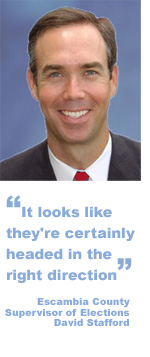
“It looks like they’re certainly headed in the right direction,” said Escambia County Supervisor of Elections David Stafford. “It sounds like they heard and listened to the input from the supervisors from the last process. We need data. We need information. We need source documentation before we’re going to start noticing these voters again. It sounds like at least they’re beginning to put together a process to do just that.”
But earlier in the day, Florida Democratic Party Chairwoman Allison Tant and Democratic National Committee Chairwoman Debbie Wasserman Schultz blasted Scott, a Republican seeking re-election, for reviving the purge.
Wasserman Schultz accused Scott of using the purge “to scare voters” into thinking the voting rolls are riddled with ineligible voters. Fewer than 200 of the 200,000 voters originally flagged by the state last year made it onto the final list of potentially illegal voters sent to supervisors.
“If your path to victory requires voter purges and suppression, then you are not fit to govern and you certainly don’t deserve a second chance,” Wasserman Schultz, a South Florida congresswoman, told reporters on a conference call.
Wasserman Schultz pointed out that Democratic President Barack Obama won 71 percent of the Hispanic vote and had the support of at least 95 percent of black voters.
“It’s very clear who they’re targeting, why they’re doing this,” she said. “They are going to use every tool at their disposal…Rick Scott and his Republican friends can’t win elections on their merits so they resort to intimidation and voter suppression.”
On Thursday, Detzner repeated what has become a common refrain in the debate about the purge issue — that non-citizens are among other categories of people, including convicted felons who have not had their rights restored and those who have been deemed mentally incompetent by judges — who are banned by law from voting. Elections supervisors are required to remove those ineligible voters from the rolls as part of their regular list maintenance.
“I don’t take my direction from political parties or leaders of particular groups. I listen to people who have positive contributions to make and look for ways to accommodate their needs, but most important is the credibility and reliability of the work that we do. I intend to follow the direction of the Florida Legislature,” he said after the meeting.
Bay County Supervisor of Elections Mark Andersen, a Republican, said the state is experiencing growing pains with the addition of non-citizens to the list-maintenance process, similar to what happened when it began removing felons from the voter database.
“Here’s the simple fact for all the parties. The review should be uniform and apply across the board equally. The simple fact is if you’re not a citizen you’re not supposed to be on our voter registration rolls. The difficult part is how do we get there?” Andersen said.
Andersen acknowledged that the issue is a thorny one, especially with another election on the horizon.
“Florida’s a swing state,” he said. “I know that everybody’s looking and if we find a measurement process with thousands of non-citizens on the rolls it is going to be frustrating for many.”
By Dara Kim, The News Service of Florida