

2013 In Photos: January And February
December 30, 2013
All this week, we are looking back at the photos that were in the news in 2013. Today, we are featuring photos from January and February.

Thousands of dollars worth of items were stolen or damaged during a burglary at a Century-owned industrial building.

A new playground was installed at the Molino Community Complex.

Ariel Holland (center) was crowned Miss Northview High School for 2013. First Runner-Up was Ashley Cunningham (right), and Second Runner-Up was Kendal Cobb.
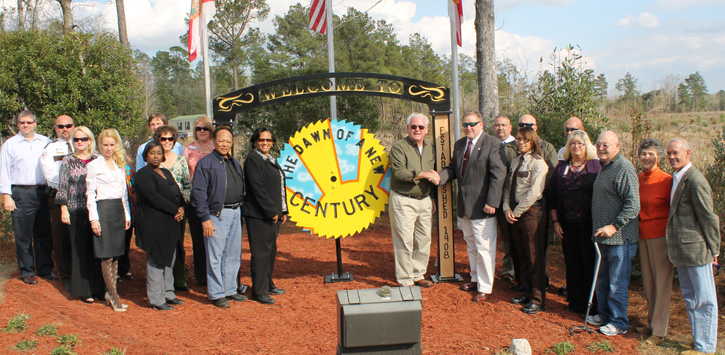
New “Welcome to Century” signs constructed with inmate labor from Century Correctional Institution were dedicated.

A country music video for Dusty Sanderson’s single “Chuggin’ Along” was filmed in Bluff Springs.

A small army of volunteers organized by Americorps worked on the National Day of Service to paint the Carver Community Center.

The legacy of Dr. Martin Luther King, Jr. was honored during a MLK Day program in Century.

Atmore honored Dr. Martin Luther King, Jr. with a parade.

High, thin cirrus clouds led to a halo around the moon one late January night.
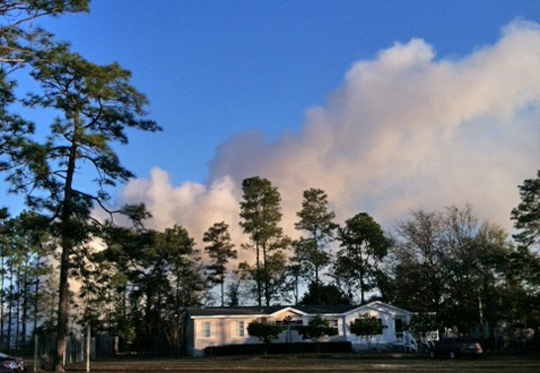
The Cove Landfill in Ensley burned for days, causing problems for Ensley residents and area schools.

Students at Byrneville Elementary School celebrated National Literacy Week.

A January sunset as seen in a rear view mirror traveling along Highway 4 near Canoe Creek.
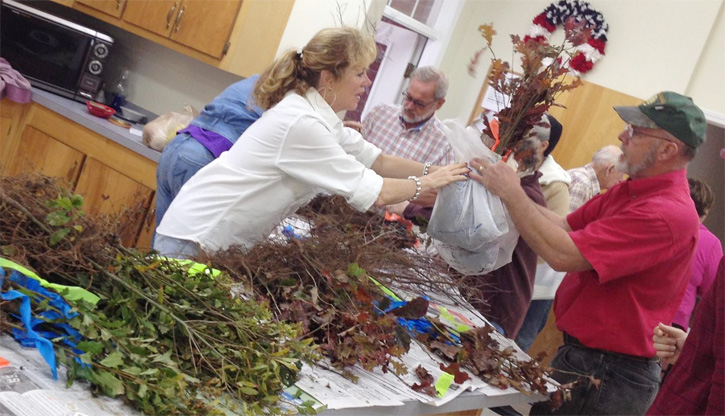
Hundreds of free trees were given away at the Walnut Hill Community Center for Arbor Day.
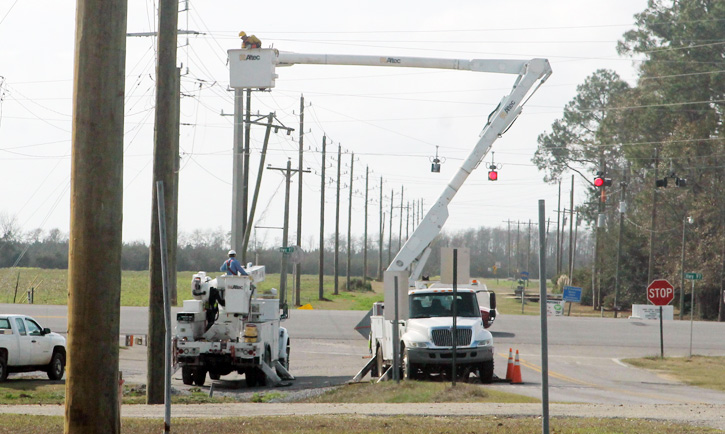
Major upgrades to the electrical system were made in the Walnut Hill area, including new lines and a new substation.

A wind-driven fire rages through a Bratt field.
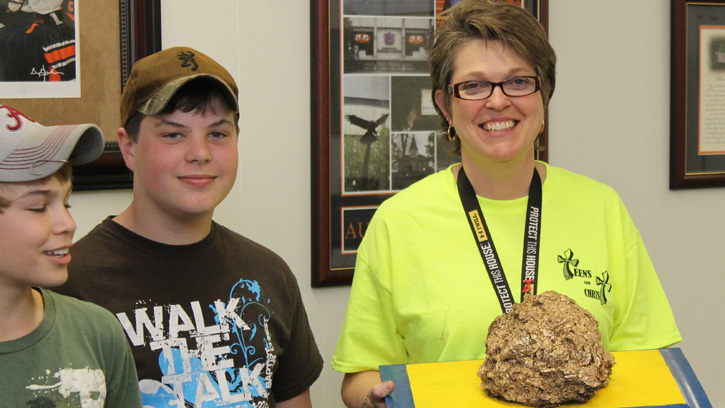
The Ernest Ward Middle School FFA presented their Golden Cow Dung Award to faculty member Betty Coon.

An early morning fire destroyed a mobile home on Brickton Road in Molino.

A cool February 2013 sunset.
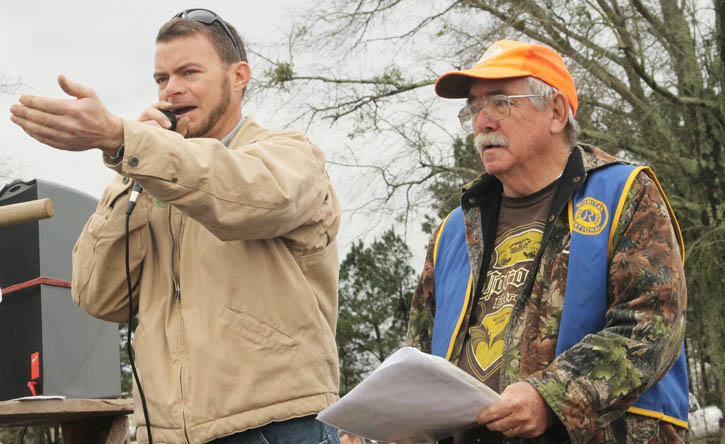
Hundreds of people attended the annual Walnut Hill Ruritan Club Farm Equipment Auction.

A missing student was located by a K-9 team in Walnut Hill, about three hours after she ran away from a school campus.

Four people were left homeless after a Century house fire.

The Northview Lady Chiefs opened their season with a win over Pensacola Catholic.

LifeFlight lifts off during the early morning hours in Bratt following a wreck.

A February rainbow over Atmore.
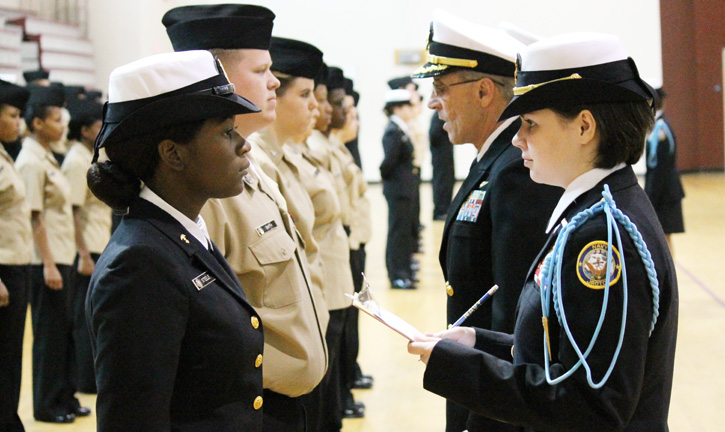
Northview High School’s NJROTC Annual Inspection was held with cadets undergoing face to face scrutiny.

Miss Ernest Ward Middle School winners: First Runner-up Nikoal Creamer, Miss EWMS 2013 Alyssa Borelli, and Second Runner-up Morgan Myrick.
Escambia County Peanuts: Enough For 252 Million PB&J Sandwiches
December 30, 2013

The final 2013 numbers are not in yet, but in 2012 farmers in Escambia County grew peanuts on 8,414.50 acres. That’s enough for 252 million peanut butter and jelly sandwiches growing in mostly North Escambia fields, like the one pictured above on Bratt Road.
So unless you have Archibutyrophobia (the fear of getting peanut butter stuck to the roof of your mouth), read on for some more fun peanut facts from the National Peanut Board:
By the Numbers
- It takes about 540 peanuts to make a 12-ounce jar of peanut butter.
- There are enough peanuts in one acre to make 30,000 peanut butter sandwiches.
- By law, any product labeled “peanut butter” in the United States must be at least 90 percent peanuts.
- The world’s largest peanut butter factory churns out 250,000 jars of the tasty treat every day.
- Four of the top 10 candy bars manufactured in the USA contain peanuts or peanut butter.
- Peanuts account for two-thirds of all snack nuts consumed in the USA.
- Peanuts contribute more than $4 billion to the USA economy each year.
- Americans spend almost $800 million a year on peanut butter.
- The average peanut farm is 100 acres.
- Peanut butter/peanut paste is the leading use of peanuts produced in the U.S. (1/2); followed by snack nuts and in-shells (1/4); and, candy and confections (1/4).
- Peanuts are the #1 snack nut consumed in the U.S., accounting for two-thirds of the snack nut market.
Consumption Facts
- The average American consumes more than six pounds of peanuts and peanut butter products each year.
- The average child will eat 1,500 peanut butter and jelly sandwiches before he/she graduates high school.
- Americans consume on average over 1.5 billion pounds of peanut butter and peanut products each year.
- Peanut butter is consumed in 90 percent of USA households.
- Americans eat enough peanut butter in a year to make more than 10 billion peanut butter and jelly sandwiches.
- The amount of peanut butter eaten in a year could wrap the earth in a ribbon of 18-ounce peanut butter jars one and one-third times.
Peanuts Made Famous
- Two peanut farmers have been elected president of the USA – Thomas Jefferson and Jimmy Carter.
- Astronaut Allen B. Sheppard brought a peanut with him to the moon. Read about peanuts bringing good luck to NASA.
- Peanut butter was the secret behind “Mr. Ed,” TV’s talking horse. Spreading peanut butter inside the horse’s mouth created a natural talking movement every time the animal moved his sticky jaws.
- Baseball Hall of Fame’s, Jim “Catfish” Hunter and Gaylord Perry are peanut farmers from North Carolina (Hunter from Hertford and Perry from Williamston).
- Former President Bill Clinton confessed that one of his favorite sandwiches is peanut butter and banana; also reported to have been the favorite of Elvis “the King” Presley.
- In Barbara Mandrell’s hit song “I Was Country When Country Wasn’t Cool” she sings about putting peanuts in her bottle of Coke. (This method of enjoying peanuts was developed by southern farm workers as a practical snack solution in the interest of time and cleanliness, plus it’s flavorful.)
- There are six cities in the U.S. named Peanut: Peanut, California; Lower Peanut, Pennsylvania; Upper Peanut, Pennsylvania; Peanut, Pennsylvania, Peanut, Tennessee; and Peanut West Virginia.
World Records
- Grand Saline, TX holds the title for the world’s largest peanut butter and jelly sandwich weighing in at 1,342 pounds. Grand Saline outweighed Oklahoma City’s 900 pounds peanut butter and jelly sandwich in November 2010. Oklahoma City, OK had been the reigning champ since September 7, 2002.
- Adrian Finch of Australia holds the Guinness World Record for peanut throwing, launching the lovable legume 111 feet and 10 inches in 1999 to claim the record.
- In August 1976, Tom Miller, a University of Colorado student, pushed a peanut to the top of Pike’s Peak with his nose(14,100 feet!). It took him 4 days, 23 hours,47 minutes and 3 seconds.
- The Guiness Book of World Records reports that on April 3, 1973, Chris Ambrose, Clerkenwell, London, ate 100 peanuts singly in 59.2 seconds!
- According to the Guiness Book of World Records, Earl Adkins, Enfield, North Carolina holds the record for growing the largest peanut – 4 inches long! (The average length of a peanut is about one inch.)
How do you like your peanuts?
- Women and children prefer creamy, while most men opt for chunky. Click here for a creamy peanut butter smoothie recipe.
- People living on the East Coast prefer creamy peanut butter, while those on the West Coast prefer the crunchy style.
- Sixty percent of consumers prefer creamy peanut butter over crunchy.
- Peanut butter is the leading use of peanuts in the USA.
- “Boiled peanuts” are considered a delicacy in the peanut growing areas of the South. Freshly harvested peanuts are boiled in supersaturated salt water until they are of a soft bean like texture. They are most frequently enjoyed at the end of the day with a favorite beverage.
Nutrition Facts
- Peanuts have more protein, niacin, folate and phytosterols than any nut.
- Peanuts and peanut butter contain over 30 essential nutrients and phytonutrients.
- Peanuts are naturally cholesterol-free.
- Rumor says that there’s enough mental stimulation in one peanut to produce 30 minutes of serious thinking. That may or may not be true, but peanuts are a good source of protein and the B vitamins, nutrients that help prevent “brain fatigue”
- Peanut oil is valued as premium cooking oil by cooks and chefs worldwide. Tasteless and odorless, peanut oil doesn’t transfer food flavors, has a very high smoke point (440 to 470† F.) and is high in the desirable mono-unsaturated fatty acids.
- Specially processed defatted peanuts may be ground into a flour for use in making high protein foods and beverages-, may be granulated and added to breakfast or diet bars to raise the protein levels; or may be flavored to taste like other foods.
- One of the many great advantages of peanuts and peanut butter is long shelf life. If held at average ambient temperature without great change in heat or humidity, peanuts and peanut butter can be safely stored for several months.
- Peanuts contain no cholesterol. Recent studies show that the combination of monounsaturates and polyunsaturates such as are found in peanuts may be helpful in reducing cholesterol levels in the body.
In our Language
- Goober—a nickname for peanuts—comes from “nguba”, the Congo language name for peanut.
- “Peanut Gallery” became popular in the late 19th century and referred to the rear or uppermost seats in a theater, which were also the cheapest seats. People seated in such a gallery were able to throw peanuts, a common food at theaters, at those seated below them. It also applied to the first row of seats in a movie theater, for the occupants of those seats could throw peanuts at the stage, stating their displeasure with the performance.
Pictured top: Peanuts are harvest just before Christmas on Bratt Road. NorthEscambia.com photo, click to enlarge.
Two Children Killed In I-65 Crash
December 30, 2013
A fiery accident that claimed the lives of two children just south of Atmore on I-65 closed the interstate highway overnight.
 The first in a series of accidents was reported about 9:45 p.m. about three miles south of Exit 54 – the Poarch, Jack Springs Road exit. A 2000 Freightliner semi-truck driven by 57-year old Terry Allen Wyatt of Andalusia, AL, rear-ended a 2010 Dodge Challenger. The car then burst into flames, according to reports.
Nadir Gillis, 9, and Naziya Gillis, 7, both of Camp Lejeune, N.C., were pronounced deceased at the scene.
The driver of the Dodge, 28-year-old Isom Hodges, and another passenger, 30-year old Labrica Hodges, both of Camp LeJeune were transported to area hospitals. The driver a third vehicle in the crash, 42-year old William C. Rousey of Lexington, KY, was transported to Sacred Heart Hospital in Pensacola. Their conditions were not available.
A second accident, reportedly involving three vehicles, occurred north of the original accident scene.
Traffic was rerouted off the interstate at Exit 54 for several hours.
Further details have not been released by Alabama State Troopers. No charges have been filed in the crash.
Year-End Expert Tax Tips
December 30, 2013
There are a couple of days left in 2013, but according to tax expert Marshall Mennenga, there are some steps people can take before 2014 arrives to not only lower their tax bills, but to help others at the same time. He suggested contributions to charitable organizations.
 “Maybe you need to clean out some closets and give some clothes to Goodwill…or many of the other organizations out there that are nonprofit organizations, that will accept your goods, your household furniture, clothes, and things like that,” he advised. “Of course, the fair market value of those items is deductible.”
Another suggestion is cash contributions, but Mennenga said to make sure to get receipts documenting the amounts. He noted there are very few tax-law changes from last year to be aware of. Every year, the Internal Revenue Service puts out a guide for tax preparation called Publication 17.
“Last year, it was like February 10th before it was available for distribution,” he recalled. “For right now, here in late December, it’s already available, so there’s no major changes coming.”
Another tip is not to jump the gun and try to fill in your tax return before you have everything you need, such as your 1099 forms for interest and dividends.
“Wait before your do your tax return to make sure you have everything. Use your previous year’s tax return as a guideline,” he said. “Check off each one of the places you received interest from or you received dividends from. Or, if you’re a small business, make sure you have good, accurate record-keeping; make sure you deduct everything that you’re entitled to.”
Mennenga said keeping good records of deductible expenses all year long is the best way to prepare for filling out the annual tax return. Many people just throw all their receipts in a shoebox or file drawer, and then have to spend hours sorting it all out at tax time.
by the Public News Service – FL
Man Guilty Of Robbing Four Hwy 29 Businesses To Pay Girlfriend’s Court Costs
December 29, 2013
An Escambia County man that committed a string of robberies along Highway 29 to pay his girlfriend’s court costs won’t be seeing her anytime soon.
 Marquis Charles Baldwin, 23, was convicted on multiple counts of armed robbery and aggravated assault with a deadly weapon. He was sentenced by Judge Scott Duncan to 10 years in state prison for the holdups.
Baldwin used a pump-action BB gun during the robbery of four businesses on Highway 29 — November 30, 2012, at the the Kangaroo gas station at 7950 Pensacola Boulevard, December 6, 2012, at the Waffle House at 7999 Pensacola Boulevard, January 3 and January 9, 2013, at the Waffle House at 6913 Pensacola Boulevard.
Baldwin told investigators that he committed the robberies in order to pay off his girlfriend’s probation costs, which deputies said were paid in full after the January robbery.
FWC Continues To Study New Deer Hunting Regulations For Northwest Florida
December 29, 2013
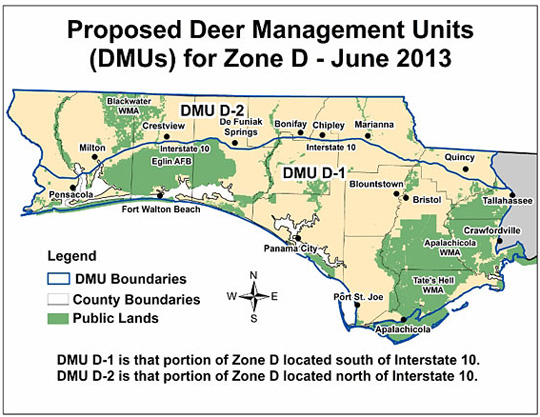
The Florida Fish and Wildlife Conservation Commission is continuing to study a proposal that would divide the state’s Hunting Zone D (from Pensacola to Tallahassee) into two deer management units (DMUs), each with its own unique set of deer antler-point regulations and antlerless deer harvest days.
These proposals for Zone D, which if passed at the April 2014 Commission meeting, would take effect during the 2014-15 hunting season and are part of a larger, statewide project aimed at managing deer on a more local level and providing stakeholders with a greater say in deer management. The Commission also directed staff to provide an update on this issue at the February Commission meeting.
 The FWC conducted a public outreach and input process in northwest Florida during the first three months of 2013. During that period, the Commission received input and comments from hunters, farmers and the general public regarding how they would like to see deer managed in the newly proposed DMUs.
As a result of this outreach process, the FWC is considering rule proposals for both public and private lands in both of the DMUs in Zone D, specifically north and south of Interstate 10. Currently statewide on private lands and most wildlife management areas, bucks that are legal to take must have at least one antler that is at least 5 inches long.
The proposals would require that bucks harvested north of I-10 in Hunting Zone D have antlers with at least three points (each point having to be at least 1 inch long) on one side. South of I-10 in Zone D, the minimum antler requirement would be two points on one side.
The proposal includes an exception to the antler requirements in both DMUs whereby youth 15 years old and younger may continue to harvest bucks with at least one antler that is 5 inches or more in length.
Also, the FWC is proposing a change to the antlerless deer season (“doe days”) on private lands within Zone D. Currently in that zone, the season to take deer of either sex (except spotted fawns) runs for seven consecutive days: Dec. 26 – Jan. 1. In the proposed rules, those dates north of I-10 would change to eight days distributed across four weekends (Saturday-Sunday after Thanksgiving, first weekend of muzzleloading gun season, third weekend of general gun season and the weekend after Christmas).
South of I-10, in Zone D, the proposal would change the antlerless season to four days consisting of two popular holiday weekends (the weekends after Thanksgiving and Christmas).
The purpose of modifying the antlerless deer season, the FWC said, is to spread out the hunting opportunity, so that more hunters may be able to participate without substantially reducing deer populations. These changes would be monitored to measure the impact on the deer harvest and hunter satisfaction within each DMU.
United Way Seeks Income Tax Prep Volunteers
December 29, 2013
United Way of Escambia County is seeking volunteers for the Volunteer Income Tax Assistance Program (VITA).
VITA volunteers provide free tax preparation help for those with low-to-moderate income. In 2013, 52 volunteers helped return over $900,000 in earned income tax credit and a total of over $2.8 million in refunds to 2,055 families in our community. The overall financial impact of this initiative was $3.3 million
VITA volunteers will:
- Volunteer in the role of either as a Tax Preparer or Greeter.
- Be able to commit to one to four hours per week from January 14th
- Receive IRS training and certification.
- Expand your knowledge of federal tax return procedures.
- Add a new skill to your resume.
- Receive CRA credit (for depository institutions only).
- Serve local citizens and help stimulate the local economy.
VITA site locations will include Pensacola State College (multiple campuses), Friendship Missionary Baptist Church, Central Credit Union (Spring Street branch) and St. Sylvester Catholic Church in Navarre. Sites will open January 14, 2014.
Training starts for volunteers in December for sites in Pensacola, Milton and Navarre. United Way will train tax preparers and greeters. The online portion of the training can be completed at the volunteer’s pace.
To become a VITA volunteer, call (850) 444-7128 or email name and contact information to lyndi@unitedwayescambia.org.
Half Cent Sales Tax Watchdog Group Elects New Chair
December 29, 2013

Alvin Wingate has been elected as chairperson of the Escambia County School District’s One-Half Cent Sales Tax Watchdog Committee for the current school fiscal year, and Ashley Bodmer has been elected vice chair.
The One-Half Cent Sales Tax Watchdog Committee is tasked with ensuring that all referendum funds are used for school capital projects such as the construction and support of Escambia County schools. The first five-year program was voter approved in 1997 followed by a second in 2002. In 2007, voters overwhelmingly voted for a 10-year extension of the tax. The One-Half Cent Sales Tax Watchdog Committee is charged with ensuring that only those projects voted for in the referendums are undertaken.
 Funds provided by this sales tax referendum built Blue Angels Elementary School and Global Learning Academy; provided many security enhancements; the modernization of several schools; continued HVAC and roofing updates as well as media centers and athletic facilities. Current sales tax funded projects include the reconstruction of Ernest Ward Middle School and A. K. Suter Elementary School.
Wingate has been a member of the committee since its inception in 1997.
The committee meets bi-monthly. The next meeting of the One-Half Cent Sales Tax Watchdog Committee is scheduled for January 16, 2014, 8:00 a.m., in the Superintendent’s Conference Room located in the McDaniel Building, 75 North Pace Blvd.
Pictured: The August groundbreaking for the reconstruction of Ernest Ward Middle School. NorthEscambia.com photos, click to enlarge.

Teen Injured In Byrneville Wreck
December 29, 2013
A teen was injured in a single vehicle accident Saturday afternoon on Byrneville Road near Neal Road.
 A 17- year old male reportedly lost control of his vehicle and struck a tree. He was transported to Sacred Heart Hospital in Pensacola by ambulance with non-life threatening injuries.
The 5 p.m. accident is under investigation by the Florida Highway Patrol. Further details have not yet been released. The Century Station of Escambia Fire Rescue and Escambia County EMS also responded to the accident.
Florida Lawmakers Send Message To Congress, Voters With Memorials
December 29, 2013
State lawmakers have often sent non-binding, declarative messages to Congress to score political point backs home, make demands on the federal government or publicize their opinions about hot topics.
Memorials considered by the GOP-controlled Florida Legislature over the past few years “ordered” Congress to build the Keystone pipeline, make BP pay for environmental cleanup from the Deepwater Horizon disaster, abolish the U.S. Department of Education and limit congressional terms.
Few of the proposals ever make it to Washington, D.C., where “there is a huge dumpster somewhere outside the U.S. Capitol where they throw all of our memorials,” former Florida Senate President Jeff Atwater once said.
And most of the measures, often replete with numerous “whereas” clauses and lofty-sounding titles, are ignored in Tallahassee as well. The memorials typically languish without a committee hearing in either chamber.
The 2014 Legislative session won’t be any different.
Mixed with the bills filed for the 2014 session are memorials that include the “Marketplace Fairness Act of 2013″ in support of a national retail sales tax (SM 196), a call for Congressional term limits (HM 81), and a request for Congress to enact federal immigration reform (HM 253).
Those measures are among 15 so far introduced for the 2014 session, about half the number typically filed in recent years.
Legislators “often propose things they know will not pass but do it to satisfy key constituents or fellow legislators in key positions – or soon to be in key positions,” said University of South Florida political science professor Susan MacManus.
One of the memorials (SM 476) filed by Rep. Alan Hays, R-Umatilla, calls for a convention to propose amendments to the U.S. Constitution that would limit the power of the federal government.
“It’s giving America, the average people, the right to control the legislation and the right to control the demagoguery that is coming from Washington,” said Sen. Greg Evers, R-Baker, in reference to Hays’ memorial. “It’s causing such a tremendous problem on the states and local government.”
Only two of 22 memorials filed during the 2013 session received legislative and gubernatorial support.
One (SM 1266) called for Congress and the President to award the Congressional Gold Medal to the U.S. 65th Infantry Regiment, the “Puerto Rican regiment” known as the Borinqueneers. The second (SM 1478) urged U.S. Homeland Security to hasten immigration applications for Haitians impacted by the 2010 earthquake seeking to join family members already in the U.S.
The main reason politicians use the memorials is to reaffirm their positions with local constituents, said Kevin Wagner, an associate professor of political science at Florida Atlantic University.
“Proposing legislation that they know cannot pass, or even if it passed would not be constitutional, is a simple way to attract voters,” Wagner said. “The fact that it is otherwise meaningless doesn’t really matter, and is actually a benefit, since there are no potential consequences to the bill.”
But Aubrey Jewett, an associate political science professor at the University of Central Florida, said there are a variety of less-cynical reasons legislators file proposals that have little hope of passing.
Lawmakers may want to bring attention to an issue or placate certain interest groups, Jewett said. Or they may repeatedly offer a memorial in the hope of building momentum, he said.
“Some legislators are just very passionate about certain issues and so bring them up over and over again regardless of the chance of passage because they really believe in them,” Jewett said.
by Jim Turner, The News Service of Floirda