

Poll: Florida Voters Are Ready For Medical Marijuana
May 6, 2014
Florida appears ready for medical marijuana.
A poll released Monday shows that 88 percent of Florida voters support allowing adults to legally use marijuana for medical purposes, bolstering the arguments of advocates who have placed a constitutional amendment on the November ballot seeking legalization.
 The poll, conducted by Quinnipiac University, indicates widespread support across political and demographic lines — Republicans and Democrats, men and women, young and old — for legal medical marijuana if it is prescribed by physicians. The constitutional amendment needs approval from 60 percent of voters to pass.
“If Vegas were giving odds on medical marijuana becoming legal in Florida, the bookies would be betting heavily,” Peter A. Brown, assistant director of the Quinnipiac University poll, said in a statement released with the results.
Support for the idea has grown slightly since a Quinnipiac poll in November 2013 indicated 82 percent of voters approved of legalization. Since that poll, a group spearheaded by prominent Orlando trial lawyer John Morgan finished gathering enough petition signatures to place the issue on this year’s general-election ballot and also received a sign-off from the Florida Supreme Court.
Attorney General Pam Bondi and Republican legislative leaders wanted the Supreme Court to block the constitutional amendment, contending that the proposal was far broader than billed. For example, House Speaker Will Weatherford, R-Wesley Chapel, described the proposal as being “about the Coloradofication of Florida, where the end game is a pot shop on every street corner.”
But the Supreme Court, in a 4-3 ruling, allowed the amendment to move forward, finding that the wording of the ballot title and summary would not mislead voters.
Despite the criticism of the ballot proposal, the GOP-dominated Legislature last week approved a bill aimed at making available a strain of marijuana that supporters say will help children who have a form of epilepsy that causes severe seizures. The substance, known as “Charlotte’s Web,” is low in euphoria-inducing tetrahydrocannabinol, or THC, so users do not get high.
The Quinnipiac poll found that legal use of medical marijuana was supported by 93 percent of Democrats, 89 percent of independents and 80 percent of Republicans. It was supported by 92 percent of voters ages 18 to 29 and 84 percent of voters ages 65 and older.
Connecticut-based Quinnipiac frequently conducts polls in Florida and other states. It surveyed 1,413 registered Florida voters from April 23 to April 28, and the poll’s margin of error was 2.6 percentage points.
by The News Service of Florida
Walker Awarded Tommy Weaver Memorial Scholarship
May 6, 2014
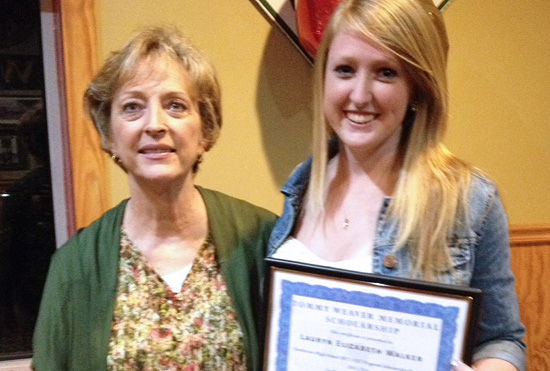
Northview High School senior Lauryn Walker has been awarded the Tommy Weaver Memorial Scholarship.
She will receive $500 upon enrollment in college. Applicants were required to fill out a brief application and write an essay explaining why the scholarship was important to them and how it would make it possible for them to continue their education.
Walker was awarded the scholarship recently during the annual Northview DCT banquet. The scholarship fund was established in memory of Tommy Weaver, DCT/Ag instructor and assistant coach who passed away in March 2012.
Pictured top: Tommy Weaver Memorial Scholarship Lauryn Walker with Northview Principal Gayle Weaver. Submitted photo for NorthEscambia.com, click to enlarge.
Three Injured In Nokomis Wreck; Cab Tore Off Pickup Frame
May 5, 2014
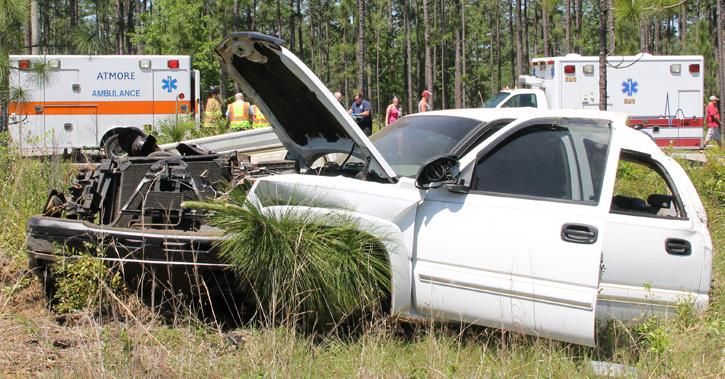
Three people were injured in a single vehicle accident in Nokomis Monday afternoon that tore the cab of a pickup truck off its frame.
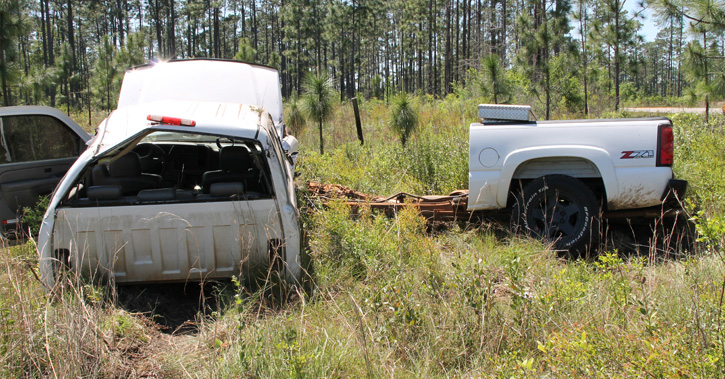 The accident happened about 1:30 p.m. on Nokomis Road near Jakes Road, about three miles west of Highway 97. The driver of a Chevrolet Silverado Z71 pickup truck apparently ran off the roadway, over-corrected and then overturned several times.
Three people were transported by ambulance to Atmore Community Hospital with injuries that were not considered serious.
The accident is under investigation by the Florida Highway Patrol; further details have not been released. The Walnut Hill Station of Escambia Fire Rescue also responded to the crash.
NorthEscambia.com photos, click to enlarge.
Wahoos Win Third In A Road, Takes Series Over Jackson
May 5, 2014
The Pensacola Blue Wahoos won the rubber match against the Jackson Generals on Sunday. The Wahoos (13-17) exploded offensively to win their third game in a row over the Generals (14-16). Brodie Greene led the game off with a home run in the top of the first inning and the Wahoos never looked back.
 RHP Mikey O’Brien made his first start of the season for the Wahoos. O’Brien had his longest outing of the year; he went 5.0 innings and gave up just one run. The right-hander struck out four batters and surrendered three hits. LHP Fabian Williamson was fantastic in relief of O’Brien, pitching 3.0 innings and giving up just one hit.
Greene went 3-for-6 with three RBI, including his first home run of the year. Bryan Anderson once again was a key component to the Pensacola offense. He went 3-for-4 with three RBI and hit his second triple of the season. Juan Silverio bounced back after a tough start to the series; he went 2-for-5 with an RBI. The Wahoos scored at least five runs so use the promo code WAHOOS and receive 50% off your entire order Monday at PapaJohns.com
Jackson’s Tyler Olson made his first ever Double-A start and the Wahoos hit him hard. Olson made it only 4.0 innings, giving up 10 hits and 6 R/ER. Moises Hernandez came on relief and steadied the ship for the Generals; he went 3.0 innings and gave up 1 R/0 ER. Jackson’s third baseman Ramon Moria had the only RBI on the evening for the Generals, a solo shot off of O’Brien.
The Wahoos will return to Pensacola Bayfront Stadium Monday to take on the Chattanooga Lookouts for a five-game home stand. RHP Daniel Corcino (2-3, 4.26) will head to the bump for the Wahoos in the first game of the series. The Lookouts have yet to determine their starting pitcher for Monday.
by Joey Truncale
Three Face Sentences In Brutal July 2013 Cantonment Beating
May 5, 2014
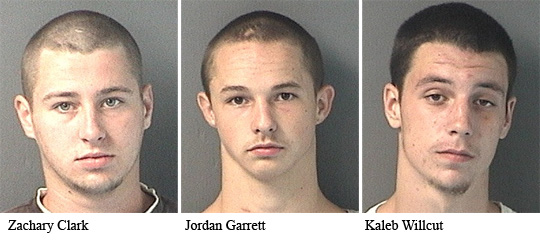
Three defendants have now either been convicted or entered pleas in connection with a severe beating over the Fourth of July 2013 weekend in Cantonment.
Jordan Scott Garrett, now 18, was convicted of felony aggravated battery Tuesday by an Escambia County jury. He will remain free on bond until a late June sentencing by Judge Gary Bergosh. Clark was a 17-year old juvenile at the time of the incident, but was charged as an adult.
Zachary Nathan Clark, now 20, pleaded no contest to felony aggravated battery. He remains free on bond as he awaits sentencing in late June.
Kaleb Orion Willcutt, now 16, was 15 at the time of the beating and tried as an adult. He was adjudged delinquent and sentenced to the Department of Juvenile Justice High Risk Program.
When Escambia County Sheriff’s deputies arrived at the home in the 700 block of Jacks Branch Road in July 2013 they found 19-year old Glenn Widish in the bathroom of the home, barely conscious, not able to talk and having difficulty breathing. Deputies reported his “face was swollen beyond recognition”.
Witnesses told deputies that the four teens were at the home, and Widish has been drinking shots of alcohol. Garrett became angry with Widish over a song that was playing and punched him three times in the face, witnesses told deputies. After Garrett punched Widish again, they ended up on the ground where Clark grabbed Widish and held him. Garrett also held Widish’s feet and they told Willcutt to hit him, an arrest report states.
Willcutt hit Widish three times, while Clark and Garrett began kicking and punching him in the head, face, back and stomach, the report states.
“I hope you die on this property,” a witness told deputies Willcutt said.
Widish was transported by ambulance to Sacred Heart Hospital as a “trauma alert”. Deputies were originally unable to speak to him because he remained unconscious at a Sacred Heart Hospital. He suffered a fractured eye orbital, a fractured nose and was unable to maintain on open airway after the beating, according to the arrest report.
Photo Gallery: Shrek The Musical
May 5, 2014


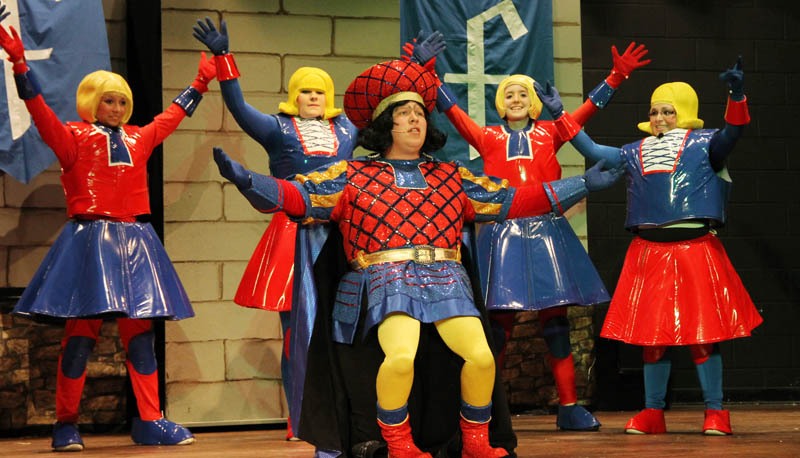
Northview High School presented two performances of Shrek the Musical over the weekend. The musical was based on the Oscar winning DreamWorks film that started it all, bringing the hilarious story of everyone’s favorite ogre to life on stage.
The production starred Cory Hester as Shrek, Anna Donald as Fiona, Kendrick Walker as Donkey, Kent Smith as Farquaad and host of other Northview students.
For a photo gallery, click here.
NorthEscambia.com photos, click to enlarge.

NorthEscambia.com Publisher Named One Of Area’s Most Influential People
May 5, 2014
The Pensacola Independent News has released their 2014 IN Power List — their ranking of the most the most powerful and influential people in the Pensacola area.
Only two people that work primarily in the North Escambia area were named to the list — NorthEscambia.com publisher William Reynolds of Walnut Hill at number 65 and Escambia County Commissioner Steven Barry of Cantonment at number 38.
Topping this year’s list was attorney Mike Papantonio.
- For the Independent News story about the IN Power List, click here.
- For the complete list, click here.
West Florida Softball Headed To State Semi’s (With Photo Gallery)
May 5, 2014

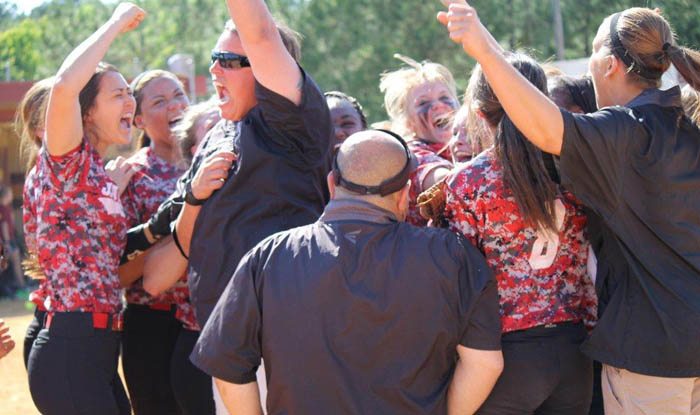
The West Florida Lady Jaguars made school history Sunday, earning the teams first ever trip to a state softball tournament. The Lady Jags earned the state berth with a tight 2-1 Region 1-4A championship win over West Nassau.
 Korina Rosario pitched the win for the West Florida in seven, with two walks, one run and three strikeouts.
Rosario was 2-3 with walk; Kristin Gunter was 2-4 with a double and RBI; Ali Cutaio went 1-3 with a double; Jibrasha Moore was 1-3 with a sacrifice bunt; Breana Roger went 1-3; Emily Loring was 1-3 with the winning RBI.
The West Florida Lady Jaguars will play the Gulliver Preparatory Raiders in the 4A semifinals on Wednesday. The game begins at 10:35 a.m. Eastern at Historic Dodgertown in Vero Beach. Admission is $9 per person, and parking is $8. The winner advances to a Thursday morning state championship game against either P.K. Yonge or Mulberry.
Pictured top: The West Florida High School Lady Jaguars won the Region 1-4A championship Sunday near Jacksonville. Pictured: the Lady Jags celebrate. NorthEscambia.com photos by Gary Carnley, click to enlarge.
One Dead, One Injured In Escambia Shooting
May 5, 2014
A Saturday night double shooting left one person dead in Escambia County.
 The shooting occurred around 10 p.m. in the Pleasant Grove community on Silver Creek Drive. The woman reportedly shot her husband before turning the gun on herself. She was later pronounced deceased at an area hospital, while the man’s injuries were not considered life threatening.
The names of the victims and further details have not been released.
Funeral Services Held For Jail Explosion Victim
May 5, 2014
One of the two victims of last week’s explosion at the Escambia County Jail was laid to rest Monday afternoon. Robert Earl Simmons, age 54 of McDavid, died in the blast that injured 184 others.
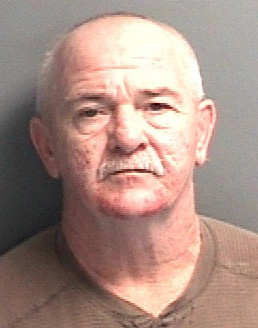 Simmons was a native of Century and lifetime resident of the area, having worked in the construction injury.
He was arrested on multiple felony animal cruelty charges on January 14. He was being held without bond due to an alleged probation violation in a 2012 grand theft and trespassing case. He was due in court for probation violation hearing on May 2 — just two days later after the explosion – to determine his possible bond eligibility.
He is survived by his mother, a son, a daughter, a stepdaughter and numerous other relatives. Graveside services for Robert Earl Simmons were held Tuesday afternoon at Ray’s Chapel Baptist Church in Bogia.