

Wahoos Snap Streak, Defeat The Mobile Baybears 4-0
July 8, 2014
The Pensacola Blue Wahoos (7-12, 38-51) snapped a three-game losing streak to the Mobile BayBears (12-7, 54-34) with a 4-0 win in game four of the series at Hank Aaron Stadium. RHP Robert Stephenson earned his first win in a month as he held the BayBears scoreless over 6.0 innings of work.
 Stephenson struck out six batters and surrendered just five hits in his final start before he heads to the All-Star Futures Game in Minnesota. Stephenson’s Futures Game teammate, Jesse Winker, provided a big two-run double in the 6th inning that stretched Pensacola’s early lead to 4-0.
The Wahoos jumped out to an early lead after Yorman Rodriguez reached third base on Brodie Greene’s bunt-single down the line that forced a throwing error from BayBears’ third baseman, Jake Lamb. The bunt-single stretched Greene’s on-base streak to 11 straight games. Ryan Wright hit a sacrifice fly to center to score Rodriguez and the Wahoos never looked back on the way to their streak-snapping victory.
Greene, Winker and Seth Mejias-Brean all finished with multi-hit games for the Wahoos. Travis Mattair finished the game 1-for-3 and added an RBI to his ledger.
The bullpen continued their streak of good pitching with three scoreless innings of relief. RHP Carlos Gonzalez pitched a scoreless seventh inning in his first appearance off of the disabled list and LHP Fabian Williamson followed with a perfect eighth. RHP Shane Dyer allowed a hit and a walk, but struck out Sean Jamieson to end the game.
RHP Justin Fitzgerald took just his second loss of the season for the BayBears. He went 5.1 innings and allowed 4 R/3ER on four hits while walking four Wahoo batters.
The Wahoos will send RHP Ben Lively (0-1, 2.93) to the mound for the series finale on Tuesday night. Lively will be opposed by RHP Michael Lee (5-4, 4.15).
by Tommy Thrall
Driver Flips Vehicle On Highway 97 Near Davisville
July 7, 2014
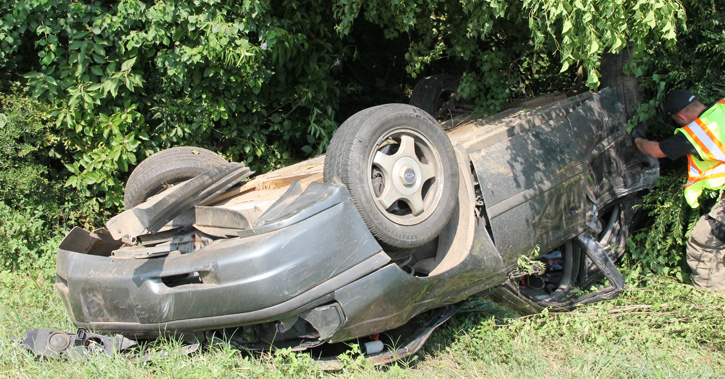
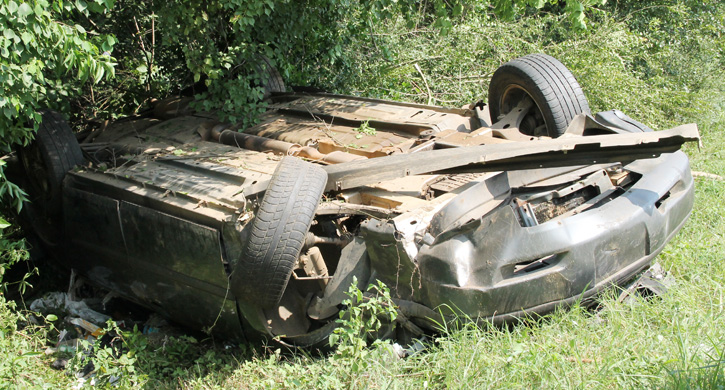
One person was injured in a single vehicle rollover accident Monday afternoon in Davisville.
The accident was reported about 2:50 p.m. on Highway 97 just north of Highway 4. The driver of a car lost control and flipped into a ditch, with the vehicle coming to rest upside down in partial wooded area.
The driver was not seriously injured.
The accident is under investigation by the Florida Highway Patrol. The Walnut Hill Station of Escambia Fire Rescue, Atmore Ambulance and Escambia County Sheriff’s Office also responded to the call.
NorthEscambia.com photos, click to enlarge.
Supreme Court Rules In Escambia Case: Car’s Color Not Enough For Traffic Stop
July 7, 2014
A divided Florida Supreme Court has overturned the conviction of an Escambia County man who was found to have cocaine and marijuana after a deputy pulled him over based on the color of his car.
The case stemmed from an Escambia County Sheriff’s deputy in June 2010 running the license tag number on a bright green Chevrolet through a state database. The database indicated the car had been registered as being the color blue, an inconsistency that led the deputy to pull over the car.
During the stop, the deputy noticed the smell of marijuana, leading to a search of the car that turned up marijuana, crack cocaine and cash.
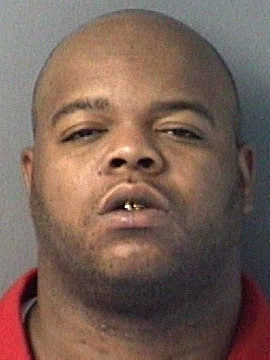 The driver of the car, Kerrick Teamer, was later convicted of trafficking in cocaine, possession of marijuana and possession of drug paraphernalia, according to the Supreme Court ruling.
Teamer sought to suppress the drug evidence, arguing it was the result of an illegal, warrant-less search.
The 1st District Court of Appeal sided with Teamer, and the Supreme Court in a 5-2 ruling agreed that the evidence should have been suppressed.
The majority said changing the color of a car is not “inherently suspicious” enough to justify a stop by police and that it is not illegal to repaint a vehicle without notifying the state Department of Highway Safety and Motor Vehicles.
“The law allows officers to draw rational inferences, but to find reasonable suspicion based on this single noncriminal factor would be to license investigatory stops on nothing more than an officer’s hunch,” said the majority opinion, written by Justice Peggy Quince and joined by Chief Justice Jorge Labarga and justices Barbara Pariente, R. Fred Lewis and James E.C. Perry.
“Doing so would be akin to finding reasonable suspicion for an officer to stop an individual for walking in a sparsely occupied area after midnight simply because that officer testified that, in his experience, people who walk in such areas after midnight tend to commit robberies.”
But Justice Charles Canady, in a dissent joined by Justice Ricky Polston, wrote that a “reasonable officer” could have suspected that the license tag had been illegally transferred from another car. “The majority is wholly unjustified in categorizing an undeniably objective factor as a hunch,” Canady wrote.
by The News Service of Florida
FWC Law Enforcement Report
July 7, 2014
The Florida FWC Division of Law Enforcement reported the following activity during the weekend ending July 3.
The “Operation Dry Water” campaign launched over the past week. Northwest Regional officers focused on boating safety education and awareness on drinking and boating. Throughout the campaign, officers inspected 901vessels and contacted 2,510 citizens taking an educational approach. There were 36 boating citations issued and 152 boating safety warnings issued. Six arrests for BUI were made.
ESCAMBIA COUNTY
 Officers Cushing and Miller were working boating safety in the Intracoastal Waterway. The officers noticed an approaching boat with fishing gear commonly used for reef fish. Upon stopping and completing a boating safety inspection, the officers conducted a fisheries inspection. Officer Miller located a bag of freshly filleted red snapper in a cooler. Of these fillets, two appeared to have been from an undersized red snapper. Due to the fish not being landed in whole condition, the officers were unable to determine the actual size. The subject was issued a notice to appear for failure to land in whole condition.
Officer Livesay was on vessel patrol in Pensacola Bay when he checked a person that was fishing from a vessel. While performing a fisheries and boating safety check, the fisherman asked Officer Livesay what the size limit on flounder was. He claimed he had only one fish on board and it was a flounder. Officer Livesay checked the flounder, which was legal, but further inspection of the vessel revealed an undersized red snapper in the live well. Officer Livesay issued a notice to appear citation for the violation.
This report represents some events the FWC handled over the past week;however, it does not include all actions taken by the Division of Law Enforcement. Information provided by FWC.
$66.5 Million In Disaster Assistance Paid Out; Application Deadline Extended
July 7, 2014
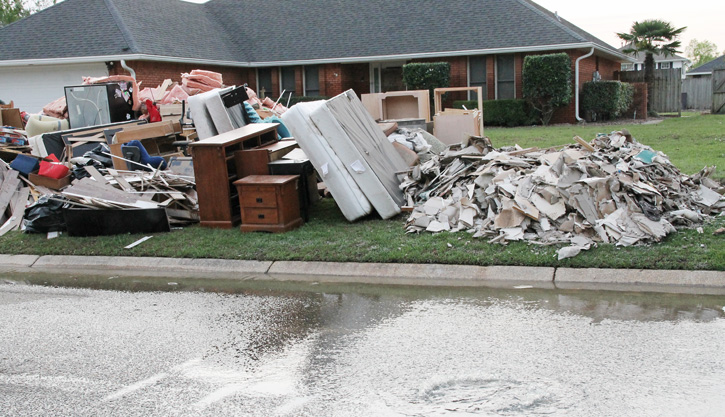
Sixty days after a violent storm system brought massive flooding to Northwest Florida, $66.5 million in disaster assistance has been approved to help homeowners, renters and business owners recover. And now, FEMA has extended the deadline to apply for assistance.
Residents affected by the storms and flooding from April 28 to May 6 in Escambia, Santa Rosa, Okaloosa, Jackson and Walton counties have until Monday, July 21, to register for disaster assistance with the Federal Emergency Management Agency.
Survivors can register online at DisasterAssistance.gov or at m.fema.gov on a smartphone. Survivors may also apply by phone at 800-621-3362 or TTY 800-462-7585.
More than 14,200 survivors have been in touch with FEMA seeking help or information on disaster assistance following what local officials called the worst flood in this part of the state in decades.
Since the May 6 disaster declaration, more than $32.1 million in Individual Assistance has helped more than 6,600 homeowners and renters who were affected by the spring storms and flooding. This includes more than $26.6 million in rental expenses and essential home repairs, and nearly $5.5 million to help cover other essential disaster-related needs, such as medical and dental expenses and lost personal possessions.
In addition, the U.S. Small Business Administration has approved more than $34.4 million in low-interest disaster loans for qualified homeowners, renters, businesses of all sizes and private nonprofit organizations.
The Public Assistance cost-share program may also be available to reimburse state agencies, local governments and certain private nonprofit organizations. These reimbursements can help pay for debris cleanup, repairs to damaged facilities and infrastructure, and for costs incurred in protecting lives and property during the floods. The program also provides mitigation funds to help rebuild infrastructure that is better able to withstand future storms.
In addition to state and federal disaster assistance programs, survivors have benefited from a wider array of disaster services and resources, including disaster unemployment assistance, free legal services, disaster-related stress help and guidance on flood insurance.
FEMA is continuing to work with state and local partners to connect survivors to recovery resources in their communities. Survivors who need extra help are encouraged to call Florida’s 2-1-1 information helpline or visit HelpNWFLrecover.org.
Several voluntary agencies, local community- and faith-based organizations and other nonprofit groups are working with survivors to help them tackle their longer term needs. Among these voluntary agencies are the American Red Cross, United Way, Volunteer Florida, Operation Blessing, Florida Baptists and Samaritan’s Purse.
West Florida’s Bedenfield Named Florida FFA Area Vice President
July 7, 2014
Jacobi Bedenfield of the West Florida High School FFA was elected as the 2014-2015 Area 1 State Vice President of the Florida FFA during the group’s annual convention in Orlando.
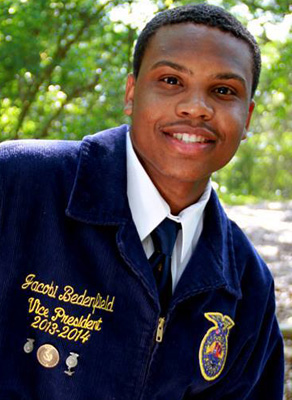 “I strive for service. Living to serve is something that I live by. I want to lead the members of Florida FFA in order to make a difference in their lives and communities. I want to guide members to premier leadership, personal growth, and career success,” Bedenfield said during his campaign.
Bedenfield and fellow West Florida High FFA member Xavier McKeon were the only two students from Florida FFA Area 1 to make it through the screening process in order to become state officer candidates. McKeon also ran for the Area 1 State Vice President position.
Wahoos Fall To Mobile
July 7, 2014
The Mobile BayBears got a bases loaded single in the bottom of the 10th to finish off their third straight win over the Blue Wahoos, 5-4, Sunday evening at Hank Aaron Stadium in Mobile. Tim Adleman made a spot start for Pensacola and fanned a career high eight batters over 5.0 innings in a no-decision. He allowed just one run in his first start of the year.
 Pensacola battled from behind on three different occasions to tie the game, but never could take the lead. Pensacola forced extra innings with some good luck. Jesse Winker’s fly ball to right-centerfield looked to be routine, but as BayBears centerfielder Evan Marzilli got to the ball, he slipped and the ball landed behind him for a double. Winker ended up scoring on a wild pitch and throwing error by the catcher. The double was one of two for the Blue Wahoos left fielder on the night.
Ryan Wright paced the offense for Pensacola with a 3-for-5 game. He also added an RBI. Kyle Waldrop had the Blue Wahoos other multi-hit effort with a 2-for-4 night.
Drew Hayes (L, 4-3) allowed the winning run in the 10th to suffer the loss. He allowed 1 R/ER on three hits over 1.1 innings. Willy Peredes (W, 4-1) picked up the win for the BayBears after working a scoreless 10th inning. Diamondbacks top prospect Archie Bradley took a no-decision after giving up 1 R/ER over 5.1 innings. He walked two and struck out three.
Pensacola looks to snap their three-game skid on Monday night with RHP Robert Stephenson (3-6, 4.24) on the mound against BayBears RHP Justin Fitzgerald (7-1, 4.04). First pitch is slated for 7:05 p.m. at Hank Aaron Stadium.
by Tommy Thrall
Sheriff’s Office Neighborhood Watch Academy Accepting Applications
July 7, 2014
Applications are now being accepted for a July 15 Neighborhood Watch Academy from the Escambia County Sheriff’s Office.
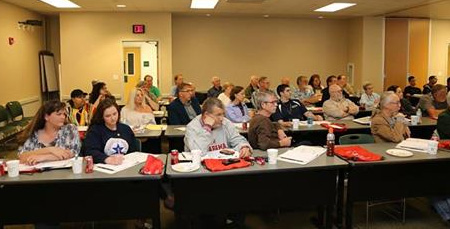
The one-evening seminar begins with a complementary meal at 5:00 and ends at 9 p.m. The event is meant for those that may wish to start a neighborhood watch group, or those that simply just want to learn how to be less likely to be a victim of crime. Much of the curriculum covers basic safety and security tips for the home, anonymous reporting and crime prevention through environmental design.
For more information or to register, call David Craig in the ECSO Community Services Unit at (850) 436-9281 or email gcraig@escambiaso.com. The seminar will be held in the Escambia County Sheriff’s Office Administration Building at 1700 West Leonard Street.
Hynes Completes Basic Training
July 7, 2014
Air Force Airman Joshua C. Hynes graduated from basic military training at Joint Base San Antonio-Lackland, San Antonio, Texas.
The airman completed an intensive, eight-week program that included training in military discipline and studies, Air Force core values, physical fitness, and basic warfare principles and skills.
Airmen who complete basic training earn four credits toward an associate in applied science degree through the Community College of the Air Force.
Hynes is the son of Michael Hynes of Pensacola.
He is a 2011 graduate of the West Florida High School.
Bratt Basketball Camp Begins Monday With Former NBA Coach
July 6, 2014

The First Baptist Church of Bratt will host a basketball camp this week with a former NBA, college and high school coach.
 The camp for children ages 8-14 will be held July 7-11 from 9 a.m. until noon at the church. Coach Roger Dutremble of Global Sports Outreach will teach kids the fundamentals of basketball and Biblical awareness.
“We are fortunate to get someone of Coach Roger’s talents and achievements to head up this camp” said First Baptist Bratt Student Pastor Tim Hawsey. “He has a unique ability to deal with children, and his love for them is evident.” This is the third year the church has offered this camp.
Dutremble is a a retired coach and member of the International Basketball Hall of Fame. He career includes coaching at every level from high school to the NBA, and into international arenas, with a lifetime coaching record of 687-117 and seven national championships. He was selected “Coach of the Year” six times, and served as national team head coach to Belgium, Scotland, and Jordan. He was an assistant coach for the Los Angeles Lakers, serving under Paul Westhead and Pat Riley, from 1979-83 and helping the team to three NBA championships with players like Magic Johnson and Kareem Abdul-Jabbar.
The cost is $45 per student with a limited number of scholarships available. The funds are used exclusively to purchase shoes and basketballs for needy children in other countries where Detremble conducts camps.
For more information, contact Hawsey at (850) 327-6529, church secretary Sherrye Gilman at (850) 327-6529 or stop by the church on Highway 4 just west of Northview High School.
Pictured: Students that participated in a previous basketball camp at the First Baptist Church of Bratt. Inset: Coach Roger Dutremble of Global Sports Outreach. NorthEscambia.com file photo, click to enlarge.