

Florida Workers Comp Rates Could Be Trimmed
August 26, 2014
Florida employers could see the first overall reduction in workers-compensation insurance rates in four years.
An overall 2.5 percent decrease has been proposed by the National Council on Compensation Insurance, the state announced. The decrease is expected to be discussed during a public hearing in October.
Manufacturers could see the biggest drop, 3.2 percent, under the proposal. The contracting industry is lined up for a 2.9 percent decrease, and office and clerical services would get a 1.3 percent drop, according to a statement from NCCI.
The proposal, if approved by the state Office of Insurance Regulation, would take effect in January. Last year, the overall rate grew 0.7 percent, which was slightly lower than a proposed 1 percent increase. The approval followed annual increases of 6.1 percent, 8.9 percent and 7.8 percent in the three previous years.
by The News Service of Florida
Florida, Alabama Officers Pledge To Crack Down On Drunk, Unsafe Driving
August 26, 2014
 Law enforcement agencies from Florida and Alabama met Monday at the I-10 Florida Welcome Center to mark the kickoff of the “Hands Across the Border” campaign toe promote safe Labor Day driving.
Drunk driving is one of America’s deadliest crimes – in 2013, there were nearly 1,000 alcohol related fatalities across Florida, according to Florida’s Department of Transportation.
Officers both states pledged Monday to work together this holiday weekend to ensure drivers are maintaining safe speeds, not drinking and driving and always using their safety belts.
“Every year, and every holiday weekend, we continue to see far too many people suffer debilitating injuries and loss of life as a result of impaired driving,” said Tim Roberts, Florida Law Enforcement Liaison representative for the Drive Sober or Get Pulled Over campaign. “This careless disregard for human lives must stop, which is why Florida and Alabama’s law enforcement agencies will be arresting impaired drivers wherever and whenever they find them during the Labor Day holiday.”
Photos for NorthEscambia.com, click to enlarge.

Northwest Escambia Chiefs Open Play In Excel Jamboree
August 26, 2014


Results were as follows:
Freshman Team
Lost vs. Excel
Won vs. Neal
Sophomore Team
Lost vs. Excel
Lost vs. Neal
Junior Team
Lost vs. Excel
Won vs. Neal
Senior Team
Won vs. Excel
Won vs. Neal
The regular season for the Northwest Escambia Chiefs (formerly the Eagles) will open August 30 at Flomaton with games at 4 p.m., 5:15 p.m., 6:45 p.m., and 8:15 p.m. The Chiefs won’t play their first home games in Northview’s Tommy Weaver Memorial Stadium on Saturday, September 13.
Submitted photos for NorthEscambia.com, click to enlarge.


Wahoos Lose To Biscuits
August 26, 2014

Kyle Waldrop became the first Pensacola Blue Wahoos player this season to earn the Southern League’s Player of the Week honors Monday.
As if that wasn’t enough, Waldrop lined a double to centerfield that scored Yorman Rodriguez and tied him for the franchise record of seven consecutive games with an RBI.
The Pensacola Blue Wahoos (56-78), though, failed to overtake the Montgomery Biscuits (64-70) and lost, 4-3, Monday in front of 3,074 fans at Pensacola Bayfront Stadium. The last home game of the regular season starts at 6:30 p.m. Tuesday.
Waldrop has been on a hitting tear and for the week ending Sunday, August 24 was recognized as the league’s top player by Minor League Baseball. During the week, the left-handed hitter batted .533 (16-for-33) with two home runs, three doubles and a triple and a slugging percentage of .900.
 “I’ve always felt in the second half I’ve done well,” Waldrop said. “‘Finish strong is my motto. I’m more patient and looking for a certain pitch to put good swings on the ball.”
The 22-year-old Waldrop now has an eight-game hitting streak, including six multi-hit games. Over the past week, he has raised his average 37 points to .309. His average is tops on the team and his 33 RBI leads the team since the All-Star break.
“He’s a solid hitter,” said Walt Jocketty, the Cincinnati Reds president of baseball operations and general manager, who was visiting Pensacola. “He’s proven he can come up here and make adjustments. If he does that, he will keep moving up.”
The left-handed hitting Waldrop was part of a group of seven High-A Bakersfield players who joined the Wahoos after the All-Star break. He was leading the California League with a .359 average.
Pensacola Manager Delino DeShields said Waldrop impressed him the most among the Bakersfield seven.
“Of all those guys, he was the most ready coming in and it shows,” DeShields said. “He was swinging the bat that way in Bakersfield and is making the adjustments faster than the others.”
Waldrop isn’t the only hot-hitting Blue Wahoos player. Yorman Rodriguez also is swinging a big stick, smacking a solo home run to right field Monday to go along with two doubles and a single in a 4-4 night and he scored all three Wahoos runs.
Rodriguez smacked home runs in three straight games against the Jacksonville Suns in the last series and now has nine homers on the year. In addition, the 22-year-old outfielder has an 11-game hitting streak, hitting .486 (18-37) with four home runs and 11 RBI.
The Venezuelan said through interpreter Yovan Gonzalez, the team’s catcher, that he has been taking extra hitting in the batting cages and working with hitting coach Alex Palaez.
“I’m throwing my hands hard through the ball and I’ve been successful doing that,” Rodriguez said. “I’m also being more patient, especially as the leadoff hitter.”
DeShields praised both Rodriguez and Waldrop for their hot hitting lately.
“They’re both playing at a high level right now,” he said.
The final home game of the 2014 season is against the Tampa Bay Rays Double-A affiliate the Montgomery Biscuits and gets underway at 6:30 p.m. Tuesday. RHP Michael Lorenzen (4-6, 3.09) takes the mound for the Wahoos and is scheduled to be opposed by the Biscuits RHP Victor Mateo (12-9, 3.61).
by Tommy Thrall
Firefighters Battle Shed Fire
August 25, 2014

Fire destroyed a storage shed at a home near Walnut Hill Monday afternoon.

A shed located in the front yard of a home in the 3600 block of Seals Road was reported to be engulfed in flames about 5:25 p.m. The approximately 10×20 shed had burned to the ground by the time the first firefighters arrived minutes later.
There were no injuries and no damage to any other structures.
Pictured top: Firefighters pull a hose line to begin fighting shed fire Monday afternoon near Walnut Hill. Pictured below: The shed was already on the ground when firefighters arrived. NorthEscambia.com photos, click to enlarge.

Man Missing Since Saturday Found Alive
August 25, 2014

A man missing Saturday has been found alive, according to the Escambia County Sheriff’s Office. Randal “Randy” Malikowski “was safely located this afternoon”at Blue Angel Parkway and Dog Track Road in Escambia County, according to a statement from the Sheriff’s Office. He was reportedly found disoriented, but otherwise his condition is unknown. Escambia County EMS was called to the scene to evaluate him. Further details have not been released.
An earlier version of this story is below.
The Escambia County Sheriff’s Office is asking for the public’s help in locating a missing man.
Man Arrested On Drug, Weapons Charges; Pair Charged With Child Abuse
August 25, 2014
A Molino man has been arrested on several drug and weapons charges. And he’s also charged, along with a woman, for allegedly smoking marijuana and leaving their stash within the reach of a child.
 The Escambia County Sheriff’s Office responded to Countri Lane for a welfare check on a woman that had not been seen in a few days. Deputies found Shawn Anderson sitting in the driver’s seat of a 2000 Crown Victoria in the driveway of the home, and they reported a strong odor of burning marijuana from the car.
A search of the vehicle revealed a bag containing 26 grams of marijuana within hands-reach of a child sleeping in the backseat, a .25 caliber pistol loaded with hollow rounds, digital scales with marijuana residue, sandwich bags, rolling papers, two marijuana roaches and $462 in cash, according to an arrest report.
Anderson and a female that had just exited the vehicle, 28-year old Tiffany Potter, admitted to deputies that they had been smoking marijuana in front of the child, deputies said.
Anderson was charged with felony possession of a firearm by a convicted felon, possession of ammunition by a convicted felon, possession of marijuana over 20 grams, possession of marijuana with the intent to distribute, possession of drug paraphernalia and child abuse without great bodily harm. He was released from the Escambia County Jail on a $20,500 bond.
Potter was charged with felony child abuse without great harm and released from the Escambia County Jail on a $5,000 bond.
Escambia Firefighters, EMS Crews Work To Keep School Zones Safe
August 25, 2014

Escambia County Fire Rescue and Escambia County EMS units were in school zones across the county with lights flashing as a reminder to drivers to slow down during the first week of school. In an email to NorthEscambia.com, Jim Allen Elementary School offered a special thanks to the crew of Escambia Fire Rescue Engine 4 (pictured) in Cantonment for slowing down the traffic on Highway 95A to help keep students safe. Photo for NorthEscambia.com, click to enlarge.
Escambia, Santa Rosa Farm Bureaus Donate 1.5 Tons Of Peanut Butter To Manna
August 25, 2014
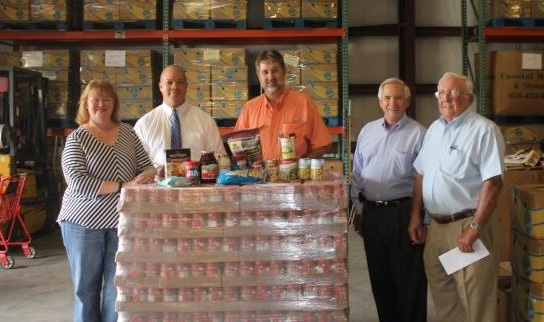
The Florida Peanut Producers and the Farm Bureau in Escambia and Santa Rosa counties teamed up to donate one and a half tons of peanut butter to the Manna Food Bank.
 After discussing the flood that damaged the Manna warehouse and food supply, the Escambia County Farm Bureau voted to spend $1,000 to buy peanut butter, Manna’s most needed item. The Santa Rosa County Farm Bureau board then voted to donate $1,001 toward the peanut butter donation.
When notified of the purchase of peanut butter, the board of directors of Florida Peanut Producers and Ken Barton, executive director and agreed to match the purchase and donated a pallet of peanut butter.
With the two counties cooperation and the match from the Florida Peanut Producers, the total number of peanut butters jars donated will be 2,880. The second of two pallets of Peanut Proud peanut butter is expected to ship later in August to complete the donation.
Stafford: Election Day Tips
August 25, 2014
Supervisor of Elections David H. Stafford offers Escambia County voters the follow tips to prepare for Tuesday’s primary election day:

- Confirm the location of your polling place prior to Election Day: check your sample ballot, voter information card, EscambiaVotes.com, or call 595-3900.
- If you are unsure of your registration status, check EscambiaVotes.com, e-mail soe@escambiavotes.com, or call 595-3900.
- If you need to update your address, contact the elections office prior to Election Day so you can be directed to your proper polling location.
- Photo and signature ID is required for all voters – if you do not present an approved form of ID, you may vote a provisional ballot.
- Be sure to review your sample ballot prior to Election Day in order to familiarize yourself with all of the contests. A sample ballot was mailed to voters, and you can view your sample ballot online at EscambiaVotes.com.
- Voters are encouraged to study and mark their sample ballot and bring it with them to the polls to expedite the voting process.
- Remember to make only one selection per contest on your ballot.
- Registration books closed on July 28 – new registrations for this election may not be made at the polls.
- You may not return your voted absentee ballot to your precinct on election day – it must be returned to the elections office by 7 p.m.
- If you requested an absentee ballot but chose not to return it and wish to vote at your polling place instead, please bring your ballot with you so it can be cancelled.
- Early voting ended Saturday – if you have not yet voted or did not request an absentee ballot by August 20, you must go to your designated precinct on election day.
- Busiest times at the polls tend to be 7:00 a.m. until 9:00 a.m., during lunch, and 4:30 p.m. until the polls close at 7:00 p.m.
- For further information, please contact us by phone at (850) 595-3900, e-mail us at soe@escambiavotes.com or visit www.EscambiaVotes.com.