
Wahoos Win Record Sixth Straight
July 14, 2015
The Pensacola Blue s set franchise records Monday night by winning its sixth game in a row and sweeping its first five-game series.
Not only that, Pensacola is now 11-7 in the second half of the Southern League season and in sole possession of first place in the South Division. The last time the Blue Wahoos were in first place this late in the season was July 22, 2012.
The Blue Wahoos defeated the Montgomery Biscuits, 6-2, on Monday in front of 4,143 at Pensacola Bayfront Stadium.
 How have they turned around a last place team in the first half to a first place team in the second half?
Pitching and defense, says Blue Wahoos manager Pat Kelly.
“All along I have thought this was a good ball club,” Kelly said. “Pitching and defense wins this league.”
During the first half, Pensacola finished in last place at 25-43 and 18 games behind the Biloxi Shuckers, who were 43-25. Kelly has said that Biloxi is the only team that he thought was better than Pensacola, winning eight of 10 games against the Blue Wahoos to start the year.
They face the hottest team in the Southern League North Division next — the Birmingham Barons. After winning, 2-0, over Jackson Generals Monday, the Barons are 14-3.
“They may be hotter than us,” Kelly said of the Barons. “It’ll be a good test for us. Our motto has been to win every series.”
Pitching and defense beat the Biscuits Monday night.
Tim Adleman earned his fourth win in a row and improved to 6-6 on the season with a 1.95 ERA. He allowed a solo home run by Montgomery catcher Justin O’Conner. In seven innings he gave up five hits, one walk and struck out five.
In his past four games, Adleman has allowed three earned runs in 28 innings for a 0.96 ERA. He also has given up 20 hits, four walks and struck out 24.
Plus, the Blue Wahoos turned three double plays and leads the Southern League with 102 double plays total.
Pensacola utility infielder Ray Chang, who is batting .323 this season, says player development is great but winning is even better. He endured a 59-79 record in 2013 and 60-80 in 2014.
“It feels great,” Chang said. “Throughout my career, I have not been a part of too many winning clubs. The last two years were rough. To start off the way we have in the second half gives the fans something to cheer about. It has been awesome.”
Pensacola catcher Kyle Skipworth hit his third homer in three games and fourth in six when he launched a bomb to straight away center field that scored three runs and put the Blue Wahoos ahead, 3-1, in the fourth inning.
“We’re just enjoying it right now,” said Skipworth, who said he didn’t want to know how many games the team has won in a row.
Adleman, the Blue Wahoos mainstay in the rotation this year, said he hopes to keep winning.
“It would be nice to win the second half and send the Blue Wahoos to the playoffs,” he said. “It would be fun, a lot of fun.”
Pensacola’s main closer Zack Weiss, who has a team-leading nine saves, added: “We just want to be competitive and give ourselves a chance to make the post season. It’s nice to get rolling. We’re not thinking about the first half.”
After second baseman Zach Vincej singled to lead off the first inning for Pensacola, Montgomery right-hander Austin Pruitt struck out five of the next six batters between the first and second innings.
Vincej also scored during a three-run eighth inning on a double into the left field corner by third baseman Marquez Smith. Vincej singled in three at bats to extend his hitting streak to eight games. He’s batting .444 (12-27) over that span.
The 24-year-old is hitting .248 this season, raising his average from .210 on July 2. This series against Montgomery, Vincej went 7-14 or .500 with three runs, one RBI and a walk.
No matter what happens, Kelly said he likes this team.
“At no time do they quit,” he said. “They always play hard.”
The Blue Washoos start a five-game series at 7:05 p.m. Wednesday, July 15-19 with the Chicago White Sox Double-A affiliate Birmingham Barons. Pensacola returns home to host a two-game series at 6:35 p.m. Monday, July 20-21 with the Miami Marlins Double-A affiliate Jacksonville Suns.
Police: Missing, Endangered Flomaton Teen Found Safe
July 13, 2015

A Flomaton teenager reported missing over two weeks ago has been found.
 Jasmine Nicole Smith, 16, was located about 3:00 this afternoon in Central Alabama, according to Flomaton Police Chief Bryan Davis. He declined to release complete details, but Davis said the girl is “fine” and in good condition. Davis said additional details will be released later by Flomaton Police.
Smith was reported missing from her residence in Flomaton on June 27. On July 9, police upgraded the case from a runaway to missing/endangered status after receiving information from a family member that the teen was in physical danger. Flomaton Police warned July 8 that because Smith is a juvenile, anyone harboring her without the consent of a parent “is committing a crime and will be prosecuted”.
Highway 97 Temporary Bridge Nears Completion
July 13, 2015

Work is nearing completion on a temporary bridge in Walnut Hill, part of the replacement of a 75-year old Highway 97 bridge over Little Pine Barren Creek in Walnut Hill.
 Last week, the approach lanes to the temporary bridge were paved, after months of work that began on the structure at the end of March.
The work is part of a $2.5 million contract which consist of replacing the existing structurally deficient bridge, including roadway reconstruction, milling and resurfacing, guardrail, drainage, new signs and pavement markings. Drivers will utilize a temporary roadway and bridge during construction of the new bridge. Work is anticipated to be completed in the spring of 2016. No overweight loads will be permitted onto the temporary bridge (loads weighing over 88-thousand pounds).
The bridge is located at the intersection of Wiggins Lake Road, about one mile north of Ernest Ward Middle School. The bridge was constructed in 1940.
There’s no word yet from the Florida Department of Transportation as to when traffic will shift to the new temporary bridge.
Pictured: A temporary bridge nears completion on Highway 97 in Walnut Hill. NorthEscambia.com photos, click to enlarge.


Justices Could Hear Satellite TV Tax Fight
July 13, 2015
The Department of Revenue has filed a notice of appeal in the Florida Supreme Court after a lower court ruled that a state law is unconstitutional because it imposes a higher tax rate on satellite-television companies than on their cable-TV competitors.
 The department is seeking to overturn a ruling last month by the 1st District Court of Appeal, which also ordered that a circuit court determine how much money should be refunded to satellite-TV companies.
The case focuses on the state communications-services tax being set at 6.65 percent for cable TV and 10.8 percent for satellite service. The appeals court, in a 2-1 decision, found that the tax is discriminatory and violates the Commerce Clause of the U.S. Constitution.
Alleged Drunk Driver Plows Into Deputy’s SUV
July 13, 2015
An alleged drunk driver was jailed after slamming his SUV into an Escambia County Sheriff’s deputy in a marked Tahoe.
 Joseph Gavin Merritt, 34, was eastbound on Gulf Beach Highway in a 2003 Chevrolet Suburban about 11:30 Saturday night. Merritt crossed the center line into the path of Deputy William Hallford, 51. Hallford swerved in an unsuccessful attempt to avoid a collision.
Hallford was transported to Baptist Hospital with minor injuries.
Merritt was charged with driving under the influence of alcohol and refusal to submit to a lawful DUI test. He was later released from the Escambia County Jail on a $1,000 bond.
Missing Century Child Found At Neighbor’s Home
July 13, 2015
A 5-year old reported missing in Century late Sunday morning was located safe and sound a short time later.
The Escambia County Sheriff’s Office responded to the missing child report on Campbell Road just off East Highway 4 shortly before noon. According to the Sheriff’s Office, the child was located at a nearby relative’s home.
Escambia Search and Rescue was called to Century to assist in the search for the child, but the child was found before ESAR arrived.
The Sheriff’s Office said there was no criminal wrongdoing in the case.
Court: Defendants Face Burden In ‘Stand Your Ground’ Case
July 13, 2015
In a case that started with a tourist brandishing a gun during a traffic dispute, the Florida Supreme Court said people who use the state’s controversial “stand your ground” legal defense have the burden of proving they should be shielded from prosecution.
The 5-2 ruling dealt with a key part of the way the state has carried out the “stand your ground” law, which in part provides immunity to people who use justifiable force in self-defense.
In “stand your ground” cases, pre-trial evidentiary hearings are held to determine whether defendants are immune from prosecution because of the law. The Supreme Court ruling centered on who should have the burden of proof during those hearings — defendants or prosecutors.
Justices sided with lower courts that have required defendants to prove that they should be protected from prosecution by the self-defense law. The majority opinion, written by Justice Barbara Pariente, said immunity in the “stand your ground” law “is not a blanket immunity, but rather, requires the establishment that the use of force was legally justified.”
“We conclude that placing the burden of proof on the defendant to establish entitlement to Stand Your Ground immunity by a preponderance of the evidence at the pretrial evidentiary hearing, rather than on the state to prove beyond a reasonable doubt that the defendant’s use of force was not justified, is consistent with this court’s precedent and gives effect to the legislative intent,” said the majority opinion, which was joined by Chief Justice Jorge Labarga and justices Peggy Quince and James E.C. Perry.
Justice R. Fred Lewis concurred in the outcome, though he did not sign on to the majority opinion.
In a dissenting opinion, Justice Charles Canady wrote that the majority ruling “substantially curtails the benefit of the immunity from trial conferred by the Legislature under the Stand Your Ground law.”
“The factual question raised by the assertion of Stand Your Ground immunity in a pretrial evidentiary hearing is the same as the factual question raised by a Stand Your Ground defense presented at trial: whether the evidence establishes beyond a reasonable doubt that the defendant’s conduct was not justified under the governing statutory standard,” Canady wrote in the dissent, which was joined by Justice Ricky Polston.
The ruling came in a case that started in 2011 with a dispute on Irlo Bronson Memorial Highway in Osceola County. Jared Bretherick, a tourist from Indiana, was a backseat passenger in a vehicle driven by his father that was almost side-swiped by a truck, according to a summary in the Supreme Court opinion.
The driver of the truck, identified in court documents as Derek Dunning, then abruptly stopped in front of the Bretherick vehicle. Dunning, who was unarmed, got out of his truck and approached the vehicle. Bretherick’s father held up a holstered gun, which led Dunning to return to his truck.
Bretherick subsequently got out of the vehicle and approached the truck while pointing the handgun at Dunning, the court opinion said. He later went back to the family’s vehicle and continued pointing the gun at Dunning. Police arrived after receiving 911 calls, and Bretherick was charged with aggravated assault with a firearm.
After an evidentiary hearing, a circuit judge ruled that Bretherick was not entitled to immunity from prosecution under the “stand your ground” law. The judge pointed to Dunning’s retreat to his truck after Bretherick’s father showed the handgun, ruling that the “threat was no longer imminent, and in fact, the possible volatile situation had been diffused. The defendant’s subjective fear was no longer reasonable.”
The National Rifle Association and another gun-rights group, Florida Carry Inc. filed briefs in the Supreme Court supporting Bretherick. But the Florida Prosecuting Attorneys Association backed the state’s position on the burden-of-proof issue.
by Jim Saunders, The News Service of Florida
Blue Angels Announce 2016 Team Members
July 13, 2015

The U.S. Navy flight demonstration squadron, the Blue Angels, announced the officers selected for the 2016 team, July 10.
The squadron selected two F/A-18 demonstration pilots, one C-130 demonstration pilot, a maintenance officer, and a public affairs officer to join a pre-selected commanding officer on the 2016 team.
Many highly-qualified Navy and Marine Corps officers submit applications to join the Blue Angels each year.
“Selecting team members is always a difficult process, but once again I am confident we have picked the best, most qualified individuals for our team,” said Capt. Tom Frosch, the current flight leader and commanding officer for the 2015 team. “The 2016 team members were chosen from an exceptionally competitive talent pool, and we are excited to have them join our team.”
The Blue Angels select finalists to interview at the Blue Angels’ home base at Naval Air Station Pensacola, Florida, during the week of the Pensacola Beach Air Show. The team makes selections at the conclusion of the interview week.
“All of our extremely qualified applicants went through a rigorous screening and interview process,” said Lt. Ryan Chamberlain, opposing solo pilot and the applications officer for the 2016 team selection. “The individuals selected are some of the finest Navy and Marine Corps officers in the fleet today, and we look forward to serving with them.”
The newly-selected 2016 team members include:
F/A-18 Demonstration Pilots:
Navy Lt. Lance Benson, 32, of McPherson, Kansas, is an F/A-18 Super Hornet pilot currently assigned to “The Eagles” of Training Squadron (VT) 7. He is a 2006 graduate of Kansas State University, Salina, Kansas.
Navy Lt. Tyler Davies, 33, of Kennesaw, Georgia, is an F/A-18 pilot currently assigned to the “Gladiators” of Strike Fighter Squadron (VFA) 106. He is a 2007 graduate of the University of La Verne, La Verne, California.
C-130 Demonstration Pilot:
Marine Maj. Mark Montgomery, 36, of Cartersville, Georgia, is a KC-130 Aircraft Commander currently assigned to USMC Manpower Management/Officer Assignments. He is a 2001 graduate of the University of Georgia, Athens, Georgia.
Maintenance Officer:
Navy Lt. Samuel Rose, 35, of Whitehouse, Texas, is a maintenance officer currently assigned to the Fleet Readiness Center, Detachment Jacksonville, Florida. He was commissioned through the Limited Duty Officer Program in 2011.
Public Affairs Officer:
Navy Lt. Joe Hontz, 37, of Longmont, Colorado, is a public affairs officer currently assigned to U.S. Naval Forces Central Command Bahrain. He is a 2006 graduate of the University of Colorado, Colorado Springs, Colorado.
Pre-selected to join the 2016 team was:
Commanding Officer, Flight Leader:
Navy Cmdr. Ryan Bernacchi, 42, of Mountain View, California.
Expected to return for the 2016 season are:
F/A-18 Demonstration Pilots:
Navy Lt. Matt Suyderhoud, 32, of Honolulu.
Navy Lt. Andrew Talbott, 32, of Sedan, Kansas.
Navy Lt. Ryan Chamberlain, 30, of Bloomington, Illinois.
Marine Capt. Jeff Kuss, 31, of Durango, Colorado.
Events Coordination Officer:
Marine Capt. Corrie Mays, 35, of Marstons Mills, Massachusetts.
Executive Officer:
Navy Cmdr. Bob Flynn, 46, of Moorestown, New Jersey.
C-130 Demonstration Pilots:
Marine Maj. Mark Hamilton, 37, of Becker, Minnesota.
Marine Capt. Katie Higgins, 28, of Annapolis, Maryland.
Supply Officer:
Navy Lt. Gregory Bollinger, Jr., 32, of Carbondale, Illinois.
The mission of the Blue Angels is to showcase the pride and professionalism of the United States Navy and Marine Corps by inspiring a culture of excellence and service to country through flight demonstrations and community outreach.
In 2016, the Blue Angels will celebrate their 70th anniversary. Since 1946, the Blue Angels have performed for more than 484 million fans.
Wahoos Win Record Tying Five In A Row
July 13, 2015

Power has surged through Pensacola Blue Wahoos catcher Kyle Skipworth’s swing recently. The 25-year-old’s solo home run deep to right field in the fourth inning against the Montgomery Biscuits put the Blue Wahoos ahead, 3-0, at Pensacola Bayfront Stadium.
Pensacola tied its franchise record by winning its fifth game in a row over Montgomery, 4-1, Sunday in front of 4,168 fans. It is now 10-7 in the second half of the Southern League season and 35-50 overall. The Biscuits fell to 8-8 and 42-42 and now have lost eight straight games on the road.
A bolt of lightning knocked out the score board Sunday and 1.5 inches of rain in about 45 minutes flooded downtown streets and delayed the start of the game from 4:05 p.m. to 5:30 p.m.
It was Skipworth’s second dinger in two days and third in five games. His homer on Friday jump started a five-run inning. Skipworth now has five home runs on the season, tying him with Blue Wahoos right fielder Jesse Winker for the team lead.
“I just had to kick myself in the butt,” Skipworth said. “Sometimes I don’t bare down mentally enough. When I do bare down I get a good approach and get better at bats.”
Skipworth has also been a force behind the plate especially this series. He ended a Blue Wahoos victory Thursday by throwing out a runner trying to steal. He also received a Juan Duran throw to get a runner out at the plate against Montgomery.
He tore a ligament May 27 and was out of the lineup for a month and the Blue Wahoos went into a tail spin, going 4-18. In addition, the team’s ERA wen from 3.61 (third in the Southern League) to 3.86 (seventh).
Skipworth said the pitchers have just improved.
“A lot of it is just them,” he said. “They understand what they do well and what they don’t do well. They’re hitting their mid-season form.”
Pensacola starter Daniel Wright threw another strong game, using his fastball to get ahead in the count and then relying on his slider and changeup. He improved to 5-7 with a 4.87 ERA. He pitched seven innings, giving up five hits, two walks and striking out five. Wright gave up the run and three hits by the Biscuits in the seventh with right fielder Johnny Field Jr. scoring on a single by third baseman Patrick Leonard.
Wright has now completed seven innings in four of his last six starts, going 3-1 with a 1.29 ERA in those games. He blanked the Jacksonville Suns July 2 over seven innings.
Pensacola scored first in the second inning when third baseman Marquez Smith, who hit his third triple of the year, put the Blue Wahoos up, 1-0. He crossed the plate when Montgomery first baseman Cameron Seitzer couldn’t hold on to a throw by pitcher Ryne Stanek to get the charging Pensacola first baseman Seth Mejias-Brean out.
Blue Wahoos second baseman Ray Chang scored in the second inning when Smith knocked him in with a single to right field to put Pensacola up, 2-0.
Skipworth smacked his homer in the fourth and Pensacola tacked on another run in the sixth when center fielder Beau Amaral singled to score shortstop Juan Perez for a 4-0 lead. Amaral was 1-3 with a single and RBI and is now 5-8 or .625 in his last three games after entering the series against Montgomery in a 1-16 slump.
Pensacola manager Pat Kelly said he sat Amaral a few games to work on his hitting.
“He looks more aggressive at the plate to me,” Kelly said. “He has got to be aggressive, not tentative.”
The final game of the five-game series is scheduled at 6:35 p.m. Monday with the Tampa Bay Rays Double-A affiliate Montgomery Biscuits. RHP Timothy Adleman (5-6, 2.00) takes the mound for the Wahoos and is scheduled to be opposed by a Biscuits RHP Austin Pruitt (5-4, 2.99).
Century Home Damaged By Fire
July 12, 2015
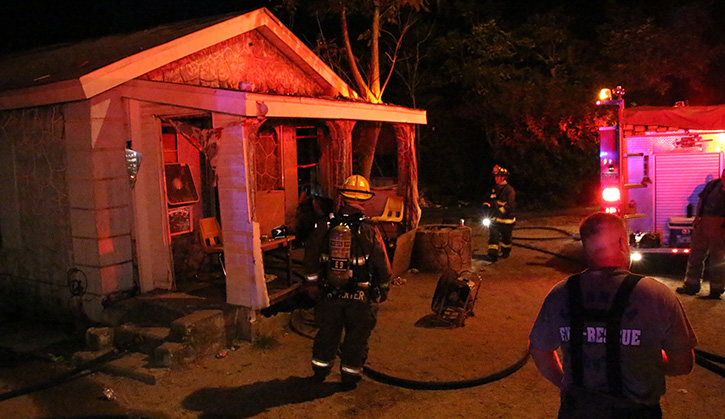
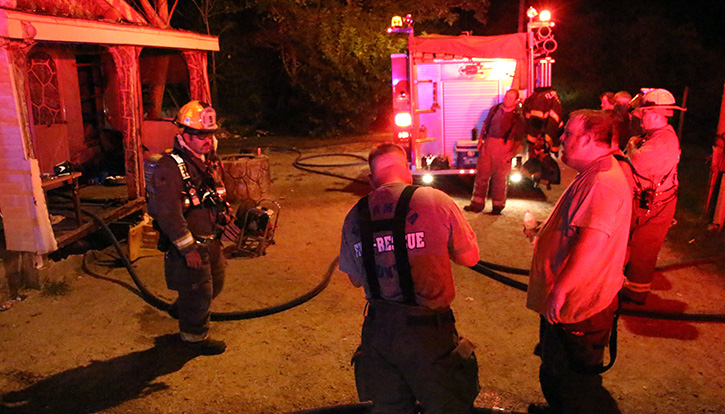
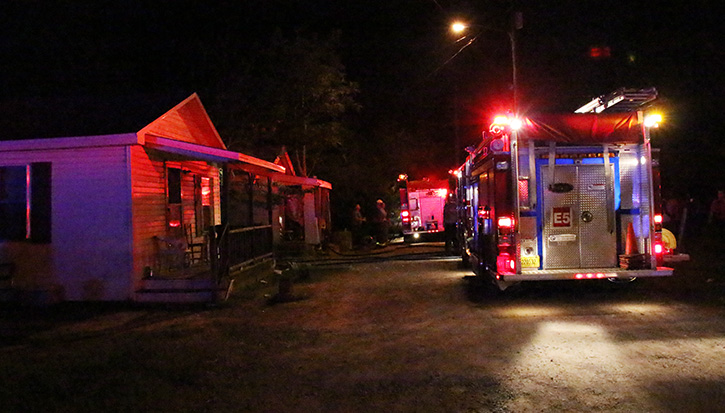
A Century residence was damaged by fire Saturday night, leaving an unknown number of people without a home.
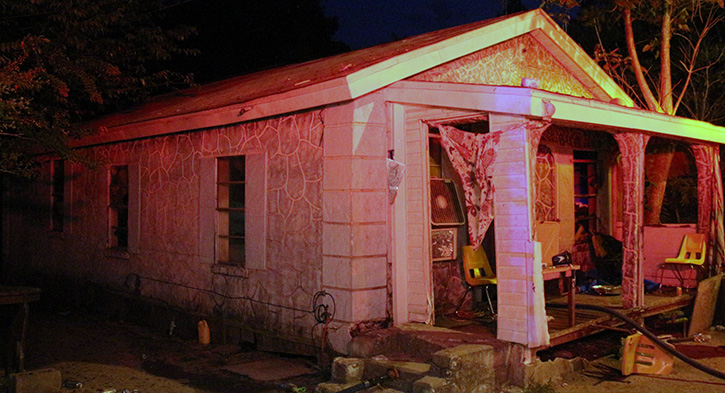 The fire was reported just after 8 p.m. on George Avenue, off West Pond Street and Highway 29. Officials said the fire was contained mostly to a bedroom and living room, with smoke and water damage throughout the home. Reports indicated the fire may have been accidentally started in a bedroom by children.
All occupants of the home were able to escape the fire without injuries.
The Century, McDavid, Molino and Walnut Hill stations of Escambia Fire Rescue were dispatched to the blaze, along with the Flomaton Fire Department, Escambia County EMS and the Escambia County Sheriff’s Office.
Pictured: Fire damaged a home on George Avenue in Century Saturday night. NorthEscambia.com photos, click to enlarge.