
Florida DOT Has Snow Plows On The Ready
January 23, 2016
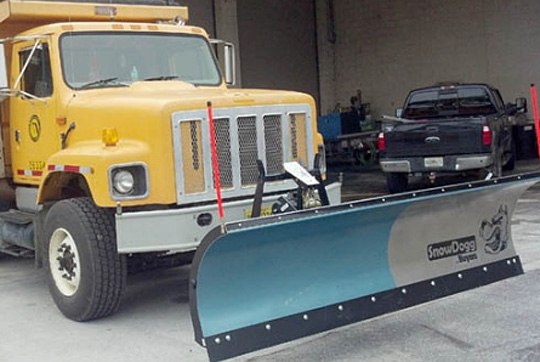
A few very light snow flurries fell in portions of the North Escambia area Friday night…with no accumulation. But if the snow had accumulated, the Florida Department of Transportation would have been ready.
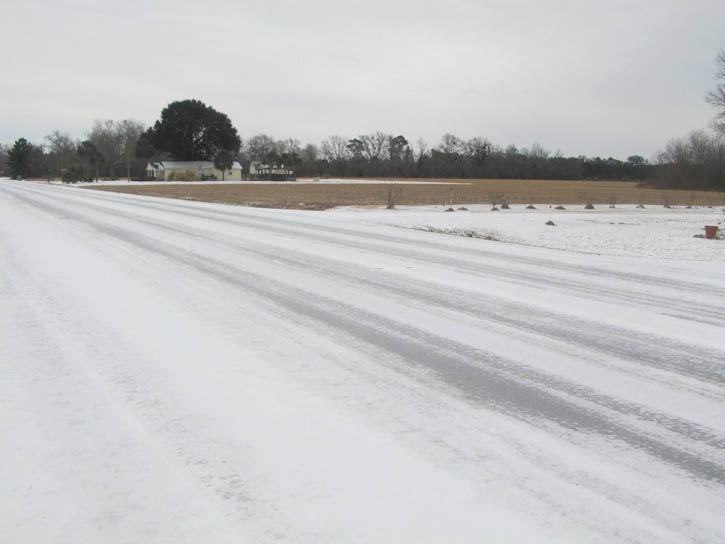
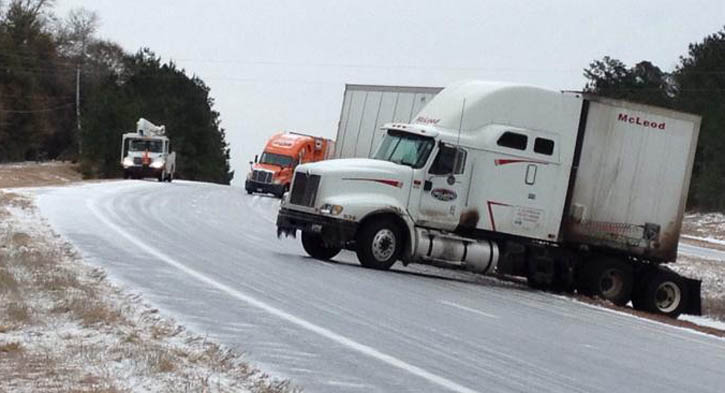 Back in 2014, FDOT purchased snow plows, salt and spreaders for use in Northwest Florida The purchases came on the heels of a freak ice storm in January 2014 that paralyzed the area.
The DOT spent $22,000 for five snow plows that will attach to the front of current DOT vehicles, $12,400 for 42 tons of salt, $26,400 for 10 salt spreaders to attach to dump trucks and $26,400 for 4,400 gallons of the ice-melting chemical potassium acetate.
The equipment can be used in mutual aid effort in other areas, and the snow plows can be used to remove beach sand from the roads after strong storms and hurricanes.
“FDOT is ready for winter weather,” the department posted on Twitter on Friday.
Pictured above: One of FDOT’s snow plows. Pictured inset: Two jack-knifed 18-wheelers on an icy Highway 29 south of Century and (below) an impassable Highway 97 near Davisville in January 2014. NorthEscambia.com file photos, click to enlarge.
Ball Registration Info: Cantonment, Century, Molino, NWE
January 23, 2016
Registration is underway, or beginning soon, at area ballparks:
Cantonment — Registration is underway for baseball and softball at the Cantonment Sportsplex. In-person registration dates will be every Saturday in January and the first two Saturdays in February from 9 a.m. until 1 p.m. Teams will be available for ages 3-14. The registration fee will be $85. Online registration is available at www.cantonmentbaseball.org/Register. Donations of new and gently-used equipment will be accepted on registration Saturdays. The Sportsplex is located at 681 Well Line Road in Cantonment.
Century — Little League registration will be held Saturday, February 6 from 9-11:30 a.m.; Thursday, February 11 from 5-7 p.m.; Saturday, February 13 from 9-11 a.m.; and Saturday, February 20 from 9-11:30 a.m. at Showalter Park in Century. Registration fee is $50 for the first child, $45 for each additional sibling. Birth certificate needed at registration. Teams available for ages 3 and up. For more information, contact Terry Levins (251) 656-6044, Nathan Brown (850) 377-0962, Brandy Carter (850) 619-4915 or Charity Miller (850) 501-9663.
Molino — Molino Ballpark registrations will be held Saturday January 23, January 30 and February 6 from 10 a.m. until 1 p.m. at Don Sutton ballpark. Registration is $60 for the first child, $55 for the second and $50 for the third. Birth certification needed at registration. Ages 3-17. For more info, call Luman at (850) 698-4396 about t-ball; Karen at (850) 281-4748 about softball; of Tommy at (850) 449-7578 about baseball.
Northwest Escambia – Registration will be Saturday January 30, from 9 a.m. until 12 p.m; Friday, February 5, from 5 p.m. until 8 p.m and Saturday, February 6, from 9 a.m. until 12 p.m. Teams will be available for ages 4-18. Registration cost for ages 7 years and older is $100 for first child, $85 for second child and $75 for third child. For 5-6 year olds, (T-Ball), registration cost will be $95 for first child; $80 for second child and $70 for third child. Price includes registration fee, $30 for Jersey and hat and $25 concession stand fee. Payment options are available. Bring a copy of your child’s birth certificate to registration. For more information, contact Brad Sullivan at (850) 324-5692 or Sara Knighton at (850) 572-5000.
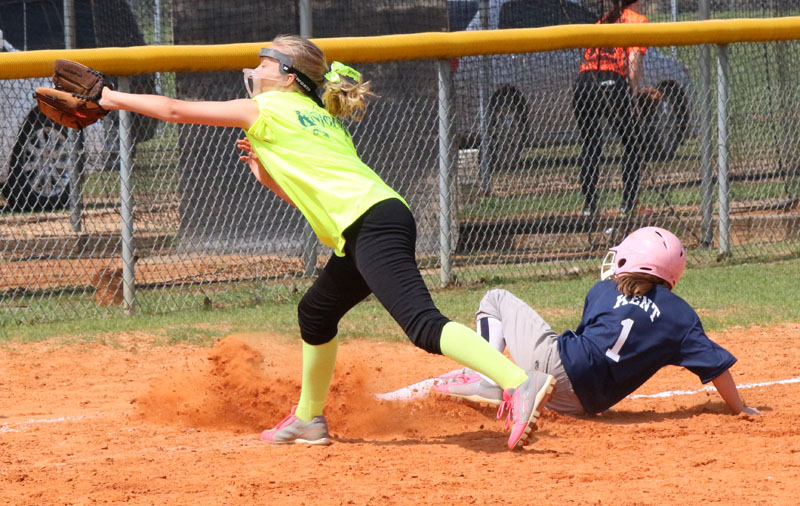
NorthEscambia.com file photo, click to enlarge.
Teens Arrested In Vehicle Burglary Ring
January 23, 2016

Five teenage suspects have been arrested in Escambia County in connection with numerous vehicle burglaries and vehicle thefts.
DKelvin Dwayne Craft 17, Maurice Jones Jr., 17, Detravious Ontario Morrell, 17, Deontrerrious Palmore, 17, and Noah Simms, 18, were all charged with burglary of a vehicle, criminal mischief, grand theft, grand theft of a motor vehicle, petty theft and fraud.
Escambia County Sheriff’s Office investigators said they were part of a vehicle burglary ring that targeted subdivisions from Perdido Key to Beulah. All of the vehicles that were burglarized were unlocked, according to deputies, and all of the stolen vehicles were taken using the owner’s keys that were left inside the unlocked vehicles or inside another vehicle parked in the same driveway.
All total, 60 arrest warrants were served on the five suspects. Authorities said more arrests are expected.
Storms Leave Minor Damage Across Area (With Photos)
January 22, 2016

Strong storms rattled nerves but left behind only scattered mostly minor damage across the area Thursday night.
In Byrneville, a metal barn at a home on Highway 4A was destroyed by strong winds (pictured above).
In Walnut Hill, scattered power outages were reported, including a large outage that included Highway 97 north of Walnut Hill, Arthur Brown Road, Highway 99A , Highway 97A and surrounding areas. The outage was traced to loose wire on a pole at the Walnut Hill Fire Station, which suffered minor damage to a sign and a door awning. A small tree was downed onto Highway 97 just north of the fire department, and traffic signs in a nearby bridge construction zone were tossed about.
Much of the damage in the area was in Flomaton, were a large tree was reported down on Jackson Street and a tree was reported on another house at the end of Jackson Street. Highway 31 was closed from Bondurant Lumber to Hurricane Park for several hours while first responders cleared downed trees and power lines. Highway 31 was back open at 1:15 a.m.
In Nokomis, AL, the false roof was blown of a fireworks stand but the owner reported that the structure’s main roof was still intact with no leaks.
Numerous small trees and power lines were reported down across the area.
In Santa Rosa County, the Florida Highway Patrol reported Highway 4 was closed east of the Berrydale Forestry Camp at James Jernigan Road due to water flowing over the roadway.
Wind gusts of 73 mph were reported at official weather stations in Myrtle Grove and at Pensacola NAS. A wind gust of 57 mph was reported at a weather station near Walnut Hill.
After the height of the storms, Gulf Power reported about 5,500 customers without power in Escambia County, including a large outage on Perdido Key and about 140 customers on West Kingsfield Road west of County Road 97.
Scroll down the page for multiple damage photos.

A metal barn on Highway 4A near Byrneville was destroyed.
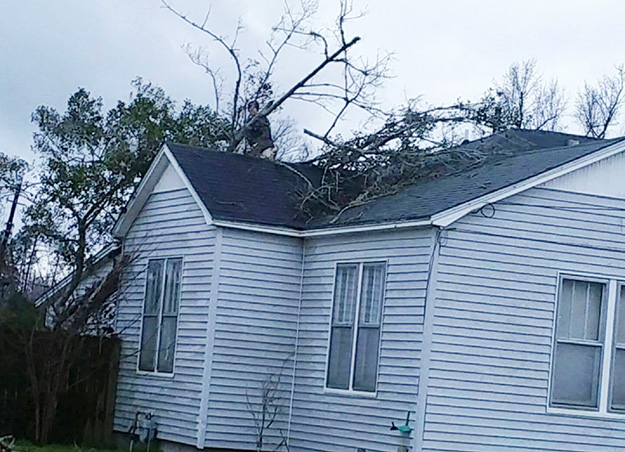
Tree on a house in Flomaton.
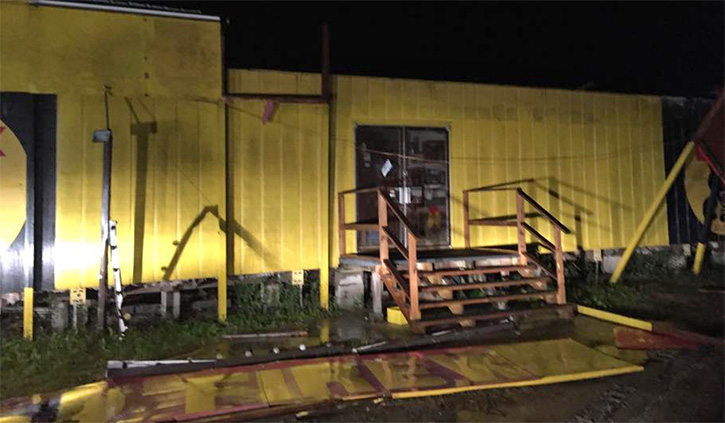
False roof and sign off a fireworks stand in Nokomis, AL.

Tree down on Jackson Street in Flomaton.
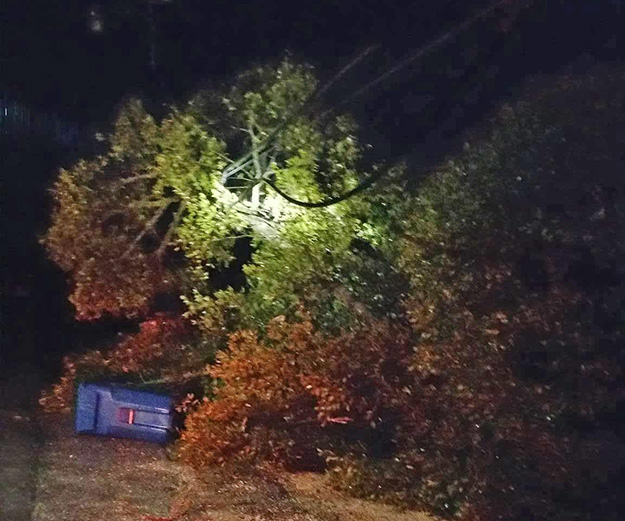
A tree down on utility lines on Jackson Street in Flomaton.
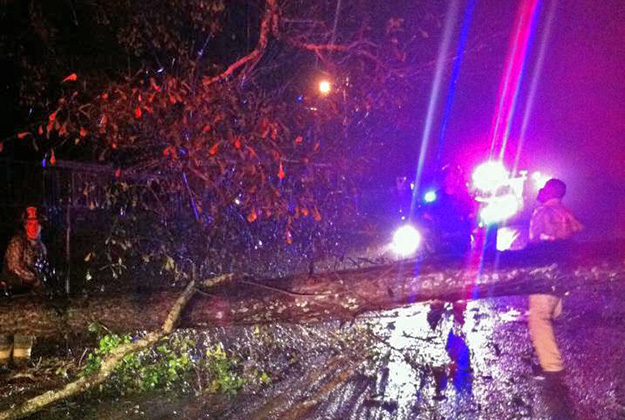
The Flomaton Fire Department worked to clear a downed tree on MLK Drive in Flomaton.

Tree split on Jackson Street in Flomaton by Thursday night’s storms.
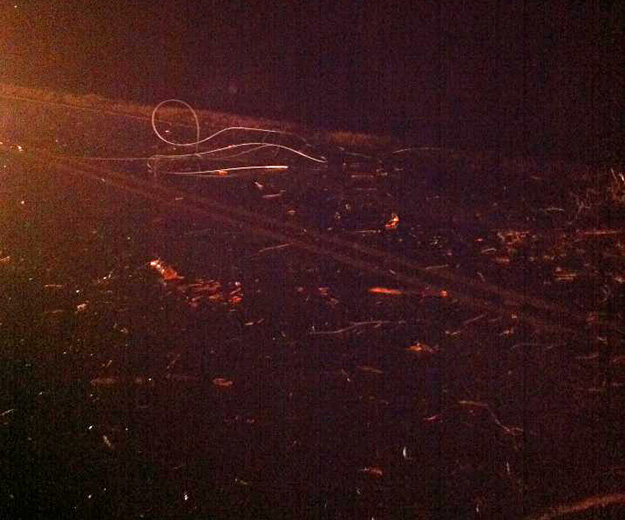
Downed trees and power lines closed Highway 31 in Flomaton from Bondurant Lumber to Hurricane Park. Power was detoured for several hours while first responders and Alabama Power worked to clean it all up. The roadway was reported re-opened at 1:15 a.m.

Trampoline versus house in Flomaton.

In Perdido, AL, on the Escambia (AL)/Baldwin County line, reader Felicia Overton took this photo of a trampoline and dog fence tossed around by the storms.
Reader submitted photos for NorthEscambia.com, click to enlarge.
Felon Gets 10 Years For Weapon Possession
January 22, 2016
An Escambia County felon is headed back to prison for possessing a weapon.
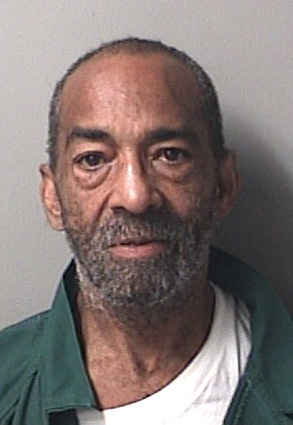 Ronnie Clausell was convicted by an Escambia County jury of possession of a firearm by a convicted felon. Following the verdict, Circuit Judge Jennie Kinsey sentenced Clausell to 10 years in state prison.
The Escambia County Sheriff’s Office received a tip of illegal activity at Clausell’s residence. When the officers arrived, they spoke with Clausell who ultimately consented to a search of his home. The search revealed a .22 caliber rifle and live ammunition. Clausell admitted ownership of the ammunition, according to prosecutors.
Thousands Lose Power In Thursday Night Storms
January 22, 2016
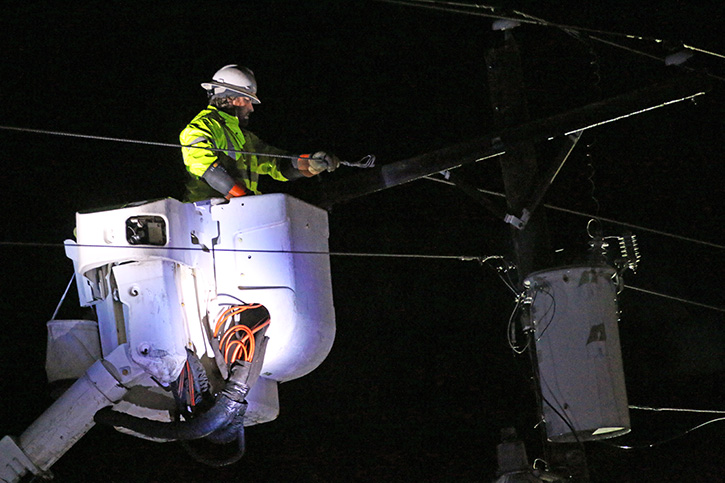
Thousands of people lost power as a storm system moved through the area Thursday night.
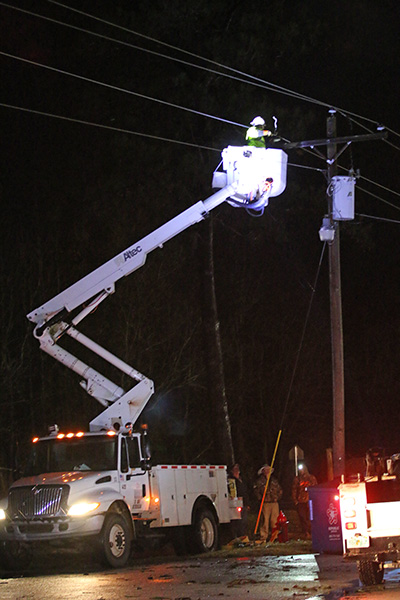 The entire cities of Atmore, Flomaton and Bay Minette reportedly lost power about 10:50 p.m. due to the storms. Many customers had their power restored by 11:30 p.m., while hundreds more remained in the dark until early Friday morning.
After the height of the storms, Gulf Power reported about 5,500 customers without power in Escambia County, including a large outage on Perdido Key and about 140 customers on West Kingsfield Road west of County Road 97.
Highway 31 in Flomaton was closed from Bondurant Lumber to Hurricane Park for several hours while first responders cleared downed trees and power lines. Highway 31 was back open at 1:15 a.m.
Hundreds of EREC customers lost power, including a large area along Highway 97 north of Walnut Hill, Arthur Brown Road, Highway 99A , Highway 97A and surrounding areas. The outage was traced to loose wire on a pole at the Walnut Hill Fire Station. Power was restored to Walnut Hill area customers by about 1:30 a.m.
Pictured: An Escambia River Electric Cooperative lineman works to repair a power line along Highway 97 in front of the Walnut Hill Fire Station about 1:15 a.m. Friday. NorthEscambia.com photos, click to enlarge.
‘Stand Your Ground’ Shift Ready To Pass Senate
January 22, 2016
Taking issue with the Florida Supreme Court, state senators next week could approve a bill that would shift the burden of proof in “stand your ground” self-defense cases. The Senate on Thursday took up the bill (SB 344), filed by Sen. Rob Bradley, R-Fleming Island, and put it in position for a vote as soon as Jan. 28.
The bill stems from a Supreme Court ruling last year that said defendants have the burden of proof of showing they should be shielded from prosecution under the “stand your ground” law. In “stand your ground” cases, pre-trial evidentiary hearings are held to determine whether defendants should be immune from prosecution.
Bradley’s measure would place the burden of proof on prosecutors in the evidentiary hearings.
“It’s a fundamental tenet of our criminal-justice system that the state has the burden of proof throughout the criminal prosecution — you’re innocent until proven guilty, I think we can all agree with that — so this bill applies this fundamental tenet of criminal law to the self-defense immunity hearing,” Bradley said.
But while the Senate appears poised to pass the bill, it remains unclear whether the shift will get approval in the House.
The House version (HB 169), filed by Rep. Dennis Baxley, R-Ocala, was blocked in November by the House Criminal Justice Subcommittee on a 6-6 vote.
by The News Service of Florida
State Offer Apologies, But Future Of Marianna’s Dozier School Remains Unclear
January 22, 2016
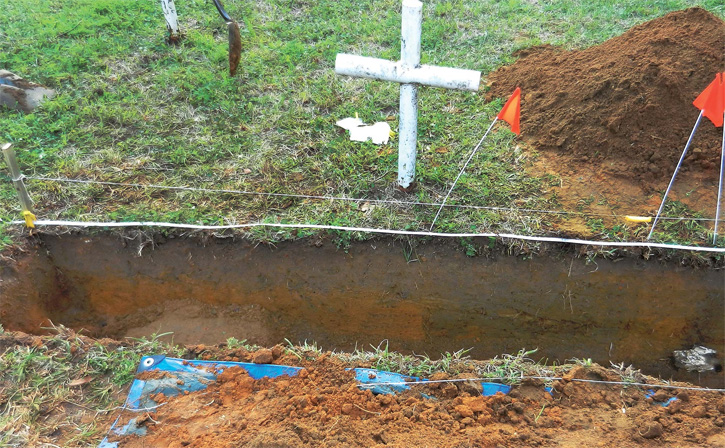
State leaders Thursday apologized for the past as university researchers released their final study on long-buried bodies unearthed from the shuttered Arthur G. Dozier School for Boys in Northwest Florida.
Now, the state must figure out what to do with remains that have yet to be identified and with the 1,400-site in Jackson County, about 70 miles west of Tallahassee. The site had been put for sale before excavation was ordered due to questions about whether boys were left in unmarked graves after suffering abuse and death at the reform school.
 After saying he was “sorry” for the generations of boys who endured whatever hardships may have occurred as wards of the state, Agriculture Commissioner Adam Putnam said the state must find a use for the Dozier site, whether it be recreational, educational or even for veterans’ services.
“The status quo is just not an option,” Putnam said. “It would make it worse for it to turn into a caricature of itself, some haunted juvenile prison that just breeds more rumors and mythology.”
The state might even consider some way to memorialize the site, which served as a reform school from 1900 to 2011 and is now locked behind a high chain-link fence. But Gov. Rick Scott and members of the Cabinet did not give direction Thursday after being presented with the University of South Florida researchers’ 168-page report, which doesn’t verify any students were killed by Dozier staff.
One holdup may be the need for a chemical analysis of the site, as researchers located asbestos and other potentially hazardous materials in some of the older buildings and where a dorm fire in 1914 claimed the lives of eight boys and two employees.
Attorney General Pam Bondi said the research findings should help the state and community “put these atrocities behind us.”
Scott said “people want to do the right thing.”
There may be additional unmarked burial sites on the property where researchers, starting in 2013, looked for remains. But USF anthropology professor Erin Kimmerle said that unless new information is advanced, “We feel our field work is done.”
Researchers reported unearthing 51 sets of remains from an area known as the Boot Hill Burial Ground. Seven of the bodies have been identified through DNA testing, of which four have been turned over to relatives and buried in family cemeteries.
The rest of the remains are housed at the Tampa university.
Former students at the school, who have told researchers of boys being beaten to death, said any unidentified remains should be laid to rest outside Jackson County, which includes Marianna.
“Do not return the remains to that area,” said Jerry Cooper, a ward of Dozier in the 1960s. “A lot of these children were not buried in a proper Christian manner.”
Dale Landry, president of the NAACP’s Tallahassee branch, favored using a mausoleum at the Dozier site to allow researchers in the future easier access to remains if identification can be made.
The report doesn’t fully verify the atrocities alleged by former students at the facility, which was segregated until 1968 and housed minors for crimes such as theft and murder, along with relatively minor offenses such as “incorrigibility,” “truancy,” or “dependency.”
Researchers found records for nearly 100 deaths among boys ages 6 to 18 between 1900 and 1973. Only 44 death certificates were issued, according to the report. At least 45 people were reportedly buried on the school grounds between 1914 and 1952, another 31 bodies were shipped to other locations for burial, and 22 deaths did not include burial locations.
Marianna City Manager James “Jim” Dean said local leaders want to work with the state to close what is a dark chapter in the community’s history.
The site is on the south side of Marianna, just north of Interstate 10. Putnam once described the site as the “gateway to Marianna.”
Elmore Bryant, a former Marianna mayor, asked if the local community could take control of the land.
“We will make you proud of what we do with that land,” Bryant said. “As Martin Luther King said, ‘It’s never too late to make a wrong right.’ I want to do that.”
by Jim Turner, The News Service of Florida
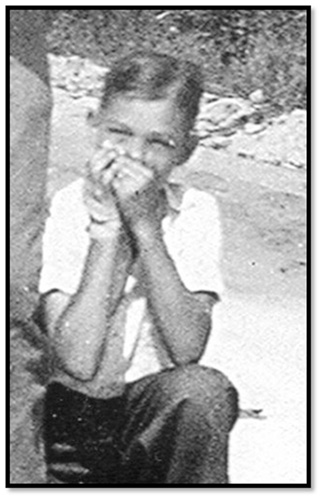
Pictured top: A trench dug in the search for human remains at the Arthur G. Dozier School for Boys in Marianna. Pictured inset: The remains of George Owen Smith were positively identified. NorthEscambia.com file photos.
Scott Signs ‘Unique Abilities’, Water Policy Bills
January 22, 2016
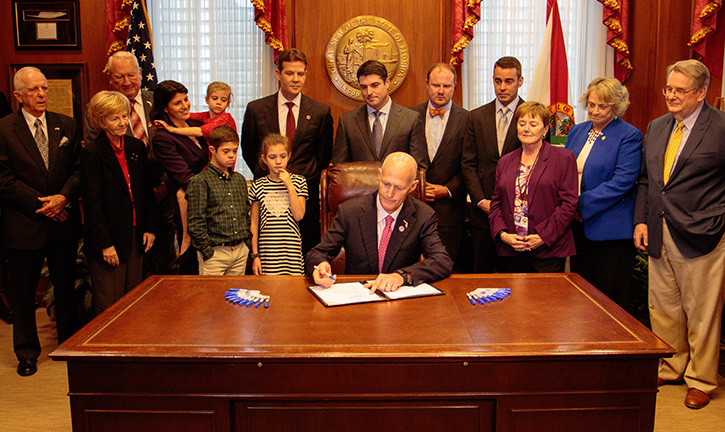
Gov. Rick Scott on Thursday signed a trio of legislative leadership-backed bills that set statewide water policy and offer more educational and job opportunities to people with developmental disabilities.
Scott signed the bills in his office, ignoring calls by a number of environmental groups and former Gov. Bob Graham to veto the water measure.
“This is a great start to session,” Scott said while flanked by lawmakers including House Speaker Steve Crisafulli and Senate President Andy Gardiner. “We’ve started with things that are very important to the president, speaker and other members of the House and Senate. Everybody knows my priorities.”
All three bills, which go into effect July 1, were approved by the Legislature last week during the opening days of the 2016 legislative session.
The water policy measure (SB 552), a priority of Crisafulli, R-Merritt Island, calls for establishing water-flow levels for springs and setting guidelines in central and south Florida
The measures focused on people with developmental disabilities have been championed by Gardiner, an Orlando Republican whose son has Down syndrome. One bill (HB 7003) is intended to provide job opportunities and financial independence for people with disabilities. The second bill (SB 672) includes programs that provide educational aid and higher-education opportunities to families whose children have developmental disabilities — or, as Gardiner calls them, “unique abilities.”
Pictured: Thursday, Governor Rick Scott was joined by Senate President Andy Gardiner, House Speaker Steve Crisafulli, their families, and other members of the Florida legislature to sign HB 7003 (Relating to Individuals with Disabilities), SB 672 (Educational Options) and SB 552 (Environmental Resources). Submitted photo for NorthEscambia.com, click to enlarge.
Jeep, Gasoline Tanker Collide In Cantonment (Updated Details)
January 21, 2016
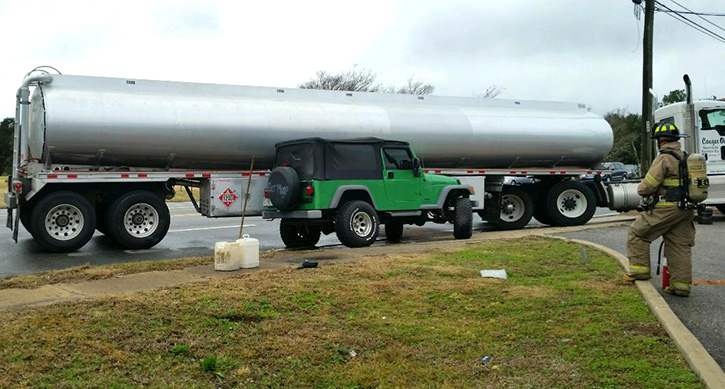
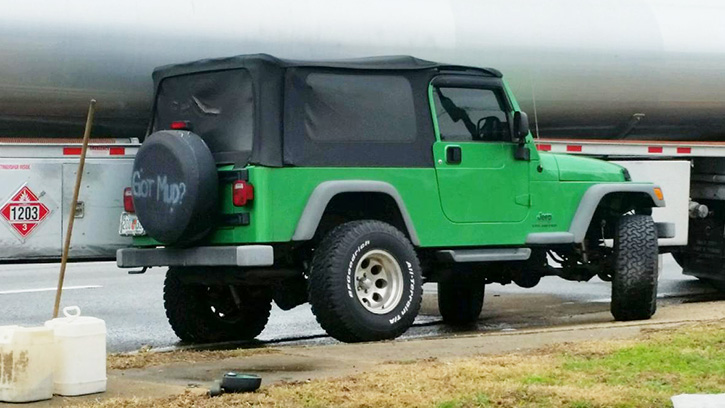
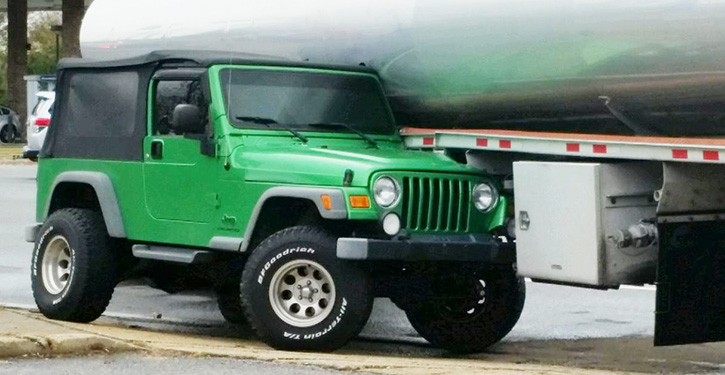
[Update 7 pm] A crash between an 18-wheel tanker truck hauling gasoline and a Jeep caused traffic delays in Cantonment Thursday afternoon.
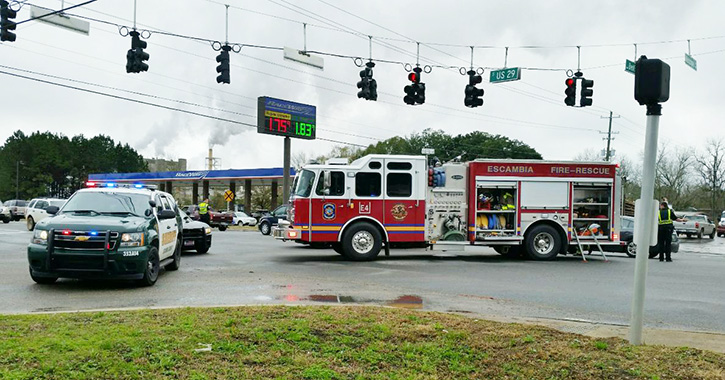
According to the Florida Highway Patrol, 35-year old Michael Jason Crabtree of Pensacola was northbound on Highway 29 and lowered his rate of speed and activated his turn signals to turn the tanker truck into a gas station. Troopers said 32-year old William Todd Barlow of Molino was northbound on Highway 29 in 2004 Jeep Wrangler collided with the truck’s trailer about 2:10 p.m.
The Jeep became lodged under the partially loaded tanker trailer. There were no injuries and no leaks. However, there was concern that the accident might have damaged a valve on the tank that would lead to gasoline leak when the vehicles were separated. At about 3:55 p.m., the vehicles were separated with no further fuel leakage.
Barlow was cited with careless driving, according to the Florida Highway Patrol.
NorthEscambia.com photos by Kristi Price, click to enlarge.