

Man Gets Five Years For Burglarizing Vehicles At Molino Park Elementary, Other Locations
June 9, 2016
A man that burglarized several vehicles in the parking lot of Molino Park Elementary School and other locations in the North Escambia area is headed to prison.
 Brett Derel McDonald was found guilty on multiple counts of armed burglary of a vehicle, grand theft of a firearm, grand theft and petit theft. He was sentenced by Judge Joel Boles to five years in state prison.
On November 16, 2015, a parent who had just walked her child into Molino Park Elementary School noticed McDonald in the school parking lot pulling on vehicle door handles before entering a Chevrolet Equinox. The vehicle owner told deputies that nothing was taken. The parent called the school and watched as McDonald went to more vehicles in the parking lot before being confronted by the school principal. The principal told deputies she knew McDonald because has a child in the school, and that he left the campus in a dark colored Mustang.
About 2 p.m. the same day, deputies responded to a vehicle burglary on Calderwood Court where the owner reported multiple items stolen, including a designer purse and wallet, paper work, credit cards and other items totaling about $285 in value.
About half an hour later., deputies responded to another vehicle burglary in the 9000 block of Fowler Avenue. The owner reported that sometime during the past day, someone stole three firearms from his vehicle along with a box of ammunition.
And later that same day, a vehicle owner reported that a radar detector was taken from her Dodge Charger while it was parked during the school day at Molino Park Elementary.
The weapons, ammunition, wallet, purse, radar detector and other items were recovered when McDonald was taken into custody at his home in the 400 block of 9½ Mile Road. None of the stolen firearms were taken from vehicles the Molino Park campus, according to the Sheriff’s Office.
Escambia Offering $12,500 Homebuyer Assistance In CRAs
June 9, 2016
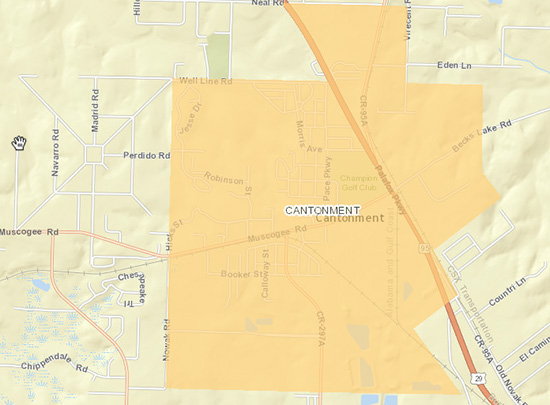
Escambia County and the city of Pensacola announce the availability of down payment and closing cost assistance of up to $12,500 for homebuyers purchasing new homes in county or city Community Redevelopment Areas through the HOME Program. Buyers must make the property their principal residence. Assistance is provided in the form of a five-year loan, forgivable at the end of the loan term provided that the buyer does not sell, rent or transfer the property within that time frame. Funding is available on a first qualified, first served basis.
Buyer qualifications for HOME Homebuyer Program:
- Have a total gross family income that does not exceed 80 percent of area median income for Escambia County adjusted for family size.
- Have sufficient income and credit worthiness to qualify for primary financing from a participating lender.
- Must attend a free eight-hour HUD certified homebuyer class offered by Community Enterprise Investments Inc., (850) 595-6234, or Consumer Credit Counseling Services, (850) 434-0268, prior to closing.
For a map of Escambia County CRAs, click here.
For a map of city of Pensacola CRAs, click here.
For more information, contact Tracy Pickens at (850) 858-0350, option 8.
Pictured: The Cantonment CRA.
New Voter Cards On The Way
June 9, 2016
All voters in Escambia County will be mailed a new voter information card in the coming days, according to David Stafford, Escambia County Supervisor of Elections.
 The new cards will be in green text, making identification of the most current card simpler. The updated card reflects Escambia County’s State Senate District number change to District 1. Voters are strongly encouraged to review their new cards carefully, particularly their party affiliation and polling location.
Voters should be on the lookout for their new card, and contact the elections office immediately with any necessary updates. Voter information cards are NOT required when voting; Florida requires approved photo and signature ID when voting in person.
August 1 is the deadline to register to vote or change party affiliation for the August 30 Primary Election.
Dirt Portion Of Greenland Road Is Now Paved
June 9, 2016

A pavement project on the dirt portion Greenland Road near Davisville was recently completed by contractor Roads Inc. of NWF for a total cost of just over $205,000. NorthEscambia.com photos, click to enlarge.

Scott Looks To Lure Louisiana Businesses To Florida
June 9, 2016
Gov. Rick Scott will head to Louisiana next week to encourage businesses to move to Florida, his office announced Wednesday.
 The “trade mission” comes as Louisiana lawmakers hold a special session to patch an estimated $600 million budget shortfall, and Scott used Wednesday’s announcement to blast the state’s Democratic governor, John Bel Edwards. “Gov. Edwards already approved 14 new tax increases this spring that will cost Louisiana taxpayers $300 million,” Scott said in a prepared statement.
“These poor decisions will not only increase the burden on Louisiana families, but they will also further bring down the state’s business climate and job growth.” Scott told members of the economic-development agency Enterprise Florida last month that he would be traveling to Louisiana.
At the time, Edwards’ office criticized Scott for omitting that economic policies backed by former Gov. Bobby Jindal left Louisiana with a $1 billion deficit for the current year that, without correction, would grow to $2 billion next year. Edwards took office in January.
by The News Service of Florida
The Magic Of Summer Reading Comes To The Library
June 9, 2016
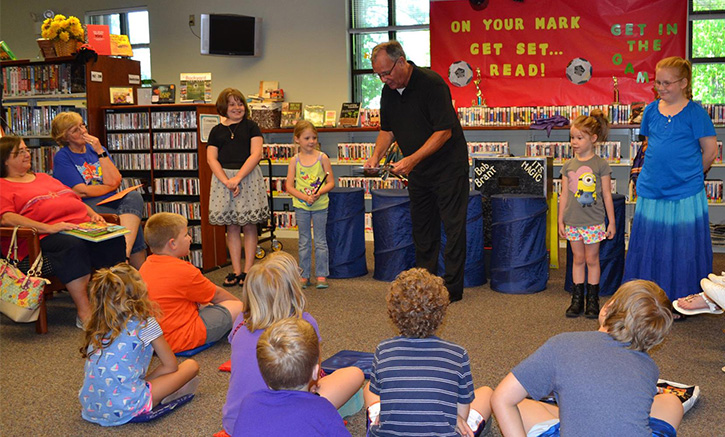
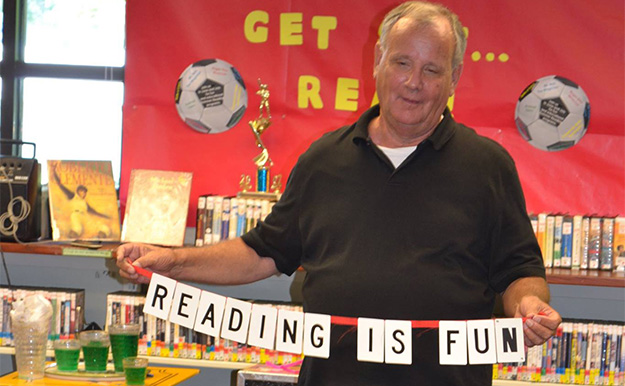
The magic of the annual Summer Reading program entertained children in Century Wednesday morning.
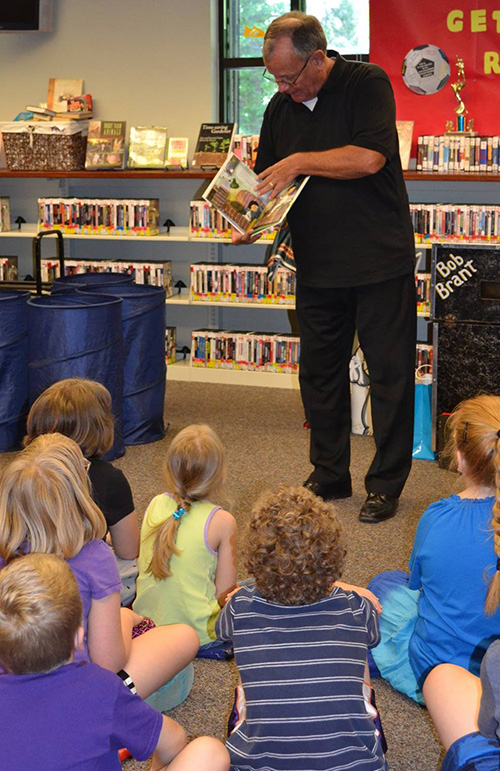 The summer of free events features a variety of performers, including a balloon artist, musician, gymnastics team, magician, theatre group, reptile handler and juggler. And the more children ages 0-17 read, the more prizes they can earn.
The June schedule for the remainder of the Summer Reading Club is as follows:
Mr. Bob’s Magic Show
Mr. Bob’s magic show includes mind blowing magic, music and lots of hilarious audience participation.
- Thursday, June 9, 11 a.m. – Molino Branch Library
- Thursday, June 9, 4 p.m. – Tryon Branch Library
Musician: Roger Day
Roger Day’s skilled musicianship combines with his wit and wordplay to create a musical experience that parents will enjoy as much as the kids.
- Tuesday, June 14, 11 a.m. – Southwest Branch Library
- Wednesday, June 15, 11 a.m. – Century Branch Library
- Wednesday, June 15, 4 p.m. – Pensacola Library
- Thursday, June 16, 11 a.m. – Molino Branch Library
- Thursday, June 16, 4 p.m. – Tryon Branch Library
Pensacola Gymnastics
Enjoy the Pensacola Gymnastics team as they demonstrate agility, flexibility, self-confidence, teamwork, dedication, and determination.
- Tuesday, June 21, 11 a.m. – Southwest Branch Library
- Wednesday, June 22, 11 a.m. – Century Branch Library
- Wednesday, June 22, 4 p.m. – Pensacola Library
- Thursday, June 23, 11 a.m. – Molino Branch Library
- Thursday, June 23, 4 p.m. – Tryon Branch Library
Dr. Magical Balloons
Enjoy amazing balloon sculptures and original stories as Dr. Magical Balloons captivates and astounds readers of all ages.
- Tuesday, June 28, 11 a.m. – Southwest Branch Library
- Wednesday, June 29, 11 a.m. – Century Branch Library
- Wednesday, June 29, 4 p.m. – Pensacola Library
- Thursday, June 30, 11 a.m. – Molino Branch Library
Pictured: Bob the Magician at the Century Branch Library Wednesday morning. NorthEscambia.com photos by August Whorff, click to enlarge.
Jackson Gets 8-4 Win Over The Pensacola Blue Wahoos
June 9, 2016

All night Wednesday Jackson Generals DH Tyler O’Neill delivered and he did it again in the ninth inning when he hit a two-out, walk-off grand slam against Pensacola Blue Wahoos closer Carlos Gonzalez.
The Southern League Player of the Month for May drove in all eight of Jackson’s runs in its, 8-4, victory over Pensacola at The Ballpark in Jackson.
O’Neill entered the game going 1-9 with one run, a walk, one RBI and a strikeout in the series. But Wednesday, the 20-year-old was 3-4 with a run scored, a double and a home run. He’s now batting .332 with 11 homers and 51 RBIs on the season. He is second in homers and batting average and first in RBIs in the Southern League.
Both teams were tied, 4-4, after the first five innings. But both team’s relievers buckled down. Barrett Astin and Nick Routt held Jackson scoreless over 3.1 innings on two hits, a walk and three strikeouts.
But Pensacola’s Gonzalez took over in the ninth, loaded the bases and then gave up the grand slam with two outs to O’Neill.
Pensacola right-handed starter Rookie Davis worked 4.2 innings and allowed four runs on seven hits and a walk and struck out four.
Jackson relievers Forrest Snow and Dan Altavilla no-hit the Blue Wahoos over the last 3.2 innings with one walk and five strikeouts.
They came in for Generals starting pitcher Jordan Pries, who worked 5.1 innings and allowed four runs on eight hits, one walk and struck out seven.
It was a back and forth game up until the ninth inning. In the top of the second inning, Pensacola center fielder Phillip Ervin and first baseman Kyle Parker both hit solo home runs to left field to take a 2-1 lead. It was Ervin’s sixth and Parker’s fourth of the season. Pensacola left fielder Tony Renda singled to left field to drive in third baseman Eric Jagielo, who singled to center, to put the Blue Wahoos up, 3-1.
Jackson scored first in the first inning when O’Neill got his first run-batted in when he hit a sacrifice fly to center that scored center fielder Ian Miller to go ahead, 1-0.
O’Neill then knotted the score, 3-3, in the third inning when he smashed a single to left field that scored both shortstop Benji Gonzalez and right fielder Guillermo Heredia.
Pensacola’s Renda put the Blue Wahoos back on top in the fifth inning, 4-3, when he singled sharply to left field and scored when second baseman Brandon Dixon grounded out to second base.
O’Neill then smacked his 17th double of the season to drive in Heredia with two out and tie the game, 4-4, in the bottom of the fifth inning.
Pensacola is 15-18 on the road this season. They are now 33-25 on the season and are tied for first place with the Biloxi Shuckers.
Jackson, the Double-A affiliate of the Seattle Mariners, owns the best record in the Southern League and sits atop the North Division at 39-20.
Dixon earned the Southern League Player of the Week honors but in the three games since is 0-9 with five strikeouts and two RBIs. During his six game hitting streak, he was 15-24 (.625) with eight homers and 19 RBIs.
A Fallen Angel Returns
June 8, 2016

The remains of a fallen Blue Angel were flown back to Pensacola Tuesday aboard Fat Albert with a Blue Angel jet escort.
Fat Albert, flying under the call sign “Blue Angel 6″, and Lead Solo Lt. Ryan Chamberlain flew over downtown Pensacola, Pensacola Beach and Perdido Key as thousands paid tribute to Capt. Jeff Kuss, who was killed in the crash of his Blue Angel jet in Smyra, TN.
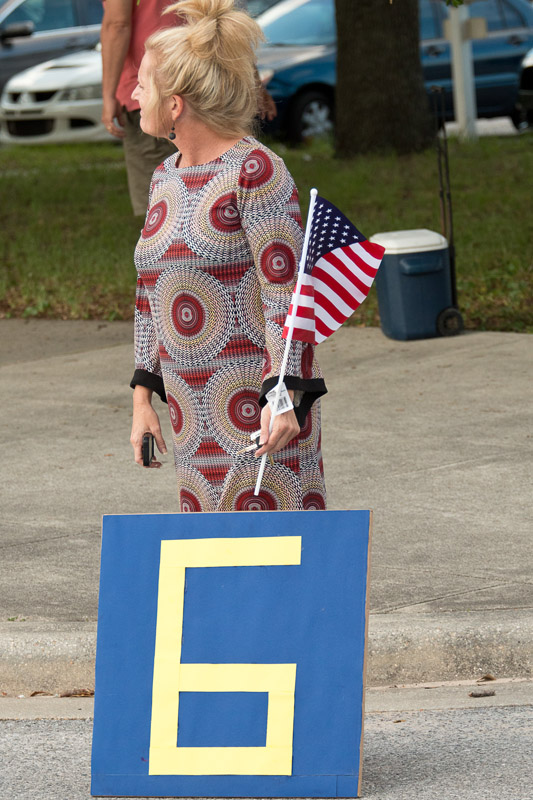 A public candlelight vigil will be held for Kuss this Thursday at 7:30 p.m. at the Veterans Memorial Park in downtown Pensacola. The public is invited to gather with candles and American flags to pay tribute to the fallen pilot. Six minutes of silence will be observed as Kuss was the pilot of plane number six.
Kuss’ body is expected to be transported to his hometown of Durango, CO, for burial.
For a photo gallery, click here.
Just prior to Tuesday’s flyover, Blue Angels Commanding Officer Cmdr. Ryan Bernacchi released the following statement:
Good afternoon to all of the Blue Angels friends and supporters in Pensacola, Florida.
Presently, our number six pilot, the Opposing Solo, Capt. Jeff Kuss, is returning to Pensacola aboard Fat Albert, where he will be reunited with his family, friends, teammates, and the Pensacola community. Jeff absolutely loved our Sunday evening arrivals. Flying in over downtown, “smokin’ the beach” from Pensacola to Perdido, and then the hitting the Delta Pitch Up Break at sunset into Naval Air Station Pensacola. The smile I would see radiating under that gold visor was truly spectacular. It emanated the pride, passion, and pure joy that he felt representing the Navy and Marine Corps, flying Blue Angel 6.
Tonight, I hope you will join the team in saluting him as he flies that special route home to Pensacola again. He is flying in Fat Albert – callsign “Blue Angel 6”, and escorted by the Lead Solo, in Blue Angel 5.
As Jeff’s family and the Blue Angels have navigated this immensely difficult time, a constant gift has been the unwavering support from our hometown of Pensacola, and from all across this great nation.
This great city, and also this great nation has lost a Blue Angel. We are all grieving this tremendous loss, and inspired by the life he lived so incredibly well.
Our number one priority now is to assist the Kuss family in honoring Jeff and returning him to Durango, Colorado, where he will be surrounded by his beautiful family. We thank you for your continuous support, and will honor Jeff with you at the Candlelight Vigil.
When you see the Solos overhead tonight, please send him your thoughts, prayers, and a Semper Fi. ~Boss
For a photo gallery, click here.
NorthEscambia.com photos by Ditto Gorme and Kristi Barbour, click to enlarge.



Chamber To Fight Worker’s Compensation Coverate Rate Increase
June 8, 2016
The Greater Pensacola Chamber announced Tuesday that it will fight the spike in workers’ compensation rates that will take place this summer. As a result of a recent Florida Supreme Court ruling, workers’ compensation rates in Florida are scheduled to rise by 17.1 percent on August 1.
“We surveyed our Chamber membership and found that our local business community is adamantly opposed to this workers’ compensation rate hike,” stated Greater Pensacola Chamber Board Chairman Gary Bembry. “We also heard loud and clear that our membership wants the Chamber to join the fight in finding a solution to this onerous rate increase.”
Eighty-seven percent of respondents to the Greater Pensacola Chamber’s membership survey said this rise in workers’ compensation rates will have a negative impact on their business, and 97 percent of survey respondents want the Chamber to engage in fighting this increase.
The Greater Pensacola Chamber will partner with the Florida Chamber of Commerce and other pro-business groups to find a legislative solution to this increase.
Committee’s Plans For Former Century High School Brick Memorial Almost Complete
June 8, 2016
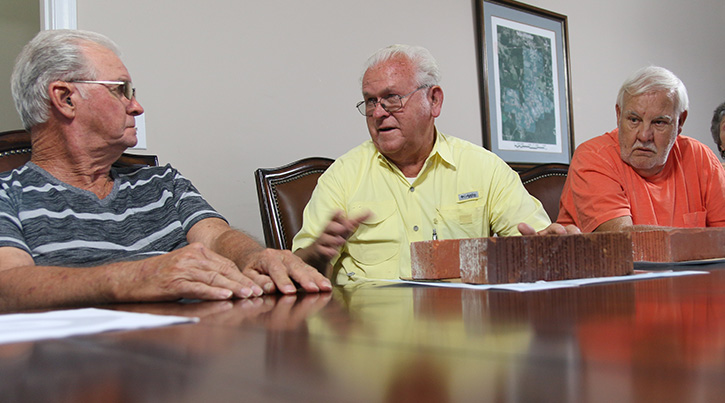
A committee working to decide how to preserve bricks from the former Century High School in a monument has almost finalized their plans.
They anticipate that engraved bricks will be sold at $50 each to be placed around a 1936 monument and flagpole salvaged from the former school, which was demolished due to tornado damage. In total, about 3,000 bricks were saved from the school building for the project.
The committee is exploring the possibility of constructing the monument at, or very near, the actual site of the former Century High School on Hecker Road. Other sites that were considered included the Alger-Sullivan Historical Park, the Nadine McCaw Park and Showalter Park.
It is expected that the bricks will be on sale before the end of June. Complete purchase details will be published on NorthEscambia.com.
Pictured top: Mayor Freddie McCall, center, addresses the “Brick and Monument Committee” Tuesday evening in Century. Pictured below: A sample engraving on an actual brick from the former Century High School. NorthEscambia.com photos, click to enlarge.