

Smokies Snap Blue Wahoos Streak
August 16, 2016
The Tennessee Smokies took four games of frustration out on the Pensacola Blue Wahoos on Monday at Blue Wahoos Stadium.
The Blue Wahoos were trying to sweep their second five-game series in its five-year history on Monday. Pensacola’s last won all five games when it beat the Montgomery Biscuits in July 2015.
However, Tennessee starter Zach Hedges threw his third straight scoreless game and the Smokies added 15 hits to roll to a 9-4 victory over Pensacola.
 In front of 3,518 Blue Wahoos fans Monday, including Walt Jocketty, president of baseball operations, and other Cincinnati Reds executives who watched the entire homestand, Tennessee also snapped Pensacola’s five-game winning streak. It was the Blue Wahoos longest winning streak of the season.
“Every time we had a good count, we hung the pitch and they didn’t miss that’s for sure,” Pensacola manager Pat Kelly said. “The eighth inning got interesting and we definitely had our chances. Better than getting shutout that’s for sure.”
Hedges, who was pitching in his fifth game for the Smokies, has now thrown 19 scoreless innings in the past three games. He is 3-1 with a 1.50 ERA.
Tyler Mahle threw two perfect innings in the rain shortened opening game against Tennessee Thursday night, but he struggled coming back to start the fifth game against the Smokies. The 21-year-old gave up five runs on seven hits, one walk and hit one batter in three innings, while striking out four. He got the loss in the game and is now 5-3 with a 4.15 ERA.
Kelly said it was tough for Mahle to come back after three days’ rest.
“I’m sure he hasn’t done that before,” Kelly said. “He just didn’t look comfortable out there.”
It was all Tennessee at the plate with all nine starters getting a base hit, including 23-year-old pitcher Hedges whose first professional hit down the first base line drove in two runs in the fourth inning.
Leading the way for the Smokies was Lane Adams, who was picked up by the Chicago Cubs Aug. 3 after the New York Yankees released him July 28. In his 10th game with Tennessee he got on base four times and smacked his first home run—a two-run shot in the seventh—and knocked in three runs, which were his first RBIs for the Cubs affiliate. Going 3-4 Monday jumped Adams average from .167 entering the game to .225.
Pensacola avoided being shut out by scoring four runs in the eighth inning off of Tennessee relievers Stephen Perakslis and David Garner.
“The biggest thing to me is the way we swung the bats,” Kelly said, reflecting on the series. “We don’t have to score a ton of runs, we just got to get them (Pensacola pitchers) some.”
The first run came when right fielder Sebastian Elizalde stroked a line drive into right field to score pinch hitter Ronald Bueno to make the score 9-1. Blue Wahoos second baseman Brandon Dixon singled up the middle when the second baseman failed to field his ground cleanly, allowing center fielder Jeff Gelalich to score from second base to trail the Smokies, 9-2.
Pensacola shortstop Zach Vincej then smacked a high fly ball to left field and Smokies left fielder Kelly Dugan fell down chasing the ball. It was ruled a double—his 23rd of the season—and drove in both Elizalde and Dixon to pull the Blue Wahoos within, 9-4.
Elizalde went 3-4 with an RBI for his 25th multi-hit game and fifth three-hit game. He has two more hits in seven of his last 10 games and is hitting .269 on the season.
The Blue Wahoos, who were the first half champions, fell to 25-25 in the second half. They will start a five-game series at the Mississippi Braves ballpark on Wednesday.
No Injuries In Nine Mile Road Crash
August 16, 2016

There were no injuries in a two vehicle crash Monday afternoon on Nine Mile Road at Pine Forest Road, in front of Publix. Everyone involved in the accident refused medical transport to the hospital. NorthEscambia.com photos by Kristi Barbour, click to enlarge.

One Airlifted After Four Vehicle Cantonment Crash
August 15, 2016

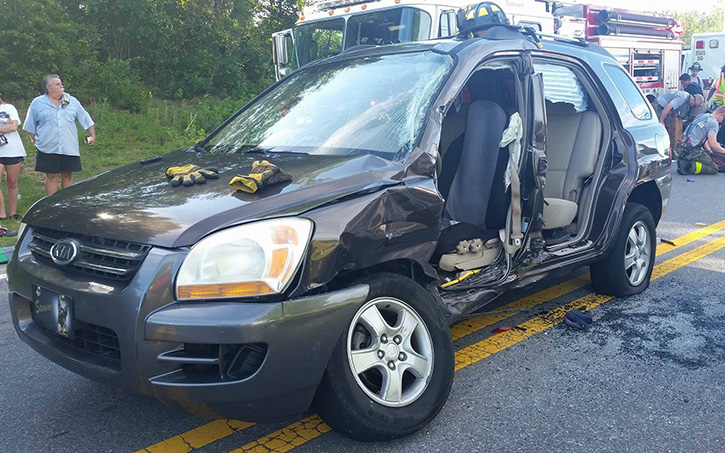
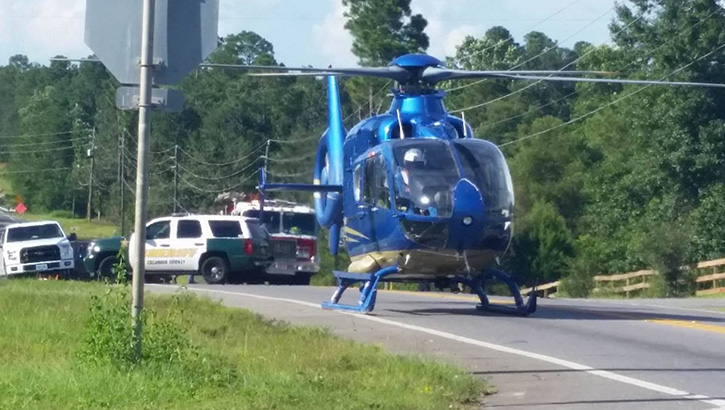
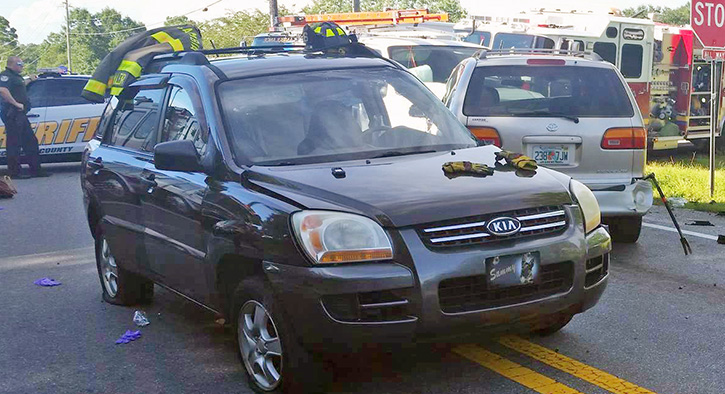
One person was airlifted to an area hospital after a four-vehicle collision at the intersection of Highway 297A and West Kingsfield Road Monday afternoon.
According to the Florida Highway Patrol, 35-year old Dwane Hendley of Montgomery was southbound in an AT&T cargo van on Highway 297A when he ran a stop sign at Kingsfield Road and hit a 2007 Kia Sportage driven by 54-year old Angela Miller of Pensacola and a 2000 Toyota Sienna driven by 60-year old Thomas Starks of Cantonment. Starks’ Sienna was forced back into a Toyota Camry driven by 33-year old Aprill Christopher of Cantonment.
Miller was trapper in her vehicle for about half an hour while firefighters worked to free her. She was airlifted by LifeFlight helicopter to Sacred Heart Hospital in serious condition.
Hendley, Miller’s 11-year old passenger, Starks and Christopher received minor injuries.
Hendley was cited for the violation of a traffic control device.
NorthEscambia.com photos by Kristi Barbour, click to enlarge.

One Injured In Highway 29, North Tate School Road Crash
August 15, 2016
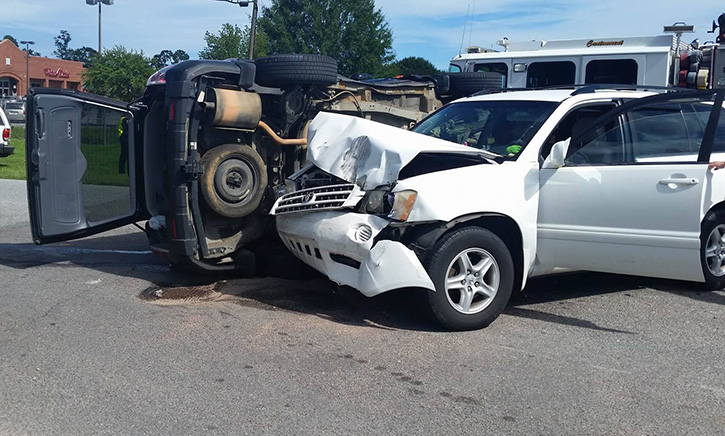
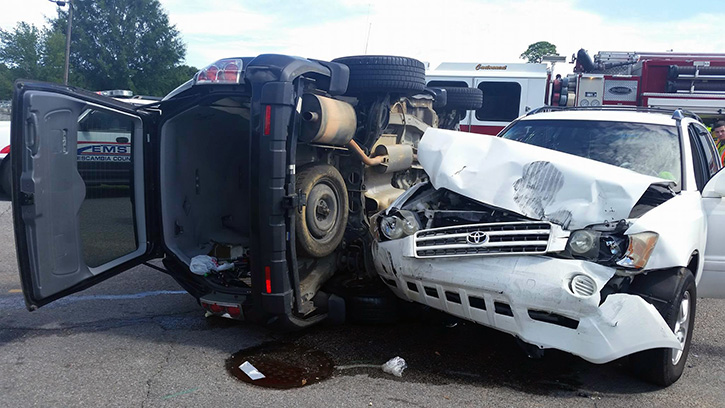
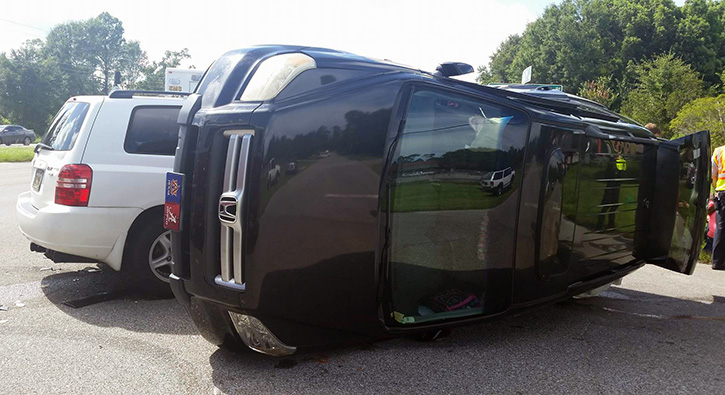
One person was injured in a two vehicle rollover crash on Highway 29 at Tate School Road Monday afternoon.
The injured person was transported by ambulance to an area hospital with injuries that were not considered to be life threatening. Two other people involved in the crash refused medical transport.
The accident is under investigation by the Florida Highway Patrol. Further details have not been released.
NorthEscambia.com photos by Kristi Barbour, click to enlarge.
FWC Law Enforcement Report
August 15, 2016
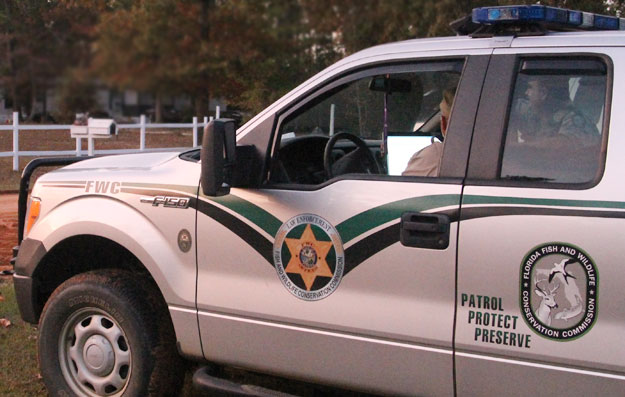
The Florida FWC Division of Law Enforcement reported the following activity during the weekly period ending August 11 in Escambia and Santa Rosa counties.
ESCAMBIA COUNTY
 Lieutenant Hahr was patrolling in the Perdido River Wildlife Management Area (WMA) when he observed four adults smoking a cannabis cigarette. A search of their belongings revealed a bag of cannabis and a cannabis roach. They were each charged with possession of not more than 20 grams of cannabis.
SANTA ROSA COUNTY
Officer Lewis was on forest patrol in Blackwater River State Forest at a primitive campsite when he observed a man and a woman sitting in a creek sharing what appeared to be a cannabis cigarette. Officer Lewis also observed them drinking beer from glass bottles. Alcoholic beverages and glass containers are prohibited in the area they were in. Officer Lewis observed the adult male toss what they were smoking into the water and immediately approached the subjects. He explained to them that alcoholic beverages and glass bottles were prohibited in the area they were in. He also explained to them that they appeared to be smoking cannabis. The female subject said that the male subject passed her a cigarette to smoke. Officer Lewis thought that was odd because she was almost finished smoking a cigarette as he spoke with her. He asked where the female’s cigarettes were and she retrieved a small bag from a larger bag. She gave Officer Lewis permission to search the bag and he found two smoked cannabis cigarettes. Officer Lewis searched the large bag the small bag was in and found various paraphernalia items containing methamphetamine. The female subject voluntarily stated all the illegal drugs belonged to her. Officer Lewis arrested the female subject and booked her into the Sarasota County Jail for possession of a controlled substance without a prescription, possession of cannabis not more than 20 grams, and possession of drug paraphernalia.
Officer Lewis received a complaint in Blackwater River State Forest in reference to dumped garbage on a forest road. Officer Lewis met the complainant at the dump site and the complainant gave him an article with a name and address on it that was found in the garbage. Officer Lewis was able to ascertain who dumped the garbage, and cited them for littering not more than 15 pounds.
Officer Lewis received a complaint about two Jeeps tearing up the road in the Hutton Unit WMA. Officer Lewis entered the WMA and was met by two Jeeps fitting the description of the complaint. Officer Lewis stopped the Jeeps, and explained to the drivers that there was a complaint about Jeeps tearing up the roads in the area. One of the drivers said that they were doing donuts because they did not think it would be a problem. The driver showed Officer Lewis where they were tearing up the roadway. The complainant identified the drivers of the Jeeps and gave Officer Lewis a written statement. Officer Lewis charged the drivers with destruction of public lands by motor vehicles.
Lieutenant Hahr checked a fisherman returning from fishing with six largemouth bass. The man admitted to catching all of them and was charged with taking over the bag limit of bass.
Officer Land witnessed an individual fishing by himself at the Oriole Beach Boat Ramp during an evening patrol in Gulf Breeze, and approached the individual to inspect his catch. There were multiple fishing poles with lines in the water, a crab net, and a five-gallon bucket. Officer Land asked the man if he had caught anything, and he replied that he had not. The officer then looked into the bucket beside the fisherman, and saw blue crab and stone crab in whole condition. The man stated that the crabs were not his and he was not fishing. The illegal stone crab was photographed and the man was issued a notice to appear. After signing for his citation, the man loaded the fishing poles, crab net, and bucket into his vehicle and left the area. The stone crab was still alive and released back to the water.
While on patrol in Blackwater Bay, Officers Land and Lewis conducted a fisheries inspection of a vessel they saw actively fishing. There were two men on board and when asked about their catch, the captain of the vessel said they had caught some mullet and a sandbar shark. Upon inspection, the officers located the head of a small bull shark. All sharks must be landed in whole condition, and bull sharks must measure at least 54 inches to the fork of their tail. The captain of the vessel was issued a notice to appear for the violation.
Officers Jones, Roberson, and Hughes responded to a complaint from Eglin Air Force Base (AFB) officials of a group who were in possession of large sacks of palmetto berries. The officers arrived to find six males in a pickup truck loaded with freshly picked palmetto berries. They had no permit to harvest and no required permits to be on Eglin AFB lands. All claimed they did not speak English and only the driver produced identification. An investigation ensued which included assistance from a trooper who spoke Spanish and a trooper with rapid identification capability. One individual, the driver and apparent head of the group, was charged with removing vegetation from the Eglin WMA and for having no permit to be on Eglin AFB lands. One member of the group was arrested on an outstanding warrant and transported to Santa Rosa County Jail.
This report represents some events the FWC handled over the past week; however, it does not include all actions taken by the Division of Law Enforcement. Information provided by FWC.
Incumbents Lead Campaign Fundraising In District 5
August 15, 2016

Incumbent Escambia Commission member Steven Barry and incumbent ECUA board member Larry Walker are leading the campaign fundraising in District 5. Here are the latest numbers reported by the candidates, as of reports that were due at midnight last Friday:
Escambia Commission, District 5
Steven Barry had received $26,486 in contributions, including $15,500 of his own money. Barry received $2,582 of in-kind contributions. He had spent $14,100.08, resulting in a campaign account balance of $12,385.92. His largest expenditures to date were for t-shirts and signs.
Daniel J. Smillie received $9,650.00 in contributions, including $6,000 of his own money. He also received $176.61 of in-kind contributions. As of the last report, Smillie had spent $7,675.98. His largest expenditures were for signs and magnets, and $2,600 for a video on BLAB-TV. He had a campaign fund balance of $1,974.02
ECUA, District 5
Larry Walker reported $14,041.43 in contributions, including $5,000 of his own money. He also had $1,581 of in-kind contributions and $10,565.11 of expenditures. His campaign had a balance of $3,476.32.
Jim Taylor reported $8,745 in contributions including $1,500 of his own money. He also received $725 of in-kind contributions and had expenditures of $8,124.40 for a balance of $620.60.
James Hunt reported a campaign loan to himself of $50 and $14.98 in expenditures for promotion cards, for a balance of $35.02
William Fink has reported no contributions and no expenditures.
One other District 5 candidate, Bill Slayton, is unopposed in his re-election bid to the Escambia County School Board.
Busy Highways Keep Flomaton Police Busy With Drug Arrests
August 15, 2016
Flomaton may be a small town with less than 1,500 residents, but it has a big time problem with drugs transported though the town on major thoroughfares, according to Police Chief Bryan Davis.
 “It’s everywhere. With Flomaton having Highway 31, Highway 29, Highway 113 — which all are major four lane highways coming into Flomaton – we see it more. The issue that we face is having the time to properly work it. Flomaton sees an average between 13,000 to 17,000 vehicles per day. This brings the drugs,” Davis said.
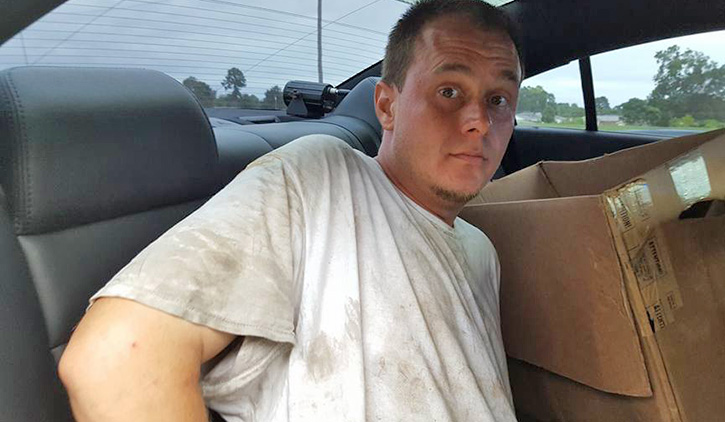
The Flomaton Police Department made several drug busts over the weekend, including one local man. Calem Shane Robinson (pictured top), 32, of Flomaton was arrested and charged with unlawful possession of controlled substance methamphetamine and DUI controlled substance.
(article continues below photo)

Two people from Georgia were arrested on drug charge Friday. John William Reeves (above right) was charged with unlawful possession of controlled substance – methamphetamines, DUI controlled substance, unlawful possession of drug paraphernalia and no seat belt. Brittany Marie Walton (above left) was also charged with unlawful possession of drug paraphernalia.

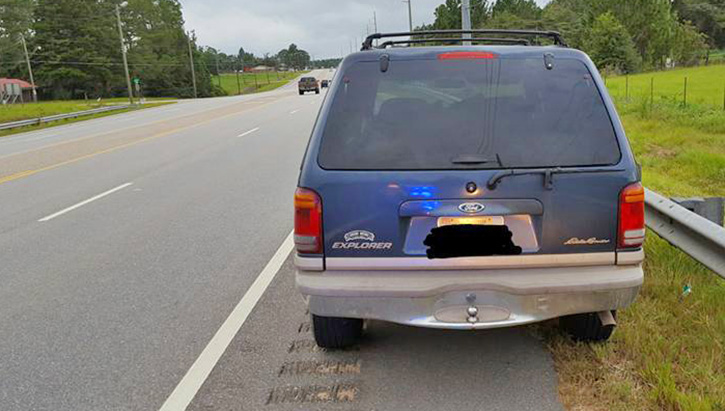
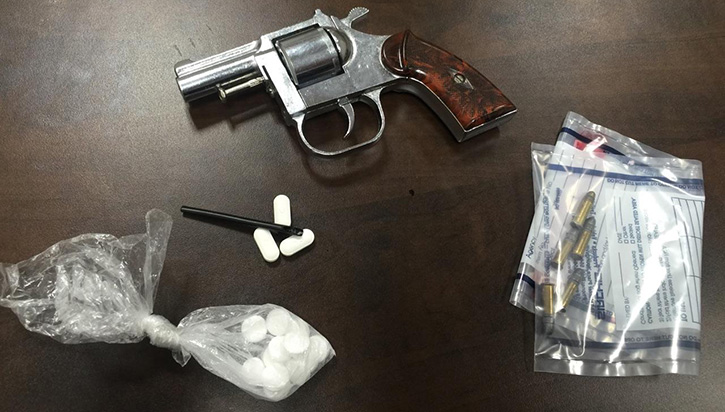
And Flomaton Police also arrested Theautry W Cooper (pictured left), 36, of Eldridge, IA, for unlawful possession of a controlled substance oxycodone, unlawful possession of drug paraphernalia, carry concealed weapon, DUI and driving while license revoked.
Items seized from Cooper’s traffic stop are pictured below.
Photos for NorthEscambia.com, click to enlarge.
‘We Back The Blue’
August 15, 2016
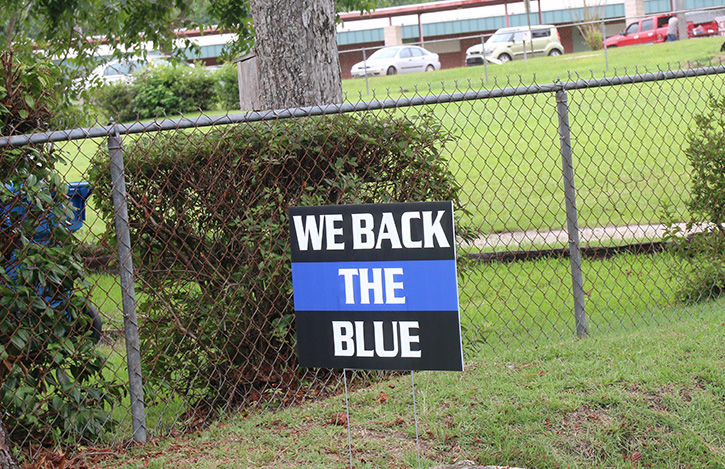
“We Back The Blue” yard signs are appearing across the North Escambia area to show support for local law enforcement. This sign is on Mayo Street near Hecker Road in Century. NorthEscambia.com photo, click to enlarge.
State Says Abortion Waiting Period Does Not Infringe On Rights
August 15, 2016
Trying to move forward with a requirement that women wait 24 hours before having abortions, Attorney General Pam Bondi’s office has filed a brief at the Florida Supreme Court saying such a waiting period “does not significantly burden the right to privacy.”
 The brief is part of a more than year-long legal dispute about a 2015 law that would require 24-hour waiting periods.
A Leon County circuit judge last year approved an injunction that blocked the state from carrying out the law, but the 1st District Court of Appeal in February overturned that ruling. The Supreme Court agreed in May to take up the case after earlier issuing a stay that at least temporarily halted the waiting-period requirement.
In a 49-page brief, Bondi’s office argued that 1st District Court of Appeal had ruled correctly when it rejected the “faulty injunction” by the lower-court judge. The brief also said the law does not restrict abortion rights or women’s privacy rights.
“The new law justifiably protects pregnant women from undergoing serious procedures without some minimal private time to reflect on the risks and consequences of the abortion. … The abortion decision involves deeply personal considerations, and a brief reflection period is a reasonable and minimally intrusive means of ensuring that informed consent to abortion is knowing and voluntary,” the brief said.
But in a brief filed in May, abortion-rights advocates asked the Supreme Court to block the law, saying in part that the waiting-period requirement “only imposes greater burden, stigma, and delay — and communicates the state’s condescending message that a woman seeking an abortion, alone among patients, is unable to decide for herself when she is ready to make an informed decision about her medical care.”
Justices have not scheduled arguments in the case.
Wahoos Win 10-7 Over Tenn.
August 15, 2016

Pensacola Blue Wahoos center fielder Jeff Gelalich was facing his old UCLA buddy and Tennessee Smokies reliever David Berg in the seventh inning when he hit his second triple of the game Sunday off the left center field wall and drove in two runs.
Gelalich’s had a career night at the plate with three extra base hits, including two triples in a game for the first time and he also smacked a double.
His 3-5 night with three runs scored and two RBIs helped the Blue Wahoos win its fifth straight game—its longest winning streak of the season—with a 10-7 victory over Tennessee in front of 4,295 at Blue Wahoos Stadium.
“My buddy was the pitcher and my buddy in college,” Gelalich said. “Now I can go see him after the game and not hear about it.”
Gelalich, who joined the Cincinnati Reds with as the 57th pick overall in 2012 had a lot of hoopla surrounding him when he started his professional career, said he is now “something like 2-20 off of him.”
Gelalich recalled that Berg, a submariner pitcher, was “All-World” in the Pac-12 for the Bruins.
“He’s still a good pitcher,” Gelalich said. “He just had a rough night (Sunday).”
Now, it’s Gelalich who is living up to his potential, working his way into becoming an everyday player for the Blue Wahoos, hitting .270 with five triples, 10 doubles and 16 RBIs in 59 games. He has batted first in the Pensacola lineup in 20 of those games.
“I love it,” he said about leading off. “At the beginning of my career, I was trying to be what everyone wanted me to be. Now, I’m enjoying it and having fun. I’m not taking any of this for granted.”
Pensacola manager Pat Kelly said the 24-year-old Gelalich seems more relaxed.
“He’s never really had that break out year,” Kelly said. “Now that there are no expectations, he is earning his hits.”
After taking the first four games of the five game series from Tennessee, Pensacola could sweep the Smokies with a win Monday. The Blue Wahoos, who were the first half champions, have improved to 25-24 in the second half.
“They took four out of five at their place,” Kelly said. “Obviously, there’s a little payback. We have a chance at winning the fifth game of the series and we’ll try and do that tomorrow (Monday).”
The Blue Wahoos have swept only one other series in its five-year history, when it beat the Montgomery Biscuits in July 2015.
Tennessee jumped out to a 4-0 lead in the first inning, as Pensacola starter Nick Travieso gave up a walk, single, triple and double to the first four batters he faced.
Smokies catcher Victor Caratini hit a triple off the wall in right center to score both center fielder Trey Martin and second baseman Ian Happ to put Tennessee up, 2-0. David Freitas doubled in Caratini for a 3-0 Smokies lead. Frietas moved to third on a wild pitch and then scored on third baseman Jason Vosler’s deep sacrifice fly to left field to make it, 4-0.
But then Travieso, who was making his second start after going on the DL for three starts with a shoulder injury, retired 11 of the next 12 batters and only allowed three more hits over the next four innings.
When Travieso left the game after five innings, Pensacola had gone ahead, 6-4. After working 3.1 innings in his first start back and throwing 58 pitches, Travieso threw 76 pitches Sunday. He allowed six hits, two walks and struck out one, while giving up four runs.
“Obviously that first inning put us behind the eight ball,” Kelly said. “But he got us through five innings. He feels good. It’s just a matter of building his pitch count up. I wasn’t so sure after the first inning that we would be able to do that.”
While Travieso settled down on the mound, the Blue Wahoos settled in at the plate. Pensacola scored its 10 runs on 15 hits Sunday, after getting just four runs on three hits in Saturday’s victory.
Pensacola scored three runs in the third and fourth innings to go ahead, 6-4. The Blue Wahoos sent nine batters to the plate in the third inning and center fielder Jeff Gelalich doubled and scored, second baseman Blandino singled and scored and right fielder Sebastian Elizalde singled and scored.
Pensacola shortstop Zach Vincej singled with the bases loaded and is now 2-6 with three RBIs in that situation. Vincej was 3-5 with a double and two RBIs Sunday and now has 22 multi-hit games.
Three more Blue Wahoos scored in the fourth with Gelalich hitting a triple and scoring, Blandino singling and scoring and Elizalde singling and scoring to give Pensacola a 6-4 lead.
However, Tennessee tied it in the sixth inning when right fielder Lane Adams singled on a tap back to the pitcher and advanced to second on a throwing error. He scored on shortstop Carlos Penalver’s ground out to shortstop. Smokies left fielder Kelly Dugan tied it up, 6-6, when he scored on a hard hit single by pinch hitter Chesney Young.
Before Pensacola won five in a row, it’s longest win streak was four games this season, which they’ve done six times.