

Wahoos Take Series Lead With 5-1 Win Over Mississippi
August 3, 2016
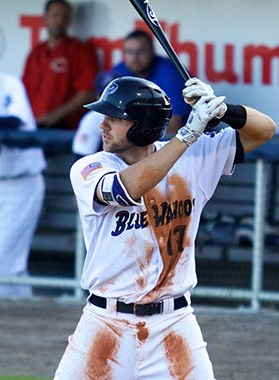
Pensacola catcher, turned first baseman, Chad Wallach continued his team’s power surge Tuesday belting the team’s fifth home run in three games at Blue Wahoos Stadium.
Wallach knocked a two out, two-run bomb to left field that ended up in Pensacola Bay and put the club ahead, 3-0, on their way to a 5-1 victory Tuesday over the Mississippi Braves, who are in first place in the South Division in the second half.
 Pensacola has 76 home runs as a team, which is third in the Southern League and one behind Mississippi.
Wallach’s fifth homer of the season was his second in nine games and also brought home third baseman Taylor Sparks, who drew a two out walk.
Pensacola manager Pat Kelly said Wallach’s homer was critical to give starting pitcher Jackson Stephens some breathing room. Stephens has taken the L in seven of his last 10 starts but that’s because the Blue Wahoos offense has averaged just 1.43 runs in those losses, getting shutout three times.
“He’s been that guy the last month or so who we haven’t been able to get runs for,” Kelly said. “We didn’t make it easy for him.”
Wallach said he was happy to contribute to Stephens’ first victory in five starts. Playing first base for the third time this season Tuesday night, instead of catching, he got on base all four times with a homer, single to left field and two walks.
“When he’s been pitching lately, we have not put up the runs to give him the wins,” Wallach said.
Pensacola also got offense out of right fielder Brandon Dixon, who hit his team-leading 14th home run in the second inning to give the Blue Wahoos a 1-0 lead. Before the homer, Dixon was 2-28 with one RBI and no extra base hits.
Mississippi shortstop Dansby Swanson, the 2015 No. 1 draft pick, led off the seventh inning with a triple when his opposite field fly ball landed just fair and rolled into the corner. The next batter left fielder Dustin Peterson grounded out on a chopper to first to allow Swanson to score, pulling the Braves within, 3-1.
In eighth inning, Pensacola center fielder Jeff Gelalich dove face first on a tailing fly ball to rob Mississippi catcher Willians Astudillo of a base hit.
In the bottom of the eighth, Pensacola second baseman Alex Blandino singled to center field with two outs to drive in two more runs for a 5-1 Blue Wahoos lead. Blandino extended his hitting streak to seven games by going 3-5. During his hitting streak, he’s batting .407 going 11-27.
“He and (hitting coach) Alex (Pelaez) have worked really hard in the cage and he’s starting to have success,” Kelly said. “He enjoys playing and wants to win.”
Meanwhile, Stephens improved to 7-10 on the year with a 3.27 ERA. The 21-year-old pitched seven innings, allowing one run on three hits and one walk, while striking out seven. Stephens retired 15 in a row before the Braves No. 1 prospect, Swanson, hit a triple.
Pensacola also got another strong relief outing from Alejandro Chacin, who slammed the door on Mississippi in the ninth by striking out both Swanson and Peterson, who leads nearly every major offensive category in the Southern League.
Pensacola, the first half Southern League South Division champion, moved into third place at 19-19 in the second half and are 60-48 overall. The Blue Wahoos trail first place Mississippi by three games after they fell to 22-16 in the South Division in the second half and are 56-51 on the season.
Head-to-head, Pensacola has a 9-4 record against the Braves this year.
Parole Denied For Nokomis Brothers In Murder Of Woman, Girl
August 2, 2016
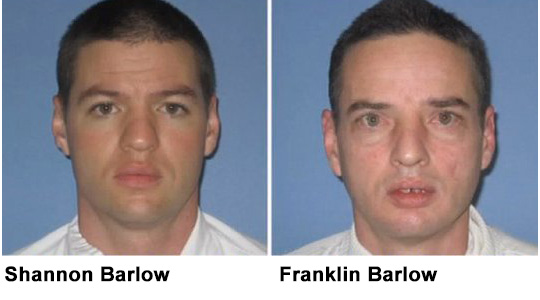
This morning, the Alabama Board of Pardons and Paroles denied parole for two Nokomis men behind bars for the 1993 murder of a woman and 12-year old girl.
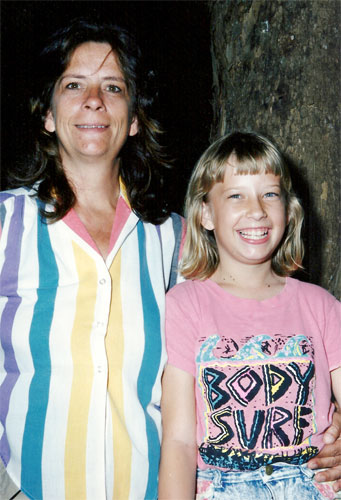 Shannon Dean Barlow, 38, and Franklin Lee Barlow, Jr., 42, are both serving life sentences with the possibility of parole for the murders of Kathy Victor Hall Barlow and Angel Marie Hall. They will eligible for parole again in 2021.
This morning’s parole hearing was attended by 22 family members of the victims, and almost 2,500 area residents signed an online petition to stop the parole after a series of news stories on NorthEscambia.com and other media.
On October 10, 1993, the Barlow brothers went out with Albert Ganoe “Rocky” Beasley, consuming alcohol and smoking marijuana. They then went to the home of Kathy Barlow in Perdido, Ala., shooting her in the head with a .410-gauge shotgun when she opened the door. According to testimony, he then went to the room of Angel Hall, 12, raped her and shot her in the face.
“The reason why Shannon and Frankie Barlow don’t deserve parole is because they viciously murdered my aunt and cousin. They blew my aunt’s head off with a shotgun. They raped, stabbed, strangled, and beat my cousin till her body finally died. There should be no reason in the world why they should be let out. They possess a spirit inside of them that society cannot handle,” Masha Maher of Century said.
“We give all the glory to God, and thank you all for your support and concern,” Maher said.
“We will fight these parole hearings for the rest of our lives and theirs. They do not deserve the right to walk the streets anymore. They are a threat to us and society,” said Barlow’s sister, Janie Criswell of McDavid.
Shannon Barlow was sentenced to three consecutive life terms, and Franklin Barlow was sentenced to two life sentences. Both will remain behind bars at the Limestone Correction Facility in Alabama. Beasley remains in prison, sentenced to life without the possibility of parole.
Man Tells Town Of Century ‘Stay Off My Property’ After ‘Illegal’ Work
August 2, 2016

Two weeks after Century Mayor Freddie McCall said that he may have broken the law with work he had performed on a private road in the town, the man claiming to own the property put the town on notice to stay away.
 “Stay off my property,” David Knight told the Century Town Council Monday night. “Leave me alone.”
On July 18, McCall said that about six to eight months prior he had a load of dirt dumped into washed out areas on Ashford Alley, a dirt roadway off Jefferson Avenue. His move came after a resident approached McCall and requested additional maintenance on the road. He said recent research found that Century does not have a deeded right-of-way or easement on Ashford Alley according to Escambia County Property Appraiser records.
“There is no such thing as Ashford Alley,” Knight said, waving paperwork in front of the council. “It does not say anything about Ashford Alley on my deed.”
For a previous story, click here.
Pictured top and inset: Resident David Knight warns the Town of Century to say off his property during a Monday night council meeting. NorthEscambia.com photos, click to enlarge.
Taiwanese Delegation Learns About American Agriculture On Walnut Hill Visit
August 2, 2016

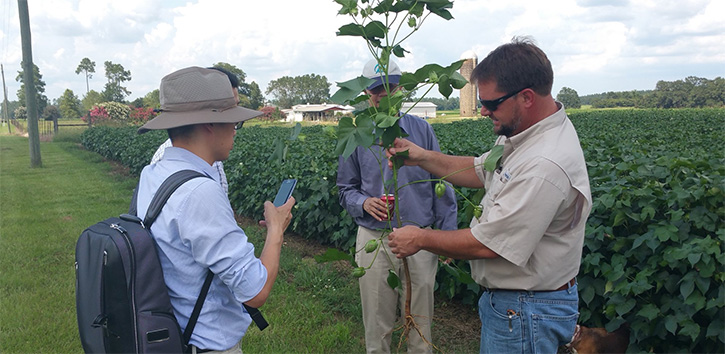
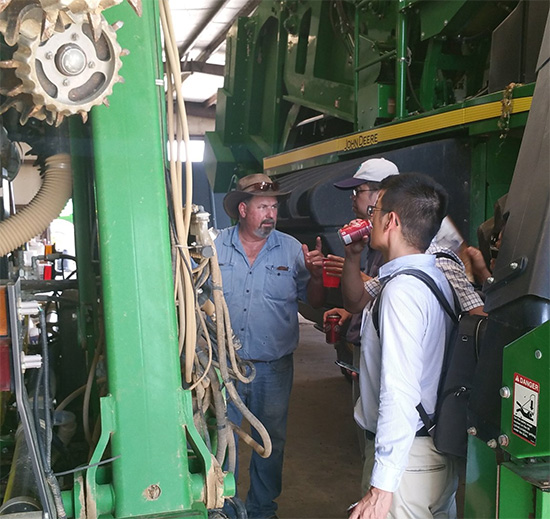
A small delegation from Taiwan learned about agriculture Monday in Walnut Hill and Cantonment.
The delegation, including a farmer, economist and bureaucratic official visited the Brett Ward farm in Walnut Hill where they learned about precision agriculture and equipment using GPS, and the Mike Koehn farm were they learned about cotton and invasive species. They also learned about agricultural farm apps for smartphones. And they enjoyed homemade cinnamon roles baked by Sharla Koehn.
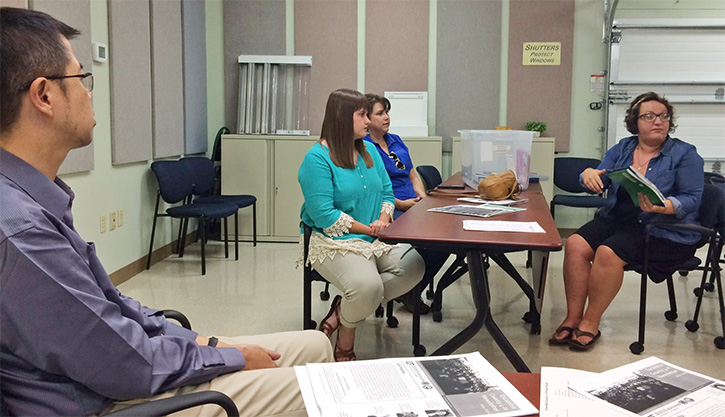
Earlier in the day, the delegation discussed the FFA program with Lydia Weaver and the 4-H curriculum with Jenny Savely at the Langley Bell 4-H Center in Cantonment.
Pictured top and below: Visitors from Taiwan learn about cotton in Walnut Hill on Monday. Pictured inset: Enjoying a homemade cinnamon roll in Walnut Hill. Pictured second below: Learning about smartphone apps in agriculture. Pictured third below: Brett Ward of Walnut Hill discusses precision agriculture. Pictured bottom: Lydia Weaver discusses FFA and Jenny Savely explains 4-H to the group. Photos for NorthEscambia.com, click to enlarge.

Football Practices Open With New Contact Rules; New Coach For Northview
August 2, 2016

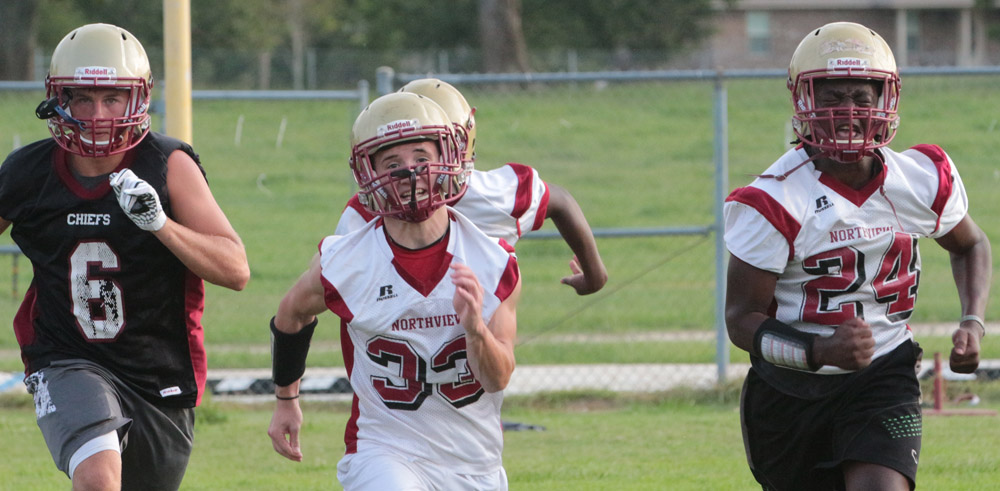
High school football practices opened across the North Escambia area Monday, with new practice rules for everyone and a new head coach for one school.
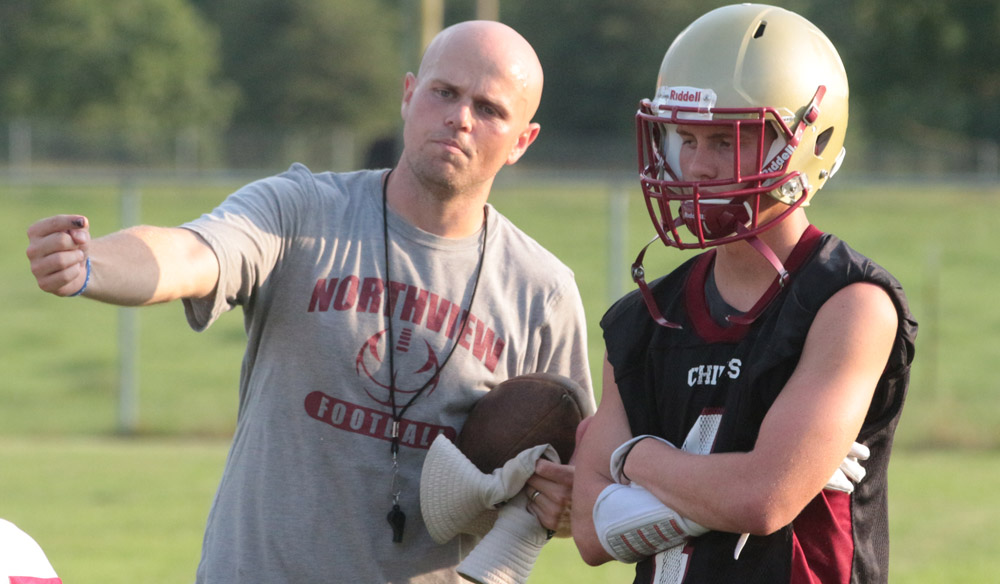
At Northview High School, it was the first practice under new head coach Derek Marshman, who was named to the position just last Friday following the resignation of Sid Wheatley. The Chiefs were the last team in Escambia County to bring home a state title, having won a state championship in 2012 under Wheatley and then-assistant coach Marshman.
Monday also marked the first day new Florida High School Athletic Association procedures that limit live contact at every member school in the state in an effort to improve player safety.
During the regular season, live contact will be restricted to 30 minutes per day and 80 minutes total per week. Live contact, defined as drills with game-like conditions where players are taken to the ground, will not occur on more than two consecutive days and may not exceed three practice days per week.
“Player safety has and will always be the number one goal of the FHSAA,” FHSAA executive director Dr. Roger Dearing said. “Protecting our student-athletes is paramount in growing the game of football and this administrative procedure is a step in the right direction.”
From day six through Monday of the first regular season game, live contact at all schools will be limited to 40 minutes each day, with no more than two straight days of live contact. During two-a-days, only one practice shall include live contact and it shall not surpass 40 minutes.
“The game of football will always come with some inherent risk, but we will never stop working to try and make one of the greatest team sports on earth safer,” FHSAA Football Administrator Frank Beasley said. “We will continue our efforts to educate and teach coaches on the Drive to December about how to run effective practices while using the limited-contact procedures.”
Pictured top: New Northview Coach Derek Marshman held practice Monday, just day after being named head coach. Pictured inset and below: The Chiefs open practice Monday. NorthEscambia.com photos, click to enlarge.
Bicyclist Dies As Result Of Traffic Crash
August 2, 2016
A bicyclist has died as the result of injuries received in a traffic crash Monday night.
 According to the Florida Highway Patrol, 22-year old Martin Curran of Escambia County was westbound on Sorrento Road near Coral Creek Road about 8:55 p.m. Breanna Rodriguez, 18, attempted to pass the bicyclist in a Saturn Vue by entering the painted median. As Rodriguez was passing, Curran also entered the painted median, directly into the path of the vehicle.
Curran was transported to Baptist Hospital where he later passed away.
Any charges are pending the outcome of a traffic homicide investigation, according to the FHP.
Response Team Secures Holman Prison Dorm After Stabbing; Lockdown Continues
August 2, 2016

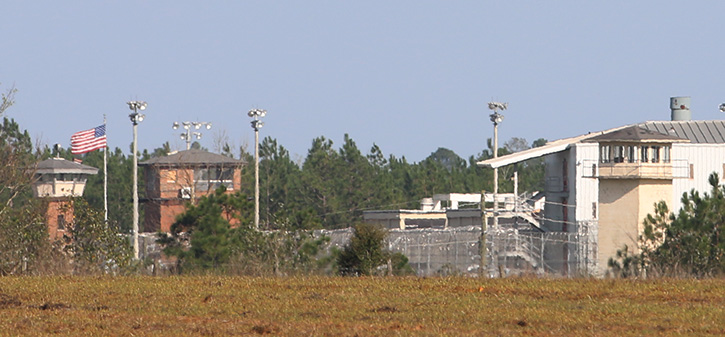
Officials with the Alabama Department of Corrections reported Monday night that a dorm inside the William C. Holman Correctional Facility in Atmore was secure following a disturbance hours earlier.
At 9:45 p.m.Monday, a Correctional Emergency Response Team (CERT) entered the dorm without meeting any resistance from the inmates. Inmates were cooperative and the situation was resolved without use of force or further incident.
The prison was placed on lockdown following an altercation about 3 p.m. between a group of inmates housed in the dorm.
Initial reports indicated four inmates were involved in the altercation. In an updated report, officials said only three inmates were involved in the incident and confirmed all three received stab wounds in the altercation. The inmates were treated onsite for non-life threating injuries.
The incident had escalated when several inmates inside the dorm became aggressive toward the correctional officers who were responding to the altercation. As a precaution, the officers secured the door to the dorm area and waited for backup from the CERT team.
The facility is reporting some damage inside the dorm area caused by a fire the inmates had started during the disturbance. Other areas of the prison were not affected.
The ADOC is conducting an investigation to determine the cause of the incident. The prison will remain on lockdown until the investigation is complete.
NorthEscambia.com file photos.
Homegrown Zika Cases In Florida Climb To 14
August 2, 2016
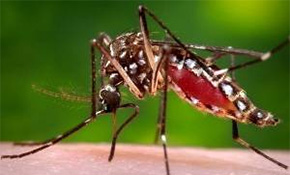
Gov. Rick Scott said Monday that 10 more people are believed to have contracted the Zika virus through mosquito bites in Miami and that the state is asking for additional help from the federal Centers for Disease Control and Prevention.
The announcement came after Scott and health officials disclosed Friday that the first four locally transmitted Zika cases had been diagnosed in residents of Miami-Dade and Broward counties. About 400 Zika cases have been diagnosed in the state, but until Friday all of the cases were described as travel-related. Two travel-related cases of Zika have been reported in Escambia County.
 A statement released by Scott’s office said the 14 locally transmitted cases are believed to have occurred in a 1-square-mile area north of downtown Miami.
“Today, DOH (the Florida Department of Health) has confirmed that 10 additional people have contracted the Zika virus locally, likely through a mosquito bite,” Scott said in the statement. “DOH has been testing individuals in three locations in Miami-Dade and Broward counties for possible local transmissions through mosquito bites. Based on DOH’s investigations, two locations have been ruled out for possible local transmissions of the Zika virus. DOH believes local transmissions are still only occurring in the same square mile area of Miami.”
Scott also said the Centers for Disease Control and Prevention has issued a notice advising women who are pregnant or thinking about becoming pregnant to avoid unnecessary travel to the targeted area. The virus is particularly dangerous to pregnant women and can cause severe birth defects.
“While we continue to learn more about this virus each day, we know that it is most harmful to pregnant women and their babies,” Scott said in the statement. “For women who live or work in the impacted area and are either pregnant or thinking of becoming pregnant, I urge you to contact your OB/GYN for guidance and to receive a Zika prevention kit.”
Scott said he also is asking the Centers for Disease Control and Prevention to activate an “emergency response team” to help the Department of Health. The federal agency has been heavily involved for months in trying to combat Zika in the United States and other countries.
The statement said six of the 10 newly diagnosed people are “asymptomatic” and were found through a door-to-door survey conducted by the Department of Health. It did not say whether all 10 of the people live in the area. Of the 14 locally transmitted cases, two involve women and 12 involve men.
Public health officials have long feared that Zika, which emerged last year in South America, would be spread by mosquitos this summer in Florida and other states. Scott and state Agriculture Commissioner Adam Putnam on Friday announced a series of steps to try to fight the spread of the disease, including stepped-up efforts to control the mosquito population.
Florida Republican and Democratic leaders have also expressed frustration that Congress has not passed additional funding to help combat Zika. President Barack Obama early this year proposed spending $1.9 billion on Zika, but lawmakers could not agree on a funding package.
In a statement Friday, U.S. Rep. Vern Buchanan, R-Fla., said the announcement of locally transmitted cases was “exactly what the nation’s top disease fighters alerted Congress about for months.”
“It’s critical now that we immediately direct all necessary federal resources to this health crisis to protect the public,” said Buchanan, who supported Obama’s request for funding. ” Millions of Floridians — and Americans at large — are at risk as the hot summer months roll on and mosquitoes continue to spread.”
by Jim Saunders, The News Service of Florida
Sparks Crushes Walk-off Homer For The Wahoos
August 2, 2016
Taylor Sparks hit his second solo home run in two games but this time it came in the 11th inning as a pinch hitter to give the Pensacola Blue Wahoos its franchise record ninth walk-off of the season.
Sparks is now 3-3 as a pinch hitter with two homers and a single.
“That’s fun right there,” said Sparks after the game whose seventh homer of the season gave Pensacola a 4-3 victory Monday in front of 3,943 at Blue Wahoos Stadium.
 Pensacola manager Pat Kelly said he “felt very comfortable” with Sparks, who is hitting .198 on the season, pinch hitting with one out.
“I did like Sparks in that situation,” Kelly said. “He’s a good looking player. Obviously, he’s got power. Those (walk-offs) are pretty amazing. I don’t think I’ve ever seen a team hit that many.”
Sparks, who is playing his first season in Double-A getting called up June 22, said he goes to the plate with a different approach when he’s pinch hitting.
“I walk up to the plate just trying to smash one,” said Sparks, who hit two homers in his Double-A debut. “It’s tough coming off the bench and swinging it. I waited for a pitch I could hammer. There’s no science to it.”
Pensacola, the first half Southern League South Division, improved its record to 18-19 in the second half and 59-48 overall. Mississippi is now 13 of 17 and leads the South Division in the second half with a 22-15 record and are 56-50 on the season.
Pensacola third baseman Alex Blandino sent the game into extra innings with his solo bomb that tied the score up, 3-3, in the bottom of the seventh inning. His deep fly ball cleared the left field fence just over the outstretched glove of Mississippi left fielder Dustin Peterson.
Mississippi had taken the lead, 3-2, in the seventh inning when catcher Joseph Odom ripped his first home run of the season over the left field wall in the top of the seventh inning to score two runs to tie the game, 2-2. Braves pinch hitter Carlos Franco hit a two-out single to drive in right fielder Stephen Gaylor, giving Mississippi a 3-2 lead.
“These are two pretty good clubs right here,” Kelly said. “They got a hanger and beat us last night and we got a hanger and beat them tonight (Monday).”
Pensacola shortstop Zach Vincej, named Southern League Player of the Week earlier in the day, continued his hot hitting Monday. Vincej — batting .444 during his seven game hit streak — hit a chopper that squeezed between the third baseman and shortstop in the fourth inning to drive in left fielder Phillip Ervin, who doubled to start the inning. The run put the Blue Wahoos ahead, 1-0.
Ervin then hit a grounder to shortstop and beat out the throw on a double play attempt by Mississippi, allowing center fielder Jeff Gelalich to score from third in the fifth inning to put Pensacola ahead, 2-0.
Pensacola starting pitcher Rookie Davis cruised through the first six innings against Mississippi, allowing only one hit and retiring 11 in a row.
Mississippi’s best chance to score against Davis came in the sixth inning when center fielder Connor Lien reached third base with two outs and shortstop Dansby Swanson at the plate. Swanson entered the game hitting .360 against Pensacola but Monday was 0-4. Davis, a 22-year-old righty, struck out Swanson, the 2015 No. 1 draft choice, to end the inning.
Davis ended up allowing three runs, though, in the seventh inning to the Braves. He finished the game throwing 6.2 innings, giving up four hits and two walks, while striking out four.
In his previous four starts, Davis has allowed three earned runs in 23.1 innings for a 1.16 ERA, while striking out 24. He has won his last three starts and the Blue Wahoos had won all four games that Davis started.
“Rookie (Davis) was terrific,” Kelly said. “He had a one-hitter going into the seventh. I told him real men play in the National League. You have to run the bases and pitch, too.”
Mississippi starting pitcher Jed Bradley had dominated the Pensacola lineup coming into the game going 3-0 in 10 appearances and throwing 15 scoreless innings with 12 strikeouts.
After throwing three scoreless innings of one-hit ball with four strikeouts Monday, Pensacola finally broke the lefty’s streak with Ervin’s run in the fourth inning.
Mississippi’s Bradley ended up lasting 5.2 innings giving up two runs on six hits and three walks, while striking out a season-high eight batters.
The Braves gave up two runs on two hits both solo homers by Sparks and Blandino. Despite that, they have now allowed nine runs in 65.1 innings dating back to July 11.
Property Taxes Hiked In Century Due To Tornado Destruction
August 2, 2016
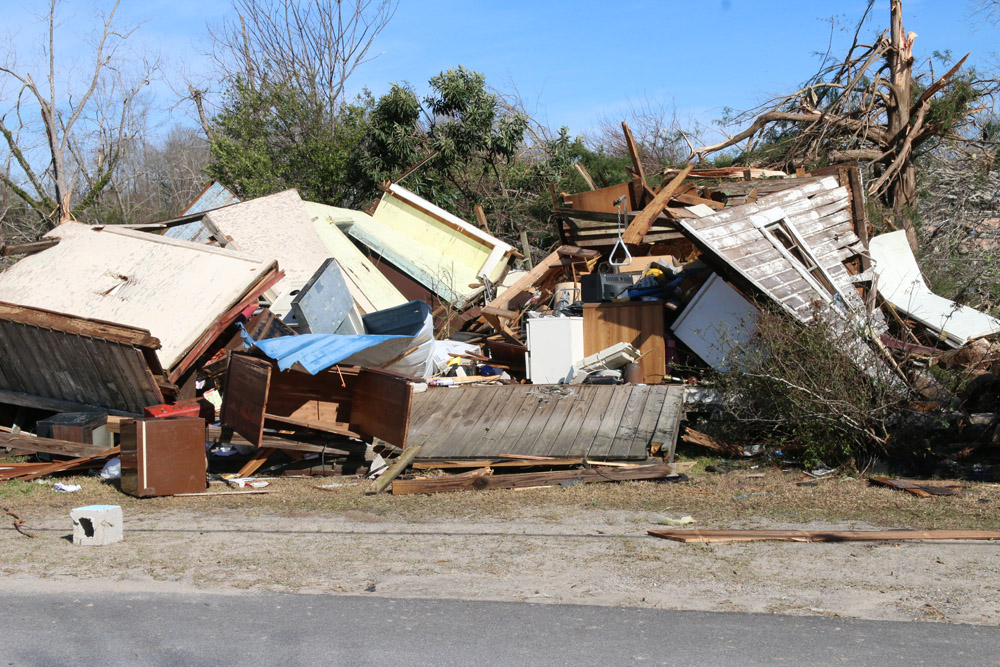
Property taxes in Century are going up to offset revenue lost when hundreds of thousands of dollars worth of property was destroyed during an EF-3 tornado.
The Century Town Council voted Monday to hike the ad valorem millage rate from 0.9005 to 0.9732 for the next fiscal year. That’s equal to a $3.63 tax increase on a $50,000 property.
The town lost $404,593 in taxable property to the February tornado, according to the Escambia County Property Appraiser’s Office.