
Brand New Century Academy Shines During Open House
August 5, 2016
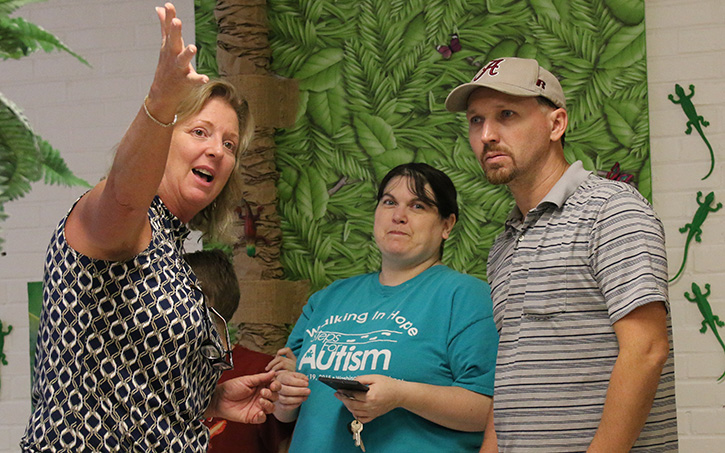
An open house was held Thursday evening at the new Century Academy, a private, non-profit K-12 school that will specialize in teaching children diagnosed with autism and other related learning disabilities.
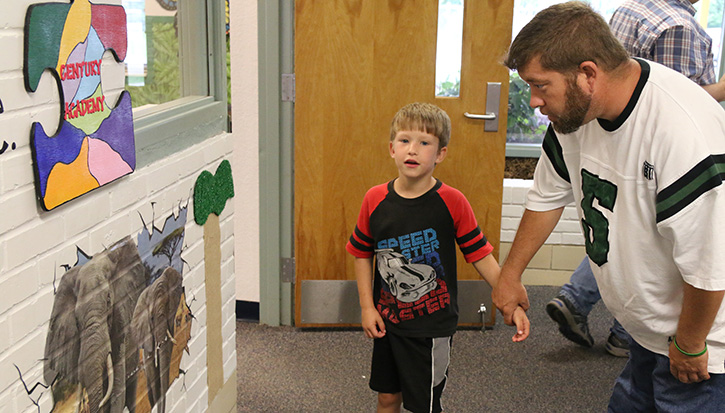
Century Academy is operated by the well established East Hill Academy in Pensacola. It’s located in the former Carver/Century K-8 school on Hecker Avenue — an older building that has been transformed with plenty of paint and decor into a world filled with rain forest and ocean scenes — designed to capture the attention and imagination of children with autism.
“It is a beautiful place but one that is carefully designed to enhance the educational experience for children with autism and other learning disorders,” said director Barbara Barber.
After winning $20,000 in the Studer Institute’s Century Business Challenge, Barber knew the time was right for Century Academy, and she wanted it to be as much of a part of Century of possible.
“I hired only local staff,” Barber said. “I wanted them to be part of the community.”
 The K-12 school plans to operate with a student-teach ratio of about five to one, with a teacher and assistant, in each classroom. Each students will have a Lenovo Thinkpad laptop, not a Chromebook like is being used in the public schools, she said.
Before the open house, about 15 students had officially registered for Century Academy, but Barber said she expects more students will be registered as their August 15 first day of school approaches. And she said she expects additional students to transfer in after school begins.
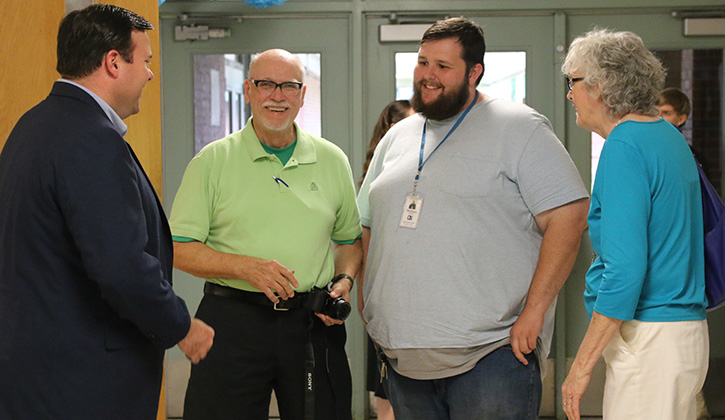
“I’m so excited about the opening of Century Academy. This school has the potential to change the entire face of the community and raise the bar economically for the community and personally for the children for years to come,” Rep. Clay Ingram, who attended the open house Thursday, said.
Century Academy has an official motto, stenciled on a wall just inside the front door — “We are Century Academy. All of us are unique. And when we come together, The puzzle is complete.”
There are two types of scholarships available for students that will cover the cost of tuition at the private school. Century Academy is now actively in the second phase of registration for the John McKay scholarship. This scholarship has a September 1 deadline to file an intent notice.
For more information about Century Academy, call (850) 437-5560.
NorthEscambia.com photos, click to enlarge.

State Attorney: Morgan Campaign Ad In Northview FFA Program Not Criminal
August 5, 2016

The State Attorney’s Office has completed its review into a complaint that Sheriff David Morgan’s re-election campaign violated the Florida elections law concerning an advertisement that was published in a program booklet for the Northview FFA Blue Jacket Jamboree last spring.
The SAO found that there is insufficient evidence to prove a criminal violation. They determined that possible civil violations of the election law may have been committed, and the complaint has been refereed to the Florida Elections Commission.
The report from the State Attorney’s Office stated:
The State Attorney’s Office was contacted regarding possible election law violations by Sheriff David Morgan’s re-election campaign. These reports alleged two possible violations. The first possible violation was that Morgan’s campaign published a political advertisement that did not contain the required disclosure statement. The second allegation was that a Sheriff Office employee, Chief Deputy Eric Haines, participated in a political campaign while on duty.
Morgan’s campaign was contacted by a student representative at Northview High School to see if the campaign was interested in publishing a political advertisement in the Blue Jacket Jamboree booklet. A half-page advertisement was
purchased and was paid for using campaign funds in February 2016. Chief Deputy Haines asked his daughter to design and prepare the advertisement. On March 7, 2016, Chief Haines’ daughter completed the advertisement and sent it by email to Perry Byars, the FFA faculty advisor at Northview. Byars acknowledged receiving the advertisement and forwarding it to the FFA treasurer. This political advertisement did not contain the required disclosure stating the candidate’s name, party affiliation, or office sought.
On March 31, 2016, the Northview student responsible for the Blue Jacket Jamboree booklet contacted Morgan’s campaign deputy treasurer, Henrique Dias, to determine if the campaign was still interested in publishing an advertisement. At the time this email was sent, the student was unaware that Byars had already received the advertisement. This email was forwarded to Chief Haines the morning of April 1, 2016, shortly before he arrived at the Sheriff’s Office for work.
Haines, being concerned that his daughter had failed to complete the delivery of the advertisement, attempted to contact her. When he was unsuccessful in contacting his daughter and believing that there was an immediate deadline to return the advertisement, Chief Haines sent an email to the Northview student with the political advertisement attached. This email was sent at 9:26 a.m. while Chief Haines was on duty at the Escambia County Sheriff’s Office. This email was sent using Chief Haines personal cell phone and personal email account. No sheriff’s office computers or equipment was ever used.
The SAO said the required political disclaimer in the ad is a civil matter, enforceable by the Elections Commission with a fine up to $1,000.
The SAO also determined there was insufficient evidence to provide a criminal violation by Haines. Morgan has set forth policies and procedures that prohibit employees from engaging in political activity while on duty.
After the investigation, Haines docked himself one day of leave. For this reason, the SAO said the matter will be referred to the Florida Elections Commission for their review.
Tate Cheerleaders Take Honors At Camp; Four Headed To London
August 5, 2016

The Tate High School cheerleading squads recently attended the UCA Cheerleading Camp in Panama City Beach. The Tate varsity and junior varsity brought home Superior Overall in both of their categories.
Varsity received first place extreme routine, first place sideline, second place game day and Superior Overall.
Junior varsity received second place extreme routine, second place cheer and Superior Overall, and the freshman squad received second in game day.
Four Tate High cheerleaders — Payton Simmons, Zoe Williams, Jasmine Crabtree, and Mallory Stephens — were All-American Cheerleaders out of hundreds who attended the camp. Those who earned All-American status have been invited to cheer in the New Year’s Day parade in London.
Members of the Tate Varsity cheerleaders are: Taylor Roushon, Gloria Jones, Jasmine Crabtree, Emilee Potter, Cole Stillwater, Jonah Cass, Kinsey Gill, Krysanne Hagen, Mallory Stephens, Blessing Kirk, Lexi Holley, Elena Lucci, Morgan Austin, Brylee Dodd, Alexis Wilson, Kennedy Bellard, Hayden Lindsay, Abi Manoso, Kearstyn Lile, Bailey Carter, Shelby Flemming, and Coach Jessica King.
Members of the Tate Junior Varsity cheerleaders are: Payton Simmons, Tayler Mills, Kyndal Milstead, Zoe Williams, Taylor Barnes, Kensley Foley, Payton Herring, Keaden Martin, Kyanna Woods, Hannah Hamilton, Destiny Campbell, Madyson Reaves, Carlie Boswell, Danyah Turner, Ally Stephens, Skylar Smith and Coach Jamie Southard.
Members of the Tate Freshman cheerleaders are: Leila Jones, Madison Lucio, Skye Stillwater, Sherrie Swinson, Maddie Ray, Hailey Morphis, Savannah Weaver, Savanna Bowen, Lillie Hamrac, Karis Parmley and Coach Karen Potter.
Pictured top: Tate Varsity cheerleaders. Pictured first below: Invited to London are All-American cheerleaders Jasmine Crabtree, Mallory Stephens, Zoe Williams and Payton Simmons. Pictured second below: Tate JV cheerleaders. Pictured third below: Tate Freshmen cheerleaders. Photos for NorthEscambia.com, click to enlarge.



Mississippi Beats The Wahoos In Five Hour Game
August 5, 2016

The Pensacola Blue Wahoos and Mississippi Braves were locked in a 2-2 tie for 13 innings and then the 14th inning happened.
That’s when the Braves sent 12 batters to the plate scoring eight runs on four walks, four singles and four errors by the Blue Wahoos. Mississippi won, 10-2, over Pensacola Thursday in a four hour, 57 minute game at Blue Wahoos Stadium to stay tied with Mobile for first place in the Southern League South Division. Both teams are 24-16, while Mississippi improved to 58-51 this season.
Pensacola fell to 9-4 on the season in extra-inning games. They also dropped to 9-2 in five-game series at home on the year after going a perfect 7-7 in the first half.
Pensacola is now 19-21 in the second half and 60-50 on the season.
In the top of the 14th inning, Pensacola relief pitcher Jake Ehret gave up a one out, bases loaded walk to center fielder Connor Lien to score third baseman Johan Camargo, who started the inning with a single. It gave the Braves a 3-2 lead and opened a flood gate of runs for Mississippi.
Pensacola set a franchise record with 20 strikeouts in the extra-inning game. The previous high was 18, including one that was a regular nine inning game.
Pensacola second baseman Ronald Bueno came to the plate with the bases loaded and two outs in the ninth inning. Bueno, who was called up from High-A Daytona Tortugas Tuesday, took a 2-2 pitch and sent a liner to left field to score right fielder Brandon Dixon to tie the game, 2-2, and send it into extra innings for the second time this series.
It was no pressure on the 23-year-old Bueno, who in his last bases loaded situation this season hit a double and drove in two runs for Daytona.
The Braves scored first, going up, 2-0, when first baseman Carlos Franco hit a two-out, two-run line drive over the center field wall in the sixth inning.
Pensacola got a run back in the seventh inning when the Blue Wahoos loaded the bases with one out and right fielder Brandon Dixon scored from third on a wild pitch, pulling them within 2-1.
Pensacola went 6-50 or .120 with runners in scoring position against Mississippi in the series. In the previous series against the Montgomery Biscuits, the Blue Wahoos hit .190.
Sean Newcomb, the top Atlanta Braves pitching prospect, retired 16 in a row Thursday. He struck out a season-high 10 Blue Wahoos and gave up three hits in 6.2 innings.
Newcomb, who has allowed one run or less in nine of his 22 starts, did not get a decision Thursday and remains 5-7 on the year with a 4.26 ERA.
A first round pick in 2014, Newcomb dueled Pensacola spot starter Barrett Astin matched goose eggs through the first five innings. Astin, who had started in his last three outings and eight times this season, finished his outing pitching 5.2 innings, allowing two earned runs on four hits and one walk and striking out six.
New Plant, 100 High Tech Jobs Coming To Atmore
August 5, 2016
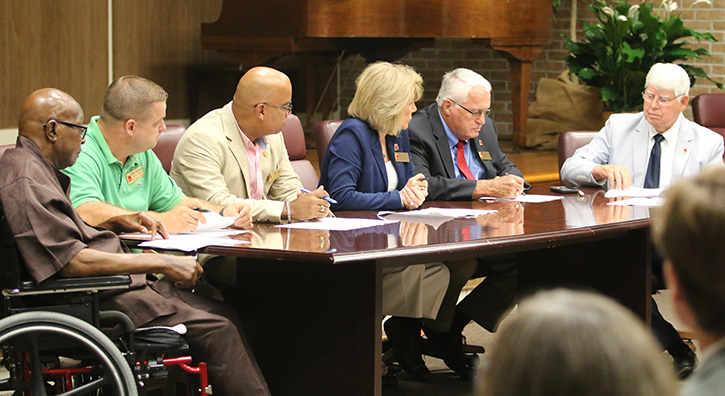
The City of Atmore officially signed off Thursday on an agreement with Hunstville-based Brown-Precision that will bring 100 new jobs and a multi-million dollar investment to a new industrial park. And officials say they hope it is just the beginning of the job announcements in a new aerospace corridor.
Aerospace is Alabama’s second fastest growing industry sector and a key target in my Accelerate Alabama economic development strategy,” Alabama Gov. Robert Bentley said in a prepared statement. “I’m committed to helping companies like Brown Precision expand in Alabama and strengthen their aerospace business. Rural communities are important to me, and I am honored to know the hard-working men and women in Atmore will soon have an opportunity to compete for more than 100 skilled well-paying jobs.”
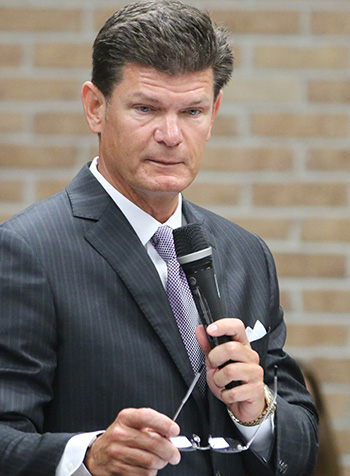 “We are excited about being in Atmore,” Greg Brown, president and co-CEO of Brown Precision said Thursday morning in Atmore. “We hope this is going to be a corridor of aerospace industry all up and down I-65.” .
“Brown Precision is a great addition to Southwest Alabama’s growing aerospace cluster, which is poised to become a key region in this global industry over the next decade,” said Greg Canfield, secretary of the Alabama Department of Commerce. “Brown Precision counts many of the industry’s biggest names as clients, so its expansion to Atmore says a lot about the region’s potential.”
Brown Precision, a family owned company founded in 1964, performs precision machining for clients in the aerospace and medical industries. It manufactures complex components ranging from aircraft and helicopter components to artificial human joints. Clients include GE Aviation, GKN Aerospace, Bell, PPG Aerospace, and Smith & Nephew.
The Atmore facility is expected to eventually employ more than 100 workers in activities such as CNC-based manufacturing, custom fabrication and component coating. The company expects to make an initial investment of approximately $7 million in the facility, with expansions possible.
“We think the Atmore area is a great fit for what we do at Brown Precision Inc., and we look forward to being part of the community,” said Dan Brown, the company’s co-CEO and chief operating officer. “We believe southwest Alabama and the Coastal Gateway region is positioned extremely well as a point of growth for the aerospace industry, and we wanted to be on the leading edge of that. We look forward to putting down roots that will hold for many years to come.” Dan Brown will move to the Atmore area to oversee the new facility.
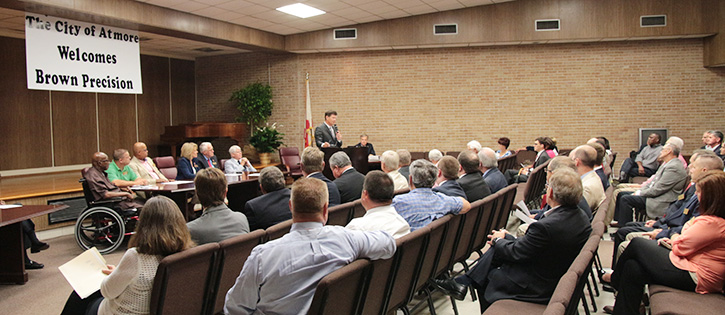
At a ceremony in Atmore today, Mayor Jim Staff welcomed Brown Precision as the first industrial tenant in the Rivercane Industrial Park, located at the intersection of Interstate 65 and Alabama 21. A new access road to the park will be built in coming months.
“It is great day for Atmore,” Staff said. “They are going to be a great fit for the community.
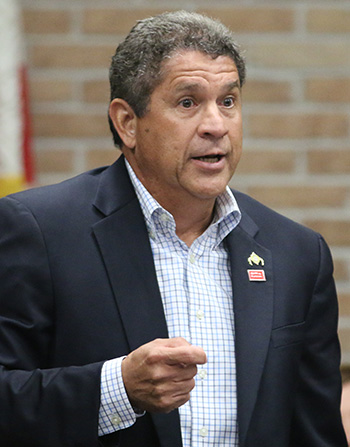 “The Atmore area is a prime area to become a cluster of aerospace activity,” Tim Martin, president and CEO of the Creek Indian Enterprises Development Authority. He said CIEDA’s Muskogee Metalworks will work in conjunction with Brown Precision, allowing the companies to bid on larger projects, especially for the government.
To develop the Rivercane Industrial Park, the City of Atmore received funding commitments from the Alabama Department of Transportation, the Alabama Department of Economic and Community Affairs and the Delta Regional Authority.
The Alabama Department of Commerce and AIDT, the state workforce development agency, lent support to the Brown Precision project, as did numerous local agencies and businesses. The Poarch Band of Creek Indians and Creek Indian Enterprises also supported the project.
“We believe our region is going to benefit greatly over the years from the presence of Airbus and the expansion of the aerospace industry in general,” said John Johnson, executive director of the Coastal Gateway Economic Development Alliance, which acted as project manager.
“Adding Brown Precision Inc. to existing local aerospace companies, such as Muskogee Technology, and connecting with our local community colleges and training programs, serves notice that the Coastal Gateway region is not only ready to expand our aerospace sector, but has also proven capable of doing so,” Johnson added.
Pictured top: The Atmore City Council, with Mayor Jim Staff (right), approved the resolutions necessary to enter into an agreement with Brown Precision during a special meeting Thursday morning. Pictured top inset: Greg Brown, president and co-CEO of Brown Precision. Pictured botttom inset: Tim Martin, president and CEO of the Creek Indian Enterprises Development Authority. Pictured below: A large crowd was on hand for the Brown Precision announcement. NorthEscambia.com photos, click to enlarge.
Morning Rains Cause Flooding Problems
August 4, 2016

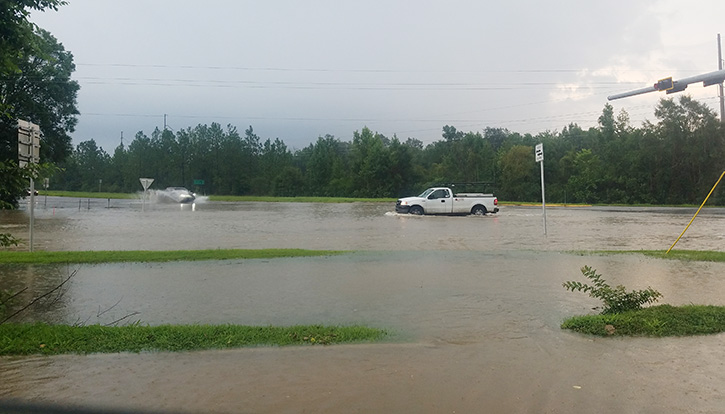
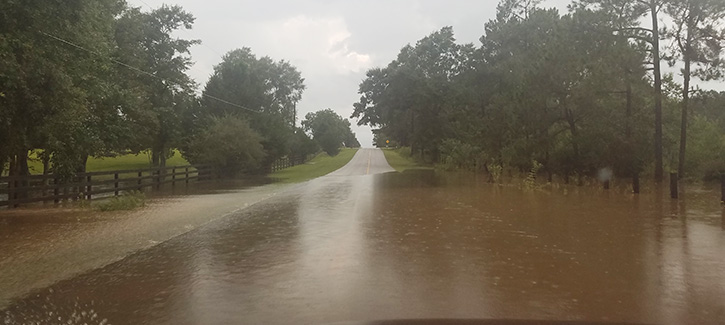
Heavy rains caused flooding across a large portion of Escambia County Wednesday morning, including Molino, where flooding was a major issue at the intersection of Highway 29 and Highway 97 (first three photos) and on Crabtree Church Road (bottom photo). NorthEscambia.com photos by Kayla Bedell, click to enlarge.
ECSO: Two Robberies At Cantonment Tom Thumb Are Related (With Video)
August 4, 2016

The Escambia County Sheriff’s Office now says they believe two different robberies at a Cantonment convenience store were committed by the same suspect.
The Tom Thumb at Highway 29 and Woodbury Circle was robbed on July 4 and again on July 29. In both robberies, the suspect walked behind the counter and took cash from the register without producing a weapon.
In the July 4 robbery, the black male opened the store’s door using a white cloth on his hand, walked around behind the counter an demanded cash. He did not produce or indicate that he had a weapon. He was wearing a gray and black ball cap, mostly black clothing and black tennis shoes.
In the second robbery on July 29, the suspect is seen in a black ball cap, dark pants, white t-shirt. and the same black tennis shoes.
The suspect was described as being about 5-feet, 8-inches tall and weighing 150 pounds.
Anyone with information on the robbery is asked to call the Escambia County Sheriff’s Office at (850) 436-9620 or Crime Stoppers at (850) 433-STOP.
Surveillance video from both robberies is below.
Obama Commutes Sentences Of 214, Including Two From Pensacola, One From Atmore
August 4, 2016
President Obama commuted the sentences of 214 more federal inmates Wednesday, including one from Atmore and two from Pensacola.
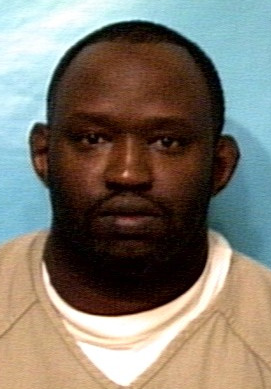 Scottie Ladon Dixon of Atmore was sentenced to life in prison with a concurrent 33 month sentence with 10 years supervised released on May 18, 2010. Dixon pleaded guilty to conspiracy to possess with intent to distribute crack cocaine. Dixon admitted in federal court that he sold 6.2 kilograms (13.67 pounds) of crack cocaine while he was on supervised release from a 1997 drug conviction.
A Drug Enforcement Administration’s High Intensity Drug Trafficking Area task force agent used a confidential informant to purchase crack from Dixon near Bay Minette on April 21, 2009. According to court documents, Dixon bragged about the quality of crack and sold the confidential informant two cookies of crack for $2,000. As federal agents raided Dixon’s home, he was found at the end of a trail of cocaine powder, standing over a toilet. Court documents indicated that agents found crack in the sewage pipes under his trailer. He was taken into custody by federal agents at his trailer at 307 East 4th Street in Atmore on April 30.
Dixon’s sentence was commuted to a term of 221 months imprisonment.
Christopher M. Dees of Pensacola was sentenced to life in prison, 10 years supervised release and a $1,000 fine on September 1, 2004. He was convicted of conspiracy to possess with intent to distribute 5 kilograms or more of cocaine and 50 grams or more of a mixture and substance containing a detectable amount of cocaine base. His prison sentence was commuted to a term of 262 months imprisonment, conditioned upon enrollment in residential drug treatment.
Christopher Stanton of Pensacola was sentenced to 360 months imprisonment with eight years supervised release on July 25, 2006. He was convicted of possession of a firearm by a convicted felon and possession with intent to distribute 5 grams or more of cocaine base. His sentence was commuted to expire August 3, 2018, conditioned upon enrollment in residential drug treatment.
Obama has now commuted the sentences of 562 people incarcerated under what he calls outdated and unduly harsh sentencing laws, including 197 individuals who were serving life sentences. The majority were nonviolent offenders sentenced for drug crimes. He has commuted the sentences of more prisoners than the past nine presidents combined. He has also granted 70 pardons.
Students Enjoy Milkshakes With Their School Resource Officer
August 4, 2016
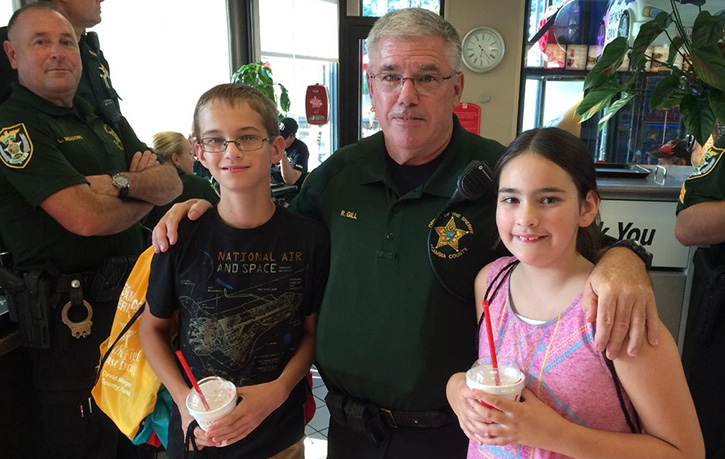
The Escambia County Sheriff’s Office held a “Milkshake With A School Resource Officer” event at Chick-fil-A on Nine Mile Road Wednesday evening.
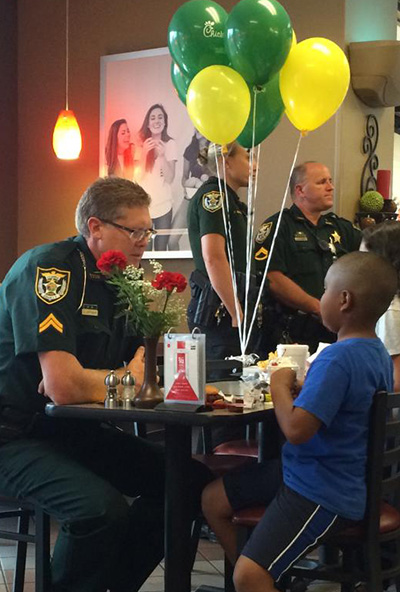 The event provided an opportunity for students to meet their SRO before school starts, and enjoy a little conversation over a free milkshake provided by Chick-fil-A.
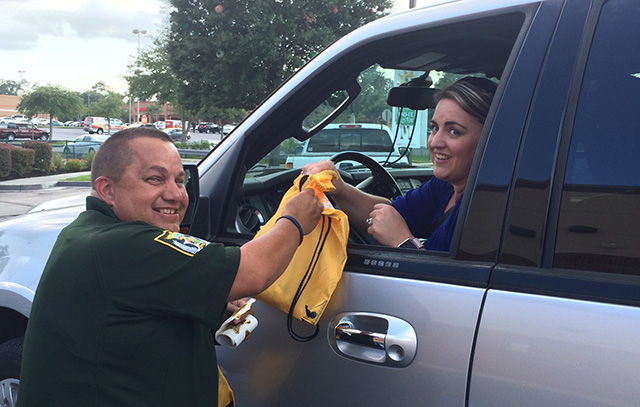
Over 50 students took part in the event. The Sheriff’s Office also handed out free school supplies to the kids.
Pictured top: Florida’s statewide School Resource Office of the Year, Deputy Ronnie Gill of Ernest Ward Middle School, with students enjoying milkshakes Wednesday evening at Chick-fil-A on Nine Mile Road. Also pictured: The Escambia County Sheriff’s Office “Milkshake With A School Resource Officer” event. Photos for NorthEscambia.com, click to enlarge.
Debate Turns Emotional Over Dozier School Memorial
August 4, 2016
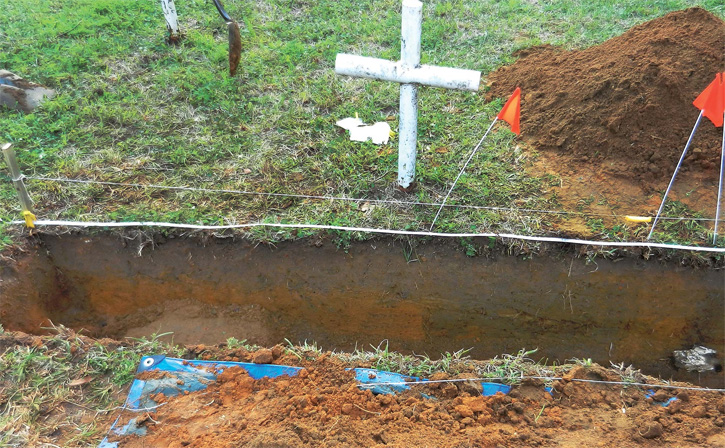
A state task force on Wednesday began an emotional debate about how to commemorate the victims of abuse and brutality at the Arthur G. Dozier School for Boys and what to do with the unidentified remains of youths who died at the shuttered reform school.
“The mission and goals of this task force are different and sensitive from most other task forces,” Secretary of State Ken Detzner told the nine-member panel, which held its first meeting in Marianna, near the site of the 1,400-acre Dozier property in Jackson County.
 Detzner said the task force has been directed by the Legislature to develop recommendations by Oct. 1 on the creation of a memorial to honor the victims of the reform school, which operated from 1900 to 2011, as well as designating a permanent burial site for victims whose bodies were unidentified or unclaimed.
An investigation led by University of South Florida researchers found 51 sets of remains in an unmarked graveyard known as Boot Hill Burial Ground at the Dozier facility, including victims of a 1914 dormitory fire. USF anthropologists identified 21 of the sets of remains through DNA and other methods.
The law that created the task force also provided $7,500 for each family for funeral and reburial costs if they claimed the remains of victims.
But in its initial meeting, the task force found itself at odds over the issue of whether the memorial and the permanent burial site should be at the former Dozier reform school or elsewhere in the state.
Eric Hill, a Jackson County commissioner who serves on the task force, said the permanent burial site and memorial would receive greater exposure if it was in a more populated area of the state, rather than the rural Panhandle county.
“I think the location would be best fit with a larger population,” Hill said.
He was supported by Jerry Cooper, who was sent to Dozier as a runaway teen and who leads a group of “White House Boys,” an organization named for a building where youths said they were beaten and abused.
“I see no reason, whatsoever, to reinter these people, these children, back on this property,” Cooper said. “As far as I am concerned, it would be only adding insult to injury.”
Dale Landry, representing the Florida NAACP, said his civil rights organization was unanimous in believing that the memorial should be at the former reform school.
“Our biggest fear is that once you let it go, it will be forgotten,” Landry said, adding the goal should be to “repurpose that land and make it sacred.”
Stephen Britt, whose uncle died at Dozier in 1946, strongly objected to the idea of not having a memorial and permanent burial in Jackson County.
“They want it to be totally eliminated. They don’t want any reference of it being here. They are ashamed, but they shouldn’t be,” Britt said. “They didn’t commit those crimes. Their ancestors did, but they didn’t.”
Britt, at one point, called the proceeding “a farce,” but later apologized for his outburst, while adding “you must understand this is extremely personal to me.”
“I think everyone understands how emotional this is,” said Timothy Parsons, head of the state Division of Historical Resources and chairman of the task force. “And I think we all feel really strongly about our responsibilities.”
David Jackson, a Florida A&M University history professor who was appointed as a non-voting adviser to the task force, said it would be “very unusual” to not have a memorial at the site of the former reform school.
“It gives us an opportunity to continue to teach people for generations to come about what’s right, what’s wrong, what should not have occurred so we won’t repeat those things going forward,” he said.
The task force agreed to wait until its Aug. 19 meeting to begin voting on proposals for creating a memorial and designating a permanent burial site for the unidentified or unclaimed Dozier victims.
The task force’s Oct. 1 report will be forwarded to the Department of State, lawmakers and Gov. Rick Scott and the Cabinet.
by Lloyd Dunkelberger and Tom Urban, The News Service of Florida
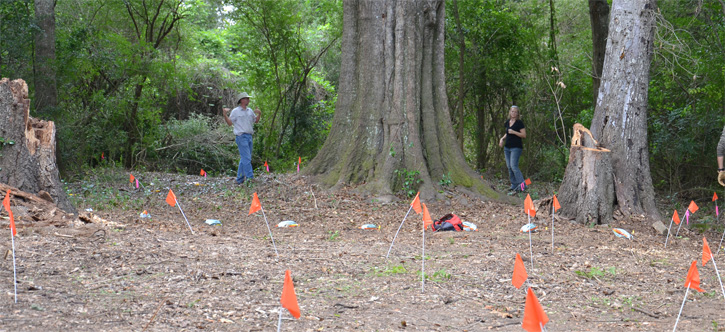
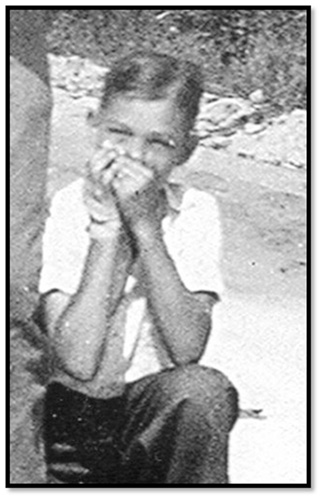
Pictured top: A trench dug in the search for human remains at the Arthur G. Dozier School for Boys in Marianna. Pictured below: Mapping the graves. Pictured inset: The remains of George Owen Smith have been positively identified. Courtesy photos for NorthEscambia.com, click to enlarge.