

UWF Professor Featured In ‘Shark Week’ Coverage
July 2, 2016
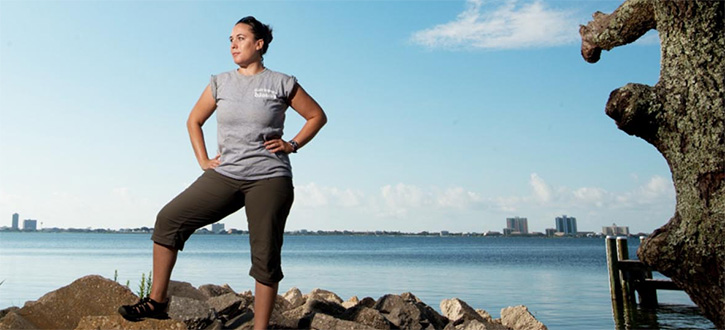
Dr. Toby Daly-Engel, an assistant professor of biology at the University of West Florida, was featured as part of the Discovery Channel’s “Shark Week” coverage.
Daly-Engel, who researches the evolution of shark reproductive strategies, was interviewed by the Discovery Channel and is expected be part of the online content that accompanies its popular week of shark-centered television programming. Daly-Engel said her interview will be part of a feature on female scientists who study sharks.
“I love Shark Week,” Daly-Engel said. “I grew up watching it just like lots of other folks. So to work with people from the Discovery Channel was exciting. Any time I get to talk about my research, which I’m really passionate about, is a good day.”
There aren’t many women working as principal investigators in shark research, Daly-Engel said. She said she was one of the first in the country doing field work when she was hired at UWF.
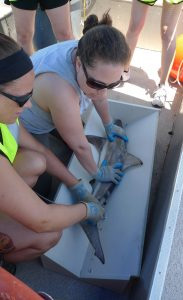 “Being a female PI (principal investigator) is rare,” she said. “Having a female-run lab that does field work on sharks is even more rare.”
Part of Daly-Engel’s research revolves around monitoring local shark essential habitats. Her study is part of the Gulf of Mexico Shark Pupping and Nursery project, which the Southeast Fisheries Science Center at the National Oceanic and Atmospheric Administration’s Panama City laboratory has been conducting since 2003.
The program monitors the distribution and populations of sharks, skates and rays in the Gulf of Mexico in order to define and protect essential fish habitats, which are areas deemed critical to the survival of a species, mostly because they’re used for reproduction.
Daly-Engel also works with the Gills Club, a group dedicated to connecting girls interested in sharks with female scientists working in the field. She was interviewed by the Discovery Channel in her office using Google Hangouts. Among the questions she was asked was how she became interested in sharks and why her research is important.
“Research on shark reproduction is important because many shark populations are at-risk or threatened, and we lack data on most of these in terms of where and how these animals are being born,” Daly-Engel said. “So figuring out what sharks need for healthy reproduction is important for management, and to preserve the ecological health of ocean systems.”
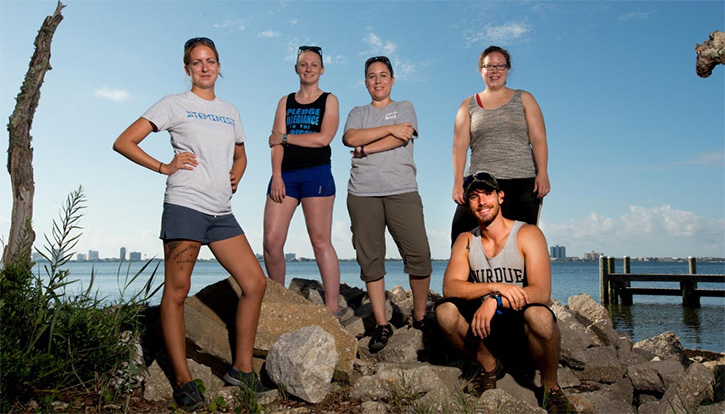
Pictured top: Dr. Toby S. Daly-Engel, an assistant professor of biology at the University of West Florida, is doing research with the Gulf SPAN (Gulf of Mexico States Shark Pupping and Nursery Area) survey/ Pictured inset: Dr. Toby S. Daly-Engel and student examining a shark. Pictured below: UWF graduate students Cody Nash, Maggie McClain, Ariel Egan and Matt Davis with Dr. Toby S. Daly-Engel (center). Photos for NorthEscambia.com, click to enlarge.
No Injuries In Beulah Crash
July 2, 2016
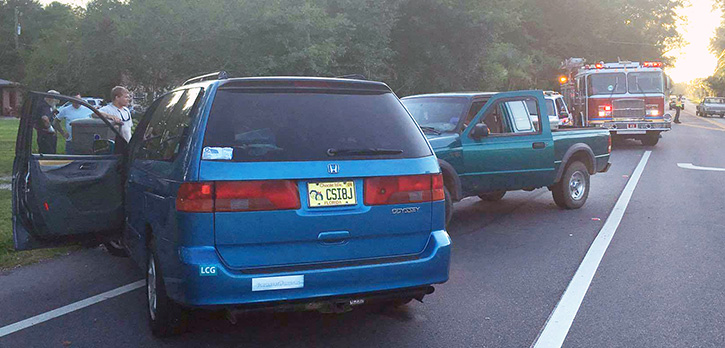
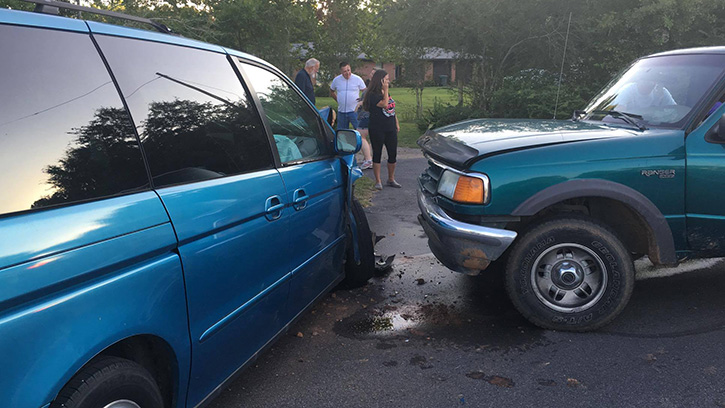
There were no injuries in a two-vehicle crash early Friday evening on Mobile Highway at Thomley Trail, near the Escambia County Equestrian Center. All parties involved in the accident refused medical treatment at the scene. The accident remains under investigation by the Florida Highway Patrol. The Beulah Station of Escambia Fire Rescue and Escambia County EMS also responded. Photos for NorthEscambia.com, click to enlarge.
Hudson Smacks First Double-A Homer As Wahoos Beat TN
July 2, 2016
Pensacola catcher Joe Hudson prides himself in his defense but Friday he came through at the plate, knocking his first Double-A home run over the left field wall at Blue Wahoos Stadium.
He launched a two-out, three-run blast in the fifth inning and Pensacola held on to defeat the Chattanooga Lookouts, 10-8, Friday in front of 4,688 fans at home.
After taking a 10-3 lead, Hudson watched normally reliable Pensacola reliever Carlos Gonzalez let Chattanooga back in the game in the eighth inning. Gonzalez allowed the Lookouts to scored five runs to pull within, 10-8. Gonzalez gave up a two-run homer to left fielder Travis Harrison and got only one out before being lifted for Blue Wahoos closer Alejandro Chacin.
 Chacin walked two batters putting the crowd on the edge of its seat after getting the first two outs of the ninth inning. But Chacin earned his Southern League leading 15th save.
Hudson said it felt good to “get the monkey off my back” yanking an inside fastball out of the park.
“I take pride in (my defense) more than anything. Defense come first,” Hudson said. “Offense comes after that and anything I get is a bonus.”
Pensacola manager Pat Kelly was thankful for Hudson’s home run that sparked the Blue Wahoos offense. Pensacola racked up 12 hits with everyone in the lineup earning a base hit.
“Hudson had a big three-run homer right there,” Kelly said. “Joe has got power we just hadn’t seen it this year.”
Hudson has mostly gotten attention for his defense in his career and this season, throwing out the most runners trying to steal second base in the Southern League. He caught two of four base stealers Friday and has thrown 22 of 50 or 44 percent out in 38 games.
He entered the 2016 season rated the best defensive catcher by Baseball America in the Cincinnati Reds organization. Hudson’s defense has always stood out, becoming a finalist for the Johnny Bench Award as the most outstanding catcher in college baseball.
“(Hudson) has a terrific throwing arm and is very accurate,” Kelly said. “He’s great to have behind the plate.”
Kelly didn’t have happy feelings about Gonzalez allowing five runs to get back into the game.
“It was pretty good for about seven innings,” Kelly said jokingly. “But you could tell right away that he wasn’t trusting his fastball. Unfortunately, we had to go to Chacin for the final five outs.”
Against Chacin, Chattanooga had the winning run on first base when he walked Lookouts slugger Daniel Palka.
Hudson said he was fine with Palka, who leads the Southern League with 20 homers and 62 RBIs, getting a free pass.
“Chacin and I have played together every year so far in pro ball,” Hudson said. “He’s the most reliable guy I’ve ever caught. He might be small but he’s not afraid of anyone. He’s made the big pitches all year and if I could have anybody I want in the game, I want Chacin right there.”
The Blue Wahoos sent all nine batters to the plate and scored five runs on five hits in the fourth inning to go ahead, 6-2. The key hit was Pensacola catcher Joe Hudson connecting on his first home run of the season over the left field wall. The two-out, three-run blast put Pensacola up, 5-2.
Pensacola had tied the game, 2-2, earlier in the fourth when left fielder Phillip Ervin smacked a low liner into left field, stole second base and scored when first baseman Ray Chang hit a high fly ball in shallow centerfield that landed in for a double when Chattanooga center fielder Niko Goodrum fell down.
The Blue Wahoos scored its sixth run of the game, 6-2, when center fielder Jeff Gelalich singled to right field to score DH Calten Daal, who got on base with his 15th infield single of the season.
Pensacola added two more runs in the fifth inning to take an, 8-2, lead when Ervin scored on Elizalde’s double to the right-center gap. Elizalde crossed the plate on the third straight hit to start the inning when third baseman Taylor Sparks singled to left field.
But Zach Vincej hit another important homer when he jacked a two-run homer over the left field wall to make it a 10-3 ball game.
Vincej went 2-3 with a home run and triple, driving in three runs and scoring twice. Vincej is hitting 24-73 or .311 in 23 games since the start of June.
Chattanooga had jumped out to a 2-0 lead in the first inning when first baseman Daniel Palka walked with two outs and then scored on catcher Mitch Garver’s seventh home run of the season for the Lookouts.
It was the first time that Pensacola starting pitcher Jackson Stephens has given up a run in the first inning this season.
But after the shaky start, Stephens settled down and at one point retired 11 in a row. Stephens worked six innings, giving up three runs on five hits and two walks, while striking out four. The 6-foot-2, 219-pound righty evened his record at 6-6 and now has a 3.28 ERA.
No Injuries In Hwy 97 Crash
July 1, 2016
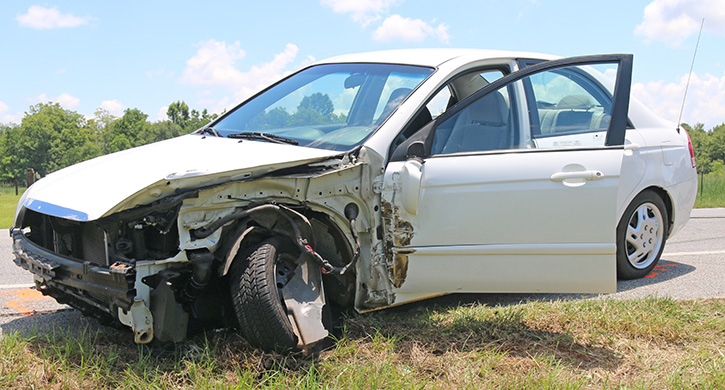
There were no injuries in a two vehicle crash just after noon Friday on Highway 97 north of Walnut Hill.
Witness said the driver of a northbound white car attempted to make a turn into the driveway of roadside watermelon stand when the driver of a northbound pickup truck attempted to pass a line of traffic. The driver of the pickup was evaluated on scene by Atmore Ambulance but not transported to the hospital. Two people in the car were not injured.
The accident is investigation by the Florida Highway Patrol. Further detail have not been released.
The Walnut Hill Station of Escambia Fire Rescue also responded to the accident.
NorthEscambia.com photos, click to enlarge.
Cantonment Woman Seriously Injured After Hitting School Bus Head On
July 1, 2016

A Cantonment woman was critically injured when drove her car head-on into a school bus Thursday afternoon.
 The Florida Highway Patrol said 72-year old Carolyn Robertson was traveling west on Ten Mile Road at Ashton Brosnaham Road when she drove her 2003 Toyota directly into the front of an Escambia County School District bus that was stopped within a left turn lane.
Robertson was transported to Sacred Heart Hospital in serious condition. Her 11-year old passenger suffered minor injuries.
The driver of the bus, 48-year old Charmaine Mixon of Pensacola, and two adult passengers were not injured. There were no children on the bus at the time of the crash.
Any charges in the crash are pending the outcome of an ongoing FHP investigation.
NorthEscambia.com photos by Kristi Barbour, click to enlarge.

Update: Judge Blocks Parts Of Florida Abortion Law
July 1, 2016
Siding with Planned Parenthood affiliates, a federal judge late Thursday blocked key provisions of a sweeping new Florida law that would have barred abortion providers from receiving public funds for other services and required a dramatic increase in inspections of abortion records by health officials.
 U.S. District Judge Robert Hinkle’s preliminary injunction came just hours before the new law would have gone into effect.
Planned Parenthood affiliates are challenging three portions of the law, approved by the Republican-controlled Legislature and signed by Gov. Rick Scott earlier this year. Hinkle sided with the abortion providers in two of the three components, and ruled that state officials had resolved concerns about a third — dealing with a change in the definition of the first trimester — during a hearing in the case on Wednesday.
“We are reviewing the judge’s order and exploring our options,” Scott spokeswoman Jackie Schutz said in an email Friday.
Planned Parenthood officials lauded Hinkle’s order.
“As a result of today’s decision, thousands of people across Florida have the peace of mind that comes with knowing they can access essential reproductive health care, such as cancer screenings, birth control, and well-woman exams. This ruling also sends an unmistakable message to politicians to quit playing politics with women’s health,” Lillian A. Tamayo, president of Planned Parenthood of South, East and North Florida, said in a statement.
In his 25-page ruling, Hinkle noted that there has been a long-held prohibition against using public funds to pay for abortions.
But the Florida law goes further and “refuses to fund services that are wholly unrelated to abortions,” Hinkle wrote of the part of the law that would block public funds from going to abortion providers.
“The provision does this based not on any objection to how the funds are being spent — on things like testing for sexually transmitted disease or dropout prevention — and not based on any objection to the quality of the services being provided, but solely because the recipients of the funds choose to provide abortions separate and apart from any public funding — as the Supreme Court has put it, on their ‘own time and dime,’” he wrote.
In determining that the defunding provision in Florida’s law was unconstitutional, Hinkle relied on the “unconstitutional-conditions doctrine,” which means that governments cannot indirectly prohibit — by withholding funds — conduct which they cannot directly ban.
The doctrine puts the “defunding provision at here squarely on the unconstitutional side of the line,” Hinkle wrote.
“The defunding provision has nothing to do with the state and local spending programs at issue, which address things like testing for sexually transmitted disease and dropout prevention,” Hinkle wrote. “The defunding provision is instead an effort to leverage the funding of those programs to reach abortion services. Indeed, the separation between the funding and the condition could not be clearer: nobody has contended that the plaintiffs have done anything in connection with the publicly funded programs that is inconsistent in any way with the goals of those programs. The state’s only beef is that the plaintiffs provide abortions.”
Planned Parenthood officials said the ban on public funds would cause clinics to lose about $500,000 in state and local funds used for other services, including a dropout prevention program in Palm Beach County.
Hinkle’s order bars the state from canceling contracts or grants, or from refusing to renew or allowing to expire contracts or grants that would have continued in the absence of the new law.
Relying in part on a recent U.S. Supreme Court decision that struck down a Texas abortion law, lawyers for the state argued that the ban on using public funds for other services was permissible because it did not impose an “undue burden” on a women’s right to an abortion.
But Hinkle disagreed.
“No court has embraced the defendants’ position. And there is no logic to it. That a woman has a constitutional right to an abortion does not mean a legislature can impose otherwise-unconstitutional conditions on public funding,” the judge wrote.
Hinkle also found problematic the portion of the law that would have required health officials to inspect half of all abortion patients’ records, saying the state offered “no legitimate explanation for the requirement, asserting only that the clinics’ records are already subject to inspection, and that increasing the number of records that are inspected thus cannot be unconstitutional.”
But no other medical providers — including ambulatory surgical centers, which perform more complicated procedures and have more adverse outcomes — are not subject to the same scrutiny, Hinkle noted.
“The state has inspected the plaintiffs’ clinics for years. The inspections have turned up no violations. For all that is shown by this record, the inspection provision is a solution in search of a problem,” Hinkle wrote.
The new law also changes the definition of a first trimester to the period from fertilization through the end of the 11th week of pregnancy. That’s a different definition than the state has used in the past, and a departure from the definition used by doctors and other health care providers, according to court documents.
Planned Parenthood had challenged that part of the law, saying it was vague.
But, on Wednesday, Deputy Solicitor General Denise Harle told Hinkle state health officials have not changed their interpretation of the number of weeks and days that make up a first trimester. The issue is important because clinics that perform second-trimester abortions are required to have a different license than those that perform procedures during earlier pregnancies.
Hinkle did not block that part of the law from going into effect, but he warned the state to “take note” that his decision was based on the state’s representation that the new definition of first trimester was no different than that which has been used for decades.
Hinkle’s Thursday ruling did not deal with the merits of the lawsuit, but granted the preliminary injunction based on the likelihood that those challenging the law will succeed. Briefs on the merits are due later this month.
State Sen. Kelli Stargel, a Lakeland Republican who sponsored the 2016 law, blasted Hinkle’s ruling as “a clear infringement on both the Legislature’s constitutional authority to appropriate taxpayer dollars, and our responsibility to properly regulate medical facilities.”
“Under our constitution, it is the people’s elected representatives, not appointed federal judges, who are tasked with making decisions about what entities should be receiving limited taxpayer dollars,” Stargel said in a statement. “The people of Florida have consistently elected legislative and executive leaders who oppose the use of taxpayer dollars to fund abortion and today’s ruling is yet another example of the pro-abortion movement utilizing the courtroom to fight battles it cannot win at the ballot box.”
House Speaker Steve Crisafulli said he trusts Hinkle to “thoroughly examine all of the facts” before the judge issues a final ruling.
“If so, he’ll find the actions of the House and Senate are both constitutional and within the legislative branch’s authority,” Crisafulli, R-Merritt Island, said in an email.
Deputies Receive Medal Of Courage For Actions Following Century Tornado
July 1, 2016
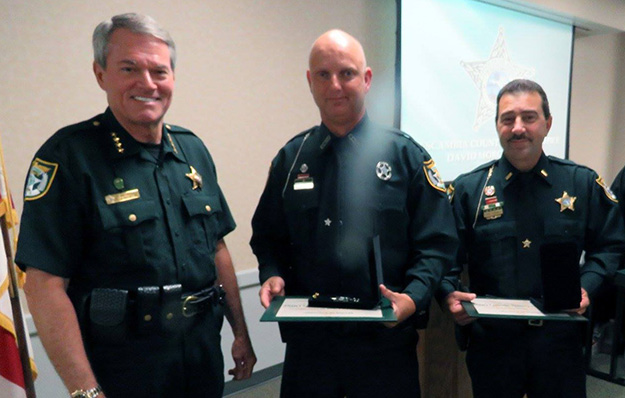
Three Escambia County Sheriff’s Office deputies received the department’s Medal of Courage Thursday for actions they took following the Century tornado.
According to Sheriff David Morgan:
“On February 15, 2016, an EF-3 tornado touched down in the town of Century. Deputy 1st Class Walter Shiver, Deputy Kyle Haver and Lieutenant Marc Dewees were in the path of the storm working shift at Precinct 6.
“Despite the the impending danger, all three deputies worked swiftly and promptly to get as many citizens as they could to safety before the storm approached.
“When Deputy Shiver saw a family driving into the path of the tornado on Highway 29, he signaled for them to go in the opposite direction, gained access to the Century Fire Department, and sheltered them in the tub of a bathroom.
“As the tornado passed through, Deputy Haver and Lt. Dewees drove through the debris and over down power lines to check on the welfare of residents in Century. After the storm passed, deputies climbed through, around and under downed trees and downed power lines in an attempt to render aid to citizens in distress.
“Deputy Shiver and Deputy Haver went about this mission with disregard for their own safety. Due to the quick action, several people were removed from debris and their homes without injury or incident.”
Pictured: The Medal of Courage was presented Thursday to Deputy 1st Class Walt Shiver (middle), Lt. Marc Dewees, and Deputy Kyle Haver (not pictured) by Sheriff David Morgan (left). Photo courtesy Escambia County Sheriff’s Office for NorthEscambia.com, click to enlarge.
Nabbed At Gunpoint: Photos Show Arrests In McDonald’s Parking Lot
July 1, 2016
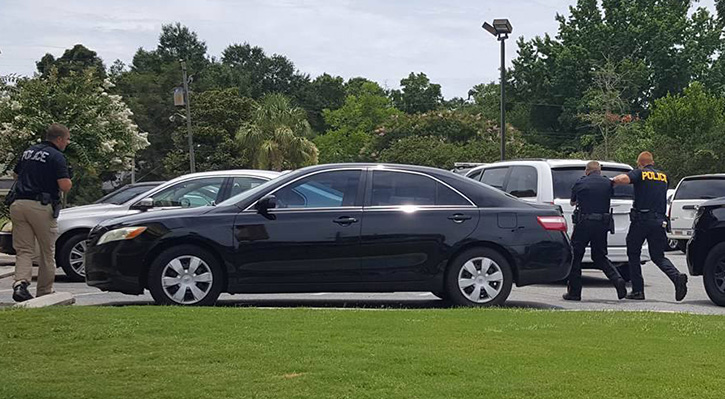
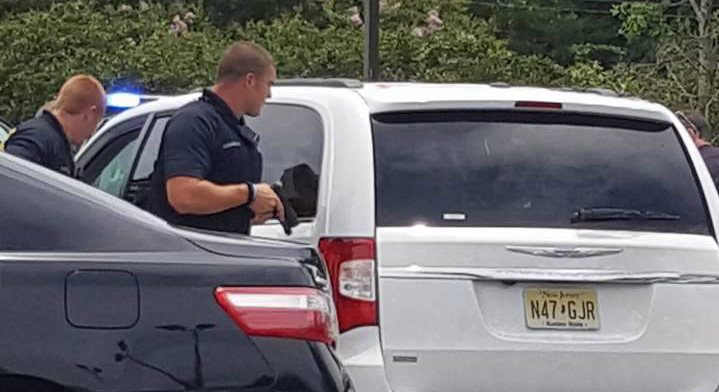
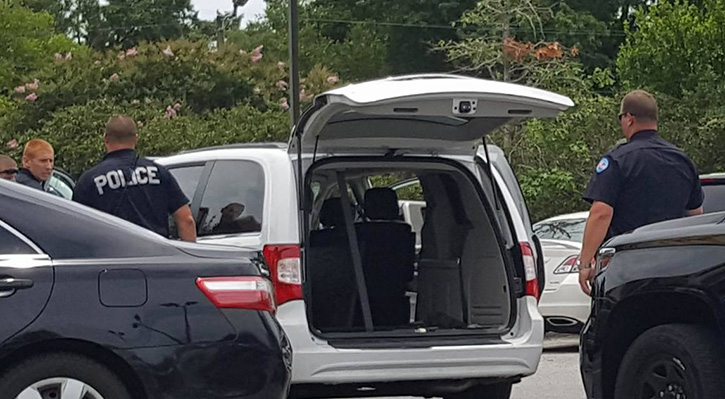
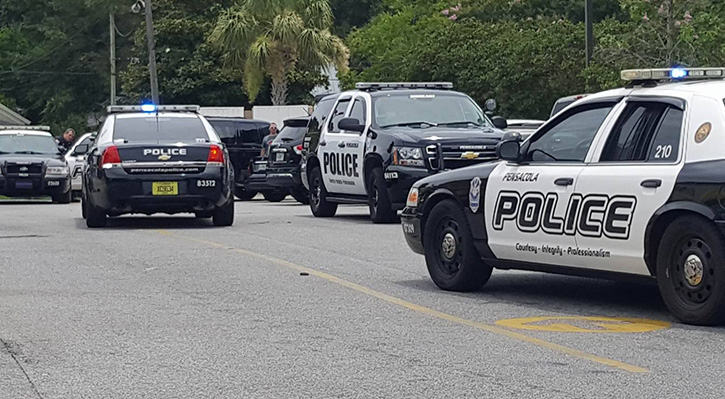
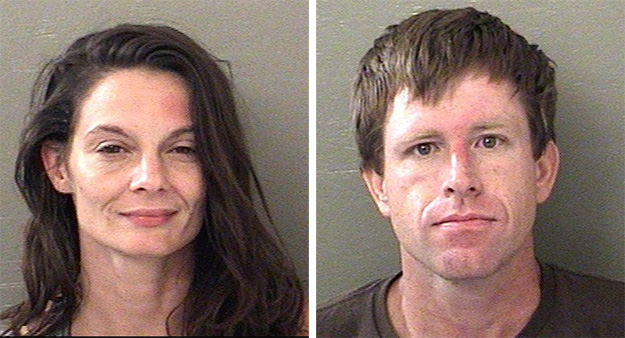
Two people in van that had been reported stolen were nabbed at gunpoint Thursday in the parking lot of an Escambia County McDonalds.
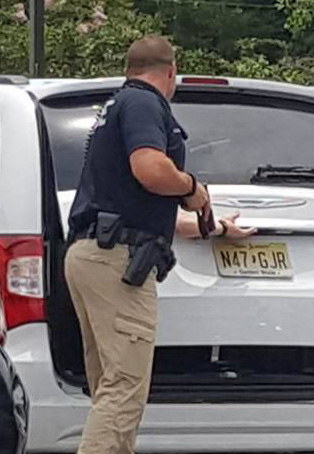
The Pensacola Police Department conducted the traffic stop and arrests in the parking lot of the McDonald’s on Cervantes Street at Ninth Avenue. A NorthEscambia.com reader captured these photos as police conducted the takedown.
According to jail records, 36-year old Jeremy Ray Hodge of Pensacola was charged with possession of a controlled substance without a prescription and released from the Escambia County Jail on a $3,000 bond, and 33-year old Brandie Nicole Burk of Port Richey, FL, was arrested on an outstanding failure to appear warrant and released on a $2,500 bond. Additional charges related to the stolen vehicle may be forthcoming.
Reader submitted photos for NorthEscambia.com, click to enlarge.
Thursday Storms Bring Heavy Rainfall, Down Tree
July 1, 2016
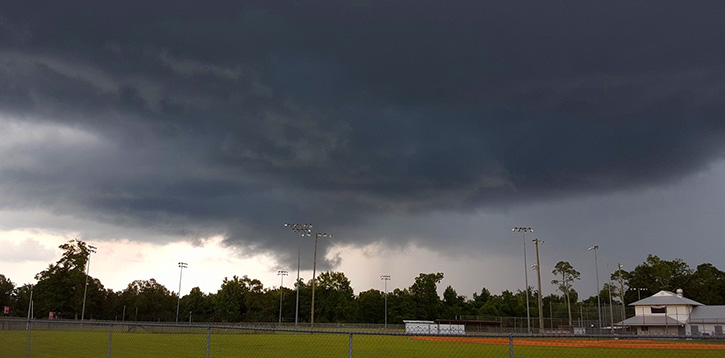
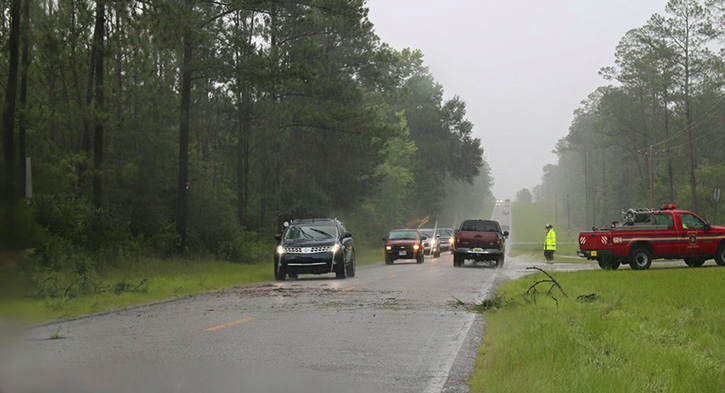
A Thursday afternoon storm brought torrential rainfall some parts of the North Escambia area, including Bratt, Byrneville and Century. Near Century, winds downed a small tree across West Highway 4 at the entrance to Lake Stone. Pictured top: A storm approaching Century, as seen from Showalter Park. Pictured below: Firefighters removed a small tree that fell across West Highway 4 at Lake Stone. NorthEscambia.com photos, click to enlarge.
159 New Laws In Florida
July 1, 2016
Beginning last Friday, clergy who don’t want to marry same-sex couples will have state backing for their beliefs, high school students will have more choice over where they play sports or study, and local governments won’t be able to regulate the use of Styrofoam containers.
Those are among the 159 new laws that went into effect on July 1.
Lawmakers sent 272 bills to Gov. Rick Scott during the regular legislative session, which ended in March. Scott vetoed three and signed the rest. Of the bills approved by Scott, a handful still require approval from local voters before coming law, 25 won’t be enacted until Oct. 1, and 67 instantly went into effect after the governor signed them.
Here are highlights of the laws taking effect July 1:
BUDGET
— HB 5001, which boosts spending on education to the highest level in state history, bankrolls more than $713.5 million worth of education construction projects. The $82 billion fiscal plan also includes $151 million for restoration of the Everglades and an area north of Lake Okeechobee, which lawmakers call “the Northern Everglades.”
The budget, which tops this year’s $78.2 billion record-setting spending plan, also steers money that would otherwise go into the state’s school-funding formula into a plan to hold the line on property taxes. The issue involves part of the school-funding formula known as “required local effort.” Lawmakers have linked the property tax money with a tax cut package that they say puts “tax relief” for the coming year at more than $550 million.
TAX CUTS
HB 7099, a $129.1 million package, exempts sales taxes on food and drinks sold by veterans’ organizations and phases out, over three years, a sales tax on asphalt used for government projects. The measure also revises how taxes are calculated on alcohol and tobacco sales for cruise ships within Florida waters; on pear cider; and on an excise tax on aviation fuel, which is a discount for most carriers.
For many Floridians, the biggest part of the package will be a sales-tax “holiday” for back-to-school shoppers, which runs from Aug. 5 to Aug. 7.
CRIMES
SB 228, removes aggravated assault from a list of offenses that has been used to sentence people under the 10-20-Life mandatory-minimum sentencing law.
SB 636, requires local law-enforcement agencies to submit sexual-assault evidence kits, known as “rape kits,” to the Florida Department of Law Enforcement within 30 days of the beginning of their investigations, or after being notified by victims or victims’ representatives that they wish the evidence to be tested.
SB 1044, sets a minimum of 70 percent of the proceeds from seized property from an arrested individual to be used on court costs, fines and fees.
SB 1294, increases the age of a child victim or witness who may have his or her testimony videotaped or who may testify by closed circuit television from under 16 years to under18. The law also increases the minimum term of imprisonment — from 5 days in jail to 30 days — for a domestic violence crime when there is intentional bodily harm to another person.
HEALTH CARE
— SB 12, the “no wrong door” policy, allows people who need mental-health or substance-abuse treatment to get it no matter how they enter the systems, whether through criminal offenses or personal crises.
— HB 221, addresses a controversial health-insurance issue known as “balance billing” that supporters say will help shield patients from getting hit with surprise tabs after going to hospital emergency rooms.
— HB 1411, cuts off funding to organizations affiliated with abortion clinics, such as Planned Parenthood. The measure, being challenged in state and federal courts, requires the Agency of Health Care Administration to conduct annual inspections of abortion clinics and review at least half the patient records. The law also requires clinics that provide first-trimester abortions to have written patient-transfer agreements with hospitals.
FOR THE VETS
— SB 184, makes clear that former members of the Florida National Guard are eligible for the Florida Veterans’ Hall of Fame. The new law also requires landlords to make decisions within seven days about lease applications by service members, and sets up a task force to consider an online-voting system for overseas military voters.
— SB 222, requires publicly owned or operated airports to provide free parking to any vehicle displaying license plates for disabled veterans.
— HB 799, provides that active duty service members who attend state universities or colleges, career centers or charter technical career centers may receive out-of-state fee waivers while living or stationed out of state.
— SB 1202, provides entrance fee discounts at state parks to members of the military, honorably discharged veterans, surviving spouses or parents of either a military member who died in combat or a first responder who died in the line of duty.
FIRST RESPONDERS
— SB 7012, ensures that survivors of first responders killed in the line of duty who were members of the Florida Retirement System are eligible for the same benefits as those enrolled in the state’s traditional pension plan.
RELIGION
— HB 43, protects churches, clergy members and church employees who object, due to their religious beliefs, to performing wedding ceremonies for gay and lesbian couples.
EDUCATION
— HB 229, requires school districts to review bullying and harassment policies at specified intervals.
— SB 576, allows Florida Keys Community College in Monroe County to build a dorm with up to 400 beds.
— HB 7029, allows parents to transfer their children — through an “open enrollment” process — to any public school in the state that isn’t at capacity, and gives charter schools that serve lower-income students or those with disabilities a bigger slice of construction funding doled out by the state.
The wide-ranging measure also allows private schools to join the Florida High School Athletic Association or other organizations on a sport-by-sport basis and sends additional funds to “emerging pre-eminent” universities, possibly the University of Central Florida and the University of South Florida.
DEVELOPMENTAL DISABILITIES
— HB 7003, is intended to provide job opportunities and financial independence for people with disabilities.
— SB 672, includes programs that provide educational aid and higher-education opportunities to families whose children have developmental disabilities, referred to as “unique abilities” by Senate President Andy Gardiner, R-Orlando. Gardiner, whose son Andrew was born with Down syndrome, pushed for the measure.
— HB 963, the “Wes Kleinert Fair Interview Act,” requires law enforcement to ensure a mental health counselor or instructor is provided during interviews involving an individual with autism.
JURY DUTY
— HB 111, declares that certain people incapable of caring for themselves may be permanently excluded from jury service.
SALT LIFE
— SB 158, allows people with lifetime fishing or hunting licenses or boater-safety identification cards to have a symbol added to their driver licenses — for a $1 charge — that will display that lifetime status.
— HB 427, provides a discount of about 12 percent on annual vessel-registration fees next year for boaters who show they have purchased and registered emergency locator devices.
— HB 703, redefines the rule that a boater must operate in a manner that doesn’t endanger “any person” to limiting actions that threaten “another person outside the vessel.” The law also restricts the ability of certain law enforcement officers to stop and search boats, if the vessels display commission safety-inspection decals.
— SB 846, authorizes “divers-down flags” to have more than one white diagonal stripe or to be oriented in the same direction.
— HB 1051, prohibits overnight anchoring in part of the Middle River in Broward County, Sunset Lake in Miami-Dade County and three parts of Biscayne Bay in Miami-Dade.
THE GREAT OUTDOORS
— SB 552, sets water-flow levels for springs and guidelines for the Central Florida Water Initiative, a multi-agency, water-supply planning effort.
— HB 989, “Legacy Florida,” a restoration effort, sets aside up to $200 million a year for the Everglades, $50 million annually for springs and $5 million each year for Lake Apopka.
— HB 7007, designates Tupelo honey, commercially harvested from the Ogeechee Tupelo tree in northwest Florida, as Florida’s official honey.
— HB 7013, a wide-ranging bill focused on fish and wildlife, increases the fine from $250 to $500 for illegally taking game while trespassing; decreases the penalty for not filing required alligator hunting reports; and specifies that possession of any marine turtle species or hatchling without state or federal approval is a third-degree felony.
TRANSPORTATION
— HB 7061, increases annual seaport funding from $15 million to $25 million, extends the length of certain semitrailers allowed on public roads, and requires a brewery to pay for a requested directional sign.
— SB 698, allows the state Division of Alcoholic Beverages and Tobacco to issue alcoholic beverage licenses to the owners of railroad transit stations that are used for passenger service between two or more cities.
PUBLIC RECORDS
— HB 381, keeps private the results of the taped matches controlled by the Florida State Boxing Commission before they are publicly aired.
CAPITOL MEMORIALS
— SB 716, establishes the creation of a Florida Holocaust Memorial at the Capitol.
LOCAL GOVERNMENT
— HB 1361, eliminates a required state review of new developments of regional impact if they comport with a local comprehensive plan.
— HB 7007, prohibits local governments from making new laws that regulate the use or sale of polystyrene, most commonly known as Styrofoam, by grocery stores and related businesses.
DINING OUT
— HB 633, adds temporary “food contests” and “cook-offs” hosted by a school, religious group or nonprofit civil or fraternal organization from having to pay a licensing fee or undergo an inspection from the Division of Hotels and Restaurants.
HOME ELEVATORS
— HB 1602, the “Maxwell Erik ‘Max’ Grablin Act,” requires newly installed residential elevators to have a sensor that keeps the lift from moving in the same direction if something is detected in the shaft.
FOOD STAMPS
— HB 103, allows the use of EBT cards, formally known as food stamps, in fresh-produce markets.
VOTING
— SB 112, replaces the term “absentee ballot” with the term “vote-by-mail ballot.”
DOWN ON THE FARM
— HB 59, prohibits local governments from enforcing a local ordinance, regulation, rule, or policy that prohibits, restricts, regulates, or otherwise limits an agritourism activity on land classified as agricultural land.
— HB 1046,exempts the driver of a covered farm vehicle from commercial driver license requirements.