

Council On Aging Fears Trump Budget Will End Program Funding
March 17, 2017
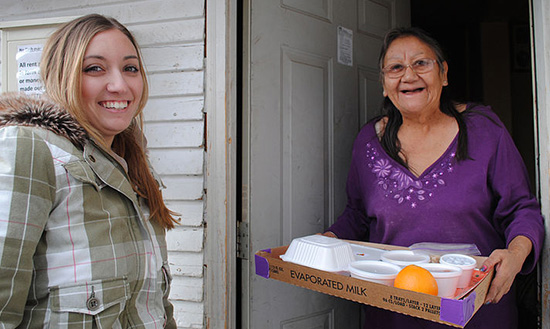
The budget submitted Thursday by President Donald Trump includes the elimination of grant programs that currently fund the Council on Aging of West Florida’s “Meals on Wheels” program.
Locally, Meals on Wheels delivers almost 130,000 meals to nearly 500 senior citizens throughout the year. Many of these aging adults are homebound and cannot care for themselves like they once could. Meals on Wheels not only provides much-needed nutrition and sustenance, but companionship and a chance for social service agencies to check in with clients.
“Meals on Wheels is a program that serves a vital need for homebound, disabled and vulnerable aging adults,” said John Clark, President and CEO of Council on Aging. “The program is largely comprised of volunteers who donate their time and transportation to alleviating hunger in our senior community. This is not a government agency bloated with bureaucracy whose cuts would benefit the tax-payer; Meals on Wheels is fully dedicated to the client and in fact helps Americans avoid the far greater cost of caring for these individuals in a nursing home or retirement community.”
The program needs increased funding and participation, not less, according to Clark.
There are almost 500 elderly people on waiting lists in Escambia and Santa Rosa counties who need the services of Meals on Wheels. Nationwide, the need is growing rapidly as well, and federal funding has not kept pace. Meals on Wheels is already serving 23 million fewer meals now than in 2005, and waiting lists are mounting in every state. At a time when increased funding is needed, millions of seniors who rely on the program every day for a nutritious meal, safety check and visit from a volunteer will be left behind, Clark said.
“The problem with a skinny budget is it is lean on details. So, while we don’t know the exact impact yet, cuts of any kind to these highly successful and leveraged programs would be a devastating blow to our ability to provide much-needed care for millions of vulnerable seniors in America, which in turn saves billions of dollars in reduced healthcare expenses” said Ellie Hollander, President and CEO Meals on Wheels America.
Tate Softball Beats Washington; Northview Baseball Tops Pine Forest
March 17, 2017
SOFTBALL
Tate 12, Washington 2
The Tate Lady Aggies defeated the Washington Wildcats Thursday night 12-2.
Hannah Brown took the win on the mound for Tate, pitching six, allows two its , two runs, two errors and striking out nine.
For Tate – Hannah Brown R; Hayden Lindsay 2-2, 2 R; Deazia Nickerson 1-1, R; Belle Wolfenden 1-4, 2 R; 2 RBI; Shelby Ulrich 2-3, R, 3 RBI; Sydni Solliday 1-4, 2 R; RBI; Ashley Lundquist 1-2, R; Gabby Locke 1-4, 2 RBI; Taylor Hedgepath 3-3, R, 2 RBI; Katie Snyder 1-1, R.
Up next for Tate: Strike Out Cancer game against West Florida, 7 p.m. Friday, Tate High School.
Tate 17, Washington 0 (JV)
BASEBALL
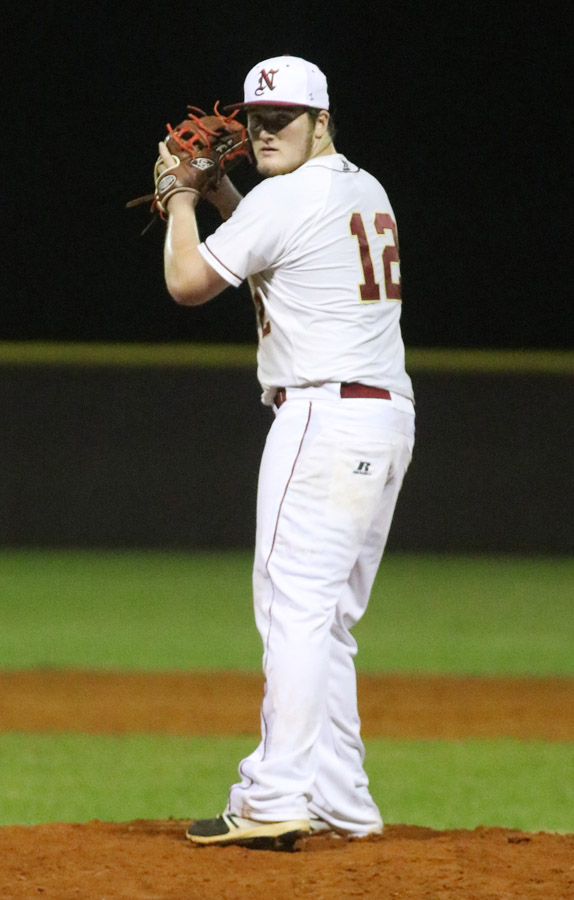 Northview 5, Pine Forest 4
The Northview Chiefs defeated the Pine Forest Eagles 5-4 Thursday night in Bratt.
Zach Payne and Quinton Sampson had doubles for the Chiefs; John Chivington and Blake Reid had RBIs for Northview, while Seth Killam had two RBIs.
Northview is on the road Friday night at South Walton at 5:00.
Two In A Row: Tate Claims Aggie Classic Championship
March 17, 2017
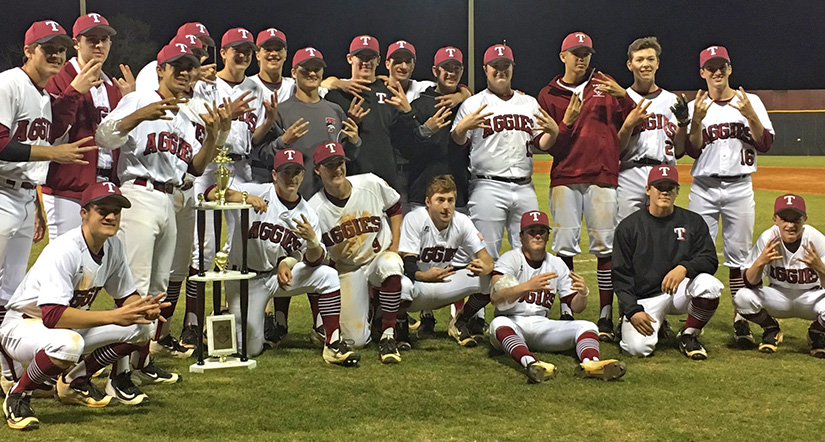
For the second consecutive year, the Tate High School Aggies claimed the Aggie Classic championship Thursday night with a 13-1 win over Niceville.
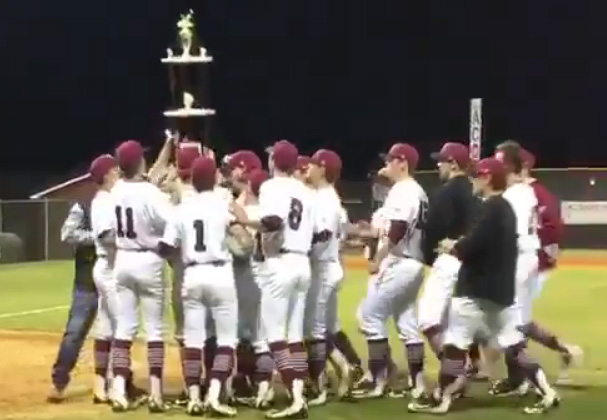 Logan Blackmon and Trey LaFleur had two-run homers for the Aggies. Mason Land and Reid Halfacre added doubles for Tate.
Gabe Castro took the win for Tate, pitching five innings while allowing two hits and just on error.
For Tate – Tate – Tate – Logan Blackmon 2-3 2 HR, 5 RBI, 2 BB; Trey Lafleur 2-3 HR, 2 RBI, BB; Mason Land 2-4 2 2B, BB; Reid Halfacre 1-5, 2 RBI; Logan McGuffey 1-5, R; Jeff Gibbs R; Hunter Nesmith 1-4, R; Kyler Hultgren 1-1, RBI; Ryan Greene 1-3; Jesse Sherill 1-1, R, RBI.
Here are final scores from Thursday’s bracket play in the Aggie Classic:
- Edmond North 8, Houston, TN 6
- Tate 13, Niceville 1
- Jenks, OK 5, Magnolia Heights, MS 0
- Union, OK 9, Gulf Breeze 5
- Choctaw, OK 6, Second Baptist, TX 4
- Mustang, OK 5, Milton 5 – 1
- Leon, FL 7, Coweta, OK 0
- Pace 11, Southmoore, OK 10
- Presbyterian Christian, MS 12, TBA 0
- Berryhill, OK 3, Knoxville Catholic, TN 2
- Durant,OK 8, Bartlett, TN 7
- Pryor, OK 6, West Florida 3
- Booker T. Washington, OK 4, Fort Gibson, OK 3
- Washington 6, vs Piedmont 3
‘Stand Your Ground Shift’ Gets Senate Approval
March 17, 2017
A move to shift a key burden of proof in “stand your ground” self-defense cases was approved by the Senate, as other key bills backed by Second Amendment advocates remain jammed in the Legislature’s upper chamber.
With Democrats labeling the self-defense proposal “a shoot to kill” and “how to get away with murder” bill, the National Rifle Association-backed measure (SB 128) was approved in a 23-15 vote, with Sen. Anitere Flores, R-Miami, joining Democrats in opposition.
 Flores, a top lieutenant to Senate President Joe Negron, has become a roadblock to other high-profile bills backed by gun-rights groups, including a measure that would allow people with concealed weapons to openly carry firearms (SB 644) and to carry on university and college campuses (SB 622). Those bills have not made it through the Senate Judiciary Committee, which includes Flores.
Flores said her vote on the “stand your ground” bill was swayed after talking to state attorneys from her South Florida district, which covers Monroe County and parts of Miami-Dade County.
“There’s going to be a cost to the state attorneys, and now I have two state attorneys who are calling and concerned, and you just have to take those things into account,” Flores said.
Flores had voted for the proposal Feb. 9 when it was before the Rules Committee and Jan. 24 in the Judiciary Committee.
Sen. Rob Bradley, a Fleming Island Republican who is sponsoring the measure, said the potential for increased costs shouldn’t be what drives lawmakers on the issue.
“We should be focused on what is the right thing for our criminal justice system, not dollars and cents when it comes to fundamental principles,” Bradley said.
A House version of the bill (HB 245) needs to clear the House Judiciary Committee before it could go to the House floor. A similar proposal failed to advance last year in the House after getting Senate approval.
The proposal, backed by the Florida Public Defender Association, stems from a Florida Supreme Court ruling in 2015 that said defendants have the burden of proof to show they should be shielded from prosecution under the “stand your ground” law.
In “stand your ground” cases, pre-trial evidentiary hearings are held to determine whether defendants should be immune from prosecution. The bill would shift the burden from defendants to prosecutors in the pre-trial hearings.
Bradley, who believes the bill has support this year in the House, said he wouldn’t have moved forward with the proposal if he believed the change in law would allow guilty people to go free.
“If I thought for one second that this bill would encourage people to engage in criminal behavior, because the bill created some sort of loophole in the law that allowed someone to engage in criminal behavior without consequences, I would have no part of this bill,” Bradley said.
Sen. Dennis Baxley, an Ocala Republican who in 2005 sponsored the “stand-your-ground” law while serving in the House, called the proposal one of the most important of the legislative session that started March 7.
“I don’t think anybody in our state should be beaten, raped, murdered, simply because they were afraid to act, and stand against a violent act,” Baxley said. “Interestingly, there is not a firearm in this bill. I don’t care if you use a chair leg; you have the right and even the responsibility under our brand of freedom to stop a violent act if you can.”
In its 2015 ruling, the Supreme Court majority opinion — written by Justice Barbara Pariente — said immunity in the “stand your ground” law “is not a blanket immunity, but rather, requires the establishment that the use of force was legally justified.”
“We conclude that placing the burden of proof on the defendant to establish entitlement to Stand Your Ground immunity by a preponderance of the evidence at the pretrial evidentiary hearing, rather than on the state to prove beyond a reasonable doubt that the defendant’s use of force was not justified, is consistent with this court’s precedent and gives effect to the legislative intent,” said the majority opinion.
But a dissenting opinion, written by Justice Charles Canady and joined by Justice Ricky Polston, countered that the majority ruling “substantially curtails the benefit of the immunity from trial conferred by the Legislature under the Stand Your Ground law.”
“The factual question raised by the assertion of Stand Your Ground immunity in a pretrial evidentiary hearing is the same as the factual question raised by a Stand Your Ground defense presented at trial: whether the evidence establishes beyond a reasonable doubt that the defendant’s conduct was not justified under the governing statutory standard,” Canady wrote.
Sen. Darryl Rouson, D-St. Petersburg, said Bradley’s bill puts the dissenting views of the two conservative justices into law.
“I welcome the day when the dissent in the Senate chamber can run the Senate chamber,” Rouson said. “What we’re doing elevates the dissent to where it would rule the land in the state of Florida. And I don’t think that’s right.”
The “stand your ground” law has long been controversial. It says people can use deadly force and do not have a duty to retreat if they think it is necessary to prevent death or great bodily harm.
Critics of Bradley’s bill, including the Florida Prosecuting Attorneys Association and the Florida Coalition Against Domestic Violence, have argued it would put an end to cases before all the facts are revealed. They also contend the “stand your ground” law has disproportionate effects on minorities, as it is used more successfully as a defense when white shooters kill African-Americans.
Sen. Gary Farmer, D-Fort Lauderdale, said shifting the burden of proof in “stand your ground” cases would incentivize people involved in shooting incidents to leave no witnesses.
“Dead men tell no tales,” Farmer said. “That’s a phrase that goes back to pirate days, and that’s why pirates were so ruthless, and that’s why pirates made sure that everyone died, so they could tell no tales.”
by Jim Turner, The News Service of Florida
Headed The Beach? There’s Now A Cheaper Toll Option
March 17, 2017
At the Thursday, March 16 commission meeting, the Escambia Board of County Commissioners approved a reduction in the Pensacola Beach General Public Annual Pass, reducing the annual fee from $50 to $20. The fee reduction will become effective Monday, May 1.
 The board’s action does not impact the ability to choose to pay the cash toll of $1 for single trips or the other Pensacola Beach Annual Pass rates. The homestead pass will remain at $5 and the commercial pass, $70. No refunds will be given for any general public annual passes purchased prior to the new fee rate.
The new Pensacola Beach Annual Pass integrated with SunPass® provides a true 365-day pass to Pensacola Beach by providing unlimited passage through the Bob Sikes Toll Booth for one full year from the date of purchase. To get your Pensacola Beach Annual Pass:
- Step one – Purchase a SunPass transponder online at www.SunPass.com or in person at retail outlets including Publix, CVS Pharmacy and Walgreens. For a full list, visit https://www.sunpass.com/sunPassRetailers.
- Step two – Enroll in the Pensacola Beach Annual Pass program online or in person at the Bob Sikes Bridge Toll Plaza Customer Service Office located in the Santa Rosa Island Authority office, 1 Via De Luna Drive, Pensacola Beach.
Running A Stop Sign Gets Century Man Busted For Meth
March 16, 2017
Running a stop sign landed a Century man in jail on meth charges.
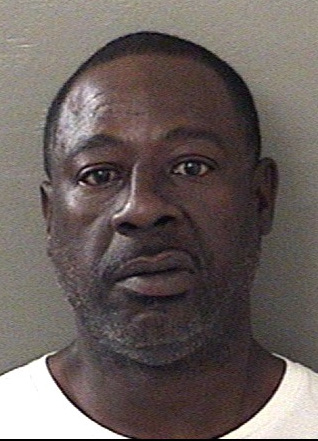 James Edward Lewis, 49, left the Century Woods Apartment on West Highway 4 at a high rate of speed without stopping at a posted stop sign, according to an arrest report. A deputy who witnessed the incident conducted a traffic stop.
The deputy noted Lewis was very nervous and the vehicle had an odor of marijuana, and Lewis was detained. A small plastic bag with a white substance that field tested positive for methamphetamine was located in Lewis’ wallet. A bag with a “brown leafy substance” was found in Lewis’ pocket.
Lewis was charged with felony possession of methamphetamine. He was booked into the Escambia County Jail and later released on a $10,000 bond.
He may face additional charges pending the outcome of laboratory testing on the brown leafy substance, according to the Escambia County Sheriff’s Office. He was given a verbal warning for running the stop sign.
Search Warrant Turns Up Drugs, One Arrested
March 16, 2017

An Atmore man was arrested after narcotics agents executed a search warrant in Atmore Tuesday.
Officers searched a home at 157 Harris Street in Atmore where they say they found Derek James Staples in possession of large amount of marijuana and a handgun. Staples was charged with drug trafficking, being in possession of a firearm and possession of drug paraphernalia.
Staples was booked into the Escambia County Detention Center in Brewton.
The search warrant was served by officers from the Atmore Police Department, Poarch Creek Police Department, and the Escambia County (AL) Sheriff’s Office.
Escambia Man Busted Afer Traveling To Meet Minor For Sex
March 16, 2017
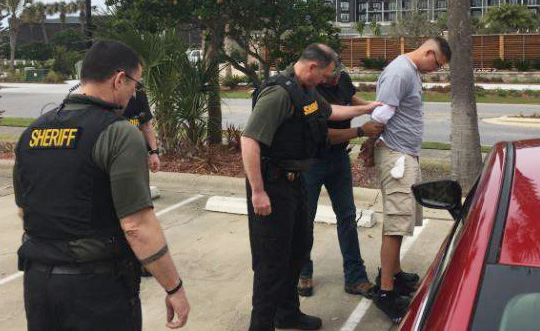
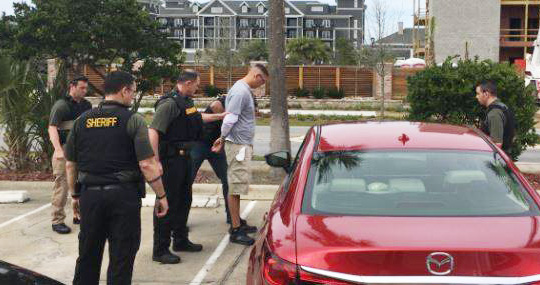
An Escambia County man who expected to meet a 13-year old for sex when he traveled to Okaloosa County this week was met by Okaloosa County Sheriff’s Office investigators instead.
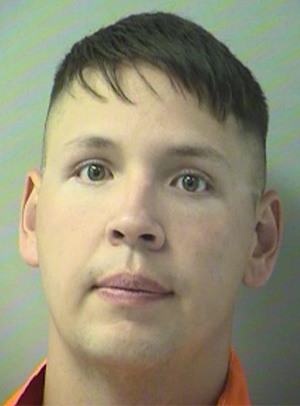 William Charles Huff is charged with obscene communication – traveling to meet after use of a computer to lure a child, and use of a two way communication device to facilitate a felony.
OCSO Investigators say Huff, 31, traveled from Pensacola to a predetermined location in Okaloosa County for the purpose of engaging in sexual activity with a person he believed was 13-years old.
Huff made the trip after a period of communication throughout February and March with an undercover officer who was posing as the youngster. They arranged to meet for a sexual liaison and Huff was taken into custody after he showed up in the parking lot for the encounter.
Photos for NorthEscambia.com, click to enlarge.
Tate High FFA Provides Meals Of Hope To The Needy
March 16, 2017

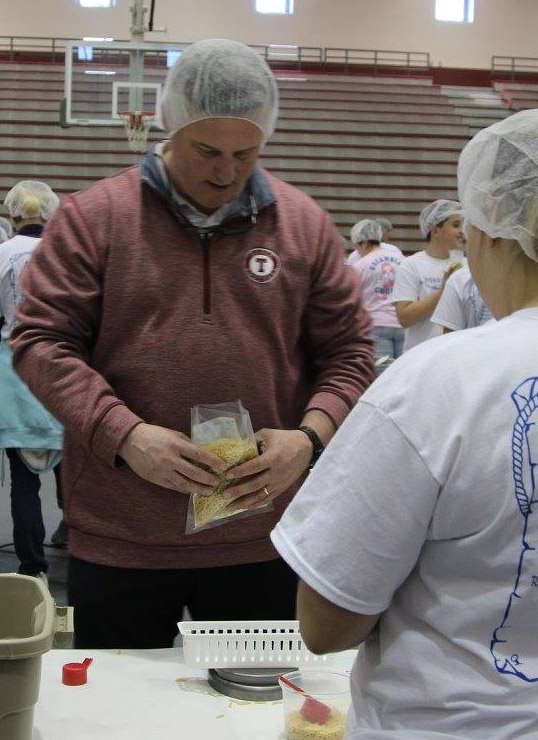 The Tate High School FFA is lending a hand to local families in need along with Feeding the Gulf Coast and Meals of Hope.
The group raised $5,000 to purchase bulk commodities to be packaged in single family portions and redistributed to help feed families in Escambia and Santa Rosa counties.
Wednesday, the FFA students packaged thousands of macaroni and cheese meals — carefully measuring, pouring, weighing labeling and counting each bag. Each family receiving one of the mac and cheese meals will know from the label that it was packed by the Tate High School FFA.
For a photo gallery, click here.
Photos by Kim Stefansson for NorthEscambia.com, click to enlarge.

Aggie Classic: Complete Day Three Results, Championship Schedule
March 16, 2017

Host team Tate and Niceville will battle it out tonight for the Aggie Classic championship.
Here are scores from Wednesday and the Aggie Classic Championship Day schedule:
Wednesday Scores:
- Presbyterian Christian, MS 6, Southmoore 2
- Pryor, OK 7, Knoxville Catholic, TN 6
- Edmond North, OK 17, Leon, FL 7
- Second Baptist, TX 10, Fort Gibson, OK 8
- Houston, TN 12, Piedmont, OK 2
- Magnolia Heights, MS 7, Mustang, OK 4
- Bartlett, TN 4, Choctaw, OK 3
- Milton FL 5, Coweta, OK 1
- Pace FL 13, Union, OK 2
- Booker T Washington 3, Durant, OK 2
- West Florida 3, Booker T Washington, OK 2
- Tate 9, Knoxville Catholic, TN 2
- Gulf Breeze 1, Berryhill, OK 0
- Niceville 9, Jenks, OK 0
Aggie Classic Championship Day Schedule:
- At Tate High – 3rd place: Houston vs. Edmond North, 4 p.m.; Championship game: Niceville vs. Tate, 7 p.m.
- At Gulf Breeze- 4 p.m. Magnolia Heights vs. Jenks; Gulf Breeze vs. Union, 7 p.m.
- At Milton- Second Baptist vs. Choctaw, Okla, 4 p.m.; Mustang vs. Milton, 7 p.m.
- At Pace- Leon vs. Coweta, 4 p.m.; Pace vs. Southmoore, 7 p.m.
- At Escambia- Presbyterian Christian vs. TBA, 4 p.m.; Berryhill vs. Knoxville, 7 p.m.
- At West Florida- Bartlett vs. Durant, 4 p.m.; Pryor vs. West Florida, 7 p.m.
- At Washington- Fort Gibson vs. Booker T. Washington, Okla., 4 p.m.; Booker T. Washington vs. Piedmont, 7 p.m.