

FDOT: Weekly Traffic Alerts
July 17, 2016

Drivers will encounter traffic disruptions on the following state roads in Escambia and Santa Rosa counties as crews perform construction and maintenance activities.
Escambia County:
- Nine Mile Road (State Road (S.R.) 10)- Lane restrictions east of Guidy Lane as crews construct a new eastbound, right and westbound, left turn lane for the shopping center Sunday, July 17 through Thursday, July 21. Lane closures will be in effect from 8 p.m. to 5 a.m.
- I-10 Widening – Alternating lane closures on I-10 eastbound, near U.S. 90 (Exit 17/Scenic Highway), from 7 p.m. to 6:30 a.m. the week of Monday, July 18 as crews perform paving work.
- Texar Drive (S.R.) 752 – Access to the pedestrian bridge will be closed for approximately one month. Eastbound ECAT bus stops located at the pedestrian bridge will be temporarily relocated during construction to just west of N Miller Street.
- Airport Road (S.R. 750)- Intermittent lane restrictions will begin Wednesday, July 20 from 8 p.m. to 6 a.m. as crews perform paving operations between U.S. 29 and County Road 95A(North Palafox Street). Work should be complete in a little over one month.
Santa Rosa County:
- S.R. 87 and S.R. 89 from S.R. 4 to the Alabama line – Intermittent and alternating lane closures and slow moving operations from 7 a.m. to 6 p.m. continuing through Sunday, July 31 as crews perform striping operations.
- I-10 Widening – Alternating lane closures, between the Escambia Bay Bridge and S.R. 281 (Avalon Boulevard/Exit 22), from 8 p.m. to 6 a.m. Sunday, July 17 through Thursday, July 21 as crews continue widening work. In addition, alternating lane closures on Avalon Boulevard near the I-10 interchange for bridge work.
- S.R. 87 Multilane – Drivers are reminded the speed limit has been reduced to 45 mph, from the Eglin Air Force Base boundary to north of the Yellow River near County Road 184 (Hickory Hammock Road), as crews widen the roadway.
- S.R. 281 (Avalon Boulevard)- Intermittent lane closures and slow moving operations from U.S. 98 to the toll bridge from 8 p.m. to 5 a.m. continuing through Thursday, July 28 as crews perform striping operations. There will be no work performed Friday through Sunday.
- U.S. 98 – Crews will perform striping operations and install raised pavement markers (RPMs) from the Pensacola Bay Bridge to Central Parkway (approximately nine miles) Sunday through Thursday nights through Sunday, July 31. Motorists may encounter minor traffic delays from 8 p.m. to 5 a.m.
All activities are weather dependent and may be delayed or re-scheduled in the event of inclement weather. Drivers are reminded to use caution, especially at night, when traveling in a work zone and to watch for construction workers and equipment entering and exiting the roadway.
Barrineau Park Elementary School Reunion Held
July 17, 2016
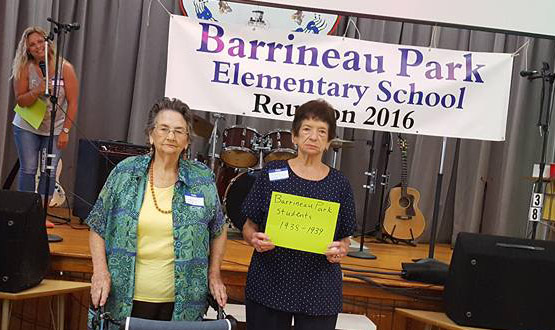
A Barrineau Park Elementary School reunion was held Saturday at the old school with dozens of former students representing the school’s history from 1938 to 2003. Members of various classes are pictured above and below.
Pictured top: Class of 1938 members.

Above: Class of 1940 to 1949 students.
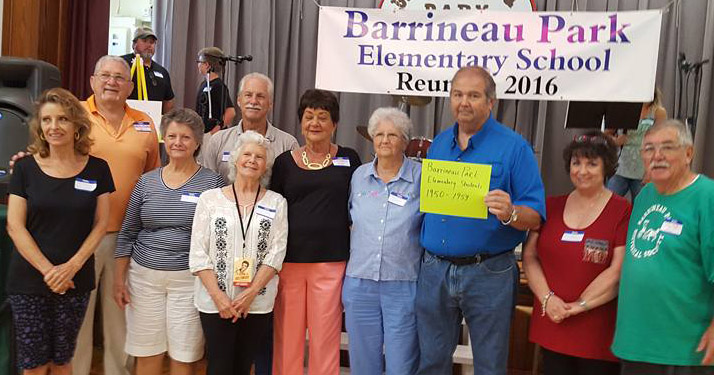
Above: Class of 1950 to 1959.

Above: Class of 1960 to 1969.
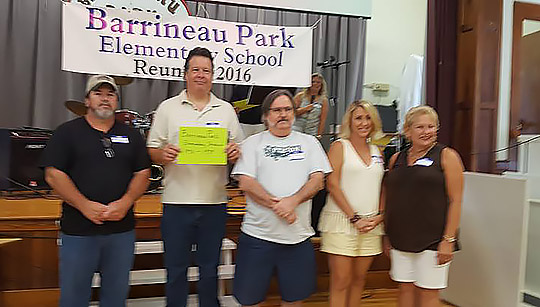
Class of 1970 to to 1979.

Above: Class of 1980 to 1989.

Above: Class of 1990 to 1999.

Above: Class of 2000 to 2003.
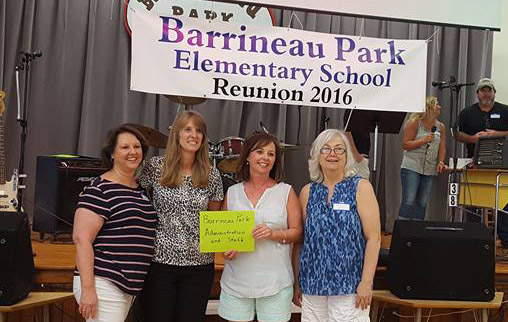
Above: Staff and administration.
Courtesy photos for NorthEscambia.com, click to enlarge.
Pediatricians: More Obstacles To Care Under Private Medicaid Plans
July 17, 2016
Florida pediatricians say children covered by Medicaid face more obstacles to getting needed care than they did before the state switched them over to private health-care plans, a recent survey found.
The survey, released last month by Georgetown University’s Health Policy Institute, showed that two-thirds of responding physicians saw an increase in the number of Florida children being reassigned to other doctors or health-care plans without their parents’ knowledge or consent.
 “Some of our patients keep getting switched to plans where they have to go all the way across the state for primary care,” one physician reported.
Respondents also said newborns were assigned to different plans than their mothers, while medical staff spent considerable time helping families return to their previous plans so that children could stay with their regular doctors.
“We spend much time and money appealing denials, even for treatments that patients have received for many years,” a respondent said.
The state’s Medicaid program has undergone a ten-year transition to managed care, with 95 percent of children covered by Medicaid moved to private managed-care plans by July 2015.
Under the new system, the managed-care plans get a monthly fee rather than payment for individual services — and the Georgetown survey was, in part, designed to evaluate the change.
It found that 84 percent of pediatricians said their patients in Medicaid managed care had difficulty obtaining prescriptions or over-the-counter medications, while 55 percent had cases in which a health plan kept them from providing needed treatment due to limits on benefits or requirements for prior authorization from the plans. Fifty-nine percent said families struggled to find specialists who would accept Medicaid, with referrals to behavioral or mental-health professionals the most difficult to fill.
Sarasota pediatrician Carola Fleener said she often advised patients to pay out of pocket for crutches or prescriptions they needed immediately, because getting the plans to approve would take too long.
Fleener also said the reimbursement rate for seeing Medicaid patients is so low that many doctors can’t afford it — and that private plans often challenge or deny their requests for payment.
Additionally, the survey found that just 27 percent of Florida children covered by Medicaid and the Children’s Health Insurance Program receive preventive dental care, compared to 48 percent of the programs’ recipients nationwide.
The survey was distributed to members of the Florida Chapter of the American Academy of Pediatrics from late February to early May. The sample size of 131 respondents was small — just under 6 percent of those contacted — although the study noted that 61 percent of those responding drew a majority of their patients from Medicaid enrollees.
However, the Florida Agency for Health Care Administration, which oversees the state’s Medicaid program, said the respondents represent less than 1 percent of all of the 37,593 physicians “who can provide services to our recipients.”
“We would not say that this survey is a true reflection of the program,” AHCA spokeswoman Mallory McManus wrote in an email.
Additionally, McManus said, surveys by the private plans show that those enrolled in Medicaid managed care “are satisfied with the access and care they are receiving.”
“We have on average fewer than two complaints from patients in any given month about having their plans switched, and we process those complaints promptly,” she wrote. “All Medicaid-eligible children are receiving medically necessary services. If anyone is aware of a child who is not receiving medically necessary care, they need to contact AHCA immediately.”
Others, however, say the state fails to provide proper oversight of its Medicaid managed-care plans.
“Florida has some decent protections in the managed-care contracts, but they’re clearly not being enforced,” said Joan Alker, executive director of Georgetown’s Center for Children and Families, in a recent interview.
“I don’t see where (the state is) overseeing anything,” Fleener said.
But Heather Urquides, spokeswoman for WellCare Health Plans, wrote in an email that the state is diligent in overseeing her company’s Staywell program for Medicaid beneficiaries.
“As part of the selection process, Staywell committed to meeting stringent benchmarks and quality metrics to ensure our members get the care they need,” Urquides wrote. “The state aggressively manages our performance to ensure we deliver on those commitments.”
Alker, however, said the complaint process for Medicaid managed care is “deeply buried” in AHCA’s website.
“It’s clear that families are not well-informed about what to do if they have a problem,” she added.
McManus said AHCA “takes very seriously the level of care all Florida Medicaid recipients receive.”
“We have strengthened our contracts and our oversight to the highest levels ever in the program,” she said. “The contracts give the agency the authority to ensure that our plans are providing the highest quality of care.”
by Margie Menzel, The News Service of Florida
Oak Grove Girl Competing For National Barrel Racing Title
July 17, 2016

A North Escambia girl is competing this week for national barrel racing title.
Lelia Mason of Oak Grove, a fifth grader at Molino Park Elementary School, and her horse Scoot are in Perry, GA, to compete with 2,200 youth from across the country who qualified for the 2016 National Barrel Horse Youth World Finals. Scoot, the horse, is owed by Kathy Braddock of Century.
Mason, 10, said she promised to bring pride to the local community by exhibiting a Godly attitude, good sportsmanship and great horsemanship.
Century Academy Registration Underway, Announces Scholarship Deadline
July 17, 2016
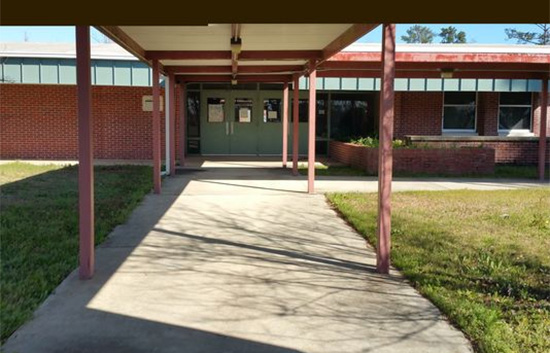
Century Academy has announced a September 1 deadline to apply for scholarships for their new private, non-profit K-12 school in Century for the 2016-17 school year.
The school specializes in teaching children diagnosed with Autism and other related learning disabilities. The current construction project to renovate the old elementary school building on Hecker Road is well under way and will be completed to welcome students starting school in August.
“We are very excited to bring this old building back to life and to be able to enrich the Century community. The students will absolutely love the rainforest and ocean themes. It is a beautiful place but one that is carefully designed to enhance the educational experience for children with autism and other learning disorders,” says Barbara Barber, director of Century Academy.
Potential parents need to understand the registration and application process must be completed as early as possible for scholarships designated for Florida students with learning disabilities for the next term. August is the beginning of the school year but it is typical to have students transfer in after the school year has started.
At the present time there are two types of scholarships available, the John McKay scholarship and the Gardiner scholarship. These scholarships generally cover the cost of tuition for a student attending a private school. Century Academy is now actively in the second phase of registration for the John McKay scholarship. This scholarship has a September 1 deadline to file an intent notice.
Ms. Barber will meet prospective parents to actively register students at the school at 440 East Hecker Road Monday through Friday by appointment only. Parents can call the Pensacola location at (850) 437-5560 Monday through Thursday to schedule an appointment.
Century Academy is a subsidiary of East Hill Academy in Pensacola.
Wahoos Beat Suns 5-2
July 17, 2016

With a pair of home runs by Brandon Dixon and a season-high nine strikeouts by Rookie Davis, the Pensacola Blue Wahoos were lights out against the Jacksonville Suns in a 5-2 win at the Baseball Grounds of Jacksonville.
The Blue Wahoos jumped out to an early 3-0 lead in the first inning after a two-out home run by Taylor Sparks. After a single by Sebastian Elizalde, Brandon Dixon hit his first homer of the night.
Rookie Davis, the Reds No. 11 prospect according to MLB Pipeline, started off his night by striking out five of the first six Suns’ batters. In the top of the second, Davis also raked his fourth RBI of the year with a single to bring home Ray Chang.
Brandon Dixon hit his final home run of the night, and 13th of the year, in the third inning to give Pensacola a 5-0 lead, and the team’s final run of the night.
It wasn’t until the fifth inning that Jacksonville was able to put runs on the board. After a ground rule double by Francisco Arcia, former Pensacola catcher Cam Maron hit his first home run of the season.
Davis finished the night striking out by striking out four more batters for a total of nine, a Double-A high for him.
After leaving the game after the sixth inning, the Pensacola bullpen shut down Jacksonville including an inning of hitless baseball by MLB rehabber Caleb Cotham. Carlos Gonzalez came in the eighth inning and struck out one while giving up no hits in his third straight appearance (3.2 innings total).
Alejandro Chacin, who leads the Southern League in saves, picked up his 17th save after two strikeouts and allowing two hits.
Pensacola and Jacksonville play two seven-inning games Sunday after Friday night’s postponement due to rain. RHP Jackson Stephens and RHP Sal Romano are taking the mound for Pensacola while LHP Matt Tomshaw and RHP Patrick Johnson take the hill for Jacksonville.
July Gardening Tips
July 16, 2016
The heat, humidity and frequent rains of July are great for tropical plants. Gardeners, however, take a bit of a beating. Remember to keep the sunscreen, insect repellant and iced tea handy as you venture out into your garden to perform some needed summer maintenance.
A midsummer application of fertilizer is usually required, especially on annual flowers, lawns, shrub beds and vegetable gardens. This is a supplemental application, so don’t overdo it. A 15-0-15 slow-release fertilizer is a good general purpose landscape fertilizer for most plants.
Major pruning jobs should have been done earlier, but there is still some maintenance pruning that should be done. Deadhead, or clip old flowers, from summer flowering shrubs as soon as they fade to help insure an extended season of bloom. Crape myrtles, hibiscus, hydrangeas and althea are examples of shrubs that will bloom repeatedly if light, selective pruning is done.
 Flowering annuals also respond well to deadheading. Snip off old flowers and flower spikes before they have an opportunity to form seed. Allowing annual flowers to set seed can shorten their blooming season considerably.
Inspect your lawn and shrub plantings frequently in order to identify pest problems as early as possible. The most severe damage from pest insects normally begins in July. Be on the lookout for chinch bugs in St. Augustine grass; spittlebugs in centipede grass; sod webworm in all lawns-especially new ones; lacebug and caterpillars on azaleas; whiteflies on gardenia and spider mites on lots of different types of shrubs.
Sod webworms often attack lawns in the summer. They eat the grass blades producing areas that look as if they have been mowed too short. Close inspection will reveal that the blades have not been cleanly cut as with a mower blade but have been chewed along their edges and tips. These caterpillars feed at night and rest during the day down among the runners and in the thatch.
 Once an insect pest is found, evaluate the damage and determine if control is necessary. If it is, choose the least toxic option. If only a few caterpillars are found, hand picking might be the choice. Aphids and spider mites can often be controlled by spraying with an insecticidal soap solution. Chemical insecticides are sometimes required. Before choosing one be sure that the insect pest has been properly identified and that the insecticide is labeled for that purpose For vegetable gardeners that have problems with nematodes, soil borne diseases and extensive weed problems, July is a great time to try soil solarization.
Prepare the soil as you normally would for a vegetable garden including adding organic matter. Moisten the area and cover with clear plastic, not black plastic. Clear plastic will produce the highest temperatures. Be sure to weigh down the edges of the plastic so that it doesn’t blow up. Allow the soil to bake in the sun for four to six weeks. The sun will raise the soil temperature high enough to kill many soil borne problems.
Tip of the Week: The nice thing about tomatoes is that you have the option of harvesting when the fruit is green if needed. Tomatoes will ripen indoors at room temperature. To ensure even ripening, place the tomato with the stem up. The ideal time to harvest tomatoes is when they are fully colored but still firm.
In general, it is best to harvest vegetables early in the mornings while the moisture content is higher. The overall quality will quickly diminish as vegetables are exposed to hotter temperatures later in the day.
Florida Delegation Looks To Unite At GOP Convention
July 16, 2016
A year ago, some Florida Republicans dared to dream that one of the state’s own would be accepting the GOP presidential nomination in Cleveland at next week’s convention.
Former Gov. Jeb Bush was the front-runner, with piles of campaign contributions and a name that, for all of its baggage, designated him as a member of the party’s unofficial first family. And U.S. Sen. Marco Rubio, young and Hispanic in a party struggling with both of those demographics, showed up in polls as seemingly everyone’s second choice, a prime position to pick up support once other candidates dropped out.
Instead, Bush couldn’t even make it to the Florida primary after devastating losses in states that voted earlier, and Rubio suspended his campaign after getting smashed by businessman Donald Trump in the Sunshine State — part of the real-estate mogul’s romp to the nomination.
Meanwhile, the primary and its aftermath exposed fault lines in the Florida GOP, divisions that party leaders will hope to heal, or at least patch over, during the party gathering in Cleveland. Especially since the electoral math for any Republican hoping to win the White House remains daunting without Florida.
“It’s already, we know, going to be very, very close, and Florida’s going to again be critical to Republican success. … The importance of unity for Florida is elevated this time out,” said Susan MacManus, a political science professor at the University of South Florida.
Much of the discussion in the lead-up to the gathering, though, has highlighted the fissures in the state GOP. Gov. Rick Scott, who emerged as an enthusiastic Trump supporter following the Florida primary, is scheduled to speak at the convention. So is Attorney General Pam Bondi, the highest-profile Republican in the state to endorse Trump before Floridians voted.
But others are staying away completely. Bush won’t attend, and Rubio will be campaigning for re-election in Florida after his surprise decision last month to run for another term in the Senate.
Some members of the state’s congressional delegation also won’t be in attendance. Congressman Carlos Curbelo, one of Trump’s harshest critics in the Florida GOP, reportedly won’t go. The offices of Congressmen Rich Nugent, Tom Rooney, Dennis Ross and Dan Webster told The News Service of Florida they won’t be in Cleveland next week.
“The congressman has a full schedule of events next week, and will not be attending the convention in Cleveland,” Elizabeth Tyrrell, a spokeswoman for Webster, wrote in an email.
Other lawmakers will be there. Congressmen Ander Crenshaw and Jeff Miller are delegates, while Congressmen Ted Yoho and Gus Bilirakis also plan to attend, according to their offices.
Most Florida Republicans who won’t attend either didn’t provide a reason for skipping the gathering or chalked it up to some reason other than the outsized presence of Trump, one of the party’s most controversial nominees in years.
“I’m not a delegate and I’d rather be home, to be honest,” said state Senate President Andy Gardiner, R-Orlando.
But if political calculations are driving some GOP candidates to avoid Cleveland, other Republicans are taking flak for staying home. Carlos Beruff, a developer challenging Rubio for the GOP nomination for the U.S. Senate seat, slammed Rubio for backtracking on speaking at the convention and offered to take his spot.
“It’s no surprise that Marco Rubio and others are shying away from supporting Donald Trump. … Trump is (motivating) voters across Florida and the country who have felt ignored by the Republican and Democratic establishment alike. He’s looking to shake up Washington, and I’m behind him 100 percent,” Beruff said.
There will also be agendas at play beyond 2016. Agriculture Commissioner Adam Putnam, a top candidate to run for governor in 2018, will host the state’s delegates at a “Florida Grown Breakfast” on Tuesday, featuring neurosurgeon and former presidential candidate Ben Carson.
Other marquee names are likely to speak to the Florida delegation, either to help promote the party’s chances in 2016 or to boost their own profiles for future bids for office, perhaps the presidency in 2020 if Trump falls short.
“You can see raw ambition at every level,” MacManus said.
by Brandon Larrabee, The News Service of Florida
Ballots On The Way To Military And Overseas Voters
July 16, 2016
The Escambia County Supervisor of Elections Office began sending vote-by-mail ballots on Friday, July 15, to eligible military and overseas citizens. Voters will either receive their ballot by mail or electronically, depending on their chosen method of delivery. Absent military voters and those living overseas can request, mark and track their vote-by-mail ballots electronically.
Vote-by-mail ballots for all eligible domestic voters will be mailed beginning on Monday, July 25. The deadline to request a vote-by-mail ballot to be mailed for the Primary Election is 5 p.m. on Wednesday, August 24. To request or track your vote-by-mail ballot for the Primary Election, visit EscambiaVotes.com and click “Vote by Mail”, or contact the Supervisor of Elections Office at (850) 595-3900.
Across the state, county supervisors of elections have already sent out more than 1.5 million ballots to overseas and military voters.
Of the ballots already out statewide, Republicans accounted for 626,019 and Democrats accounted for 610,328. Another 250,261 ballots went to people with no party affiliation and 36,457 were sent to people registered with one of the state’s minor parties.
The News Service of Florida contributed to this report.
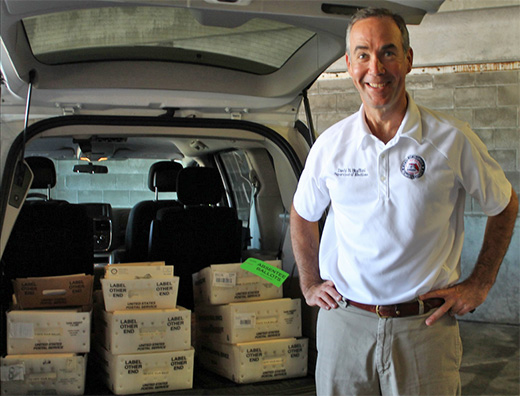
Pictured: Escambia County Supervisor of Elections David Stafford with vote-by-mail ballots on their way overseas and to military voters. Courtesy photo for NorthEscambia.com, click to enlarge.
Florida Gov’t Weekly Roundup: In The Background For A Bit
July 16, 2016
When it came to news, it was hard for Florida to get a word in edgewise this week.
 Republican presidential candidate Donald Trump selected Indiana Gov. Mike Pence as his running mate. There was a brutal terror attack in the French city of Nice. And on Friday, an attempted coup in Turkey threw into grave doubt the future of one of America’s NATO allies.
By comparison, things in Florida seemed rather tame. There were some polls about whether Trump or former Secretary of State Hillary Clinton, his Democratic opponent, had the upper edge in Florida with the national political conventions looming. The fight over kosher food at state prisons drew closer to a conclusion. And algae continued to muck things up in southern parts of the state.
None of which will diminish Florida’s reputation as odd news capital of the world, of course. But it did keep the spotlight off the Sunshine State for a few days.
OPPOSITE CONCLUSIONS
Who’s leading the presidential race in Florida, a state that is once again shaping up as one of the most important in the nation? It depends on whom you ask.
Quinnipiac University, one of the highest-profile independent polls, showed Trump taking a narrow lead over Clinton in Florida, with 42 percent of voters favoring the real estate mogul and 39 percent backing the first female major-party nominee. The margin grew to five points when pollsters added a pair of third-party candidates — Libertarian Gary Johnson and the Green Party’s Jill Stein.
The results of the head-to-head match-up between Clinton and Trump marked an 11-point swing in about three weeks. Peter A. Brown, assistant director of the poll, said Clinton’s numbers might have been dragged down by FBI Director James Comey, who publicly criticized the nominee for being “extremely careless” with email during her time as secretary of state, though Clinton was not charged with a crime.
“While there is no definite link between Clinton’s drop in Florida and the U.S. Justice Department decision not to prosecute her for her handling of e-mails, she has lost ground to Trump on questions which measure moral standards and honesty,” Brown said in comments accompanying the poll results.
But some Democrats were skeptical of the poll released Wednesday by the Connecticut-based university. In a blog post, Democratic strategist Steve Schale said he had no doubt Florida will be tight in November — but that the trend in Quinnipiac’s numbers lacked a ring of accuracy.
“For as much of a mess as Florida can be, it is a remarkably consistent state,” he said. “There just isn’t 10-12 points of movement here.”
And by Friday, another survey gave Clinton the lead. The NBC News/Wall Street Journal/Marist Poll showed the former secretary of state up 44 percent to 37 percent, and by five points when the third-party candidates were factored in.
Lee M. Miringoff, director of The Marist College Institute for Public Opinion, said in comments released with the poll numbers that Trump is “playing catchup” against Clinton in Florida, Colorado, North Carolina and Virginia. The institute, part of New York-based Marist College, also released results Friday showing Clinton ahead in those three other battleground states.
“The driving force behind voters’ choices is the negative impressions they have of both Trump and Clinton,” Miringoff said. “Clinton’s single-digit lead in each of these states is due to her slight advantage in how voters perceive the two candidates.”
Get ready for another nail-biter in the Sunshine State.
COURT MAKES NO BONES ABOUT PRISON FOOD
Complaints about meals in jail are probably about as old as jails themselves. But an appeals court on Thursday upheld a lower court’s decision to require Florida corrections officials to provide kosher meals to inmates.
U.S. District Judge Patricia Seitz last year ordered the Department of Corrections to offer kosher meals and barred it from removing inmates from the religious dietary plan if prisoners buy non-kosher food from canteens or don’t pick up the meals more than 10 percent of the time.
Corrections Secretary Julie Jones has maintained she has no plans to stop offering kosher meals. But her agency has argued that a federal law — the “Religious Land Use and Institutionalized Persons Act” of 2000 — allows prison officials to stop offering the meal plan if it gets too expensive.
A three-judge panel of the 11th U.S. Circuit Court of Appeals ruled Thursday that Jones and the agency failed to prove their case. The state has spent nearly $500,000 on legal fees and costs in the prolonged dispute.
Jones “fail(ed) to explain why the department cannot offer kosher meals when the Federal Bureau of Prisons and other states do so,” or why she can’t provide the kosher meals although the department offers other special diets “at similar marginal costs,” wrote appeals court Judge William Pryor.
Corrections officials were reviewing the court’s decision and “will determine next steps,” agency spokeswoman Michelle Glady said in an email Thursday evening.
“We will continue to serve the more than 9,000 inmates enrolled in the religious dietary program meals that comply with the tenets of their faith,” she said.
The fight over kosher meals in Florida prisons has dragged on for more than a decade.
The department started offering kosher meals in 2004 to Jewish prisoners at 13 facilities and transferred inmates who were eligible for the meals to those institutions. The agency expanded the program to inmates of all faiths in 2006 but halted it the following year before reinstating it as a pilot project at a single prison in 2010, serving fewer than 20 prisoners.
A year after the Justice Department filed the lawsuit in 2012, the state again began serving kosher meals and promised to have the meals available to all inmates by last July.
About 9,000 of the state’s 100,000 prisoners are receiving kosher meals, according to Glady. As of Monday, the state was spending $3.32 per inmate per day on kosher meals, compared to about $1.97 for the regular diet.
POLITICAL MUCKRAKING
Amid a blossoming problem with toxic algae linked to water releases from Lake Okeechobee, the state this week opened its bridge-loan program to businesses in Southeast and Southwest Florida that have been hurt by the crisis.
By Thursday, 59 businesses — mostly in Martin, St. Lucie and Lee counties — had reported some form of financial impacts from the toxic blooms.
Florida Department of Economic Opportunity Executive Director Cissy Proctor said the impacts include such things as a decrease in tourists to the counties, fewer people going to restaurants and fewer people using recreational facilities on or near the water.
“We’ve seen the reports of these blooms not only on our local news, but on the national news,” Proctor said. “And we’re also seeing that even if (people) are going down to visit, they’re not going out on their boats. They’re not going out to see the manatees. They’re not going out to do the things that you normally do, especially in these areas on the water that are recreationally or are part of these folks’ livelihood.”
The loans are available only to businesses in four counties in which Gov. Rick Scott has declared an emergency: Martin, St. Lucie, Lee and Palm Beach.
But assistance for businesspeople affected by the problems also caused a political storm this week after Scott’s office posted on the state’s Sunburst email system a chain of emails in which Democratic Congressman Patrick Murphy’s office on Monday requested a delay in announcing the opening of a Small Business Administration recovery center. The potential delay could have led to an announcement during a press conference Murphy was holding Thursday about the algae issue.
Opponents on both sides pounced on Murphy’s request. Congressman Alan Grayson, who is running against Murphy in the Aug. 30 Democratic primary for a U.S. Senate seat, called Murphy’s action an abuse of power.
“Putting his own political fortunes in front of the needs of legitimate small business owners is stunningly shameless,” Grayson campaign manager Michael Ceraso said in a release.
Meanwhile, Carlos Beruff, a developer from Bradenton seeking to become the Republican Senate nominee, went further, demanding Murphy “resign his office immediately” and be investigated by the House Committee on Ethics.
But Murphy’s campaign fired back, saying it was Scott’s office “looking to score partisan points” that took out of context a “standard request to coordinate a media strategy with a federal agency.”
“Of course our office did not request for this program to be delayed,” Murphy campaign spokesman Anthony Kusich said in a statement. “Anyone who reads the original email can see that we did not. The official emails that Republicans are distributing to press intentionally leave out the Small Business Administration’s email to our office on Monday morning, which suggests no impending announcement.”
STORY OF THE WEEK: Polls showed both Donald Trump and Hillary Clinton in the lead in Florida’s presidential race, pointing to the likelihood of another close campaign for the state’s 29 electoral votes.
QUOTE OF THE WEEK: “The United States Supreme Court has recognized that there is a guerilla war currently occurring against the death penalty in the United States. Anti-death penalty groups have been on a crusade against those legally involved with executions, harassing and threatening them until they feel pressured to withdraw their participation. … In Florida, the plight has not been any different.”— Florida Chief Assistant Attorney General James Lee Marsh, in a filing asking a federal judge in Tallahassee to quash a subpoena from a case involving seven Arizona Death Row inmates.
by Brandon Larrabee, The News Service of Florida