

Lawmakers Headed To Overtime For Budget
May 3, 2017

The Republican-dominated Legislature will need extra time to finish work on the state budget for the second time in three years, as lawmakers ended Tuesday with no agreement on an $83 billion spending plan for the year beginning July 1.
Negotiations between House Speaker Richard Corcoran, Senate President Joe Negron and their budget chiefs failed to work out a final deal that would allow the annual legislative session to end on Friday, as scheduled.
Because of a constitutionally required 72-hour “cooling off” period, an agreement on the budget needed to be finished Tuesday for the session to wrap up on time.
Instead, Negron stood on the Senate floor around 6:30 p.m. and conceded what had become increasingly clear: The House and Senate would miss the deadline.
“We will definitely not complete the budget work prior to the end of Friday,” said Negron, R-Stuart. “So we’ll continue to work diligently. … I think given the current schedule, it’s improbable we’d be able to finish before Friday.”
Instead, legislative leaders will now try to work out a deal by Friday at the latest, which would allow the budget to be voted on as soon as Monday. It seemed unlikely that lawmakers would meet over the weekend, when Florida State University is scheduled to hold its graduation ceremonies and fill up hotel rooms across Tallahassee.
Negron’s concession came less than a week after lawmakers had confidently predicted that they would be able to hammer out differences in their competing versions of the budget despite a tight timeline for negotiations.
Indeed, Corcoran had dismissed reporters’ questions on the process Thursday by implying that reporters were upset that they were wrong about the potential need for a special or extended session to finish the budget.
“I know all of you wrote that it was going to be a train-wreck, we’re going to go into 18 special sessions, we’re never going to get done, but now that we have come together, we’ve worked out our differences and now we’re having a conference, I think it’s going to be a spectacular session,” Corcoran, R-Land O’ Lakes, said at the time. “There’ll be no crashes, despite your reporting, and I think it’s going to be a good day for the state of Florida.”
Corcoran told reporters Tuesday afternoon that he believed there was a 90 percent chance that the budget would be done on time.
But the obstacles to a final deal apparently proved to be too much. Negron blamed “the number of issues that we were confronted with,” from his own plans for higher education funding and a reservoir south of Lake Okeechobee to Corcoran’s push for extra money for charter schools and teacher bonuses to what little lawmakers did to accommodate Gov. Rick Scott’s agenda.
Corcoran and Negron stepped in to take over the negotiations Sunday afternoon following talks between their respective budget chairs. But there have been no public meetings since then.
The final stumbling block appeared to be over how to distribute $651 million in Medicaid cuts to hospitals. The House and the Senate have different formulas for how to hand out those reductions.
And Senate leaders are pitching a new source of money to help bridge the gap: nearly $200 million in payments that have been set aside while the state and the Seminole Tribe tried to work out an extension of a gambling pact.
“There may be a way to do a blended (hospital) model where both sides could win and, if we could get the House to agree on the money that we’re holding from the Seminole Tribe, that money is potentially available on a very short turnaround and maybe some of that money could be used to offset the impact of the hospital cuts,” Negron said.
It was widely assumed that the money would only be available if the Legislature came to an agreement on a new gambling deal — negotiations that fell apart Tuesday. But Sen. Bill Galvano, a Bradenton Republican who has spearheaded Senate efforts on gambling issues, said that’s not case.
“I think ultimately we will try to access that money even if we don’t have a deal with the Seminole Tribe,” he told reporters Tuesday.
But Galvano also said the House has not agreed to use the funds.
Meanwhile, Scott was gearing up for one last push in pursuit of his priorities. The Legislature has largely ignored the governor’s agenda this year, rejecting his request for economic-development incentives, sharply reducing his request for tourism marketing funds and declining to go along with a $200 million proposal to help fix the Herbert Hoover Dike at Lake Okeechobee.
Scott’s office said he would launch a “Fighting for Florida’s Future” tour Wednesday, visiting the first four of several cities he will hit by the end of the week.
“All three of these issues are tied to jobs, but unfortunately the politicians in Tallahassee still haven’t committed to funding these important priorities,” Scott said. “There are still a few days left of the regular session which means that there is still time for the politicians to do the right thing and fund priorities to protect our environment and keep our economy growing.”
The threat that Scott might veto the budget has loomed over the late-stage discussions, but Corcoran and Negron said they haven’t had discussions recently about rounding up the two-thirds majorities that would be required for a veto override.
Senate Appropriations Chairman Jack Latvala, a Clearwater Republican who has fought for some of Scott’s priorities, said Tuesday he didn’t believe the governor would veto the entire spending plan.
“Now ask me if he’s going to veto parts of it, (and) I’d bet money on it,” he said.
by Brandon Larrabee; News Service of Florida writers Lloyd Dunkelberger and Dara Kam contributed to this report
Florida Lawmakers Fold On Reaching Gambling Deal
May 3, 2017
Unable to overcome an impasse on slot machines, House and Senate leaders Tuesday called off negotiations on a sweeping gambling measure, acknowledging that the effort is dead for the 2017 legislative session.
The leaders were attempting to strike a compromise centered on an agreement, called a compact, with the Seminole Tribe and to resolve a series of gambling-related court decisions affecting the deal with the tribe.
 But Sen. Bill Galvano, the Senate’s chief negotiator on the gambling issue, and his House counterpart, Rep. Jose Felix Diaz, were unable to reach consensus on whether to allow slots at pari-mutuels in counties where voters have approved the machines.
Including slots for the eight referendum counties — Brevard, Duval, Gadsden, Hamilton, Lee, Palm Beach, St. Lucie and Washington — in the gambling package was a priority for Senate President Joe Negron, but House Speaker Richard Corcoran balked at the notion.
“Gaming will not happen,” Galvano, a Bradenton Republican set to take over as Senate president late next year, said in a text message early Tuesday afternoon, three days before the scheduled end of the session.
Lawmakers’ failure to pass a gambling package mirrors similar futile efforts in previous years.
But, unlike in the past, both chambers passed separate gambling proposals, setting up talks between Galvano and Diaz.
Just last week, Galvano and Diaz achieved some success in bringing into alignment the House’s status-quo gambling proposal, which would have essentially re-inked a 20-year compact with the Seminoles, and the Senate’s more pari-mutuel industry friendly measure (SB 8).
But the negotiators could not bridge the gap over the slot machines.
“We just couldn’t get it across the finish line. We were too far apart, and the Senate wanted to bring it in for a landing during budget conference, and we were not going to be able to do that,” Diaz, R-Miami, told reporters late Tuesday afternoon. “The referendum counties was the big divide.”
Galvano and the Senate were eager to seal a deal before the Florida Supreme Court rules in a case focused on whether pari-mutuels can add slots if voters approved them, even without the express permission of the Legislature.
“We have to address that component of gaming in the state of Florida or we’ll still be in a state of jeopardy going into the summer and going forward, even if we had a bill. The Senate was prepared to address it, and recognizes that the voters in those counties had sought expansion. We would have worked on ending the court litigation with regard to those counties, and the House did not want to address that issue and saw it as an expansion (of gambling),” Galvano, R-Bradenton, told The News Service of Florida.
Negron, R-Stuart, had insisted that the counties where voters expressed a desire for slots be included in the gambling proposal.
“I believe strongly that their will should be acknowledged and accepted by all of us,” he said during a floor session after announcing the gambling impasse could not be resolved.
Corcoran, R-Land O’ Lakes, told reporters that lawmakers made “a great effort” to pass a bill.
Industry lobbyists appeared grim as news of the demise of the gambling bill spread throughout the fourth floor outside the House and Senate chambers.
“We thought this was going to be the year, as opposed to the other years where we’ve come close. This one went much further along but unfortunately, as we’ve seen the last several years, the two sides were unable to reach an agreement,” said lobbyist Nick Iarossi, who represents pari-mutuel facilities in Melbourne and Jacksonville that want to add slots.
With a number of unresolved gambling-related court issues — as well as a potential $3 billion deal with the Seminoles — still on the table, talk inside the Capitol turned to the possibility of a special session later this summer on the issue.
“We could have a series of bad court decisions that can result in a major reduction in the revenue share that we enjoy from the tribe. Does that mean we’ll have a special session on it? I don’t know,” Galvano said.
A Supreme Court ruling in favor of Gretna Racing, a small horsetrack in Gadsden County, could mean that pari-mutuels in all of the eight counties would be able to add up to 2,000 slot machines to their operations, something that would undo a revenue-sharing agreement with the Seminoles that’s part of the 2010 compact.
Addressing a court decision “after the fact” is “always a dubious position to be in,” said Galvano, a lawyer who helped craft a 2010 agreement with the Seminoles, adding that was why he wanted to include the referendum counties in the gambling proposal before the court rules on the slots counties.
“I wouldn’t be surprised if the court was waiting to see what came out of session before addressing it,” he said.
The gambling proposals under consideration would have allowed the Seminoles to add craps and roulette — something they have sought — and to keep “exclusive” rights to offer banked card games, such as blackjack.
A provision in the 2010 compact allowing the tribe to have banked card games expired in 2015, but the Seminoles accused the state of breaching the exclusivity agreement by allowing controversial “designated player” games at pari-mutuel cardrooms. A federal judge sided with the Seminoles in the lawsuit last year, but the state has appealed.
Asked whether the legislature’s failure to pass a gambling bill weakens the state’s position to negotiate with the tribe over a future compact, Diaz said there are no negotiations ongoing.
“We’re not any weaker or stronger. We just are nowhere. That’s the unfortunate reality that we find ourselves in,” he said.
Century Increases Water, Sewer Rates By Over 50 Percent
May 2, 2017
Monday night, the Century Town Council officially approved a water and wastewater rate increase that will cost the average family just over $200 per year.
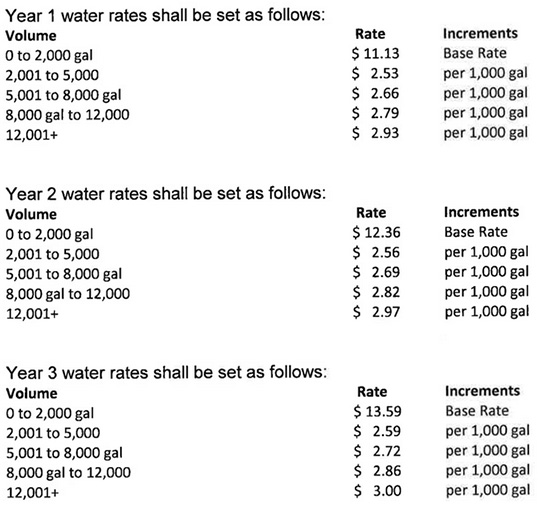
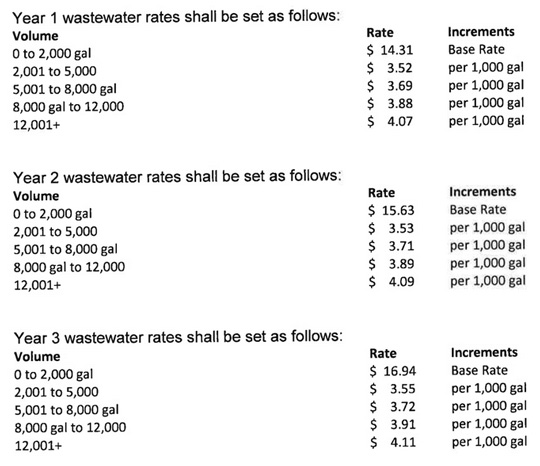
 The average family of four customer using 5,000 gallons of water per month currently pays $18.65 for water and $13.00 for wastewater, for a total monthly bill of $31.65. A three-year incremental rate increase approved Monday night totals a a 55 percent ($17.30) monthly increase for the average user….$21.36 for 5,000 gallons of water and $27.59 for wastewater, for a total bill of $48.95.
The water and wastewater department had a net income loss of $142,022 last year, according to a Florida Rural Water Association rate study. In order to apply for future grants or loans, the water and wastewater systems must be financially viable by implementing the rate increases, according to town officials.
The increase comes of the heels of a 36 percent garbage rate hike of $6.21 per month. Together, the water, sewer and garbage rate increase will cost Century’s average family of four $283 per year. The increase allowed a system that was losing to money to continue to operate at the current service level.
Century is also considering a natural gas rate increase.
The new water rates approved Monday night by the Century Town Council are as follows:
Sewer rates were increased as follows:
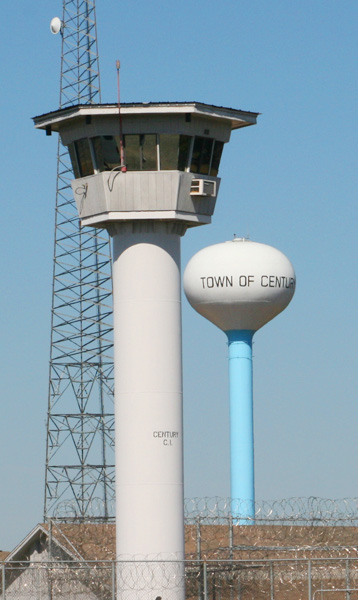
Pictured: Century’s water, wastewater and natural gas franchise also serves the Century Correctional Institution. NorthEscambia.com photos, click to enlarge.
FWC Law Enforcement Report
May 2, 2017
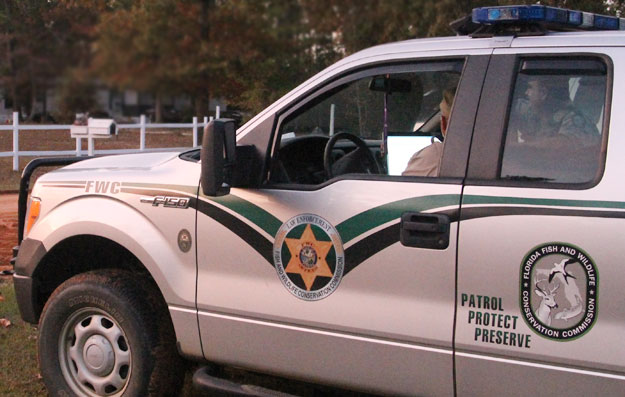
The Florida FWC Division of Law Enforcement reported the following activity during the weekly period ending April 27 in Escambia and Santa Rosa counties.
ESCAMBIA COUNTY
 While checking several fishermen on the Bob Sikes Bridge, Officer Manning noticed fresh blood and large scales on the ground. A nearby fisherman denied knowing anything about it and claimed he had not caught anything. While checking the individual’s cooler, Officer Manning found two large fillets. The individual at first insisted the fillets were from a grouper he bought from a fish market. Officer Manning determined the fillets were from a red drum and located a bloody knife. After additional questioning, the individual admitted to catching and cleaning the red drum. The subject was issued a notice to appear citation for the violation.
Officer Long taught the laws section of a hunter’s education class this week. The class was held at the Molino Community Center in Molino.
SANTA ROSA COUNTY
Officer Hutchinson was patrolling near Keyser’s Landing and the Escambia River when he observed several men standing beside a truck that was stuck in a mud hole on the edge of the right of way. He approached the men and while speaking with them, he observed fresh tire tracks and deep ruts in front of the truck leading into private property. Officer Hutchinson questioned the men about the damage to the right of way and the private property. Two of the men admitted to purposely mud riding and damaging the property. Officer Hutchinson issued the two men notices to appear for damaging public land with a motor vehicle.
Officers Lewis and Jernigan were patrolling on the beach when they observed a man surf fishing. Officer Lewis asked the man for his fishing license and when he was retrieving it from his wallet, Officer Lewis observed him remove a small baggie containing pills from his wallet and try to conceal it. Inspection of the bag revealed a controlled substance. Another pill was also found in his wallet. The subject voluntarily stated that the pill in the baggie was Sub Oxone. Officer Lewis arrested and charged the subject with two felony counts of possession of a controlled substance without a prescription and possession of drug paraphernalia.
Officer Land conducted a youth outreach event at Shoreline Park in Gulf Breeze for approximately 100 students from Gulf Breeze Middle School. Officer Land had an FWC vessel on display and educated students about the role and responsibilities of an FWC officer. He had boating safety items on display and explained the importance of safe boating and answered questions from students regarding boating rules, resource regulations, and public safety concerns.
This report represents some events the FWC handled over the past week; however, it does not include all actions taken by the Division of Law Enforcement. Information provided by FWC.
NorthEscambia.com photo.
FDOT: Weekly Traffic Alerts
May 2, 2017
Drivers will encounter traffic variations on the following state roads in Escambia County as crews perform construction and maintenance activities.
Escambia County:
· Interstate 10 (I-10)/ U.S. 29 Interchange Improvements Phase I – Alternating lane closures continue on I-10 near U.S. 29 (Exits 10A and 10B) from 8 p.m. to 6 a.m. Sunday through Thursday as crews perform pipe repair and survey work. In addition, intermittent lane closures on the on-and-off ramps at the I-10/U.S. 29 interchange.
· U.S. 29 from Stumpfield Road to North W Street Routine Roadway Work - Northbound outside lane closure from 8 p.m. to 5 a.m. Monday, May 1 and Tuesday, May 2 as crews perform shoulder work to tie in the entrance to the CarMax lot.
· Fairfield Drive (SR. 295) between Ruby Avenue and Emerald Avenue Routine Utility Maintenance- Lane closure from 11 p.m. Wednesday, May 3 to 5 a.m. Thursday, May 4, as crews replace utility pole.
· Palafox Street (S.R. 95) from Texar Drive to Cross Street Underground Utility Work- Southbound outside lane closed from 8 p.m. Thursday, May 4 to 5 a.m. Friday, May 5 as crews perform underground utility work.
· I-10 Widening from Davis Highway to the Escambia Bay Bridge – Alternating lane closures continue on I-10 westbound, between Davis Highway (S.R.) 291/Exit 13) and Scenic Highway (U.S. 90/Exit 17), from 7 p.m. to 6:30 a.m. Sunday through Thursday as crews perform paving work.
· U.S. 29 (S.R. 95) Widening from I-10 to Nine Mile Road- Alternating lane closures continue from 8 p.m. to 6 a.m. on U.S. 29 between I-10 and 9 1/2 Mile Road and on Nine Mile Road near the U.S. 29/ Nine Mile Road overpass as crews perform drainage and bridge operations.
· Nine Mile Road (S.R. 10/U.S. 90A) Widening from Pine Forest Road to U.S. 29- Alternating lane closures continue on Untreiner Avenue as crews perform jack and bore operations.
Santa Rosa County
· I-10 Widening from Escambia Bay Bridge to Avalon Boulevard (S.R. 281/Exit 22)- Alternating lane closures between the Escambia Bay Bridge to just east of Avalon Boulevard (Exit 22) Sunday, April 30 through Thursday, May 4 as crews place barrier wall and pavement markings. Traffic on I-10 eastbound will be shifted to the new inside travel lanes Thursday, May 4. The shift will allow crews to begin reconstructing the outside portion of the Avalon Boulevard overpass and the outside travel lanes.
· S.R. 87 Widening from Eglin Air Force Base Boundary to 2 miles South of Yellow River Bridge –North and southbound traffic will transition to the newly constructed outside lanes, just north of the city of Holley, the week of Monday, May 1 to allow for work in the center portion of the roadway. Additionally, traffic will be shifted approximately two miles north of Choctaw Field Road to the new outside north and southbound lanes.
· Avalon Boulevard (S.R. 281) Roadway Work- Northbound lane closure near Delmonte Street from 8 p.m. to 5 a.m. Tuesday, May 2 through Thursday, May, 4 as crews remove curb and sidewalk for a new driveway connection.
Drivers are reminded to use caution, especially at night, when traveling through the construction zone, and to pay attention for workers and equipment entering and exiting the work area. All activities are weather dependent and may be delayed or rescheduled in the event of inclement weather.
Students Win Top Honors In VFW Essay Contest
May 2, 2017
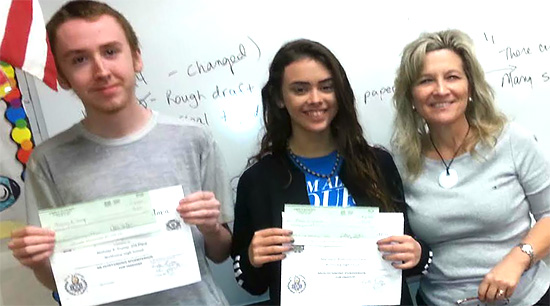
Two Northview High School freshmen won top honors in the 2017 Veterans of Foreign Wars Essay Competition.
Marissa Rothrock won first place in the county competition, and Nicholas Trump earned second place.
Both students received certificates and a cash prize for their essays entered in the Voice of Democracy competition, which is dedicated to encouraging a better understanding and appreciation for our country and fostering patriotism among the nation’s youth. This year’s theme was “My Responsibility to America”.
The local contest was sponsored by Atmore VFW Post 7016.
Pictured are (L-R) Nicholas Trump, Marissa Rothrock and their ninth grade Honors English teacher Vicki Baggett. Photo for NorthEscambia.com, click to enlarge.
Senate Approves Plan For Deepwater Horizon Money
May 2, 2017
Money from the Deepwater Horizon oil-spill settlement will be available for tourism marketing as part of a legislative deal designed to get the first payment to Northwest Florida counties most impacted by the 2010 disaster.
The Senate on Monday unanimously approved a pair of bills (SB 364 and SB 2518) that otherwise accept many aspects of a House proposal, ending months of talks over how the non-profit organization Triumph Gulf Coast and local governments can disperse the money.
 “The main thing we wanted to make sure is we got the $300 million transferred this year,” said Sen. Doug Broxson, R-Gulf Breeze. “It’s been there since July of last year.”
The House and Senate had offered separate measures to allocate $300 million of $400 million received last year to the eight Gulf Coast counties — Bay, Escambia, Franklin, Gulf, Okaloosa, Santa Rosa, Wakulla and Walton — hit most severely by the disaster.
Those counties are also slated to get three-fourths of the remainder of the $2 billion the state is expected to receive for damages associated with the BP disaster, which dumped millions of gallons of oil less than 100 miles off the Florida coast.
However, the House proposal went further than the Senate by initially imposing guidelines on how the money could be used to market Northwest Florida or to support broad economic-development projects. Those issues reflected larger philosophical differences between the House and Senate on business-recruitment and tourism-marketing issues.
“North Florida is different than Central and South Florida,” Sen. Bill Montford, a Tallahassee Democrat who represents Franklin, Gulf and Wakulla counties, said Monday. “If it were not for the funds of (tourism marketer) Visit Florida, these small rural counties, all the counties of North Florida, would have very little help.”
The proposal, which must go back to the House before it can land on Gov. Rick Scott’s desk, would create a trust fund from which the BP settlement money would be available to the non-profit; expand the non-profit’s board from five to seven so there is more representation for the less-populated counties; and require each county next fiscal year to receive 5 percent of the money received so far.
Each of the eight counties would be required to annually receive at least 4 percent of the money in later years.
Kim Wilmes, president and CEO of the regional economic-development organization Florida’s Great Northwest, called the Legislative deal “good news to the communities of Northwest Florida.”
Scott tweeted last week, “I hope to see a Triumph bill that actually helps the Panhandle economy.”
by Jim Turner, The News Service of Florida
Chiefs, Jay Earn Wins In District Tournament
May 2, 2017
In District 3-1A high school baseball Monday:
Northview 10, Baker 5
 The Northview Chiefs beat the Baker Gators 10-5 Monday night at South Walton High School.
Quenton Sampson went 3-3 for the Chiefs with two runs, two RBIs and a home run. Also for the Chiefs: Zach Payne 1-3, 4 RBI, 2B; Josh Neese 2-3, 2R; Seth Killam 1-3, 2B; John Chivington 2 R; Devin Stabler 3 R.
Northview will next play Chipley at 5:00 Tuesday at Northwest Florida State College in Niceville.
Jay 2, Freeport 1
The Jay Royals beat Freeport 2-1 in extra innings. Up next, Jay will take on South Walton.
Escambia Government Meetings This Week
May 2, 2017
The following Escambia County government meetings are scheduled for this week:
Tuesday, May 2
Planning Board/Rezoning, 3363 West Park Place, 8:30 a.m. (Agenda)
Environmental Enforcement Special Magistrate, 3363 West Park Place, 1:30 p.m. (Agenda)
County Commissioner District 3 Town Hall Meeting, Marie K. Young – Wedgewood Community Center, 6405 Wagner Avenue, 5:30 p.m.
Perdido Key Habitat Conservation Plan Town Hall, Southwest Branch Library, 12248 Gulf Beach Highway, 5:30 p.m.
Extension Council Meeting, 3740 Stefani Road, 5:30 p.m.
Wednesday, May 3
Contractor Competency Board Exam Meeting, 3363 West Park Place, 8:30 a.m.
Contractor Competency Board, 3363 West Park Place, 9 a.m.
Development Review Board, 3363 West Park Place, 1 p.m.
Thursday, May 4
Board of County Commissioners Agenda Review Session, Ernie Lee Magaha Government Building, 221 Palafox Place, 9 a.m.
Board of County Commissioners Public Forum, Ernie Lee Magaha Government Building, 221 Palafox Place, 3:30 p.m.
Board of County Commissioners Public Hearings & Reports, Ernie Lee Magaha Government Building, 221 Palafox Place, 4:30 p.m.
Friday, May 5
Escambia County BCC Relay for Life, Vince Whibbs Maritime Park, 301 West Main Street, 6 p.m.

Molino 16U Hot Shots Tops In Tournament
May 2, 2017
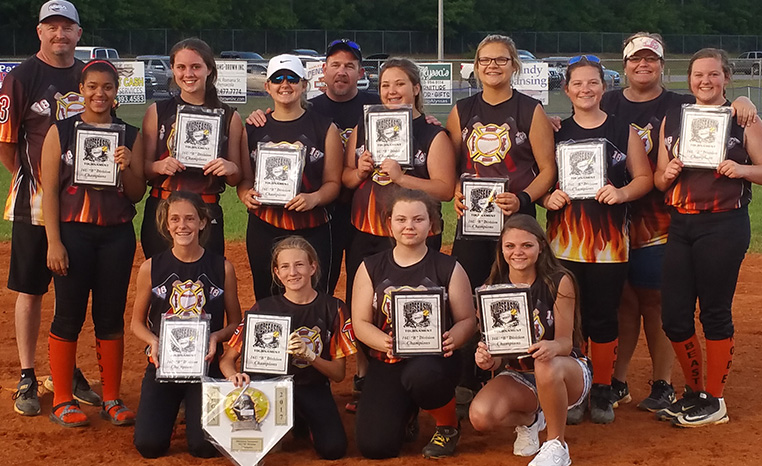
The Molino 16U Hot Shots won the 16U “B” mid-season tournament at Pace recently. The Hot Shots went undefeated in six games. Coaches are Karen Odom, Phillip Boutwell and Darrin Bridges. Submitted photo for NorthEscambia.com, click to enlarge.