

One Year Later: No More Century Semi Rollover Accidents
June 26, 2017

It has been just over a year since there has been a semi-truck rollover on North Century Boulevard at Jackson Street, perhaps thanks in part to temporary fixes by the Florida Department of Transportation.
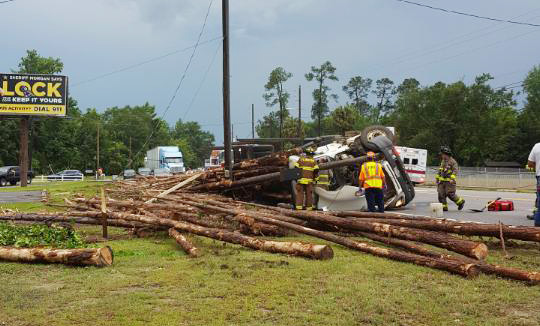
On June 13 of last year, a semi truck hauling logs overturned in the area, taking out a utility pole. The truck driver was cited for careless driving. Eight days later, another semi-truck overturned in the same location. The driver of the truck, which was hauling cotton, was also cited for careless driving. Similar accidents of the past several years have caused hundreds of thousands of dollars in damage to utilities, including power and a sewage lift station.
Then-mayor Freddie McCall met onsite with Florida Department of Transportation engineers last June. The engineers agreed that the slope and design of the roadway in the curve is such that trucks in the outer lane have a difficult time navigating the curve at the posted speed limit.
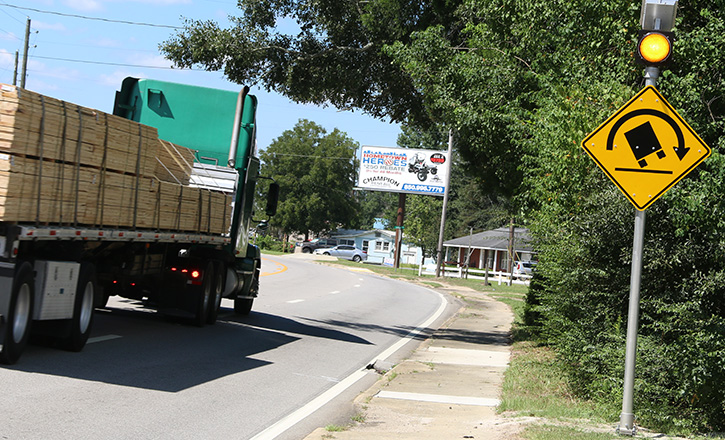
The engineer recommended flashing beacon signs warning trucks of the tipping hazard and instructing them to use the inner-lane. Those signs were installed by last October.
Virgie Bowen of the Florida Department of Transportation recently told the Century Town Council that the safety issues are still being addressed, but she could not provide a timetable for work to change the road elevation. She any long term solutions are still being studied.
Pictured above and below: Previous semi truck rollovers on Highway 29 at Jackson Street in Century. Pictured bottom: This photo demonstrates that amount of lean on a semi truck passing through the area just below the speed limit. NorthEscambia.com photos, click to enlarge.


How Much Did It Rain Last Week? Radar Map Shows Estimates
June 26, 2017
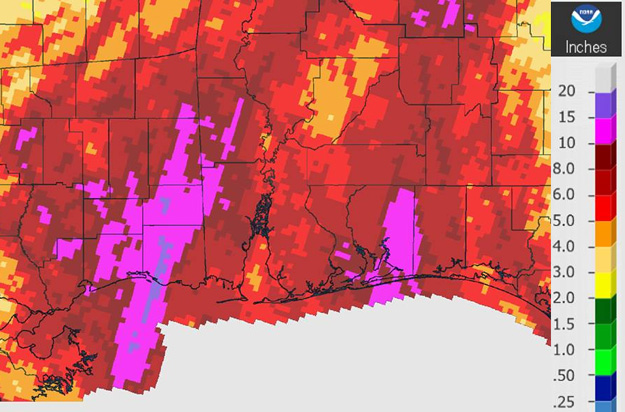
Radar rainfall totals are in for Tropical Storm Cindy last week.
Most of northern Escambia County north of Molino received 6-8 inches of rain, including areas around Molino, McDavid, Century and Walnut Hill. The radar estimated that areas Cantonment south in Escambia County received 8-10 inches of rain. A few isolated areas in Escambia County, including parts of Cantonment, received between 10-15 inches of rain.
Some 10-15 inches of rain fell apart a large portion western Santa Rosa County in Florida and southern Mississippi. A few areas in coastal Mississippi had 15-20 inches of rain.
Isolated areas may have received significantly more rainfall that displayed by the radar estimate.
Report Shows University Grads In Florida Are Getting Jobs
June 26, 2017
A new study that followed the outcomes of Florida university students who earned bachelor’s degrees in 2015 shows that more than 90 percent of students were working within one year of graduation, with full-time employees earning a median salary of $39,100.
The report, which will be reviewed by the state university system’s Board of Governors next week, was able to match 60,333 graduates of the class of 2015 against employment and education databases, showing outcomes for 53,490 students, or 89 percent of the class.
The employment and education outcomes for the remaining 11 percent of the class, 6,843 graduates, could not be determined.
Of the 53,490 graduates, 70 percent were working, 23 percent were working and continuing their educations and 8 percent were attending school within one year of graduation.
Of the working graduates, 71 percent had full-time jobs and 29 percent had part-time employment.
“Pursuing a baccalaureate degree does increase life chances,” said Jan Ignash, the Board of Governors’ vice chancellor for academic and student affairs. “That’s why people go to school. And I think what this tells is the good news is that they get jobs and lot of them go on for further education.”
This is the third survey of Florida baccalaureate graduates, following a pilot report and an assessment of 2014 graduates. It has become an annual review helping the Board of Governors develop system-wide strategies based on the employment and education outcomes.
Christy England, the associate vice chancellor for academic policy and research who conducted the study, said the data is also aimed at individual universities and the students.
England said the salary data can help students “understand the value of that degree when they get their first job and they don’t know if they are being offered a fair wage or not.”
“They could potentially use it for negotiating,” England said.
The most popular majors for the Class of 2015 included business and marketing,19 percent; health professions, 12 percent; social sciences, 9 percent; psychology, 8 percent; biological sciences, 7 percent; and engineering, 6 percent, the study showed.
Although the median salary for the 2015 graduates working full-time was $39,100, it ranged from $58,600 for engineering graduates to $29,500 for biological sciences graduates. Other salaries included: computer sciences, $53,200; business, $42,100; journalism, $34,100; agriculture, $33,500; and performing arts, $31,300.
Although the employment trends were positive, the new report showed significant racial and gender gaps for the 2015 graduates’ salaries.
The median salary for African-American students working full-time was $35,600, $3,500 below the median for all students. The largest gap, $8,500, was for students employed in health professions, while African-American graduates earned $500 above the median in education jobs, the survey showed.
There was not a significant gap in overall salaries for Hispanic graduates.
But there was a $5,500 gap between salaries for women who earned a bachelor’s degree and male graduates, who had a median salary of $42,500 and were working full-time. In the business professions, which attracted the largest number of female graduates in 2015, males earned $4,200 more than the median salary of the women, which was $40,000.
England said the Board of Governors will need more long-term data before drawing more solid conclusions on the trends.
“The gaps are pretty substantial, particularly for African-Americans compared to all other students,” she said. “But again, it’s only two years of data, so we want to keep an eye on it.”
The wage gap between women and men may provide more incentive for women graduates to bargain harder for higher initial salaries, she said.
“This might be a way to empower them to go out and say, `I’m worth more gosh darn it and you should pay me more,’ ” England said.
Comparing the 2014 baccalaureate graduates with the Class of 2015 showed the median salary for all graduates working full-time rose 8 percent from the prior year. The median salaries increased for all subgroups including African-Americans, 7 percent; Hispanics, 6 percent; and females, 7 percent.
But the median salaries for males increased 9 percent and the wage gap with females increased by $1,100 between the two years, the survey showed.
Ignash said the annual assessments of the baccalaureate graduates will be enhanced by surveys looking at the individual classes five years after graduation and nine years after graduation, providing more long-term data.
“In some of these majors, you don’t expect students to be fully launched into their careers at a year out. They’re on a path,” Ignash said. “In four or five years when we go back and look at this, I think the data is going to round out the story.”
by Lloyd Dunkelberger, The News Service of Florida
Northview Chiefs Attend Down and Dirty Lineman Camp
June 26, 2017
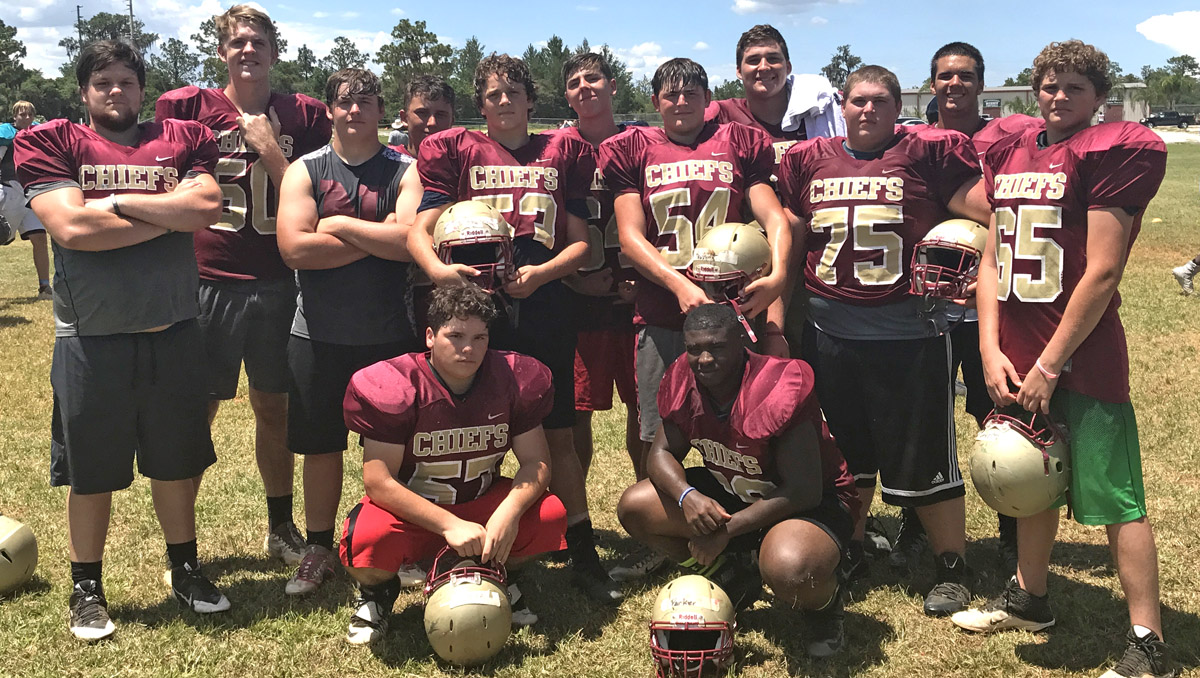
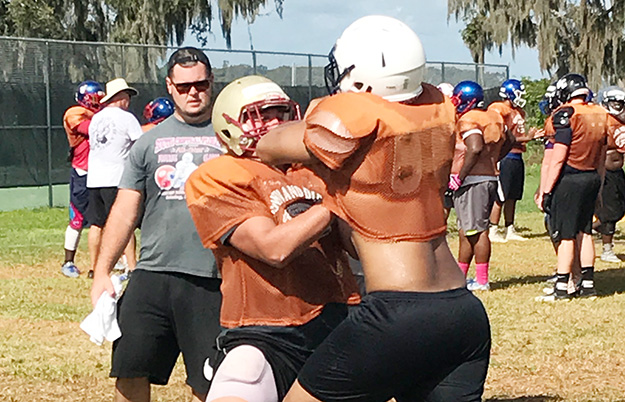
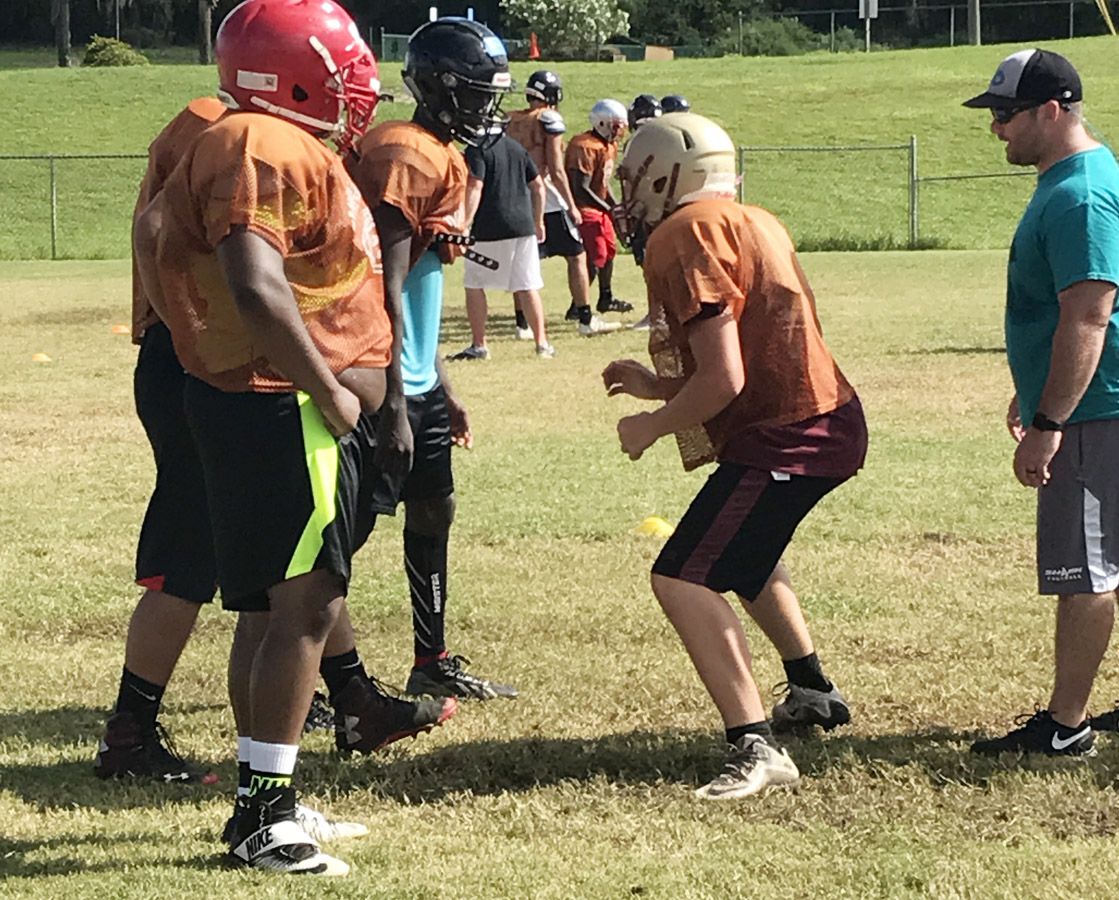
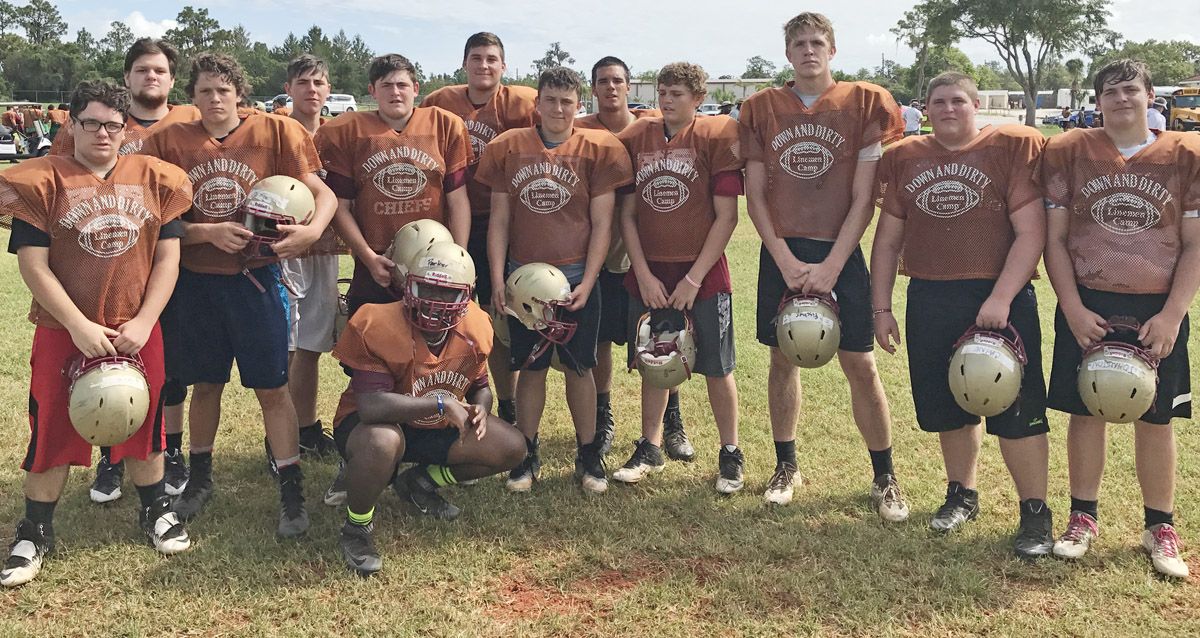
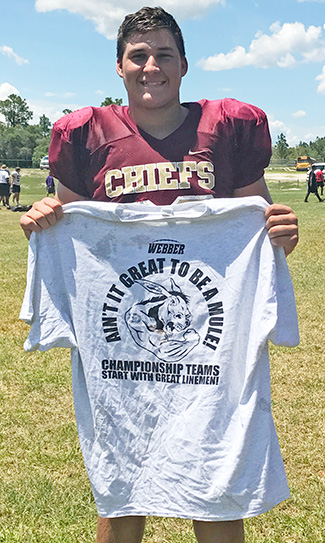 This past weekend, the linemen from the Northvew High School Chiefs competed at the Down and Dirty Lineman Camp, one of the most prestigious linemen camps in the country.
The athletes practiced seven times in three days at Webber International University in Lake Wales, FL. Over 300 athletes participated in the camp from over 30 Florida schools, ranging from 1A-8A.
Northview rising senior Justin Helton was named the Down and Dirty Lineman Camp MVP.
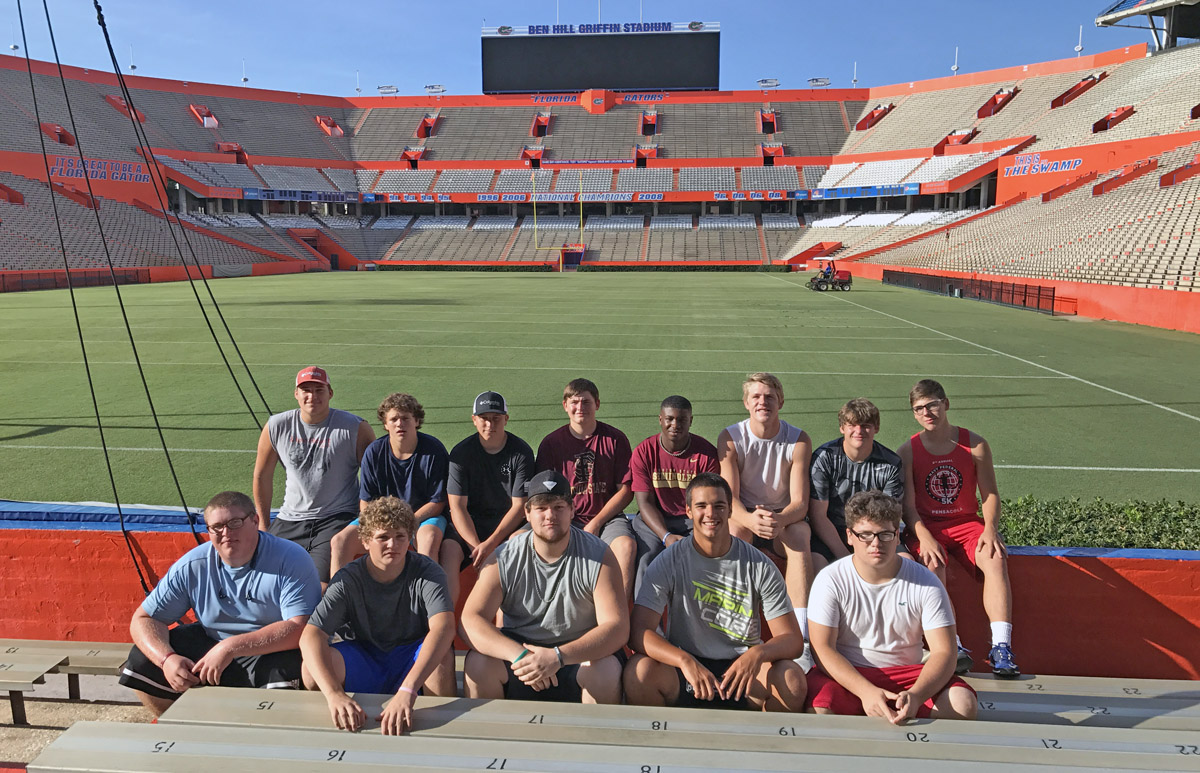
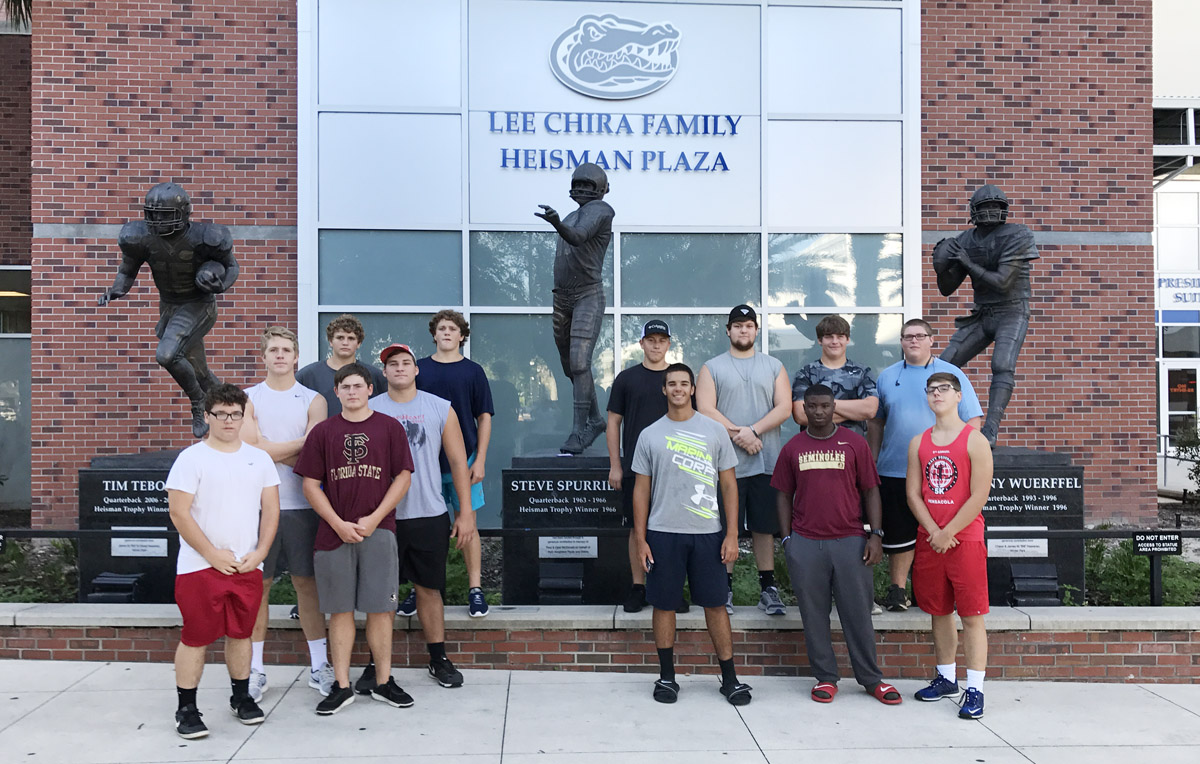
On the way to the linemen camp, the Chiefs stopped in Gainesville to visit Ben Hill Griffin Stadium, commonly known as “The Swamp”, the football stadium for the Florida Gators.
Photos for NorthEscambia.com, click to enlarge.
NWE Football, Cheer To Host Registration Event Monday
June 26, 2017
NWE Football and Cheer will have a registration event on Monday, June 26th from 5:30 until 7 p.m. at Bradberry Park in Walnut Hill.
 Cheerleaders who need new uniforms will be fitted by our cheer uniform representative. Due to uniform turnaround time, this will be the last day to register for cheerleaders who need new uniforms.
Cheerleader registration plus new uniform package is $150. Cheerleader registration (if you have a uniform) is $25.
Football registration is $50. NWE provides helmet, shoulder pads and game uniforms. NWE Football Players can now also register online at www.nwechiefsfootball.com.
Wahoos Drop Doubleheader To Chattanooga
June 26, 2017
The Pensacola Blue Wahoos lost a doubleheader Sunday to the Chattanooga Lookouts and have yet to beat them this season.
The Blue Wahoos dropped both seven-inning games, 6-0, and are now 0-9 against the Lookouts in the teams’ two five-game series. The Blue Wahoos have now been blanked nine times this season, while the Chattanooga pitching staff has recorded nine shutout wins this year.
 Pensacola dropped the first game of the seven-inning doubleheader to Chattanooga, 6-0, Sunday, thanks to 25-year-old Dereck Rodriguez, who was pitching in just his second Double-A game.
Rodriquez allowed just two hits and two walks over six scoreless innings, striking out six for his first win for Chattanooga. Rodriguez earned his first Double-A victory and is now 1-0 with a 4.50 ERA.
Meanwhile, Pensacola starter Jose Lopez gave up four runs on nine hits and four walks over five innings and struck out four. Lopez gave up a home run in the top of the second inning to Chattanooga left fielder Travis Harrison, his first of the season. He fell to 2-1 on the year with a 3.57 ERA for the Blue Wahoos.
Also leading the Chattanooga offense in game one of the doubleheader was center fielder LaMonte Wade, who was 2-3, scored and knocked in two runs, and Andy Wilkins, who hit 3-4, with a double, scored a run and drove in 2 RBIs.
Pensacola’s offense was less productive, managing just three hits in both games. The Blue Wahoos dropped the second game, 6-0, as well, with Fernando Romero tossing seven scoreless innings. He also gave up three walks and struck out six to improve to 7-5 with a 2.97 ERA. The 22-year-old Romero now has 76 Ks in 78.2 innings.
Pensacola starter Domingo Tapia gave up four runs on six hits and two walks in three innings of work to pick up the loss to drop to 2-3 with a 3.38 ERA.
Blue Wahoos first baseman Gavin LaValley was 1-3 in both games and now is 5-14 (.357) hitting in all four games since being called up from the High-A Daytona Tortugas Thursday. The 22-year-old was the only Pensacola batter to get hits in both games and now has two doubles a homerun and three RBIs against Chattanooga.
Pensacola, the Southern League first half South Division champion, will try to avoid being swept in the five-game series by Chattanooga, the first half North Division champion, for the second time this season at 6:15 p.m. Monday.
Schedule: This Week’s Escambia County Government Meetings
June 25, 2017
Here is a schedule of Escambia County meetings for the upcoming week:
Monday, June 26
Library Board of Governance, 239 N. Spring St., 4 p.m.
Tuesday, June 27
Environmental Enforcement Special Magistrate, Escambia County Central Office Complex, 3363 West Park Place, 1:30 p.m. (Agenda)
Escambia County Health Facilities Authority, 1019 N. 12th Ave., 4 p.m.
Wednesday, June 28
June Coffee with the Commissioner – Jeff Bergosh, District 1, Denny’s Restaurant, 4625 Mobile Highway, 6:30 a.m.
Development Review Committee, Escambia County Central Office Complex, 3363 West Park Place, 1 p.m.
Santa Rosa Island Authority Committee Meeting, 1 Via De Luna Drive, Pensacola Beach, 5 p.m. (Agenda)
Santa Rosa Island Authority Budget Workshop, 1 Via De Luna Drive, Pensacola Beach, 5:05 p.m. (Agenda)
Santa Rosa Island Authority Special Board Meeting, 1 Via De Luna Drive, Pensacola Beach, 5:10 p.m. (Agenda)

Scott Going To Washington Amid Health Care Debate
June 25, 2017
After U.S. Senate leaders released a proposal last week to roll back the Affordable Care Act, Florida Gov. Rick Scott said he will go to Washington this week to weigh in on the issues.
“I have been carefully reviewing the bill, and…I will be traveling to Washington to meet with congressional leaders to provide input on how we can make the bill better for Floridians,” Scott said in a prepared statement. Details of the trip were not immediately announced. But the outcome of the debate in Washington could have major implications for Florida, in part because of likely changes in the Medicaid program. Scott and other Florida officials have long sought more flexibility in how the state can manage Medicaid, including possibly getting Medicaid block grants from Washington.
But some officials also have cautioned that a key question is how money would be distributed to states.
Scott, the former CEO of a national hospital company, did not go into detail about the new Senate bill but hinted at concerns about Medicaid and other issues.
“First, all states must be treated equitably,” Scott said. “Florida taxpayers deserve the same treatment as every other state under the Medicaid program. Second, every American, including those with pre-existing conditions, should have the ability to buy any kind of insurance they want. This will drive down costs and give people the flexibility and power to determine what they want to buy.” Scott and other Florida Republican leaders have vehemently opposed the Affordable Care Act, better known as Obamacare. But state Democratic leaders have lambasted the Senate bill and a health-care bill approved by the U.S. House.
“This (Senate) bill is just as bad as the House bill, taking coverage away from millions of people and making huge cuts to Medicaid,” U.S. Sen. Bill Nelson, D-Fla., said in a statement Thursday. “If that weren’t enough, it also allows insurance companies to hike rates for older Americans.”
by The News Service of Florida
Teens Found Safe After Perdido River Search
June 25, 2017

Two teens were located safe and sound Saturday night after becoming lost on the rain-swollen Perdido River.
The kayaking teens has reportedly put into the river at a residence on Perdido Lake Road and did not return. Escambia Fire Rescue, Escambia County EMS, the Escambia County Sheriff’s Office and other agencies were called about 8:30 p.m. to assist in the search for them. By 9:30 p.m., the teens had been located uninjured in the 150 block of River Annex Road.
According to the National Weather Service, the Perdido River at Barrineau Park was at minor flood stage of 13 feet at 10 p.m. Saturday.
Pictured: First responders gather on a dirt road near the Perdido River Saturday night. NorthEscambia.com photo Kristi Barbour, click to enlarge.
Clouds, Some Rain For Sunday
June 25, 2017

Here is your official North Escambia area forecast:
Sunday: A 50 percent chance of showers and thunderstorms. Mostly cloudy, with a high near 86. North wind around 5 mph. New rainfall amounts between a quarter and half of an inch possible.
Sunday Night: A 30 percent chance of showers and thunderstorms before 1am. Mostly cloudy, with a low around 68. Calm wind.
Monday: A 20 percent chance of showers and thunderstorms. Partly sunny, with a high near 86. Northeast wind around 5 mph.
Monday Night: Partly cloudy, with a low around 66. East wind around 5 mph becoming north after midnight.
Tuesday: A 20 percent chance of showers and thunderstorms. Partly sunny, with a high near 85. Northeast wind around 5 mph.
Tuesday Night: Mostly cloudy, with a low around 68. Northeast wind around 5 mph becoming calm.
Wednesday: A 30 percent chance of showers and thunderstorms. Partly sunny, with a high near 85. East wind around 5 mph becoming southeast in the afternoon.
Wednesday Night: A 20 percent chance of showers and thunderstorms. Mostly cloudy, with a low around 71. Southeast wind around 5 mph.
Thursday: A 50 percent chance of showers and thunderstorms. Mostly cloudy, with a high near 85.
Thursday Night: A 20 percent chance of showers and thunderstorms. Mostly cloudy, with a low around 72.
Friday: A 50 percent chance of showers and thunderstorms. Mostly cloudy, with a high near 86.
Friday Night: A 20 percent chance of showers and thunderstorms. Mostly cloudy, with a low around 72.
Saturday: A 50 percent chance of showers and thunderstorms. Mostly cloudy, with a high near 86.