

Century Man Charged With Burglarizing Former Alger Lumber Mill
April 12, 2017
A Century man has been arrested for attempting to burglarize the old Alger-Sullivan Lumber Co. in Century.
 Christopher George Pace, 34, was charged with burglary of an unoccupied structure, possession of burglary tools with the intent to use, trespassing, possession of methamphetamine and possession of drug paraphernalia.
The Escambia County Sheriff’s Office said Pace entered the fence of the business at 1 Lumber Road with the intent to steal lumber and light fixtures. At the time of his arrest, deputies reporting finding to be in possession of methamphetamine and drug paraphernalia, according to arrest report.
The Alger-Sullivan Lumber company closed many years ago. The empty industrial complex off Front Street was heavily damaged in the February 2016 EF-3 tornado that struck Century.
Pictured below: The abandoned Alger-Sullivan Lumber Co. in Century was heavily damaged by a February 2016 tornado. Photos for NorthEscambia.com, click to enlarge.


Bratt Brush Fire Burns About An Acre
April 12, 2017
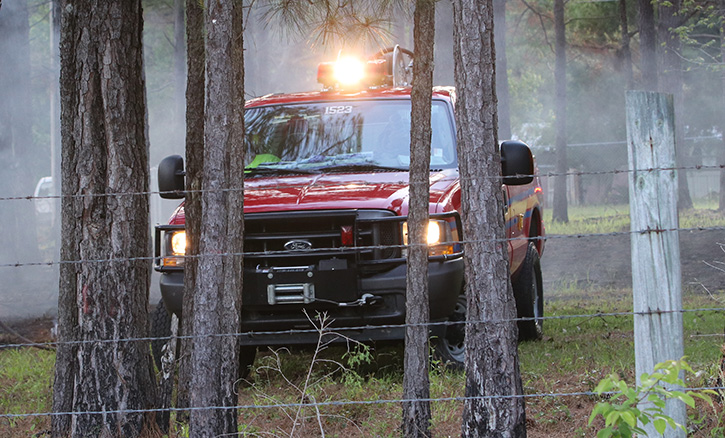
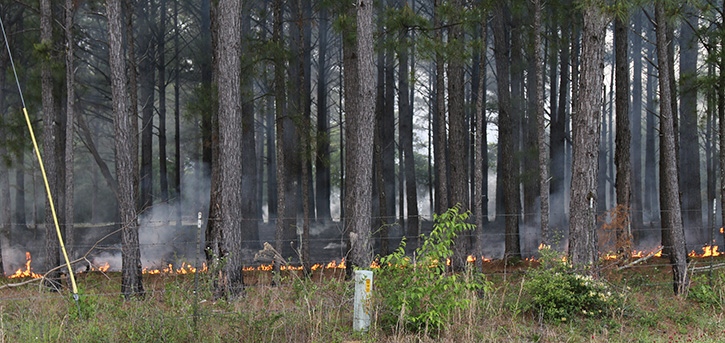
Firefighters from the Walnut Hill Station of Escambia Fire Rescue quickly contained a brush fire about one acre in size Tuesday evening. The fire was reported about 6:10 p.m on Dortch Road, just north of Highway 4 in Bratt. There were no injuries and no structures damaged. NorthEscambia.com photos, click to enlarge.
Inmate Escapes From Pensacola Federal Prison Camp
April 12, 2017
Authorities are on the lookout for an inmate that escaped from the Federal Prison Camp in Pensacola.
Hector Mulero-Algarin, 51, has been missing since Sunday when he walked away from the FPC. He was sentenced in the District of Puerto Rico to 156-months for drug-related offenses.
 Mulero-Algarin is a white male with gray hair, brown eyes, is 5’5” tall and weighs approximately 160 pounds.
The U.S. Marshals Service and other law enforcement agencies were notified and an internal investigation was initiated. Call the U.S. Marshals Service at (850) 469-8270 with information about his whereabouts.
FPC Pensacola is a minimum security facility that houses about 679 male offenders at Saufley Field.
Molino Park Elementary Names Students Of The Month
April 12, 2017

The Pre-K Students of the Month and Good Citizens of the Month for March were recently recognized at Molino Park Elementary School. Pictured are (L-R) Good Citizen of the Month Walker Maughon; Principal Lisa Arnold, Students of the Month Alexis Blackburn and Jayce McBroom. Submitted photo for NorthEscambia.com, click to enlarge.
Beauchaine Tosses No Hitter For Tate Lady Aggies
April 12, 2017

Tate 14, Pine Forest 0 (5 innings)
The Tate Lady Aggies 10-run ruled the Pine Forest Eagles 14-0 Tuesday evening in five innings as freshman Avery Beauchaine threw a no-hitter.
Beauchaine was on the mound for five innings, allowing no hits, no runs, no errors, walking four and striking out eight. At the plate, she was 1-3 with 2 RBI.
For Tate: Deazia Nickerson 1-1, R; Kendall Attaway R; Shelby McLean 3-4, 2 R, 2 RBI; Leslee Scruggs 1-2, 2 RBI 2B; Gabby Locke, 1-2, 2 R; Ashley Lundquist 1-2, R, RBI; Sydni Solliday, 2 R; Madison Nelson 1-2, 2 R; RBI, 3B; Taylor Hedgepeth 1-2, R, 2 RBI; Katie Snyder 2-3, 2 RBI.
Florida Lawmakers Work To Bridge Budget Differences
April 12, 2017
Lawmakers will begin debate Wednesday on two very different budget plans, with the House proposal about $4 billion lighter overall than the Senate version.
The bottom line differences are smaller — the Senate budget for the year beginning July 1 officially weighs in at $83.2 billion, compared to $81.2 billion for the House — but the Senate doesn’t account for $2 billion in higher-education tuition.
 After both chambers vote on their proposals — probably on Thursday — formal negotiating will begin, with legislative leaders first having to decide how much money to devote to each area of the budget before conference committees hammer out agreements on how to spend the funds in each pot.
If lawmakers want to leave Tallahassee by May 5, as scheduled, all the discussions have to be finished by May 2 to allow for a constitutionally required 72-hour “cooling off” period before a final vote is taken.
Here’s a look at some of the high-profile issues lawmakers will face:
PUBLIC EDUCATION
Some of the sharpest differences between the two budgets are in public education — which includes divisions over teacher incentives, property taxes and a House plan to spur charter-school creation near academically struggling schools.
The Senate is far more generous in the main funding formula for elementary and secondary education, increasing the per-student spending by almost $210 a head — about 2.91 percent. By contrast, the House would boost it by a shade over $19 per student, or about 0.27 percent.
The difference essentially boils down to whether lawmakers accept an increase of $535.1 million in local property tax revenues known as the “required local effort.” The House says the rise in homeowners’ property tax bills makes that a tax increase; the Senate says the increased funding is caused by the growth in property values, while the tax rate stays the same.
However, the House also plows money into two programs not included in the Senate budget. House budget-writers would spend $200 million on the controversial “Best and Brightest” bonus program for teachers, while the Senate would zero it out.
Another $200 million under the House plan would go toward “Schools of Hope,” meant to encourage non-profit charter school operators with track records of high performance among low-income students to open campuses in areas where traditional public schools have received “D” or “F” grades on state reports cards for more than three consecutive years. The Senate hasn’t created that program.
The two sides are also far apart on funding for higher education in general, and state universities in particular. The Senate would spend $5.1 billion on the state university system, compared to $4.6 billion from the House.
ECONOMIC INCENTIVES
For Gov. Rick Scott, the session’s highest priority might be what the Legislature does in this area of the budget.
House lawmakers have repeatedly bucked Scott and approved legislation to eliminate Enterprise Florida, the state’s business-recruitment agency. The House budget stays true to that, giving no money to Enterprise Florida and $25 million for Visit Florida, which promotes tourism to the state.
The Senate proposal is more in line with Scott’s requests. The upper chamber would set aside more than $80 million for programs tied to Enterprise Florida and devote $76 million to Visit Florida.
PAY RAISES
Broad-based raises for state employees have been rare since the financial crisis, and Senate Appropriations Chairman Jack Latvala, R-Clearwater, has set an increase as one of his top priorities. In all, the Senate plan would boost pay for state workers by $219.7 million.
Most state employees would get an increase of $1,400 if they make $40,000 or less a year, while those who make more than $40,000 would get a $1,000 boost. The raise would kick in Oct. 1. Other employees, mostly in law enforcement and the judicial branch, would get specialized raises.
That’s not the case in the House plan, which has specialized increases — particularly for correctional officers, an area of concern in both budgets — but not the broader-based raises offered by the Senate.
HEALTH CARE
There are substantial gaps between the two chambers on how much to provide for hospitals and other health-care needs. Under the Senate budget proposal, the Agency for Health Care Administration — which directs much of the Medicaid program — would check in at $27.7 billion, while the House has set aside $26.4 billion.
Some of those differences could be an illusion. The Senate budget includes $607.8 million in money for hospital aid from the federal government that might not materialize. The House doesn’t have that funding in the budget, saying it would be irresponsible to depend on it.
But there are substantive differences as well. Both chambers would reduce hospital Medicaid reimbursements, but the House’s cuts would be much deeper than the Senate’s.
DEATH PENALTY
The state’s budget has become part of the battle over State Attorney Aramis Ayala, elected last year as the top prosecutor in Orange and Osceola counties, who recently announced she would not pursue the death penalty in capital cases.
Lawmakers in the House and Senate have proposed a $1.3 million cut to Ayala’s office. However, senators have worked out a compromise to assuage the concerns of some critics of the cut by restoring $569,277 and six positions to Ayala’s budget, while still providing some additional funding for another circuit that Scott has ordered to handle death-penalty cases from Ayala’s jurisdiction.
by Brandon Larrabee, The News Service of Florida
State Drops 31 Child Sex Charges Against Ex Coach, Youth Leader
April 11, 2017
Prosecutors have dropped 31 child sex charges against a former Tate High School football coach and church leader.
 Charlie Hamrick, 54, was originally charged with over 40 criminal counts, but now faces 10 charges — six counts of sexual battery on a child under 12, one court of giving obscene material to a minor and three counts of lewd and lascivious molestation. He remains in the Escambia County Jail without bond.
Thirty of the charges dropped by state were sexual battery on a child under 12 in a case that reaches back to 1997 when the alleged victim was as young as 8 years old. Six of the life felony charges in that case remain active.
“When spread over an extended period of time sometimes it is hard to prove the exact specifics of each individual incident down to the what happened and exactly when,” Assistant State Attorney Greg Marcille said, explaining why the charges spanning 1997 to 2000 were dropped. “It is not unusual to limit the number of cases to cover all events.”
When law enforcement makes an arrest they do so on probably cause,” he said, “where we must prove each charge beyond a reasonable doubt.”
He said it can become more difficult as time passes for victims to remember specific events down to the time and place of each. Marcille stressed that eliminating such large number of charges in no way indicates that prosecutors do not believe they have a strong case against Hamrick.
“This does not mean that we believe there is a problem with any of the cases,” the assistant state attorney said.
If Hamrick is convicted on any one of the sexual battery on a child under 12 charges, he will face a required sentence of life in prison without the possibility of parole.
Eight additional people have come forward as possible victims in the case. The Escambia County Sheriff’s Office is investigating those claims. So far, no additional charges have been filed, Marcille confirmed Monday afternoon.
Those new allegations include claims that Hamrick gave unlicensed physical exams to athletes at Tate High School during is 2012-2015 tenure there as a supplemental football coach. Those physicals, it is alleged, may not have been limited to just football players. The physicals included genitalia exams.
Hamrick was paid a supplement as a football coach at Tate High School from August 1, 2012, to September 14, 2015. He was not a teacher and did not have students under his watch in a classroom. He passed all of the background checks at the time.
For a previous story, click here.
Cantonment Masonic Lodge Donates Supplies To Jim Allen Elementary
April 11, 2017

Jim Allen Elementary School recently received an donation containing assorted supplies from the Masonic Lodge in Cantonment.
“The supplies are appreciated, and the students are excited to receive them,” Susan Dorman, assistant principal, said.
Submitted photo for NorthEscambia.com, click to enlarge.
Tate High School Math Teams Place In Tournament
April 11, 2017

Tate High School’s Geometry and Algebra 2 teams both placed third in their divisions at the Nickolas Walker Math Tournament at Milton High School last week. Courtesy photos for NorthEscambia.com, click to enlarge.

‘Opt Out’ State Testing Case Goes To Florida Supreme Court
April 11, 2017
Several parents who oppose standardized-testing requirements in public schools are taking their battle to the Florida Supreme Court.
 The parents last week filed a notice that is a first step in asking the Supreme Court to overturn a decision by the 1st District Court of Appeal in a case related to what is known as the “opt out” movement. Parents who brought the case against the Department of Education and several school boards told their third-grade students to put their names on a standardized test, then refuse to answer questions.
When the students were barred from moving to fourth grade under state law, the parents sued, saying they wanted their children to be evaluated using a portfolio allowed in the case of “good cause exemptions.”
A three-judge panel of the appeals court on March 7 ruled that Leon County Circuit Judge Karen Gievers erred on procedural grounds in allowing the case to go forward and also disagreed with portions of her opinion that could have allowed some students to avoid answering questions on state exams.
The appeals court ruled, in part, that the state has an interest in preventing social promotion, the reason given for the testing requirement. The parents’ notice of appeal to the Supreme Court, as is common, did not provide detailed arguments.
by The News Service of Florida