

Alumni Cheerleaders Contribute To Tate Program
November 16, 2017
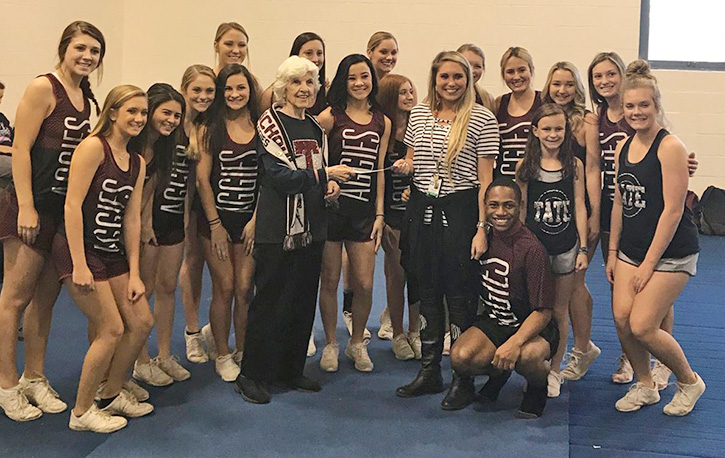
The Tate High School Alumni Cheerleaders presented a $600 donation to the Tate Aggie Cheerleader program on Wednesday. Courtesy photo for NorthEscambia.com, click to enlarge.
Operation Christmas Child Collection Week At First Baptist Bratt
November 15, 2017
Volunteers have been busy this week at the First Baptist Church of Bratt during “National Collection Week” for Operation Christmas Child. For the 24th year, the simple, gift-filled shoe boxes will bring Christmas joy and evangelistic materials to children in over 130 countries across the world.
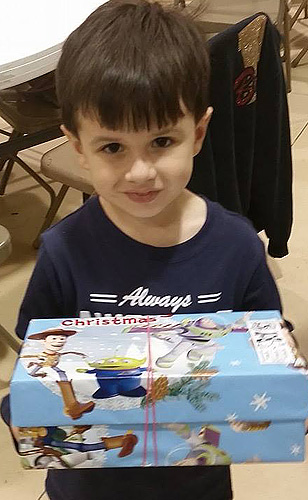 National Collection Week for OCC is November 13-20. The First Baptist Church of Bratt is the official drop-off location/OCC Relay Center for the north end of Escambia County, FL.
Pastor Tim Hawsey, Relay Center coordinator, said the shoe boxes are distributed by trained local pastors and volunteers around the world…right where the children live. The children that receive the box are invited to participate in a twelve step bible study called The Greatest Journey translated into their native language and taught by local people the children know.
Collection hours at the First Baptist Church of Bratt will be:
- Thursday, Nov. 16: 9 a.m. -noon, 4 p.m. – 6 p.m.
- Friday, Nov. 17: 9 a.m. -noon, 4 p.m. – 6 p.m.
- Saturday, Nov . 18: 10 a.m. – 2 p.m.
- Sunday, Nov. 19: 9 a.m. -noon, 4 p.m. – 7 p.m.
- Monday, Nov. 20: 8 a.m. – 10 a.m.
“This is about being a blessing and bringing God’s love and hope to children in poverty around the world that would not receive it otherwise. We have gone through the intense process of been approved as a church to be a Relay Center to collect the boxes from individuals, families, and churches of our area, document and pack them into special cartons and take them to the next level for Samaritan’s Purse, and we have been blessed to do it for eight years now,” Hawsey said.
Operation Christmas Child boxes should be packed in a specific manner. For more information, call Hawsey at the First Baptist Church of Bratt at (850) 327-6529, visit www.samaritanspurse.org/occ, or call (800) 353-5949. Resources are available for churches that wish to participate.
NorthEscambia.com photos, click to enlarge.
Murder Suspect Charged With Stealing $13K From Jukebox
November 15, 2017
Ashley McArthur, jailed for murdering a woman whose body was found in Cantonment, is now facing additional unrelated charges.
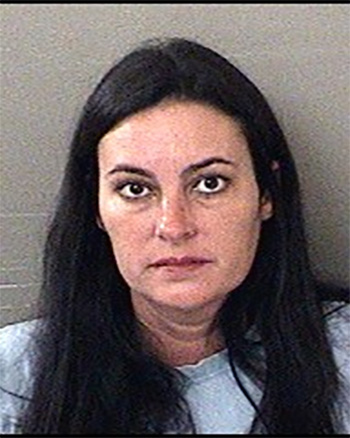 McArthur, 40, was arrested for felony grand theft and fraud for the alleged theft of $13,301.04 from the Azalea Cocktail Lounge, which represented funds reported missing between July 10, 2015, and September 14, 2017.
According to an Escambia County Sheriff’s Office arrest report, lounge customers pay for games or the jukebox using cash, credit card or a mobile phone app. The payments were to be split 50-50 between the Azalea Lounge and another company.
It was alleged that McArthur was splitting only the cash proceeds with lounge while keeping the proceeds from the credit card and mobile app payments.
McArthur is currently jailed without bond on a first degree murder charge for the death of 33-year old Taylor Wright. Wright’s body was found off Britt Road, just west of County Road 97 near Muscogee Road in Cantonment.
Frank White Makes Financial Splash In Cabinet Race
November 15, 2017
Bolstered by $1.5 million of his own money, state Rep. Frank White in less than a month has made it a three-way race — in terms of money — among the Republicans seeking to replace Attorney General Pam Bondi next year..
White, a Pensacola Republican first elected to the House in 2016, posted $1.65 million in contributions in October, with $1.5 million of that coming from the candidate himself.
 White had $1.73 million on hand in his campaign account to begin November in a GOP primary contest that also includes Rep. Jay Fant of Jacksonville and Ashley Moody, a former Hillsborough County circuit judge.
Besides his personal contributions, White picked up $51,000 from the Sansing family and their auto dealerships via 17 separate $3,000 contributions. White is chief financial officer and general counsel for the Sansing Dealer Group, a group of dealerships in Florida, Alabama and Mississippi.
The influx of cash put White’s fundraising total ahead of the $1.2 million collected the past five months by Moody for her campaign account and the political committee Friends of Ashley Moody.
Moody, who received $10,112 in October from the Republican Party of Florida through in-kind donations of campaign staffing, posted $105,490 in contributions last month for her campaign account and $43,000 for the political committee.
Fant, meanwhile, had the weakest fundraising month but has totaled just under $1.2 million for his personal account and an associated political committee known as Pledge This Day.
Fant’s war chest includes $750,000 of his own money that he put up in September.
Fant’s political committee didn’t bring in any money in October, while he picked up $12,358 for his personal campaign account.
Democratic candidate Ryan Torrens, an attorney from Hillsborough County, raised $9,934 in October. Since entering the contest on May 22, Torrens had raised a total of $49,106 while spending $42,401, as of Oct. 31.
by Jim Turner, The News Service of Florida
Cantonment Man Arrested On Meth And Heroin Charges
November 15, 2017
A Cantonment man was arrested on meth and heroin charges after a reported disturbance in an Escambia County trailer park.
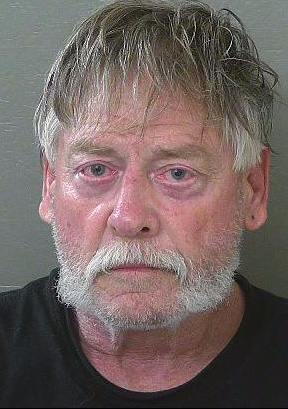 The Escambia County Sheriff’s Office responded to the disturbance, where they found 59-year old Robbie Wayne Donaldson.
According to an arrest report, Donaldson was in a Chevrolet pickup along with small canisters containing heroin and methamphetamine and glass pipes.
Donaldson was charged with possession of heroin, possession of methamphetamine and possession of drug paraphernalia. Donaldson remained in the Escambia County Jail as of Wednesday morning with bond set at $21,000.
Still Time To Donate To Peanut Butter Drive
November 15, 2017

The Escambia County 4-H youth have done their part with lots of peanut butter to donate to the UF/IFAS Extension Annual Peanut Butter Challenge. And there is still time for local residents to do their part to help over 20 food pantries in Escambia County to provide this needed food source to local families in need.
UF IFAS Escambia County Extension is teaming up again with the Florida Peanut Producers Association to help “Take a Bite out of Hunger” by participating in a local peanut butter drive.
Residents are asked to help meet the challenge of collecting the versatile food by donating unopened jars of peanut butter at one of five locations now through November 22. All peanut butter collected will be donated to local food pantries in December.
Drop-off locations:
- Escambia County Administration, 221 Palafox Place, 4th Floor
- Escambia County Extension Office, 3740 Stefani Road
- Escambia County Farm Bureau,153 Highway 97, Molino
- Escambia County Public Safety, 6575 North W Street
- Gilmore Services, 31 East Fairfield Drive
Since 2012, the volunteers and UF/IFAS Extension faculty have collected jars of peanut butter from residents, volunteer groups and businesses in 16 Northwest Florida counties. Last year, UF/IFAS Extension county offices received 3,236 jars of peanut butter.
Pictured: Peanut butter collected by Escambia County 4-H youth for the Annual Peanut Butter Challenge. Courtesy photo for NorthEscambia.com, click to enlarge.
Super Seasonable Wednesday
November 15, 2017

Here is your official North Escambia area forecast:
Wednesday: Sunny, with a high near 67. East wind around 5 mph.
Wednesday Night: Mostly clear, with a low around 46. Calm wind.
Thursday: Mostly sunny, with a high near 72. Calm wind becoming north around 5 mph in the morning.
Thursday Night: Mostly clear, with a low around 51. North wind around 5 mph becoming calm.
Friday: Sunny, with a high near 73. Calm wind becoming south around 5 mph in the morning.
Friday Night: Mostly clear, with a low around 56. South wind around 5 mph.
Saturday: A 20 percent chance of showers. Partly sunny, with a high near 74. Southwest wind 5 to 10 mph.
Saturday Night: A 30 percent chance of showers. Partly cloudy, with a low around 50. Southwest wind 5 to 10 mph becoming northwest after midnight.
Sunday: Sunny, with a high near 62.
Sunday Night: Mostly clear, with a low around 38.
Monday: Sunny, with a high near 62.
Monday Night: Mostly clear, with a low around 41.
Tuesday: Sunny, with a high near 67.
Deadline Near For FFA Smoked Meat Orders, Citrus Sale Continues
November 15, 2017

The order deadline is today for the annual Northview High School FFA Alumni Smoked Turkey and Boston Butt Sale. And, the Northview FFA’s Fruit Sale is also underway with delivery before Christmas.
Turkeys And Boston Butts
In the annual fund raiser, you can choose either a seven to nine pound smoked Boston butt or a 10-12 pound smoked turkey for $30 each.
Boston butts will be available for pickup on Monday, November 20, and the the smoked turkeys will be available for pickup on Tuesday, November 21 at either Highland Baptist Church in Molino or the Northview Ag Department (complete pickup details are on the order form).
Proceeds from the sale will go to benefit the Northview High School FFA Scholarship Fund. The sale is sponsored by Archie’s Catering Smokehouse in Molino. For a printable order form, click here. Orders must be placed by Thursday, November 16 .
Fruit Sale
The NHS FFA is selling citrus and other fruits, including naval oranges, grapefruit, oranges tangerines, pears, pineapples and sweet potatoes.
Orders must be made by Tuesday, November 28. Delivery is expected during the week of December 11 with pickup at the Northview Ag Department. Direct delivery to anywhere in the Continental U.S. is also available.
To order, visit https://fundraising-market.com/northview-ffa/#SHOP.
For more information, call (850) 327-6681, ext. 248.
Jim Allen Elementary Participates In Wreaths Across America
November 15, 2017
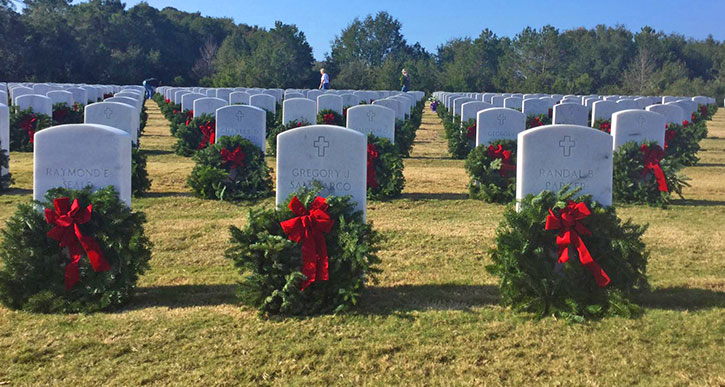
For the fourth year, Jim Allen Elementary School is participating in Wreaths Across America, a national event that places wreaths on graves at all national cemeteries across the country.
 To show your support for veterans and/or family members buried at Barrancas National Cemetery, you can either purchase a wreath for $15 or make a monetary donation of any amount through Jim Allen Elementary.
To have a wreath placed on a specific grave at Barrancas, write the grave number and honoree’s name on your check or money order. A sponsorship form must be complete. Grave numbers can be obtained by visiting www.cem.va.gov/cems/nchp/barrancas.asp — then click on “Find A Grave” on the left side of the page, and follow the prompts to obtain the specific grave site number.
All wreath sponsorships and money through Jim Allen Elementary School must be submitted no later than Friday, November 17. Make checks and money orders payable to “Wreaths Across America.” (Checks, cash, and money orders are due at the time of order). If you have any questions or need a sponsorship form, please feel free to email Lisa Hunter at lhunter@escambia.k12.fl.us or stop by the school for a form or to donate money.
FWC Law Enforcement Report
November 15, 2017
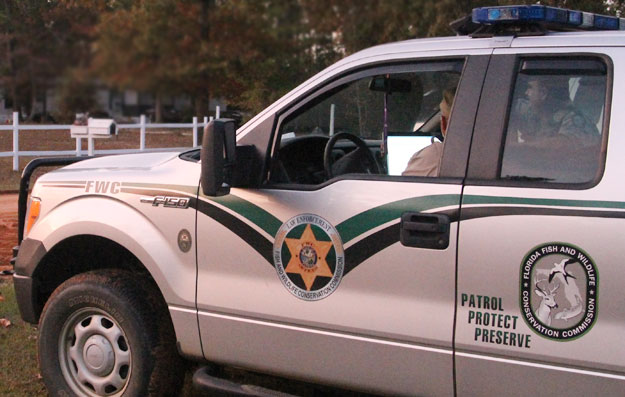
The Florida FWC Division of Law Enforcement reported the following activity during the weekly period ending November 9 in Escambia and Santa Rosa counties.
ESCAMBIA COUNTY
Detectives with the Pensacola Police Department began an investigation during September into what was originally reported as a missing persons case. As the case developed, detectives began to suspect foul play and, through their investigation, believed that the victim was possibly located on a farm in Cantonment. Pensacola Police Department requested assistance from FWC due to the wooded terrain in the area and the FWC’s expertise in this type of landscape. Officers McHenry, Pettey and Hoomes responded to assist with locating the victim. After an extensive search which included heavily wooded and wetland areas, the officers located the victim’s remains. The discovery of the remains led to an arrest of a suspect by the Pensacola Police Department.
Editor’s note: The above FWC report refers to the arrest of 40-year old Ashley McArthur for the death of Taylor Wright, whose body was found off Britt Road in Cantonment. Click here for a previous NorthEscambia.com story.
SANTA ROSA COUNTY
 Officer Hutchinson contacted the Department of Alcoholic Beverages and Tobacco (ABT) and informed them about an illegal moonshine still that he and Lieutenant Hahr located while investigating a deer poaching case. After speaking with an investigator and passing along the information to them, they drove to the suspect’s residence where the still was located. They contacted the suspect who admitted to possessing the still and making moonshine. While speaking with the suspect, the officers observed two more whiskey stills near his shed. They gained consent to search the property and with the help of two other ABT investigators, they located other items used to make moonshine. A felony warrant was later issued for the suspect’s arrest for the possession of the illegal moonshine stills.
While on patrol in the Yellow River Wildlife Management Area (WMA), Officer Mullins observed subjects at a state forest primitive recreation area. Officer Mullins spoke with the subjects and discovered one subject was in possession of cannabis, drug paraphernalia and alcohol in a posted “no alcohol area.” The subject was issued a citation for possession of cannabis under 20 grams.
Officer Ramos concluded an investigation leading to the arrest of a Navarre resident for the unlawful taking of a black bear shot in a resident’s yard in October. A thorough investigation of evidence and statements provided by witnesses and involved parties was reviewed by the State Attorney’s Office. The presiding judge concurred with the arrest affidavit and approved the arrest warrant. The suspect was booked into the county jail for the unlawful taking of a black bear.
This report represents some events the FWC handled over the past week; however, it does not include all actions taken by the Division of Law Enforcement. Information provided by FWC.
NorthEscambia.com photo.