

Woman Arrested For Crystal Meth In State Line Traffic Stop
August 26, 2017
A Flomaton woman was arrested by Alabama deputies on meth charges after a traffic stop just north of the Florida line.
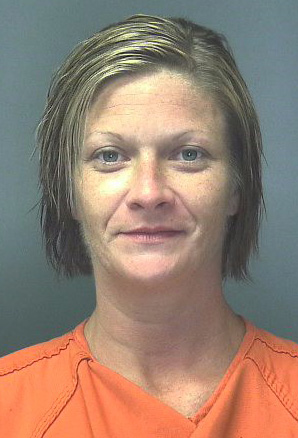 Bethanie Cash Ward, 40, was charged with possession of a controlled substance methamphetamine and possession of a controlled substance. She was booked into the Escambia County (AL) Detention Center and later released on a $5,000 bond.
Deputies assigned to the Escambia Co. Sheriff’s Office Narcotics Unit stopped Cash’s BMW on Old Atmore Road after she crossed the center line. She provided deputies with consent to search her vehicle.
During the vehicle search, deputies reported finding two packages of what field tested positive for crystal methamphetamine, according to a report.
New Escambia County Mass Transit Director Named
August 26, 2017
Mike Crittenden has been selected to serve as the county’s mass transit director. The newly created internal position reports to the county administrator and is responsible for overseeing the operation of the Escambia County Area Transit System, or ECAT, and paratransit systems. Crittenden has over three decades of transportation experience in the public and private sectors in the areas of fleet operations, logistics, project management and transportation research. His start date is immediate.
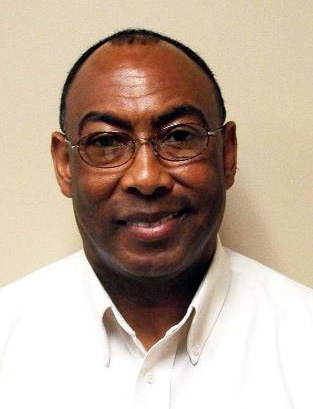 “I’m very excited to be back working for Escambia County residents.” Crittenden continued, “I am looking forward to collaborating with our elected officials, community leaders, stakeholders, customers and employees to improve ECAT and paratransit’s overall operating efficiency.”
In his most recent position, Crittenden was employed with First Transit where he served in several roles over 17 years including region director of operations for the southeast and general manager of ECAT. Prior, he held senior management positions with Destiny Transportation Group, Jacksonville Transportation Authority and the Center for Urban Transportation Research. He holds a B.A. in Criminal Justice from Alabama State University and a Transportation and Logistics Management Certificate from the United States Air Force Technical Training Center.
Four candidates were interviewed by the selection committee which consisted of County Administrator Jack Brown, Assistant County Administrator Amy Lovoy and Citrus Connect Executive Director Tom Phillips.
Tate Aggies Roll Over Choctaw
August 26, 2017
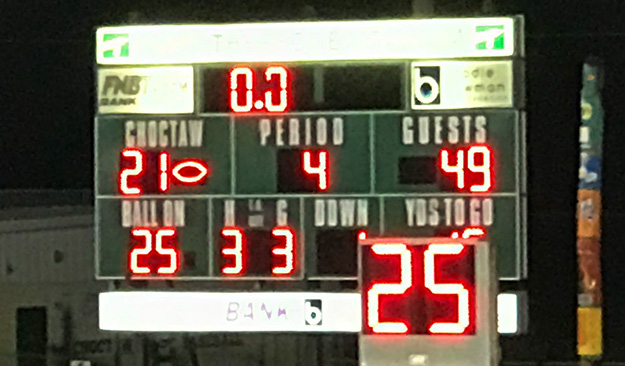
The Tate Aggies beat Choctaw on the road Friday night, 49-21.
Choctaw took an early 7-0 lead with a touchdown on their opening drive. But the Aggies answered quickly with a touchdown from Shermari Jones to make it 7-7.
Junior quarterback Hunter Riggan found Alex Jones with a touchdown pass from near midfield, 14-7 Aggies. After another TD for a 21-7 score, Riggan was in on a QB-keeper for a 28-7 Aggie advantage. Tate advanced to 35-7 with a touchdown pass to senior Alex Young.
Up 42-21 at the half, Tate pulled most starters out in the second half as they went on to earn a solid 49-21 win.
Riggan had 252 offensive yards in the first half with 71 rushing for two touchdowns and 181 yards in the air for two more touchdowns.
The Aggies (1-0) will take on West Florida next Friday night at 7:00 at the Jaguars’ home turf at Woodham Middle School.
High School Football Scores
August 26, 2017

Here are area high school football scores:
Thursday, August 24
West Florida 42 Escambia 20
Friday, August 25
FLORIDA
Northview 14 J.U. Blacksher 7 [Read more...]
Tate 49 Choctaw 21 [Read more...]
Flomaton 36 Jay 7
Pine Forest 41, Pensacola 0
Washington 46, Milton 25
Navarre 56, Catholic 35
Gulf Breeze 36, Pascagoula 0
Fort Walton Beach 31, Pace 27
ALABAMA
Flomaton 36 Jay 7
B.C. Rain (Mobile) 34 Escambia County (Atmore) 18
Escambia Academy 42 Resurrection Catholic 21
TR Miller 41 Washington County 0
WS Neal 21 South Choctaw 6
NorthEscambia.com file photo.
Jackson Downs The Wahoos
August 26, 2017
The Jackson Generals used three pitchers in the ninth inning and each pitcher struck out a Pensacola Blue Wahoos hitter to complete a, 1-0, shutout Friday at Blue Wahoos Stadium.
The game remained scoreless into the ninth inning until Jackson third baseman Marty Herum drilled a two-out solo homer, his first in Double-A, over the left field fence in the top of the ninth. Herum had five with High-A Visalia Rawhide before getting called up to the Generals July 19.
 The Generals captured the series, 3-2, in front of the 15th sellout of 5,038 at the ballpark. Pensacola recorded its 14th shutout loss of the season.
Pensacola manager Pat Kelly said the loss was tough. With 10 games left in the second half, the Blue Wahoos fell to 28-31 and 5.5 games behind first place Jacksonville Jumbo Shrimp who are 34-26. Friday’s loss hurts the ballclub’s chances of winning the second half and a Southern League record five straight halves.
Jackson put runners on first and second in the fourth and Pensacola pitcher Jose Lopez gave up a two-out single to right field to Herum. But Aristides Aquino fired the ball to catcher Joe Hudson to easily tag out first baseman Travis Denker at home to end the inning.
Both pitchers traded zeros most of the game. Through the first six innings, Lopez shut out the Jackson lineup on five hits, one walk and one hit batter, while striking out seven.
He is now 7-1 with a 2.34 ERA. The Pensacola righty has turned into one of the Southern League’s most dominating hurlers since July 6. He is 5-0 with a 1.23 ERA, allowing only nine runs in his last 66.1 innings over 10 starts.
Kelly said the key to Lopez mesmerizing hitters has been his aggressiveness in the strike zone after giving up 18 runs, 15 earned in his first four starts in Double-A.
“I thought he did a great job out there,” Kelly said. “He settled in about the third inning and pitched six scoreless. He could have easily pitched seven.”
Jackson starter Ryan Atkinson matched Lopez Friday. Atkinson blanked Pensacola’s hitters through seven innings, allowing two hits, five walks and striking out three. Reliever J.R. Bradley picked up the win to improve to 1-1 with a 4.05 ERA by tossing 1.1 perfect innings of relief with two strikeouts.
The Blue Wahoos’ Aquino singled to left field to lead off the second inning and reached second base on a ground out but was stranded. Pensacola wouldn’t get another batter past first base the rest of the game.
Pitcher Tyler Mahle, who started for the Blue Wahoos earlier this season, was called up from the Triple-A Louisville Bats to make his major league debut in a start against the Pittsburgh Pirates on Sunday, the Cincinnati Reds announced.
For Pensacola and Louisville Mahle is 10-7 with a 2.06 ERA in 24 starts with 138 strikeouts in 144.1 innings pitched.
Following In His Father’s Footsteps: Lineworker Appreciation Day
August 26, 2017
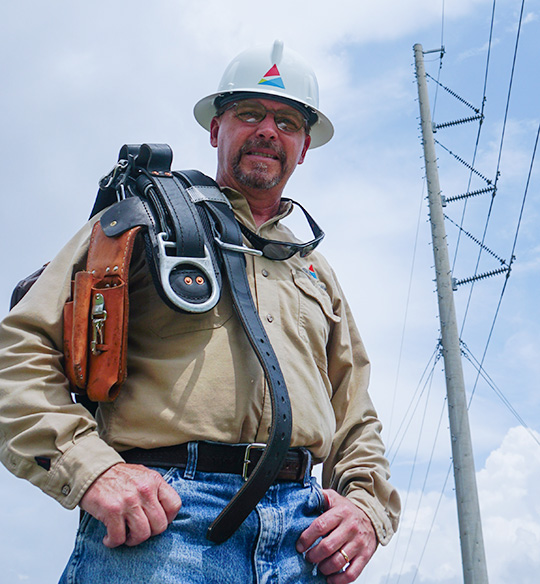
People who have endured long power outages in the wake of hurricanes or tornadoes applaud lineworkers. Some even call them heroes.
Curt Cunningham, who has been working on hundreds of miles of distribution and transmission lines for Gulf Power since 1991, flashes a smile and laughs at the thought. But he admits lineworkers do feel a sense of triumph when they make repairs and see the sparkle of lights springing back to life across a neighborhood.
“Sometimes we do feel like a hero, because we are the people our customers see and come out and thank when we get the lights back on,” said Cunningham, a Gulf Power Transmission lineworker. “But there are a whole lot of other people behind that crew who help get the lights on.”
Despite the nod to a large Gulf Power transmission and distribution team supporting lineworkers, Cunningham and his 182 colleagues are the first responders. When the lights go out, they can be called on in the middle of the night and in all sorts of weather to make repairs and restore power. Their mantra is to do the work “as safely and quickly as possible.”
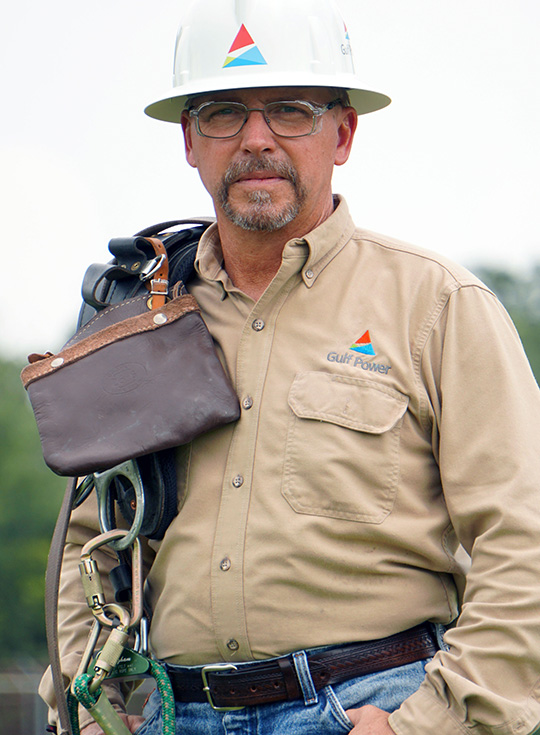 Line work is considered among the top 10 most dangerous jobs in the world. After the Florida House of Representatives designated Aug. 26, 2012 Lineworker Appreciation Day, utilities across the state observe that day annually to honor the thousands of men and women who risk their lives every day to ensure customers receive reliable energy 24/7, 365 days a year.
Cunningham was attracted to the industry at an early age, despite the inherent dangers. His father, Royce, once worked on a Gulf Power line crew and often talked about the job and the men he worked with.
“My dad was a big influencer, and I always looked up to this trade and the men who worked in it,” said Cunningham. “I was already in the electrical trade, and for me this was the career to shoot for.”
He worked as an electrician and earned a bachelor degree in Criminal Justice from University of West Florida before joining Gulf Power, and working in distribution –– the segment of the power grid that feeds homes and businesses. His first set of climbing tools were his father’s, and he learned the work on the job from the veterans.
“A lot of things have changed in my 26 years,” he pointed out. For instance, safety measures have improved and newly recruited lineworkers have comprehensive training that includes diet and fitness education and a seven-year apprenticeship.
The married father of two grown daughters spent half of his career working on the distribution in Pace, Milton and Gulf Breeze. He did his share of storm duty –– heading out into the aftermath of a hurricane, tropical storm, tornado or ice storm to repair the electric grid and restore power. That duty often requires days and weeks working long hours. Gulf Power lineworkers even travel to neighboring communities and out of state to assist other utility companies with storm restoration.
About 12 years ago, he became a transmission lineworker. He’s one of 10 who work on the high voltage lines and towers that transport power from generation facilities to substations, which feed the distribution lines that serve Gulf Power’s customers.
“Transmission gave me the big picture view of the team that supports lineworkers. By having working relations with system controls, relay and protection, substation workers and engineers, you understand the scope of what goes into just changing out a support arm on a tower,” he said. “It’s a huge team our customers don’t see.”
Cunningham said he joined transmission at one of the most interesting times in Gulf Power’s history.
“I have been involved in one of the biggest investments in the transmission system the company has ever done –– building new tie lines to Alabama, new lines from Pensacola to Panama City and upgrading transmission substations,” he said.
His team is also nearing completion of a huge, multi-year storm hardening project to replace every wooden arm –– 1,500 –– on transmission towers with steel ones. Cunningham said the upgrade and other improvements Gulf Power has invested in the transmission system have reduced outages and improved power reliability. This leads to fewer of those middle-of-the-night calls for lineworkers to rush out and restore power, he said.
On a day-to-day basis, he travels some of the 1,667 miles of transmission lines in his utility truck from the Pensacola area east to Fort Walton Beach inspecting towers, poles and equipment for deterioration or damage.
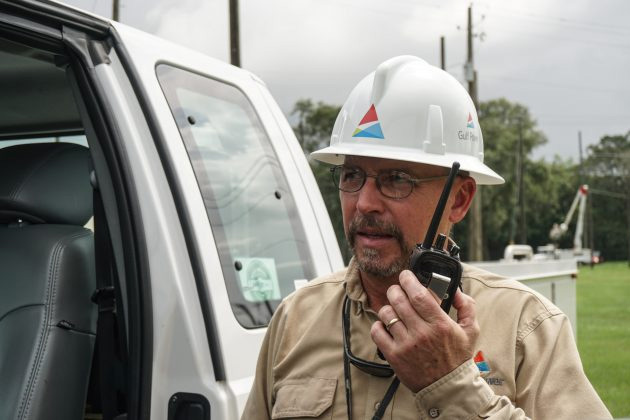
The opportunity to be out in rural areas where many of the transmissions lines lace across fields, forests, swamps, rivers and bays is what he likes best about transmission work. “I cover a lot of territory and in a lot of remote areas,” he said. “That’s one of the challenges of transmission for some people, but for me, I love it.”
Sometimes to access those remote areas he and his team board boats and an amphibious tractor called a Marsh Master to go to work. That’s what they had to do during the holiday season a few years ago when a transmission tower spanning a river fell.
“I got a call at 2 a.m. that we had a transmission line out,” he said. “We started getting our crews in and picking up our boats and amphibious tractor. That’s the only way we could get out and see what was wrong. As soon as it was light enough before dawn for us to see, we were in the water.”
Whether it’s an emergency job or completing a storm-hardening project, Cunningham said what makes him enjoy his job is “at the end of the day you can look at what you’ve done and say, ‘there’s a job I completed.’
“And we may not always see the lights come back on when we’re working in remote areas, but we get that radio call confirming our work was a success,” Cunningham said. “You feel good.”
Photos for NorthEscambia.com, click to enlarge.
Century Creates Short List Of Oil Spill Money Projects
August 25, 2017
The Century Town Council wants to purchase the their old town hall for use as welcome center.
The idea was among seven ideas given the preliminary approval by the town council as possible oil spill money projects after a joint workshop with the Century Area Chamber of Commerce.
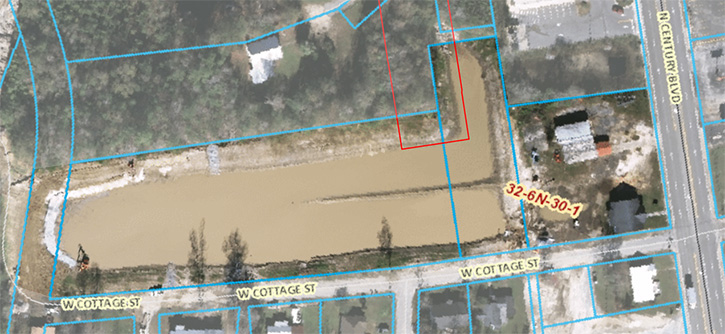
The small 1,600 square foot building would be a Florida welcome center for tourists, if the town is able to purchase it from a private owner. Behind the center, the town would construct a walking trail around a large drainage pond that’s part of what was called the “north Century drainage project”. There would also be a parking area and a “Welcome To Florida” sign for photo opportunities.
Other projects under consideration are:
- Moving about 20 sewage lift stations underground
- A workforce development, workforce training and financial literacy education program
- A partnership with Escambia Community Clinic to construct a new building near the Lakeview Center in the Century Industrial Park. ECC would use the building for an adult medical care, adult dental care and urgent care facility.
- Wastewater treatment plant improvements
- The renovation of the old Century High School gymnasium for basketball, youth sports and other activities
- The creation of a farmer’s market (similar to the Palafox Market in Pensacola) and a community garden.
During a council meeting on September 11, the list of seven projects will be narrowed to five to submit to the Escambia County Commission for possible funding through Triumph Gulf Coast.
The Gulf Coast Economic Corridor Act signed by Gov. Rick Scott on June 2 directs $1.5 billion to be spent over a 15 year period in eight counties in Northwest Florida that were impacted by the oil spill. The act directs Escambia and other seven other counties to seek proposals from other local governing boards withing their county.
Activities eligible for funding include ad valorem tax rate reductions, workforce skill development, local funding match requirements, public infrastructure projects, equipment and personnel for local disaster action plans, promotion of tourism and workforce and educational career development programs.
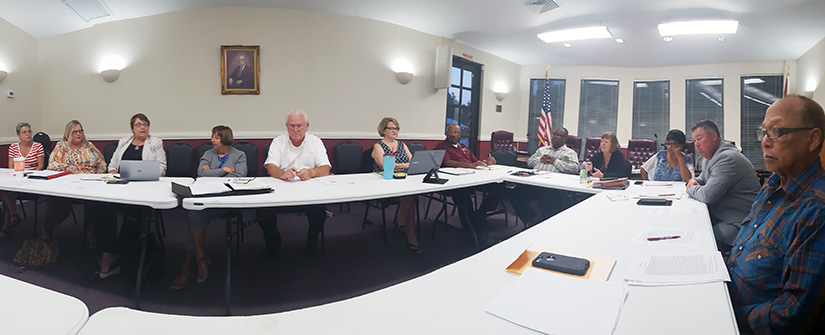
Pictured top: A panoramic view of a joint workshop meeting Thursday evening between the Century Chamber of Commerce and the Century Town Council to chose projects for possible funding by Triump Gulf Coast. Pictured below: The are properties of the old town hall and the north Century drainage project. NorthEscambia.com photos, click to enlarge.
Cantonment Man Charged With Assaulting Girlfriend
August 25, 2017
A Cantonment man has been arrested for assaulting his live-in girlfriend.
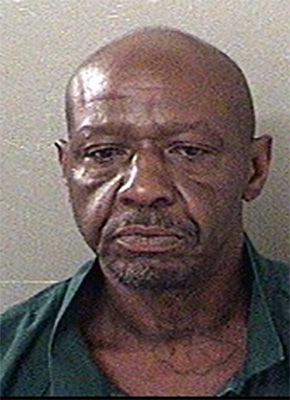 Albert McDonald Thompkins, 53, was charged with felony aggravated assault with a deadly weapon and battery.
Thompkins allegedly became involved in a physical altercation with the victim at their residence on Booker Street. During the altercation, he allegedly picked up a glass mug, which was shaped like a boot, threw it her and missed. He then hit her numerous times on her back, head and stomach before fleeing the scene, according to an arrest report.
Thompkins remained in the Escambia County Jail Thursday morning with bond set at $3,500.
Woman Sentenced For Embezzling Half Million From Poarch Creek Indians
August 25, 2017
An Atmore woman has been sentenced in federal court for embezzling a half million dollars from the Poarch Creek Indians.
 U.S. District Judge William H. Steele sentenced Carolyn Dortch, 54, of Atmore, to five years of probation for embezzling funds from the Poarch Band of Creek Indians. The Court ordered that Dortch serve the first six months of her sentence on home confinement with electronic monitoring and imposed a credit restriction. The court also ordered Dortch to make restitution totaling $502,173.35 and to pay a $100 special assessment.
From around 2010 until October 2016, Dortch was employed as the senior services director for the Poarch Band of Creek Indians. She led the Seniors Active in Learning Center, which provided numerous activities for seniors such as meals on wheels, games, crafts, and trips. Dortch was responsible for purchasing food and supplies and for handling tribal money on senior trips. In October 2016, the tribe discovered Dortch had been misusing her position of employment and submitting falsified receipts representing fictitious purchases. An investigation revealed that Dortch had been embezzling funds from the tribe and using these funds for personal gain.
In January 2017, the United States Attorney for the Southern District of Alabama charged Dortch in a one-count information, alleging that over a four-year period ending in 2016, Dortch embezzled tribal funds. Dortch pled guilty to the offense in a hearing before Judge Steele.
Florida Executes Convicted Killer
August 25, 2017
After spending nearly three decades on Death Row, convicted murderer Mark James Asay was executed Thursday evening, the state’s first inmate to be put to death in more than 19 months and the first execution under a lethal injection procedure never used before in Florida or any other state.
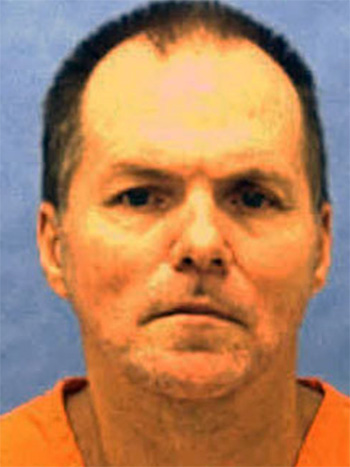 Asay’s execution at Florida State Prison was the first since a January 2016 U.S. Supreme Court decision, in a case known as Hurst v. Florida, that effectively put the state’s death penalty in limbo. He also was the first white man executed for killing a black victim in Florida.
Asay was pronounced dead at 6:22 p.m., 11 minutes after corrections officials announced that the execution phase had begun.
Asay, strapped to a gurney by leather cuffs at his wrists, twitched his legs briefly during the first few minutes of the execution procedure and appeared to breath rapidly before turning ashen prior to the announcement that “the sentence of the state of Florida” was carried out.
The lack of complications with the untested lethal-injection procedure used in Asay’s execution may have eased concerns about Florida’s new three-drug protocol.
“The execution took place without incident,” Department of Corrections spokeswoman Michelle Glady told reporters gathered in a staging area beside the prison.
When asked whether Asay’s execution ended concerns about the new drug protocol, Glady referred reporters to information the department had provided earlier.
“Our objective with this is a humane and dignified process, which was done this evening,” she said.
Asay was convicted in 1988 of the shooting deaths of Robert Booker, who was black, and Robert McDowell.
Asay allegedly shot Booker after calling him a racial epithet. He then killed McDowell, who was dressed as a woman, after agreeing to pay him for oral sex. According to court documents, Asay — who had white supremacist and swastika tattoos — later told a friend that McDowell had previously cheated him out of money in a drug deal.
A jury found Asay guilty of two counts of first-degree murder and recommended the death penalty with a 9-3 vote.
The Florida Supreme Court this month rejected a major appeal by Asay, including a challenge to the new lethal-injection procedure. The court more recently rejected another attempt at a reprieve, after justices acknowledged the court had been mistaken for more than two decades about McDowell’s race.
The U.S. Supreme Court on Thursday denied a requested stay of execution.
Thursday’s execution made Asay the 24th Death Row prisoner put to death since Gov. Rick Scott took office in 2011. Scott has ordered more executions than any Florida governor since the death penalty was reinstated in 1976.
While prosecutors portrayed Asay as a white supremacist, the condemned killer denied that he was a racist in a lengthy interview with a Jacksonville television station just days before his execution.
Asay said he got the tattoos while locked up in Texas.
“I was 19 years old, forced to survive in a hostile prison environment, and I got these tattoos in that environment so that I could blend in so that I could be safe in that environment. They are not representative at all of who I am, but they are tattoos, and they’re not easily removed. They’re easy to put on but they’re not easy to remove, and so I’ve had to live with them. I have covered them up. I had a swastika on my elbow; I covered that up. I had an SWP on my arm; I burned it off. I’ve removed every racial tattoo I had, except for the ones that I can’t reach,” he told WJXT anchor Tom Wills.
When asked if he was a white supremacist, Asay was adamant.
“Never have been. I’ve had African-American friends all my life. But I’ve had to live in very hostile environments, and I’ve had to manage the best I could. While it’s a poor choice, it’s a choice I made, and I can’t undo it,” he said.
Asay, 53, woke up Thursday around 4:30 a.m. “calm and in good spirits,” Department of Corrections spokeswoman Michelle Glady told the media during a briefing late Thursday afternoon.
Asay’s last meal consisted of fried pork chops, fried ham, French fries, vanilla swirl ice cream and a can of Coke, Glady said. Asay later visited with family members before meeting with his spiritual adviser, she said.
In the interview with the Jacksonville television station, Asay admitted to killing McDowell but maintained his innocence in the murder of Booker.
Asay told Wills he was very drunk when he shot McDowell in downtown Jacksonville.
“That just happened as I was having a meltdown apparently. That’s all I can say. I knew Robert McDowell as Rene. I had previous encounters with him, and we were sociable, and he did take money from me one time. I had said, in my mind, `When I see him, I’m going to kick his ass.’ But I never intended to murder him. It just happened,” Asay said.
Asay was the first Florida Death Row inmate executed with the new lethal-injection protocol that’s been the focus of a tangled legal battle.
In the new protocol, Florida substituted etomidate for midazolam as the critical first drug, used to sedate prisoners before injecting them with a paralytic and then a drug used to stop prisoners’ hearts.
Asay’s lawyer, Marty McClain, failed to convince a Duval County judge that the new protocol is unconstitutional because etomidate can cause pain after being injected and can result in “myoclonus,” or involuntary movements, such as twitches or jerks.
Most capital cases involve complicated and lengthy appeals.
But Asay’s case was even more tangled than most:
— Asay spent a decade on Death Row without legal representation, a violation of state law.
— Dozens of boxes of records related to his case were destroyed after being left in a rat- and roach-infested shed.
— One of his previous defense lawyers was the subject of an investigation by the Florida Supreme Court, after a federal judge chided her for shoddy work.
— McClain maintained that Attorney General Pam Bondi’s office hoodwinked him into agreeing to a delay by the U.S. Supreme Court, making it more difficult for Asay to have a review by the high court.
— The Florida Supreme Court recently issued a rare mea culpa, acknowledging that it had for more than 20 years mistakenly believed that McDowell was black.
— Department of Corrections officials changed the lethal-injection protocol a year after Scott initially signed Asay’s death warrant in 2016.
by Dara Kam, The News Service of Florida