
Wahoos Lose To Jacksonville

April 27, 2018

For the second night in a row, the Wahoos offense produced plenty runs to win. However, an exhausted bullpen was overmatched Thursday night and Jacksonville came from behind to win the series opener 10-9.

Both teams came out swinging to start the ball game. Pensacola batted around the lineup to open the game against Jumbo Shrimp starter Brandon Barker. Gabriel Guerrero doubled home two runs and then scored on Aristides Aquino’s RBI-single to make it 3-0 after a half inning of play. Jacksonville quickly countered thanks to Monte Harrison’s solo home run and John Norwood’s run-scoring single to cut the lead down to 3-2.

Pensacola went right back to work and scored once in the top of the second, but the Jumbo Shrimp immediately responded by scoring three more runs off Pensacola starter Daniel Wright in the bottom of the inning. The theme continued in the third inning, and by the time the dust settled in the fourth inning, the game was tied 4-4 and both starters were out of the game.

Pensacola manager Jody Davis hoped that his reigning Southern League Pitcher of the Week would deliver a lengthy start to rest his exhausted bullpen from the previous series; however, Wright was chased from the game with two outs in the third after allowing seven runs on 11 hits.

For the second night in a row, Davis used four different pitchers in relief. The bullpen battled throughout the night, and only allowed three runs over the game’s remaining six innings. After the Wahoos tied the game in the top of the ninth on a Taylor Sparks triple and a wild pitch Jeff Kinley (W, 1-0), to tie the game at nine. Sparks finished the night going 3-for-5 and extended his hitting streak to 12 games.

In the bottom of the ninth with Sharif Othman on second, Kyle Barrett doubled off Alex Powers (L, 0-1), which gave the Shrimp a dramatic 10-9 win.

Pregnant Woman Flips Car Trying To Avoid Ducks Crossing The Road

April 26, 2018

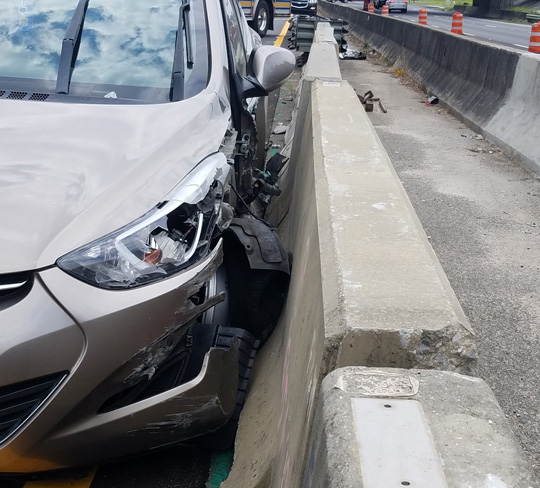
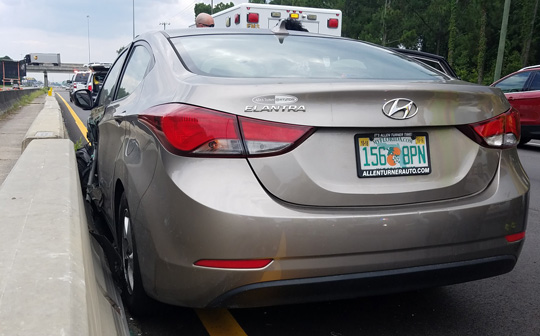
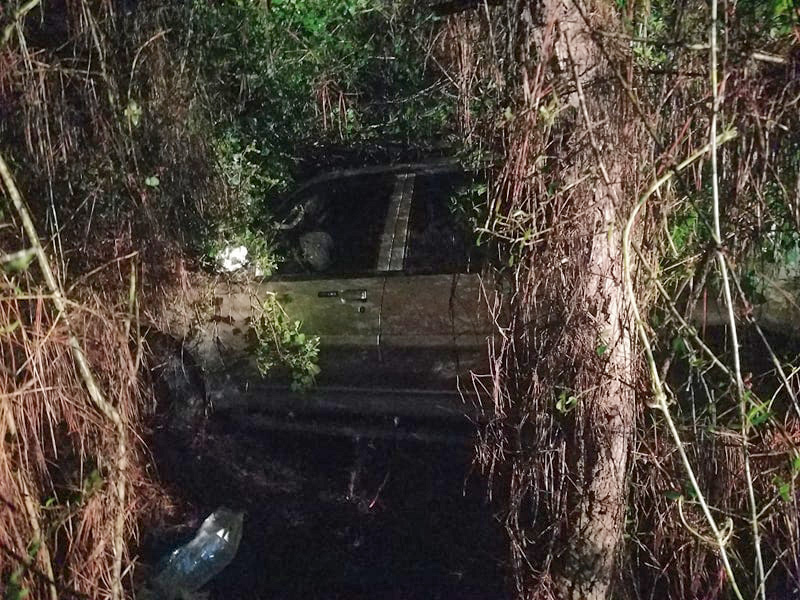
A young pregnant woman escaped serious injury Thursday when her vehicle overturned.

The accident happened on Rockaway Creek Road north of Nokomis Road. The driver reportedly stated that she was attempting to avoid ducks  that were crossing the road on their way to a nearby pond. She lost control and ran off the roadway, with her vehicle flipping over in a ditch and coming to rest upside down.

The woman refused medical transport by Escambia County EMS and headed to the hospital in a private vehicle.

The accident is under investigation by the Florida Highway Patrol. The Walnut Hill Station of Escambia Fire Rescue and the Escambia County Sheriff’s Office also responded.

NorthEscambia.com photos, click to enlarge.
Sheriff, Commission Reach New Budget Deal

April 26, 2018

The Escambia County Commission and Sheriff David Morgan have reach a new budget mediation agreement that will mean an extra $9 million over the next four years for staff pay raises.

“We are pleased that we can start the process to pay our deputies and employees what they were worth all along. We’d like to thank the citizens who stood behind the Sheriff’s Office through the appeal process. We are hopeful that the BOCC will begin a plan to properly fix compensation for their own first responders and employees as well as develop a way to ensure the County never again gets this far behind in proper compensation for the employees it is responsible to fund,” Morgan said.

The $9 million is broken down as:

  • $1 million in fiscal year 2018
  • $2.5 million in fiscal year 2019
  • $2.6 million in fiscal year 2020
  • $2.9 million in fiscal year 2021

The agreement will also create a Sheriff’s Mediated Reserve (SMR) to be used in fiscal year 2020 or after for workers compensation, pension and health care costs. The county and the sheriff will contribute a total of $2.5 million to the reserve fund — $500,000 in fiscal year 2019, $1 million in fiscal year 2020 and $1 million in fiscal year 2021.

The SMR can only be used by the sheriff if the BOCC increases their budget allocation for health care costs for each employee by more than $10,000, if there is a net increase to the amount the sheriff contributes to the Florida Retirement System, or if the sheriff has a worker’s compensation premium increase in fiscal year 2020 or 2021.

Once an interlocal agreement is signed by both parties, the sheriff agrees to drop his budget appeal to the governor’s office. The BOCC has retained the right to seek to enforce a previous mediation agreement in the event an interlocal agreement is not signed.

Unlike a previous agreement, the new terms to not require the BOCC to use commissioners’ discretionary funding for outside agencies  or Law Enforcement Trust Fund money as a funding source.

The new agreement will prevent the sheriff’s from appealing future budgets to the governor, allow him to request funding for additional positions in fiscal years 2020 and 2021, and the sheriff will be allowed to require additional operational or capital funding.

Pictured: Gov. Rick Scott and Escambia County David Morgan during a meeting October 5, 2017, at the Escambia County Emergency Operations Center concerning then Tropical Storm Nate. Photo for NorthEscambia.com, click to enlarge.

Mayor Selects Godwin As New Century Town Clerk

April 26, 2018

Mayor Henry Hawkins will recommend Kim Godwin as the Century’s town clerk.

“She’s the best fit, and she’s my recommendation,” Hawkins said Wednesday afternoon.

Godwin was named interim clerk in March after the resignation of Leslie Howimgton. She transitioned into the clerk position from gas superintendent for the town’s utility department. Godwin’s previous experience with the town includes deputy clerk of utilities and communication, and senior citizens services specialist. She also worked as a secretary specialist for the colonel at Century Correctional Institution.

Godwin is an active member of the International Institute of Municipal Clerks, is seeking official certification as a municipal clerk, is a member of the Florida Gas Utilities Board of Directors; a former secretary for the Century Area Chamber of Commerce Board of Directors; and a former member of the  Twin Cities Volunteers (previously Rotary Club) Board of Directors.

Hawkins will officially announce his selection to the Century Town Council at their next regular meeting on Monday, May 7.

Two other applicants interviewed for the job [click for previous story].

Pictured top: Kim Godwin records minutes during a previous meeting of the Century Town Council. NorthEscambia.com photo, click to enlarge.

Byrneville Elementary Hires Architect To ‘Pre-Design’ New Building

April 26, 2018

The Byrneville Elementary School Board of Directors voted Wednesday to hire a local architectural firm to take the first big step toward the construction of a new building.

Sam Marshall Architects will provide pre-design services for the proposed additions and modifications, including a 10 or 12 classroom addition, a new cafetorium and perhaps the conversion of the existing cafetorium into a library and an upgrade to the air conditioning system. The services will include preparing educational specifications required by state standards.

The company will meet with the school to set goals and hold a followup meeting to present the final report. The final report is expected to take about two months to complete and will include anticipated costs for the overall project.

Sam Marshall Architects will charge $4,000 for educational specifications, $3,000 for food service specifications and $2,000 for the statement on anticipated construction costs.

Local educational projects completed by Sam Marshall Architects include the new Ernest Ward Middle School, Northview High School and  Bellview Middle School.

The board received one other proposal from Bullock Tice Associates for $12,500.

Wednesday’s vote does not commit the charter school to actually build the facility – that will take additional steps including the arrangement of financing and a final design.

The largest building on the current Byrneville campus was build in 1941 and contains five classrooms, plus offices and a cafeteria. Several classrooms and the school library are located in old wooden portable buildings.

Pictured top: Byrneville Elementary Principa lDee Wolfe-Sullivan and board members Melanie Killam, Brandy Carter, Jeremy Hawsey, Cheryl Boutwell and Chris Hawkins review proposal for architectural services Wednesday afternoon. Pictured below: The current main building at Byrneville Elementary was constructed in 1941. NorthEscambia.com photos, click to enlarge.

Friends Of The Library Big Spring Book Sale Is This Weekend

April 26, 2018

The annual Friends of the West Florida Public Library Spring Book Sale is this Friday through Sunday at the downtown Main Library, 239 North Spring Street. Thousands of hardcover, paperback, and collectible books will be available for purchase, plus a variety of DVDs, CDs, puzzles, and other items. Proceeds are used to fund programs and enhancements at WFPL branches including Century and Molino.

Friday is the Friends Advance Sale from 3-7 p.m. with first choice on the best selection of books. General admission is $5 at the door, and Friends of the Library members are admitted free. Memberships can be purchased at the door.

Saturday is the regular book sale from 9 a.m. until 5 p.m. with free admission.

Sunday is the Bag Sale from 10 a.m. until 3 p.m. The Friends will provide a brown paper bag, and all the books that fit inside the bag are just $5. There is no limit on the number of bags that can be purchased.

Book sale items include thousands of generous donations from the public and some library books retired from circulation, many of them now out-of-print. Novels and mysteries are sorted by author or into genres like science fiction and westerns. Other book categories include arts and entertainment, children’s, cookbooks, history, holidays, home and hobbies, literature, foreign language, military, modern living, nature and gardening, religion, science, sports, technical, and travel. Most prices range from 50 cents for paperbacks to $2 for hardcover. There are also recorded books, magazines, and other media for sale.

The Collector’s Corner will feature an assortment of signed books, pre-1950s books, books by local and Florida authors, and other special books that are great for gifts. These items are priced as marked and must be checked out separately, so shoppers paying by check should bring at least two checks.

Payment by cash or check is preferred, but credit cards are welcome.

NorthEscambia.com file photos, click to enlarge.

Court Backs State In Felon’s Rights Fees

April 26, 2018

Siding with Gov. Rick Scott and the other members of the Board of Executive Clemency, a panel of the 11th U.S. Circuit Court of Appeals late Wednesday blocked a federal judge’s order that would have required state officials to overhaul Florida’s process of restoring felons’ voting rights by Thursday.

The appellate court ruling was a decisive victory for Scott, Attorney General Pam Bondi and the two other members of the Florida Cabinet, who serve as the clemency board, in a legal battle in which state officials have been on the losing side in a series of rulings by U.S. District Judge Mark Walker.

“The Fourteenth Amendment expressly empowers the states to abridge a convicted felon’s right to vote,” appellate Judge Stanley Marcus wrote in a majority opinion joined by Judge William Pryor. “Binding precedent holds that the governor has broad discretion to grant and deny clemency, even when the applicable regime lacks any standards.”

Walker ruled the state’s vote-restoration process violated First Amendment rights and Fourteenth Amendment equal-protection rights of felons. Last month, he gave Scott and the board until Thursday to revamp what the judge called a “fatally flawed” process and rejected a request by Bondi to put his order on hold.

Scott and the board immediately appealed Walker’s decision and asked the appellate court to put a stay on what the governor’s office branded a “haphazard clemency ruling.”

In its 2-1 decision Wednesday, the three-judge panel not only granted the state’s request to put Walker’s decision on hold but also indicated the judge’s invalidation of the vote-restoration process likely would not stand up.

Echoing arguments made by Bondi’s lawyers, the majority found “there is wisdom in preserving the status quo” until the appellate court issues a ruling in the overall case.

The clemency board “has a substantial interest in avoiding chaos and uncertainty in its election procedures, and likely should not be forced to employ a rushed decision-making process created on an artificial deadline now, just because a more thorough decision-making process could be employed later,” Marcus wrote. “We are reluctant to upset the system now in place — particularly since the district court order creates so truncated a schedule — when there is a good chance the district court’s order may be overturned, and the system would need to be changed again, potentially re-disenfranchising those who have been reenfranchised pursuant to the district court’s injunction.”

Scott has steadfastly defended the state’s process, saying it is founded on a 150-year old system enshrined in the state Constitution.

“We are glad that the 11th Circuit Court of Appeals has stayed the lower court’s reckless ruling. Judges should interpret the law, not create it. Governor Scott will never stop fighting for victims of crime and their families,” Scott spokesman John Tupps said in a statement Wednesday night.

The majority also found that the plaintiffs in the lawsuit, filed last year by the Fair Elections Legal Network and the law firm Cohen Milstein Sellers & Toll PLLC on behalf of nine felons, had not shown — or even claimed — that the state’s vote-restoration system is discriminatory.

“All we have is the assertion by the appellees (the plaintiffs) and a statement by the district court that there is a real ‘risk’ of disparate treatment and discrimination, precisely because the Florida regime is standardless,” Marcus wrote, adding that such a risk is “insufficient” under previous case law.

Lawyers representing the felons issued a terse statement following Wednesday’s decision, saying it “preserves the status quo” and “will be briefed and argued to the 11th Circuit on the merits.”

The court also rejected Walker’s finding that the state’s process violated the First Amendment rights of felons because, in part, “no First Amendment challenge to a felon-disenfranchisement scheme has ever been successful.”

But in a dissent, Judge Beverly Martin agreed with Walker that First Amendment rights of speech and association encompass the right to vote.

The board “has ‘unfettered discretion’ to permit an applicant to exercise her right to vote ‘at any time, for any reason,’ “ Martin wrote. “This unbridled discretion is not just concerning when it confronts expressive and associational freedoms traditionally protected by the First Amendment, but also when it threatens the right to vote.”

Martin wrote that, while she disagreed with Walker’s decision that the state could not completely do away its vote-restoration system, she would have left the rest of his injunction in place.

Due to the appellate court ruling, Scott canceled a hastily scheduled Wednesday night meeting of the clemency board, planned in case the Atlanta court did not grant the stay.

The restoration of felons’ rights has long been a controversial legal and political issue in Florida, with critics of the state’s process comparing it to post-Civil War Jim Crow policies designed to keep blacks from casting ballots.

Florida, with about 1.6 million felons, is considered an outlier in a nation where more than three dozen other states automatically restore the right to vote for most felons who have completed their sentences.

After taking office in 2011, Scott and Bondi played key roles in changing the process to effectively make it harder for felons to get their rights restored.

Under the current process, felons must wait five or seven years after their sentences are complete to apply to have rights restored. After applications are filed, the process can take years to complete.

Since the changes went into effect in 2011, Scott — whose support is required for any type of clemency to be granted — and the board have restored the rights of 3,005 of the more than 30,000 convicted felons who’ve applied, according to the Florida Commission on Offender Review. There’s currently a backlog of 10,085 pending applications, according to the commission.

In contrast, more than 155,000 ex-felons had their right to vote automatically restored during the four years of former Gov. Charlie Crist’s tenure, according to court documents.

Siding with the plaintiffs, Walker in a March 27 ruling chastised Scott and other state officials and ordered the clemency board to devise a constitutionally sound program with “specific, neutral criteria that excise the risk — and, of course, the actual practice of — any impermissible discrimination, such as race, gender, religion or viewpoint.”

Walker scalded state officials for threatening to do away with the rights-restoration process all together and gave the clemency board until Thursday to “promulgate specific standards and neutral criteria” to replace the current “nebulous criteria, such as the governor’s comfort level.”

Walker also cautioned that there is a risk that the clemency board “may engage in viewpoint discrimination through seemingly neutral rationales” or a “perceived lack of remorse” that “serve as impermissible” masks for censorship.

“Therefore, the board must promulgate specific standards and neutral criteria to direct its decision-making,” Walker ordered in March. The judge did not specify a particular process but ordered that “Florida’s corrected scheme cannot be byzantine or burdensome.”

Arguing that they needed more time to craft new regulations, the state’s lawyers asked Walker to put his decision on hold, again drawing a rebuke from the judge.

“Rather than comply with the requirements of the United States Constitution, defendants continue to insist they can do whatever they want with hundreds of thousands of Floridians’ voting rights and absolutely zero standards,” Walker wrote in a six-page decision April 4. “They ask this court to stay its prior orders. No.”

The legal tangle involving Scott, the federal judge and the felons in the case comes months before Floridians will decide whether felons should automatically have their voting rights restored.

A political committee known as Floridians for a Fair Democracy collected enough petitions to put a constitutional amendment on the November ballot that would automatically restore voting rights to felons who have served their sentences, completed parole and paid restitution. Murderers and sex offenders would be excluded. The amendment, if approved by 60 percent of voters, could have an impact on about 600,000 Florida felons, according to supporters of the measure.

by Dara Kam, The News Service of Florida

Legislative Leaders Fold On Gambling Talks

April 26, 2018

After weeks of discussions between two powerful legislators, the possibility of a special session focused on perennially elusive gambling issues came to an end Wednesday.

Incoming Senate President Bill Galvano and incoming House Speaker Jose Oliva conceded they were unable to reach a deal despite self-imposed pressure to come up with a gambling plan before the November elections.

“We’ve moved on. Will revisit next session,” Oliva, R-Miami Lakes, said in a text Wednesday afternoon.

The legislators wanted to head off a proposed constitutional amendment on the general election ballot that, if passed, would give voters control of gambling expansions, decisions now largely controlled by the Legislature.

The legislative leaders had also used a potential loss of revenue from the Seminole Tribe as a rationale for a hurried special session, after lawmakers failed to reach agreement on a gambling deal during the regular session that ended last month.

But a new, yearlong deal announced last week by Gov. Rick Scott and the tribe and fears that a proposed expansion of slot machines could backfire put the kibosh on any gambling legislation, according to Galvano and Senate President Joe Negron.

Under the arrangement between Scott and the Seminoles, the tribe agreed to continue making about $300 million a year in payments through the 2019 legislative session. In exchange for the payments, which are rooted in a 2010 gambling “compact,” the tribe would continue to have exclusive rights to offer games such as blackjack at its casinos and would continue to be the state’s only slot-machine operator outside of Miami-Dade and Broward counties.

The Seminoles would keep up the payments “provided the state does not enact legislation to expand gaming subject to exclusivity under the compact during the forbearance period.”

Whether the talk of a special session sparked a renewed agreement between the Seminoles — who are major contributors to the political committee behind the proposed constitutional amendment — and Scott, or the other way around, is unclear.

But the resulting deal — and the guarantee that the incoming leaders could rely on another $300 million from the tribe, and possibly more, when they craft next year’s budget — withered the prospect of a special session.

“That reduced the sense of urgency on behalf of Speaker-designate Oliva and President-designate Galvano. I could sense that, when it happened,” Negron, R-Stuart, told The News Service of Florida on Wednesday.

The deal being considered by Galvano and Oliva would have jeopardized the income from the tribe by allowing slots in up to six of the eight counties — Brevard, Duval, Gadsden, Hamilton, Lee, Palm Beach, St. Lucie and Washington — where voters have approved the lucrative machines at local pari-mutuels, an element the Senate has supported. To compete for the six new slot machine licenses, pari-mutuel operators would have had to relinquish active permits, a “contraction” of gambling pushed by House Speaker Richard Corcoran, R-Land O’ Lakes.

The gambling operators also would have had to make some sort of guarantee for a minimum amount of revenue to the state to offset potential losses from the tribe.

But supporters of the “Voters in Charge” proposal, which will appear on the November ballot as Amendment 3, are asserting that the measure, if passed, could apply retroactively, meaning money from both the Seminoles and the pari-mutuels would be off the table, at least temporarily.

“That was exactly the issue” that put an end to the talks, said Negron, who will be replaced by Galvano after the November elections.

“There also was uncertainty that some attorneys believe that the constitutional amendment could be interpreted retroactively so that the expansion to the slot machine counties, which I support because the voters voted, could be stricken down and then the contraction, that’s the House priority, could be sustained. Obviously, that’s not an equitable situation,” he said. “So that issue is unclear and uncertain.”

The incoming leaders were also concerned that, once a special session on gambling was called, legislators would demand that the session be expanded to include other issues, such as funding for public schools and the controversial “school guardians” program that allows certain specially trained teachers, certified by sheriff’s offices, to bring guns to schools.

Galvano, R-Bradenton, told the News Service that he and Oliva had discussed the broad outlines of a potential deal, but that ultimately, the “revenue uncertainty” and other factors put an end to the talks.

“The potential impacts of having a retroactive application of the constitutional amendment, and the litigation and delays … as well as the managing the call” of the session ultimately caused the leaders to abandon the issue, he said, at least for now.

by Dara Kam, The News Service of Florida

FHP: Hit And Run Driver Arrested After Hitting Motorcycle

April 26, 2018

An alleged hit and run driver has been arrest in connection with an accident that seriously injured a motorcyclist.

The Florida Highway Patrol said James Taylor Tice was arrested  on warrants stemming from his involvement in a hit and run crash. The FHP said Tice was traveling north on Pine Forst Road when failed to stop for a red light at Nine Mile Road and collided with the rear of a motorcycle.

The FHP said Tice then fled the scene, but a second motorcycle rider was able to follow his vehicle and obtain Tice’s tag number.

“Tice was identified through an extensive investigation that resulted in a warrant being issued for his arrest based on his involvement regarding the hit and run crash,” FHP Lt. Eddie Elmore said.

Tice was charged with leaving the scene of an accident with a serious bodily injury, leaving the scene of an accident with property damage, failing to render aid and driving with a suspended or revoked license.

Making Learning Fun: Welcome To Fleming’s Jurassic World At Lipscomb Elementary

April 26, 2018

Students in Rhonda Fleming’s classroom at Lipscomb Elementary School went wild over her decorations. Fleming went all out in decorating the classroom as “Fleming’s Jurassic World”, including desks in a jeep, a waterfall and a dinosaur, in an effort to make learning more fun. Courtesy photos for NorthEscambia.com, click to enlarge.

« Previous PageNext Page »