
Highland 633 Students Attend M-Fuge Camp

July 18, 2010

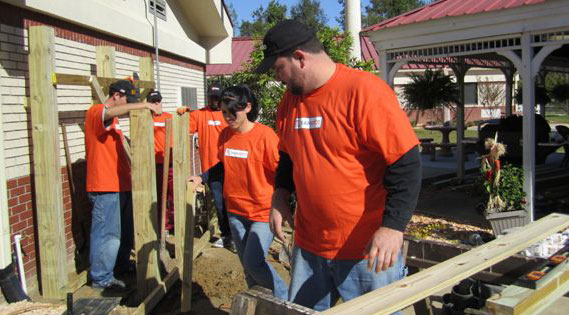
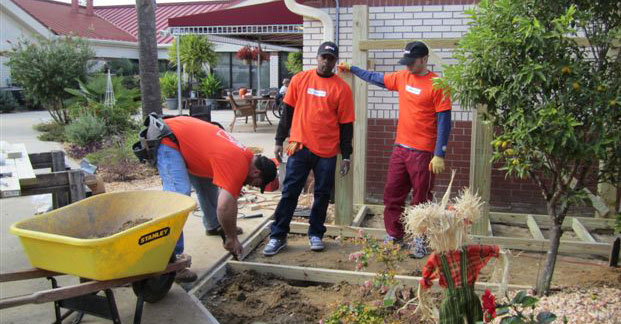
The Highland Baptist Church 633 Student Ministry recently participated in the M-Fuge Student Camp at North Greenville University in Greenville, South Carolina.

“We took 27 students and adult chaperones. Our students participated each day in ministry projects including children’s ministry, social ministry, games and recreation ministry, painting-cleanup-yard work ministry, and creative ministry.  Students were equipped to share their faith, which they did each day.  Each day the students and adults participated in worship services and enjoyed various activities as a group.  Upon return from camp our students have a renewed heart for serving others in our community with the love of Christ,” said Student Pastor Brad Johnson.

Highland Student Ministry meets each Wednesday night at 6:45pm at Highland Baptist Church, 6240 Hwy 95A North, Molino.

To share news from your church, email news@northescambia.com

Pictured: The Highland Baptist Church 633 Student Ministry at M-Fuge Student Camp in Greenville, South Carolina. Submitted photo for NorthEscambia.com, click to enlarge.

How To Pick That Perfect Summer Watermelon

July 17, 2010

One of the best ways to celebrate summer is to enjoy sweet, ripe watermelons. But knowing when to harvest or buying the best one is not always an easy chore. Of all the hard-to-choose fruits, watermelon is one of the toughest to select. The hard rind of a watermelon can be up to an inch thick and doesn’t soften as it ripens. It’s green when ripe and green when unripe. So, how do you select a juicy, sweet watermelon?

Your best bet is to grow your own or buy local and “in season”, through mid-July. Collin Adcock, Extension Agent in Washington County, provides us some tips on how to know when to harvest watermelons from your garden.

theresafriday.jpgChoosing a ripe watermelon from the field or garden can be much easier than choosing a ripe one in the store. The ability to recognize a ripe melon comes from years of experience and careful observation. In the garden there are several clues to help determine the ripeness of a melon that one does not always have in the store.

Most people rely on four methods of determining melon ripeness in the field.

First, look at the tendril or “pigtail” closest to the melon. When this tendril turns brown and dries out, it is a good sign that the melon is ripe.

Next, look at the bottom of the melon where it lays on the ground. When this area, sometimes referred to as the “color spot”, turns from white to a light yellow, there is a good chance the watermelon is ripe.

Then look at the rind. When the rind becomes rough to the touch and turns from a more shiny color to a more dull color and is resistant to penetration by the thumbnail it is a sign of melon ripeness.

The last method is the thump test. This is done by thumping the top of the melon. If the watermelon has a dull thud when thumped, it is very possible the melon is ripe. Unripe melons will usually have a tighter, ringing or hollow sound. Be careful when using this test because it is not always reliable. Watermelons do not always give off a dull thud when ripe. For some watermelons a dull thud may indicate an over-ripe melon.

Only a melon’s taste can provide definitive proof as to its ripeness. A foolproof approach is to cut open several melons that appear to be ripe (based on the above methods), and then taste all of the melons and decide which one has the best taste. After locating the best tasting watermelon note the condition of the closest tendril, the color spot, how the thump sounds, and the shine of the rind along with melon size. Harvest all those that have similar characteristics.

When buying a watermelon, you should look for “a firm, symmetrical watermelon that is free of bruises, cuts or dents” according to the National Watermelon Promotion Board.

When you see a nice-looking watermelon, pick it up and feel its heft; then pick up a few others of similar size to compare. At 92 percent water, a good melon should feel heavy for its size.

How do you know a watermelon ripened on the vine? Easy, turn the melon over and check for a creamy yellow spot. That’s a sign that the watermelon sat on the ground and in the sun to ripen. The yellow spot is the only place the sun didn’t hit.

Theresa Friday is the Residential Horticulture Extension Agent for Santa Rosa County.

Angel Food Donates 80,000 Pounds Of Food

July 16, 2010

Two tractor trailers loaded with food rolled up to the Gateway Church of Christ in Pensacola on Thursday morning for distribution to volunteers from 55 local organizations — including several in North Escambia — to help put it into the hands of those in need for free.

About 80 thousand pounds was delivered Thursday to a distribution site in Pensacola to assist families and workers impacted by the loss of work and business due to the Gulf oil disaster.

The food was from Angel Food Ministries, an organization dedicated to providing affordable, high-quality food to those in need.

“We have many oil workers who have come here to take care of the oil that washes up here; meanwhile no one is allowed in the water to fish or otherwise, and we have lost so much due to lack of tourism and commerce,” said Pat Senkow, Angel Food Outreach minister for the region. “In Escambia county we have 1,200 homeless children, and Santa Rosa County has 4,700 known homeless before the oil spoiled what we did have.”

North Escambia area organizations that participate in Angel Food Ministries include: Allen Memorial United Methodist Church, Pine Forest Assembly of God, New Life Baptist Church of Century, and the Poarch Band of Creek Indians. For more information about participating in the Angel Food program, call 1-888-819-3745 or visit www.angelfoodministries.com to find the nearest host site.

Local Brothers Find Themselves Deployed To Same Base In Afghanistan

July 16, 2010

BAGRAM AIRFIELD, Afghanistan – Two brothers from Atmore have been been deployed to the same base in Afghanistan.

Many armed services personnel are separated from their families for a long period of time on a regular basis due to deployments. Although some military members have a spouse or other family member that is also in the military and deploys frequently, rarely are they deployed at the same time or to the same location.

In Afghanistan, two brothers have found themselves deployed, not only at the same time, but to the same location as well. U.S. Army Sgt. 1st Class Dempsey Walker, supply support activity platoon sergeant, Company A, Task Force Workhorse, 3rd Combat Aviation Brigade, Task Force Falcon, from Atmore, Ala., has spent 24 years in the Army and is currently on his fourth deployment. His brother, U.S. Air Force Master Sgt. Nicholas Walker, a computer systems manager with the Combined Joint Special Operations Task Force – Afghanistan, also from Atmore, has spent 17 years in the Air Force and is currently on his third deployment. Both are deployed to Bagram Airfield, Afghanistan.

“This is the first time we have been deployed to the same base,” said Dempsey. “We were stationed in Korea at the same time and deployed to Iraq at the same time, but to different bases.”

“When I got here, my brother had already been here for six months,” said Nicholas. “It makes life here a lot easier, having a family member so close who can relate to what you are doing.”

Dempsey said he was anxious to join the military and chose the Army because it was able to let him join three months earlier than the other services. Nicholas, however, was not as anxious and made his decision based on the experiences of his brothers.

“We have an older brother that used to be in the Air Force,” said Nicholas. “After I talked to both my brothers, I decided the Air Force was right for me.”

According to Dempsey, the brothers get together at least once a week. They spend their time talking, going to church or just hanging out together. They usually eat at least one meal together whenever their schedules allow.

“It is nice to have a family member here to talk to,” said Dempsey. “Someone who is in the same location and situation and who can understand and relate to the types of problems that can pop up from time to time. In times like these, it is good to have your brother by your side.”

Pictured: U.S. Air Force Master Sgt. Nicholas Walker (right), a computer systems manager with the Combined Joint Special Operations Task Force – Afghanistan, sites and talks with his brother U.S. Air Force Master Sgt. Nicholas Walker (left), a computer systems manager with the Combined Joint Special Operations Task Force – Afghanistan recently at Bagram Airfield, Afghanistan. Photo by U.S. Army Sft. Robert Healy, Task Force Workhorse, 3rd Combat Aviation Brigade, for NorthEscambia.com, click to enlarge.
Ever Wonder What Happens When Your Power Goes Out?

July 15, 2010

oakgrovesubstation17.jpg

Power outages were reported across the North Escambia area Wednesday night as a line of storms moved through the area. But have you ever thought about what happens when your power goes out? NorthEscambia.com thought we would take a look at the behind the scenes things that take place to get your power back on.

Our scenario below involves Escambia River Electric Cooperative and a hypothetical power outage in Walnut Hill. The events could just as well happen in any community in the North Escambia  area on EREC, Gulf Power, Alabama Power, or Southern Pine Electric Cooperative.

Here’s our little story, “When the Lights Go Out”:

You were on your couch watching the TV early last night. The main storm has passed, and the rain outside has just about lulled you into a quick early evening nap.

Then it happens. Your power blinks one, two, three times and it’s off. You make your way in the dark to the kitchen where your glow-in-the-dark EREC magnet on the refrigerator is illuminated enough so that you can read the outage number. You call the number, 1-877-OUT-EREC, and follow the voice prompts to report your home’s outage. Your job is done.

What happens now? First of all, let’s set up the scenario for our hypothetical outage. Let’s say you live on Arthur Brown Road in Walnut Hill. This address receives power from the Oak Grove substation, just across the road from the Oak Grove Park on North Highway 99. You are assuming the evening’s thunderstorm is the culprit for your home being left in the dark. You know the proper action for you to take is to call the EREC outage number which you have done. Now, here’s the sequence of events which will take place to restore your power as quickly and safely as possible.

In our power outage scenario, your call comes in to the dispatch center and your name and address appear immediately on the computer screen. The dispatcher then contacts the on-call EREC crew to make repairs. Since the two-man crew is on-call for the evening, each crewman has driven home an EREC truck loaded with equipment and supplies necessary to repair any typical outage that might occur. So when the dispatch call is received, each crewman leaves his home and heads directly to the site of the outage. He does not need to take extra time to go by the EREC facility and get the vehicle, equipment and supplies needed to repair the outage.

Upon arrival to the outage location, the crew investigates the reason for the power failure. Meanwhile they have received additional calls from the dispatch center letting them know there are other nearby houses on Arthur Brown Road, Corley Road and Juniper Street that are experiencing outages as well. After assessment of the power system, the crew determines that the cause of the outage is an RE failure (an oil reclosure breaker) in the substation due to a lightning strike.

This can be handled quickly by the two-man crew so there is no need for additional personnel to be called in for assistance. The crew repairs the damage and calls the dispatch center to let them know all power has been restored. The dispatch center then calls back each member that has reported a power outage to be sure they do have power.

For more photos from inside the Oak Grove Power substation, click here.

The purpose of this story is to create a picture of what is actually happening during a typical power restoration. This is only a possible scenario and, of course, there are many different reasons why your power can go out.

“Although we cannot imagine all the power outage scenarios that can happen, there is one thing we can be sure of. EREC will be there to restore your power as quickly as possible in the dead of night, in the middle of terrible storms or whatever the case may be – EREC crews will do what needs to be done to get the lights back on,” said Sabrina Owens, EREC’s marketing director.

She said that in the case of major outages such as those that occur with hurricanes or other severe weather, specific procedures are in place to restore power to the most people in the shortest amount of time. The following steps describe power restoration after a storm.

  1. Transmission towers and lines supply power to one or more transmission substations. These lines seldom fail, but they can be damaged by a hurricane or tornado. Tens of thousands of people could be served by one high-voltage transmission line, so if there is damage here it gets attention first.
  2. Escambia River EC has several local distribution substations, each serving thousands of members. When a major outage occurs, the local distribution substations are checked first. A problem here could be caused by failure in the transmission system supplying the substation. If the problem can be corrected at the substation level, power may be restored to a large number of people.
  3. Main distribution supply lines are checked next if the problem cannot be isolated at the substation. These supply lines carry electricity away from the substation to a group of members, such as a town or housing development. When power is restored at this stage, all members served by this supply line could see the lights come on, as long as there is no problem farther down the line.
  4. The final supply lines, called tap lines, carry power to the utility poles or underground transformers outside houses or other buildings. Line crews fix the remaining outages based on restoring service to the greatest number of members.
  5. Sometimes, damage will occur on the service line between your house and the transformer on the nearby pole. This can explain why you have no power when your neighbor does. EREC needs to know you have an outage in this type of situation so that a service crew can repair it.

Members themselves (not the cooperative) are responsible for damage to the service installation on the building. The member will need to have a licensed electrician make these repairs.

For more photos from inside the Oak Grove Power substation, click here.

Special thanks to Sabrina Owens at EREC for her assistance with this story from our files , and to the linemen that assisted with the photographs. It’s worth noting that the photographs were taken on a nice sunny morning rather than during a real power outage after a storm due to the dangers of standing in a power substation after a storm has just passed.

Pictured above: EREC prepare to fix an oil reclosure breaker (RE) failure inside the Oak Grove power substation. Pictured below: That breaker is installed on a transmission line headed to the Arthur Brown Road area of Walnut Hill. NorthEscambia.com file photos, click to enlarge.

oakgrovesubstationstory10.jpg

Thousands Attend Free Jimmy Buffett Concert

July 12, 2010

Tens of thousands of people — including many from the North Escambia area — packed the beach in Gulf Shores, Alabama, Sunday night for a free Jimmy Buffett concert as thousands watched on national television.

Organizers gave away 35,000 free tickets for the show, which was televised nationally on CMT. Buffet’s free concert was to demonstrate his support for the people, businesses and culture of the Gulf Coast following the BP oil spill.

“It’s all BP’s fault,” Buffett sang as he changed the lyrics in his “Margaritaville”.

Do you have photos from the concert? Submit them to news@northescambia.com

Pictured top and below: Jimmy Buffett performs Sunday evening in Gulf Shores, Ala. Photos courtesy CMT. Pictured inset : Northview High School student Lauren Cloud and Trent Sweeney from Jay at Sunday’s Jimmy Buffett concert. Pictured bottom of the page: The crowds arriving for Sunday’s concert. Submitted photos by Lauren Cloud for NorthEscambia.com, click to enlarge.

Count Shows Blue Angels Crowd Up (With Blues Photo Gallery)

July 11, 2010

It appears that attendance at Saturday’s Blue Angels Pensacola Beach Air Show was higher than last year, at least according to a Santa Rosa Island Authority vehicle count.

A vehicle count from midnight Friday until 1 p.m. Saturday showed 9,431 vehicles passing through the toll booths to the islands, up from 8,579 last year. The Santa Rosa Island Authority estimates that an average of three people were in each vehicle, meaning 28,293 traveling to the island. Those numbers do not include people already on the beach or those traveling from Navarre.

For a Pensacola Beach Blue Angels photo gallery, click here.

Photos courtesy Cheryl Casey Photography

Ray’s Chapel Youth Visit Planetarium

July 11, 2010

The youth and children from Ray’s Chapel Baptist Church enjoyed a Saturday trip to the Pensacola Christian College Planetarium as they prepare to kick off their Vacation Bible School this week.

The group enjoyed the 36-minute “The Heaven’s Declare” show, exploring the sun, planets, constellations and galaxies of the universe on the planetarium’s 50 foot dome.

The Ray’s Chapel Baptist Church VBS “Operation Space” will be July 12-16 from 5:30 until 8:00 each night for ages 5-12.

“We are going to have skits every night featuring Capt. Scott, Turbo the robot and the crew of the Spaceship Intrepid. There will also be crafts, games, great food and bible briefings conducted by our special flight crew for the week,” according to Ray’s Chapel member Heather Leonard.

For photos from the Ray’s Chapel Baptist Church visit to the PCC Planetarium, click here.

Pictured: The youth and children from Ray’s Chapel Baptist Church visited the Pensacola Christian College Planetarium Saturday. Submitted photos by Heather Leonard for NorthEscambia.com, click to enlarge.

Do you have church news you would like to share? Email news@northescambia.com

Featured Recipe: Sweet And Savory CalRio Cuban Pie

July 11, 2010

This weekend’s featured recipe from Janet Tharpe is a CalRio Cuban Pie. Pulled pork, deli ham, Roma tomatoes, Swiss cheese are more combine to create this flavorful ethnic dish.

To print today’s “Just a Pinch” recipe column, you can click the image below to load a printable pdf with a recipe card.

Shelly Womack Named Escambia County Junior Miss

July 11, 2010

Shelly Womack was named Escambia County (Ala.) Junior Miss Saturday night at Jefferson Davis Community College in Brewton. Womack, the daughter of David and Janet Womack, is a student at Excel High School.

First alternate was Cierra White of Flomaton. She is the daughter of Earnie White of Flomaton and the late Angie White. She is a student at the Alabama School of Math and Science.

Walton Nichols of Atmore was named second alternate. She is the daughter of Randy and Melissa Nichols of Atmore.

Six young ladies took part in the program Saturday night. They were: Megan Andrews, Dallas Brown, Walton Nichols, Kelsey Templeton, Cierra White and Shelly Womack.

Pictured: Shelly Womack (center) was named Escambia County Junior Miss Saturday. Cierra White (left) was named first alternate, and Walton Nichols (right) was named first alternate. NorthEscambia.com graphic, click to enlarge.

« Previous PageNext Page »