

Peanut Butter Drive Continues
October 22, 2014
 The Escambia County Extension office, Santa Rosa County Extension office along with the University of Florida Institute of Food & Agricultural Sciences and the Florida Peanut Producer Association are collecting peanut butter now through mid-November to help take a bite out of hunger.
The groups are accepting donations of unopened jars of peanut butter to be donated to local food pantries during Farm-City Week.
Unopened jars of peanut butter of any brand can be dropped off until November 21 at any of the following locations:
Escambia County
- Escambia County Extension Office, 3740 Stefani Road, Cantonment
- Escambia County Farm Bureau, 153 Highway 97, Molino
- Escambia County Public Safety, 6575 North W Street
- Gilmore Services, 31 East Fairfield Drive
Santa Rosa County
- Jay Extension Office at 5259 Booker Lane, Jay
- Santa Rosa County Extension Office at 6263 Dogwood Drive, Milton
- South Santa Rosa Service Center, Master Gardener Help Desk at 5819 Gulf Breeze Parkway
- All Santa Rosa County Library locations
- Lowe’s Stores in Pace and Gulf Breeze
Peanut butter collected in Escambia County last year was donated to food pantries in Molino, Bratt and Century.
Pictured: The Godwins of Godwin Farms in Santa Rosa County, (L-R) Steven, Laryn, Valarie, Kylei, Rachael. Courtesy photo for NorthEscambia.com, click to enlarge.
Navy Donates T-39 Training Aircraft To George Stone Technical Center
October 22, 2014

Like many retired Navy veterans that have served decades on active duty only to return to serving their country in another role, one of the last T-39 Sabreliner jets to fly at Naval Air Station (NAS) Pensacola will help instruct students at George Stone Technical Center.
Instead of being flown to Davis-Monthan Air Force Base “boneyard” and languishing in the Arizona desert in lay-up, the airplane will become an integral part of the new Aviation Maintenance Program at GSTC.
 “We are ecstatic about our partnership with the Navy and are very excited to get this jet,” said T. J. Rollins, principal at George Stone. “It was flying just a few months ago training Navy navigators, so it’s a fully-capable airplane for our new students to practice on as they work toward their certifications and licenses from the Federal Aviation Administration.”
The Navy-GSTC partnership happened through a chance meeting with the Escambia County School District’s Curriculum Coordinator for Workforce Education, Steve Harrell and a maintenance technician working at NAS.
“When I found out he worked on airplanes at the base, I mentioned that we were starting a new Aviation Maintenance Program at George Stone,” said Harrell. “He mentioned that they were retiring all of the T-39s and that I should ask the Navy if we could have one for our new program.”
John Appicelli, assistant officer in charge for the Chief of Naval Air Training detachment at NAS helped turn the suggestion into reality. He said that it was an unusual request, but it had merit.
“It took a lot of coordination between the Navy and government agencies, but we thought it was a great idea and would be well worth the effort,” said Appicelli. “We started the process in February and it took until now to work out all the details, including moving the jet to the school. As the aircraft left the base, ownership transferred to George Stone. I’m glad to see that it’s going to a good home and will continue to help launch aviation careers.”
Whisler Aviation from Seward, Neb. handled the transport of the T-39 to GTSC. The wing and fuselage were separated at NAS, trucked to George Stone and reassembled at the school Oct. 20 with the help of Deep South “The aircraft industry definitely needs qualified Airframe and Powerplant Mechanics as there is a shortage of A&Ps across America,” said Greg Whisler, president of Whisler Aviation. “In addition to transporting planes, we also have a repair facility that maintains aircraft, and we are always in need of certified A&P mechanics.”
The George Stone Aircraft Maintenance Program will be available for new and current GTSC students and approval is anticipated for funding by the GI Bill and other veteran’s educational programs.
According to Keith Boring, program manager for the Navy’s Credentials Program Office, active-duty and reserve Navy and Marine Corps personnel will be eligible for funding for the certification testing portion of the Aviation Maintenance Program through the Navy’s Credentialing Online Program “We don’t fund for the training portion of the program, as many active duty and reserve service members qualify as a result of their military schools and on-the-job training,” said Boring. “Navy COOL does fund, however, for airframe, powerplant and combination testing for the necessary certification exams at qualified technical schools like George Stone.”
According to Harrell and Rollins, the goal of the Aviation Maintenance Program is to help develop a local workforce that can fill the future aerospace jobs coming through VT Mobile Aerospace Engineering, Airbus, and other regional employers. The GTSC Aviation Maintenance Program is currently in the process of receiving FAA approval and certification and is
scheduled to start the first class at GSTC in August of 2015.
by Ed Barker, Media Officer, Naval Education and Training Command for NorthEscambia.com
Pictured top: A retired T-39 Sabreliner training jet fuselage is lowered onto its wing at George Stone Technical Center for use as part of their new Aviation Maintenance Program for students seeking a FAA Airframe and Powerplant certification. Pictured inset: The T-39 is loaded on a fladbed. Pictured below: Greg Whisler from Whisler Aviation and Kevin Henley from Deep South Cranes secure the nosewheel of the aircraft. Photo by Ed Barker, Naval Education and Training Command, for NorthEscambia.com, click to enlarge. Pictured bottom: The reassembled plane a parking lot Tuesday morning. Photo courtesy Allison Woodfin for NorthEscambia.com, click to enlarge.


Sweet Math Project: Northview Students Supersize Candy
October 21, 2014

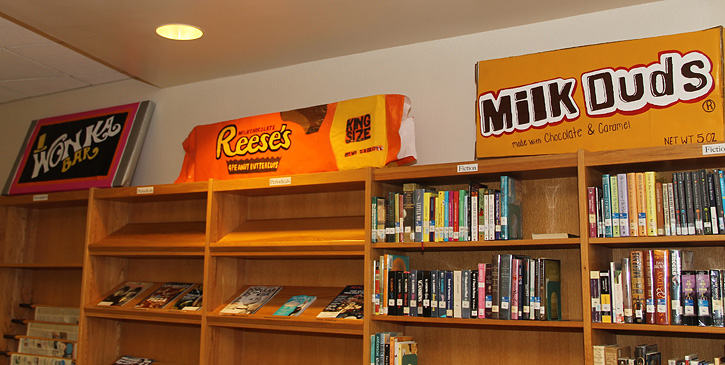
Geometry students at Northview High School recently completed a really sweet project — scaling ordinary candy packages into supersized replicas. The completed projects are currently on display in the school library. NorthEscambia.com photos, click to enlarge.



Weekend Gardening: Colorful Bedding Plants Can Brighten A Winter Day
October 19, 2014

by Santa Rosa Extension Service
Decreasing day length is a signal to start preparing for winter. Soon, deciduous shrubs will drop their leaves and the landscape will appear stark and less impressive. To keep the gloomy days of winter at bay, add cool season bedding plants to the landscape.
Bedding plants are those that are commonly used in residential and commercial landscapes to provide color and interest. No other group of plants can so quickly and economically create a colorful landscape.
Most bedding plants are annuals. These short-lived plants grow from seed, bloom and die within one growing season. The transient nature of annuals means that at the end of their season when they are no longer attractive, annuals are removed and replaced with new plantings.
Many flowering plants prefer a very specific season; therefore, bedding plants are classified into two groups based on the temperatures they prefer. Cool season bedding plants do best in the cold to mild temperatures of October through early May and generally tolerate typical winter freezes without protection.
According to a University of Florida/IFAS publication, bedding plants that can be added to the North Florida landscape now include alyssum, baby’s breath, calendula, carnation, dianthus, dusty miller, foxglove, hollyhock, ornamental cabbage and kale, pansy, petunia, snapdragons and violas.
 Most annual bedding plants prefer to be in a sunny location. Prepare the planting beds several weeks before planting. First, remove any weeds or other unwanted plants from the bed. Next, turn the soil to a depth of about eight inches. Spread a two- to four-inch layer of compost, rotted leaves, aged manure, composted finely ground pine bark or peat moss over the bed, and then evenly sprinkle a light application of an all purpose fertilizer. Thoroughly blend the organic matter and fertilizer into the bed, rake smooth and you’re ready to plant.
Gardeners are accustomed to (and even demand) that bedding plants be in bloom when they are purchased. Some cool season bedding plants, however, will provide far superior results if they are purchased when young and before the colorful display begins.
Bedding plants are typically planted to make a dramatic statement. To accomplish that, place multiple plants of the same kind in a bed. Bedding plants generally look best and the beds will fill in better when the rows are staggered. Lay out the first row of plants spaced properly. The second row is laid behind the first row at the appropriate spacing from it, but the plants are placed between the plants of the first row so that they form triangles with those plants.
Flower beds of colorful bedding plants add a lot to the landscape but require a fair amount of maintenance to stay looking their best. Keeping beds well weeded is critical. A two-inch layer of mulch will help considerably in keeping weeds from growing, and using preemergence herbicides (weed preventers) may help in some situations. However, always plan on having to do some hand weeding.
Suffering From Allergies? Don’t Blame The Goldenrods
October 18, 2014


The bright yellow flowers of the goldenrod are everywhere in the North Escambia area, taking the blame from allergy sufferers. But one of fall’s most colorful plants actually gets a bad rap, according to the University of Florida Extension Service.
The true culprit for all those sneezes and sniffles is ragweed, according to Environmental Horticulture Agent Alicia Lamborn.
Goldenrod plants are bright and showy, producing large, heavy pollen grains that are carried off by bees, butterflies and other pollinators rather than by the wind. Ragweed bares greenish yellow flowers in small heads which produce copious amounts of pollen, carried by the wind rather than insects.
Ragweed flowers are not showy which means these plants are often easier to recognize by their stems and leaves. Ragweed has branching purplish stems that are rough and hairy, and leaves which are smooth, but deeply divided into lobed portions.
Pictured: Goldenrods bloom alongside a dirt road in Bratt. NorthEscambia.com photos, click to enlarge.

Century Correctional K-9 Unit Places 2nd, Escambia Road Prison 6th, In Southern States Manhunt Competition
October 17, 2014

The Century Correctional Institution K-9 Unit placed second in the multi-leash division in the recent Southern States Manhunt Competition, while the Escambia County Road Prison placed sixth overall. Less than five minutes separated the first six places.
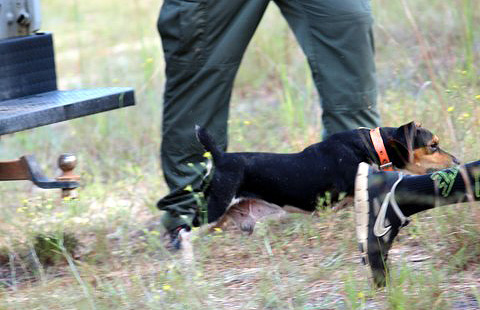 The multi leash division consists of more than one K-9 being utilized to track a suspect with the teams ranked by the amount of time that it took to capture the suspect. A total of 29 K-9 teams from Florida, Alabama, Louisiana and Arkansas participated in the event hosted by the Escambia County Road Prison.
The Florida Department of Corrections has 38 K-9 programs statewide which are used to support law enforcement agencies with felon apprehension, locating missing persons and locating and providing aid to persons in distress. In Fiscal Year 2013-2014, the Department’s K-9 tracking teams were deployed 710 times.
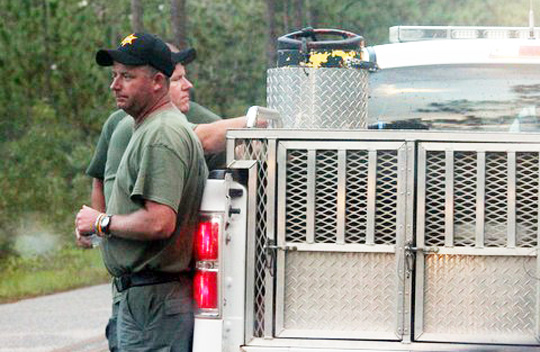
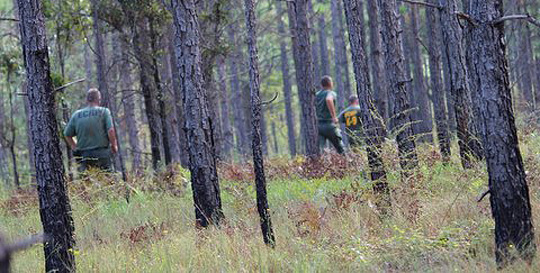
Pictured: From Century Correctional Institution – Major K. Carter, Officer J. Sanders, Officer K. Reaves, Officer D. Smith, Officer J. deGraaf, Sgt. B. Townson, Asst. Warden L. Marinin, Warden D. Sloan and Major D. Dunlap. Pictured below: Escambia County Road Prison officers during the competition. Submitted photos for NorthEscambia.com, click to enlarge.

Young Wyatt Johnson Loses Fight Against Rare Disease
October 16, 2014

Wyatt Johnson of Century passed away late Wednesday afternoon in Atlanta. He was just two and a half.
Wyatt suffered from a rare liver disease – Langerhans cell histiocytosis – that required chemotherapy and would have eventually required a transplant. He also had an enlarged liver, spleen and heart.
 Last year, Wyatt received national attention due to Shelby Godwin of Bratt. She saw a fundraising flyer with Wyatt’s picture at CVS in Century. She was so emotionally touched by the young man that she wanted to do something to help him, and she set up a roadside orange juice stand to raise money for a young child she had never met. The then 10-year old used her own money to purchase the oranges and supplies for her little business venture and borrowed an old fashioned juicer from a friend of her mom.
Wyatt’s family has an active GoFundMe website that was established to pay about $30,000 in transportation expenses for Wyatt and his family that were incurred to and from Atlanta where he received his specialized medical care. Donations can be made here.
Pictured: Wyatt Johnson in October of last year when a special event was held in his honor at Bratt Elementary School for him to meet Shelby Godwin (bottom photo) for the first time. NorthEscambia.com file photos, click to enlarge.

Learn More About Escambia’s Library System, Take A Survey
October 14, 2014

Escambia County is asking residents to take another in a series of surveys — this one about the West Florida Public Library System.
The system libraries serve more than 300,000 people in Escambia County. With seven libraries, the WFPL has grown and adapted to meet the changing information needs of the community since its inception in 1938 at Old Christ Church with just 3,300 books.
CLICK HERE TO TAKE A BRIEF SURVEY ABOUT ESCAMBIA COUNTY LIBRARIES.
Today the WFPL offers hundreds of thousands of books and audio-visual materials. More than 137,000 people this year already have used the computers and free Internet connections to build their technology skills, research genealogy and job search. More than 1.5 million visits are made to the libaries per year and more than 2,700 people each month attend neighborhood meetings, seminars, civic forums and other opportunities to interact and share ideas with their fellow residents at library facilities.
Residents of Escambia County can receive a free library card. The library system has checked out 578,712 items to the residents of Escambia County so far this year alone, such as books, DVDs, CDs, magazines and more, all free of charge witha library card. In addition to books, the library card allows patrons to access online encyclopedias and databases, attend numerous programs for all ages or use free wireless internet and computers. Nearly 12,000 residents each month use the Internet on more than 150 WFPL computers.
Over $6.7 million in Local Option Sales Tax has funded six new library faculties and a Bookmobile:
- 2004 – Southwest Branch Library
- 2007 – Century Branch Library
- 2008 – Tryon Branch Library
- 2012 – Main Library
- 2012 – Molino Branch Library
- 2014 – Westside Branch Library at Legion Field
Additionally, Local Option Sales Tax has allowed $875,000 in upgrades to preexisting library facilities:
- Buildings – $209,807
- Radio Frequency ID System – $455,367
- System Software – $209,826
For more information, visit MyWFPL.com.
Escambia Schools Holding Giveaways To Promote National School Lunch Week
October 14, 2014

The Escambia County School District is hosting daily giveaways for prizes and gift cards to increase school participation this week, which is designated at National School Lunch Week. The week highlights the importance of healthy eating and physical activity for a balanced lifestyle.
“Research shows there is a direct connection between eating healthy meals at school and improved academic performance,” said Florida Commissioner of Agriculture Adam H. Putnam. “This National School Lunch Week, we’re encouraging kids to eat right so they can succeed in the classroom and on the field.”
School meals are healthier than ever, Putnam said. Each child is offered whole grains, protein, vegetables, fruit and milk every single day.
Pictured top: This drawing shows the new cafeteria that students at Ernest Ward Middle School will enjoy by next year when a newly constructed school opens. NorthEscambia.com photo, click to enlarge.
Molino Park Elementary Parents: Learn More About Bullying
October 13, 2014
Molino Park Elementary School will hold a free Parent Bullying Training program this Thursday at the school.
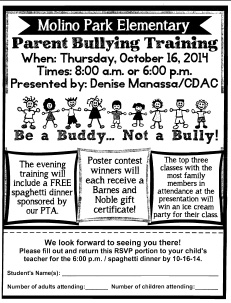 There will be two identical sessions — one at 8 a.m. and the other at 6 p.m. The evening training will include a free spaghetti dinner sponsored by the Molino Elementary School PTA. The program will be presented by Denise Manassa of the Community Drug & Alcohol Council.
The top three classes with the most family members in attendance at the presentation will win an ice cream party for their class.
Parents and guardians can click here for a printable reservation form to return to their child’s teacher at Molino Park Elementary.+