

Photos: Summer Reading (And Music) At The Century Library
August 1, 2014
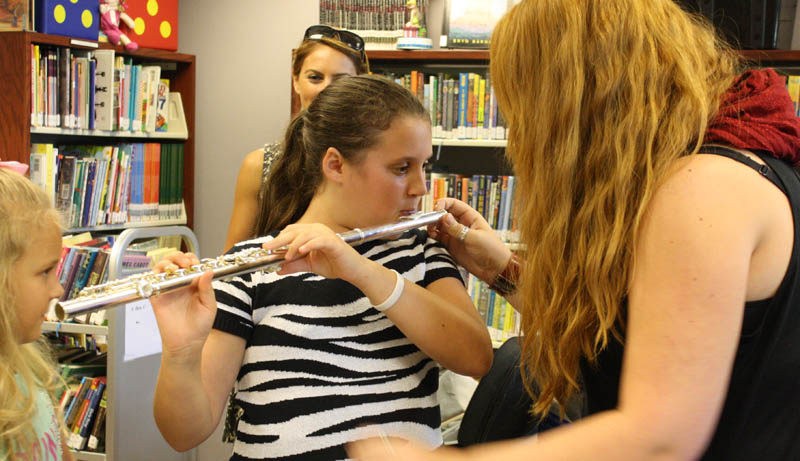
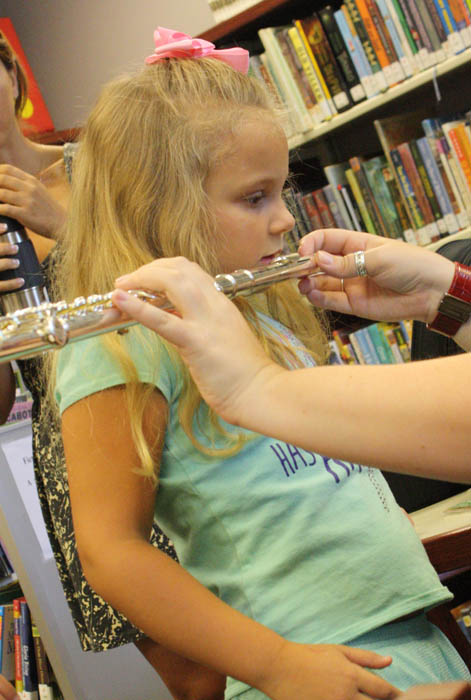 The weekly Summer Reading Program continued Thursday at the Century Branch Library. Children and teens 6-12 have participated this summer in the West Florida Public Library program at branches throughout the county.
Thursday, children at the Century Branch Library had a chance to hear a music-related story and try out various instruments.
Pictured: The Summer Reading Program Thursday afternoon at the Century Branch Library. NorthEscambia.com photos by Bethany Reynolds, click to enlarge.

Tate High Wind Ensemble Selected To Perform At Prestigious Troy Clinic
August 1, 2014
 The Tate High School Wind Ensemble has been selected to perform at the Southeastern United States Concert Band Clinic at Troy University.
The event will be held February 5-7, 2015. The musical event will feature a variety of activities including concerts, rehearsals, scholarship auditions, and clinics.
Vacation Bible Schools Are A Summertime Tradition (With Aldersgate UMC Gallery)
August 1, 2014
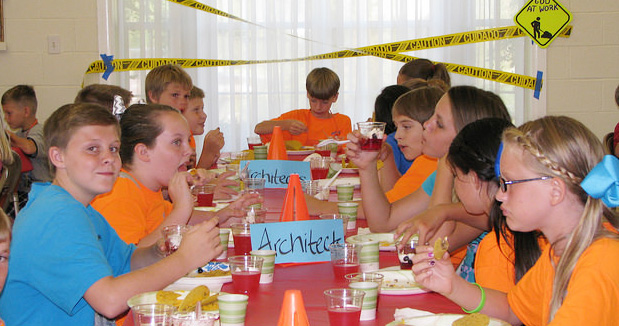
 Vacation Bible School is a summertime tradition for hundreds of area children — arts, crafts, food, songs and theme focused lessons usually all geared toward a worship theme. This week marked the end of VBS at most area churches.
At Aldersgate United Methodist Church in Molino, dozens of children have taken part in their “Workshop of Wonders” VBS this week. It will continue from 5:30 until 8:30 tonight for children three years old through fifth grade.
For more photos from Aldersgate’s VBS, click here.
Pictured: Vacation Bible School Submitted photos for NorthEscambia.com, click to enlarge.

Northview Mini Cheer Camp Set For Next Week
July 31, 2014

The Northview High School cheerleaders will host their annual mini-cheerleading camp next week.
The camp will be held August 5 from 4-6 p.m. and August 6 from 1-3 p.m. Registration is $25 for the camp or $35 for the camp and a shirt. The camp is open to anyone age three through the eighth grade. Mini-cheerleaders will admitted into the first Northview football home game for free and cheer the entire first quarter with the varsity NHS cheerleaders.
Field Corn Variety Tour Held
July 30, 2014

 A Field Corn Variety Tour was held Tuesday at the UF/IFAS West Florida Research and Education Center near Jay.
During the tour, producers and ag officials from across the region had a chance to learn about about 20 different varieties of corn, including heirloom varieties, plus crop and weed management. The event was a joint project of UF/IFAS, the Alabama Cooperative Extension Service, and Escambia and Santa Rosa counties.
Pictured top and bottom: The Field Corn Variety Tour Tuesday at the UF/IFAS West Florida Research and Education Center near Jay. Pictured inset: A tall heirloom variety of corn. Photos for NorthEscambia.com, click to enlarge.

Photos: Storm Clouds Roll
July 29, 2014

Afternoons storms rolled across the North Escambia area Monday afternoon. Pictured top: Storm clouds move across Highway 97A in Walnut Hill. Pictured: The storm as seen from nearby Corley Road. NorthEscambia.com photos, click to enlarge.

Day Of Hope: Free School Supplies, Backpacks, Groceries And More
July 28, 2014
Mark your calendars for August 16 — that’s when a free “Day of Hope” will offer back to school supplies and more.
The Day of Hope will be held from 10 a.m. until 2 p.m. at Victory Assembly of God at 1895 Victory Road, just south of Barrineau Park Road on Highway 29. The event will offer free groceries, haircuts, backpacks, school supplies, a kids zone and a hot lunch. Items are available while supplies last, rain or shine. No identification is required.
University Of Florida Study: Peanut Butter Sniff Test Could Diagnose Alzheimer’s
July 27, 2014

Detecting early stage Alzheimer’s disease may be as easy as sniffing a dollop of peanut butter.
Researchers at the University of Florida’s McKnight Brain Institute Center for Smell and Taste came up with the idea to test smell sensitivity because it can be “one of the first things to be affected in cognitive decline.” Also, the ability to smell is associated with the first cranial nerve.
Jennifer Stamps, a graduate student at the University of Florida came up with the idea for using peanut butter because it is a “pure odorant” that is only detected by the olfactory nerve and is easy to access.
 In the study, test subjects sat down with a clinician, 14 grams of peanut butter — which equals about one tablespoon — and a metric ruler. The patient closed his or her eyes and mouth and blocked one nostril. The clinician opened the peanut butter container and held the ruler next to the open nostril while the patient breathed normally. The clinician then moved the peanut butter up the ruler one centimeter at a time during the patient’s exhale until the person could detect an odor. The distance was recorded and the procedure repeated on the other nostril after a 90-second delay.
The clinicians running the test did not know the patients’ diagnoses, which were not usually confirmed until weeks after the initial clinical testing.
The scientists found that patients in the early stages of Alzheimer’s disease had a dramatic difference in detecting odor between the left and right nostril — the left nostril was impaired and did not detect the smell until it was an average of 10 centimeters closer to the nose than the right nostril had made the detection in patients with Alzheimer’s disease. This was not the case in patients with other kinds of dementia; instead, these patients had either no differences in odor detection between nostrils or the right nostril was worse at detecting odor than the left one.
Of the 24 patients tested who had mild cognitive impairment, which sometimes signals Alzheimer’s disease and sometimes turns out to be something else, about 10 patients showed a left nostril impairment and 14 patients did not. The researchers said more studies must be conducted to fully understand the implications.
“At the moment, we can use this test to confirm diagnosis,” Stamps said. “But we plan to study patients with mild cognitive impairment to see if this test might be used to predict which patients are going to get Alzheimer’s disease.”
[VOA]
Rolfe Completes Basic Military Training
July 27, 2014
Air Force Air National Guard Airman 1st Class Alec D. Rolfe graduated from basic military training at Joint Base San Antonio-Lackland, San Antonio, Texas.
 The airman completed an intensive, eight-week program that included training in military discipline and studies, Air Force core values, physical fitness, and basic warfare principles and skills.
Airmen who complete basic training earn four credits toward an associate in applied science degree through the Community College of the Air Force.
Rolfe is the son of Daniel L. and Nicole R. Rolfe of Cantonment.
He is a 2013 graduate of Pensacola Christian Academy.
Weekend Gardening: Distinctly Southern Hydrangeas
July 26, 2014

by Santa Rosa County Extension
Nothing defines a southern landscape more than hydrangeas.
These beautiful, large flowering shrubs fill gardens with their green, leafy foliage and incredible blooms during the warm months.
In order to ensure consistent and reliable blooms, these shrubs must be cared for correctly. In addition to proper site location, fertilizer and moisture conditions, hydrangeas may require pruning. Proper pruning includes correct timing.
Hydrangea aficionados are constantly debating pruning techniques. There are many different types of hydrangeas and pruning differs according to the type. It is a big genus of plants and so it’s important to know what type of hydrangeas you may have and on what type of wood they bloom on.
Blooms on old wood, prune after flowering
The bigleaf hydrangeas, known scientifically as Hydrangea macrophylla, are what most people think of when you mention hydrangeas. Most gardeners will know these as mopheads (also called hortensias) and lacecaps. Many of these blooms will be blue or pink although other colors now are available.
Many large colonies of bigleaf hydrangeas have existed around old homes for decades, surviving and blooming in spite of neglect. This tells us that it is not necessary to prune bigleaf hydrangeas.
However, if you want to keep these shrubs within a defined boundary, control their height or rejuvenate old shrubs, it will be necessary to prune them.
Bigleaf hydrangeas can be reduced in size immediately after flowering. A general rule of thumb is that you may remove up to a third of the shrub’s height. Be sure to complete your pruning before August. This is critical because next year flower blooms start to form in August. Pruning after August will remove next year’s blooms.
There now is a small group of bigleaf hydrangeas that are everblooming or remontant. Endless Summer® is one well-known brand. According to the developers of these reblooming hydrangeas, remove spent flowers to encourage rebloom. They are quite forgiving and will not suffer if left unpruned or pruned at the wrong time because these cultivars bloom on both old and new growth.
Our native oakleaf hydrangea (Hydrangea quercifolia) is a large, deciduous shrub that can grow up to six feet tall. It has deeply lobed, oak-like leaves which turn bronze in the fall. This plant does not usually need pruning. If reshaping or size-reduction is necessary, prune after blooms begin to fade.
Article Continues Below Photo
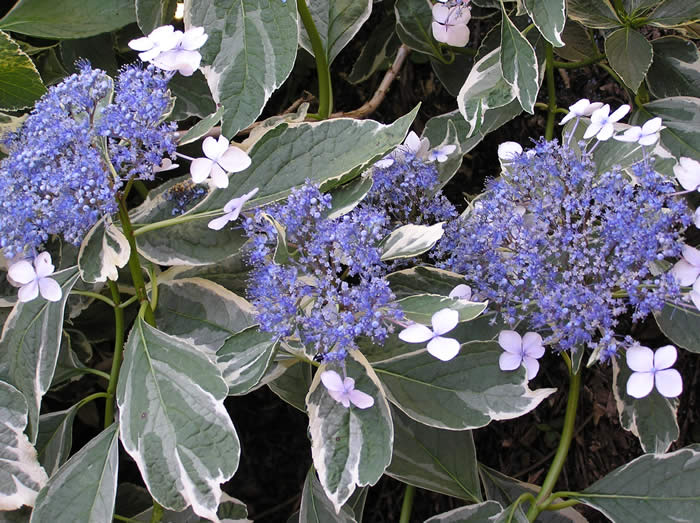
Lacecap hydrangea
Blooms on new wood, prune in early spring
Smooth hydrangea (H. arborescens) is the other U.S. native. The most common cultivar, ‘Annabelle’, produces rounded inflorescences that may reach up to a foot in diameter.
The panicle hydrangea (H. paniculata) is more of an upright type. It is typically a 10 to 15-foot large shrub or low-branched tree.
Panicle and smooth hydrangeas flower on current year’s growth and can be pruned anytime from late summer until early spring. If pruning these two species in the spring, try to prune before leaves appear.
Winter pruning
Established bigleaf, panicle, oakleaf and smooth hydrangea plants can often benefit from rejuvenation pruning. Remove about one-third of the oldest stems each year. The result is a fuller, healthier plant. This type of pruning is easiest to do in winter, since the absence of leaves makes it easier to see and reach inside plants.
Hydrangeas offer a wide variety of plants which can make the timing of pruning difficult to remember. Just keep in mind, if in doubt, either don’t prune at all or prune after flowering.