

Little Found During Daily Drug Dog Searches In Escambia Schools
February 17, 2011
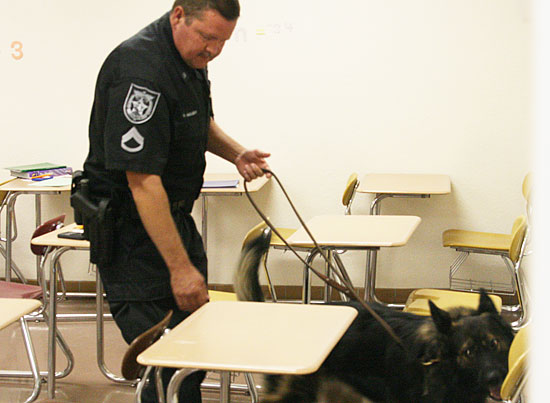
 Drug dogs have been used daily in Escambia County’s schools since August, and, so far, very few illegal substances have been found.
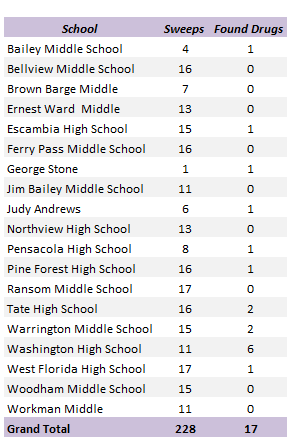
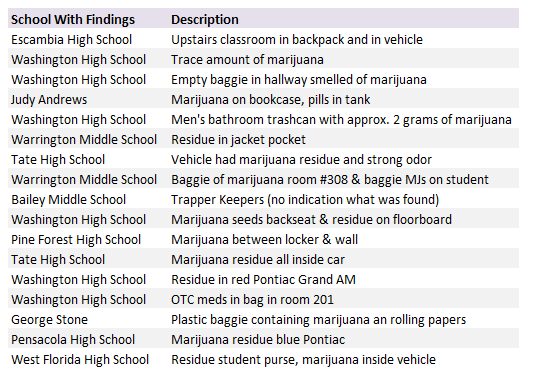
Each day, at least one middle or high school in the county is randomly visited by a canine officer and his dog. The North Escambia schools — Ernest Ward, Northview, Ransom and Tate — have each had 13 to 17 random searches since the first day of school. The only findings at the North Escambia schools has been at Tate High School, with marijuana residue found in two different vehicles on campus.
Of 228 searches, there have been 17 searches with drug related finds.
“I’m amazed that some schools have a much higher hit rate than one might expect — while others that many might expect to yield big finds — have so far not had any significant findings,” Escambia County School Board Member Jeff Bergosh said on his blog where he posted the latest numbers. “I’m told the searches and the random nature in which they are being deployed is proving to be an effective deterrent to students bringing drugs to our schools. Less drugs at schools equals safer schools.”
Of the 19 schools searched, 10 have had positive searches. At Washington High, the K-9 has alerted on over half — six of eleven — visits, including finds of two grams of marijuana in a men’s bathroom, an empty baggie that smelled of marijuana and a find of a trace amount of marijuana.
 The most searched school is Ransom Middle and West Florida High with 17 drug dog visits each. Bellview Middle, Ferry Pass Middle, and Pine Forest High have been searched 16 times each.
The Escambia County School Board implemented the random drug dog searches this school year, as part of an aggressive anti-drug and alcohol policy. Only one person at the district office, Manager of Protection Services Steven Sharp, knows which school will be visited in advance. The canine officer reports to the principal’s office upon his or her arrival and is accompanied during the search by an administrator or their designee.
Students are not being searched, and they are removed from any classroom that is searched. Searches also include hallways, lockers, parking lots and other common areas.
The district is spending $36,000 from its general fund over the course of a year for the program. Two dozen off-duty canine officers from the Escambia County Sheriff’s Office and the Pensacola Police Department are utilized for the searches.
The school district will hold a public hearing at 5:30 tonight to consider a proposed random student drug testing program. Click here for more information.
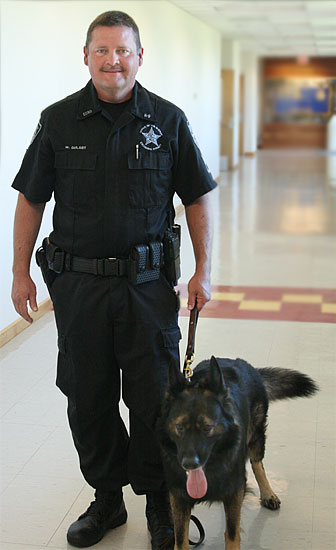
Pictured: Escambia County Sheriff’s Office Master Deputy Wayne Gulsby performs a drug dog search at Northview High School. NorthEscambia.com file photos, click to enlarge.
Molino Woman Charged With Child Abuse Hair Color Argument
February 17, 2011
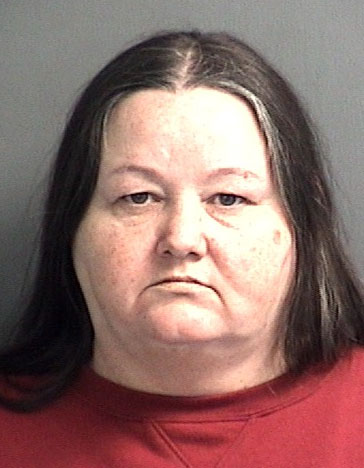 A Molino woman is facing a felony child abuse charge after allegedly getting into an argument with a relative over her hair color.
An Ensley man told Escambia County deputies that on January 18, he took his daughter to the Highway 97 home of his aunt, Cynthia Ann Cole, 51. It was the first time Cole had met her great niece, and she told the minor girl that her hair was too dark, according to the Sheriff’s Office report.
Cole then told the girl, “You can’t take a joke?” to which the girl replied “Sure can”, according to the arrest report. That’s when Cole allegedly got into the girl’s face and asked her to repeat herself. Cole, according to the report, then grabbed the girl by her hair, pulling it and pushing her down. Cole then allegedly swung at the father, who went outside to call police.
The girl told deputies that Cole then tried to choke her while the father was outside. Arriving deputies noted that the juvenile had scratches and marks on her throat consistent with being choked, and had a swollen black eye. She refused medical treatment.
A warrant was completed for Cole’s arrest. She was booked into the Escambia County earlier this week on the felony child abuse charge and released on $5,000 bond.
Escambia Accepts $1.84 Million BP Settlement
February 17, 2011
Escambia County has accepted $1,841,171 BP settlement for revenues lost in 2010.
The county commission approved the settlement Thursday night, while agreeing not to sue BP for any other revenue covered in the settlement agreement. The county is negotiating a second settlement with BP for about $400,000 to cover lost sales tax revenue.
The $1.84 million settlement will cover revenue lost by the county on toll fees during the 2010 fiscal year from the Bob Sikes bridge, local option sales taxes, local option gas taxes, tipping fees, electric franchise fees and natural gas franchise fees.
Order Boston Butts From The Tri-City Rotary Club
February 17, 2011
The Tri-City Rotary Club is taking orders now for Boston butts.
The six-pound average butts are $25 each, ready to eat or freeze. Orders are due March 1, with pick up on Friday, March 11 from 2-4 p.m. at the Escambia County Bank in Flomaton. Five or more butts will be delivered locally for free.
Orders should be placed by March 1 by calling Bo Brantley at (251) 236-1100, Robert Lasher at (251) 363-7100 or Bill Cox at (251) 296-5356. Or click here for a printable order form to fax.
The Tri-City Rotary Club serves Century, Flomaton, Jay and surrounding areas with community projects such as scholarships for high schools seniors and helping the needy.
Tax Increases: Shopping, Gas, Renting Even Dying Costing More In Atmore
February 17, 2011
Shopping, living, buying gas and even dying is becoming more expensive in Atmore thanks to new tax hikes.
The Atmore City Council has voted to raise many taxes and fees — including the city’s sales tax. Beginning April 1, sales tax will rise one percent — from 8 to 9 percent, along with increases in several other taxes:
- Atmore’s gas and fuel tax will jump from 2 cents to 3 cents.
- Lodging tax, such as that on motel and hotel rooms, will increase from 8 percent to 10 percent.
- Atmore’s rental tax on tangible items like vehicles, trailers and clothes will jump from 2 to 5 percent.
City officials said the higher taxes are needed in order to maintain city services despite money saving measures like purchasing used police cars and fire trucks.
The price of a lot in a city-owned cemetery was doubled, effective immediately, for residents within the police jurisdiction — from $450 to $900. For everyone else, cemetery lots are now $1,000. There’s also a $125 perpetual care fee, and a $100 burial permit fee.
NorthEscambia.com photos, click to enlarge.

Senate Rolls Out Pension Revamp, Draws Heat From Cops
February 17, 2011
The Senate rolled out its push to revamp city and state pension plans, drawing immediate pushback from the state’s largest law enforcement union.
New employees in both systems would be required to join 401(k)-style investment plans with the legislation clearly aimed at phasing-out traditional pension plans.
Base salary – no overtime or other compensation – would be used to determine an employee’s pension benefits, under both city and state plans, according to the two bills (SB 1128, 1130) filed late Tuesday by Sen. Jeremy Ring, D-Margate, chairman of the Governmental Oversight and Accountability Committee, which has been holding hearings on the pension overhaul.
The legislation is expected to be reviewed Friday during a workshop by Ring’s committee slated to span four hours.
Ring’s bill affecting the huge Florida Retirement System (FRS), would require still-to-be-determined contributions from the plan’s 655,000 government employees, mostly county school district members.
State analysts have said 5-percent employee contributions would save $1.3 billion, helping lawmakers patch a budget shortfall topping $3.6 billion. The level of funding also would come close to the $1.4 billion property-tax cut Gov. Rick Scott has promised over the next two years.
Scott has offered his own proposal to revamp the Florida Retirement System, including at least some of the provisions outlined by Ring. In another cost cutting measure, both Scott and Ring would bar employees hired after July 1 from joining the state’s lucrative Deferred Retirement Option Plan (DROP).
The House hasn’t unveiled legislation yet, although House Speaker Dean Cannon, R-Winter Park, and other leaders have called for overhauling public pensions to reduce the growing financial liability faced by the cash-strapped state and cities.
Matt Puckett, of the Florida Police Benevolent Association, which campaigned against Scott last fall, said a 5 percent contribution is “way too high for workers who haven’t seen any pay raise” since 2006.
Further, he said proposed changes to city police and fire pension funds are unnecessary. “These are local problems that can be fixed locally,” Puckett said.
The legislation eases requirements on municipalities that dollars accumulated under the insurance premium tax be used solely to cover enhanced pension benefits, a provision sought by the Florida League of Cities. Instead, the municipal pension bill (SB 1128) would allow cities to deploy this money to ease liabilities in city pension plans.
The legislation also would create a task force that could result in stricter standards for police and fire officers seeking disability payments as part of their pensions.
Kraig Conn, lobbyist for the Florida League of Cities, said the league “supports the direction” of Ring’s municipal pension bill. He predicted, though, there would be resistance from cities to the requirement that new hires go into 401(k) plans and not be covered by traditional pensions.
By John Kennedy
The News Service of Florida
Traffic Delays Begin On Hwy 29 At Burgess
February 17, 2011
A potential delay on your commute to and from Pensacola the next couple of days — weather permitting; Anderson-Columbia will begin paving at the intersection of Highway 29 and Burgess Road Thursday and Friday.
The outside, northbound lane on Highway 29 will be closed to traffic between 9 a.m. and 3 p.m. each day. This work is part of the intersection improvement project to construct a northbound, right turn lane off Highway 29 onto Burgess Road.
Motorists are reminded to use caution and obey the posted speed limit when traveling through the work zone, according to the Florida Department of Transportation.
Bratt Students Awarded In PTA Reflections Art Program
February 17, 2011
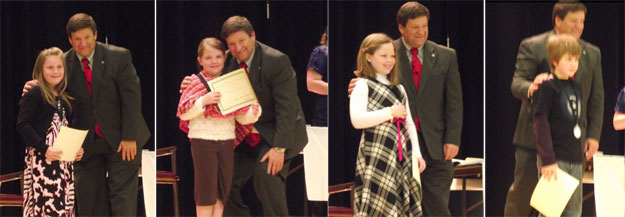
Five Bratt Elementary School students were awarded during the annual PTA Reflections Art Program recently in Pensacola.
Winners were: Madison Peterson, second place musical composition; Savannah Doremus, second place dance choreography; Amber Gilman, first place photography; Gracen Brooke, second place photography; and Landon Chavers, second place photography. Each received a medal and certificate presented by Escambia County School Superintendent Malcolm Thomas.
Pictured top: Bratt Elementary students receive their PTA Reflections Art Program awards from y Escambia County School Superintendent Malcolm Thomas. Pictured below: (L-R) Madison Peterson, Savannah Doremus,Amber Gilman, and Gracen Brooke. Not pictured: Landon Chavers. Submitted photos for NorthEscambia.com, click to enlarge.

Arrest Made: Auburn Toomer’s Corner Oaks Poisoned, Unlikely To Survive (With Radio Show Caller Audio)
February 16, 2011

Auburn University confirmed Wednesday that an herbicide commonly used to kill trees was deliberately applied in lethal amounts to the soil around the Toomer’s Corner live oaks on campus, and there is little chance to save the trees.
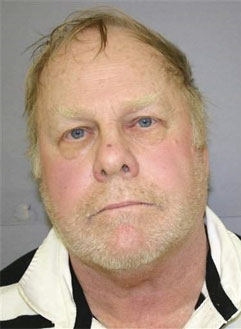 The Lee County Sheriff’s Department arrested Harvey Almorn Updyke Jr., 62, Thursday morning and charged him with a felony count of criminal mischief in the first degree. Updyke, according to the Lee County Sheriff’s Department, is a unemployed resident of Dadeville, Ala. Updyke, who attended Milton High School, was being held on $50,000 bond.
The university learned that a caller to The Paul Finebaum Show, a nationally syndicated radio show based in Birmingham, on Jan. 27, claimed he had applied the herbicide. (Click at bottom of page to listen to audio.) As a precaution, soil samples were taken the next day and sent to the Alabama State Pesticide Residue Laboratory on campus for analysis. Due to a small fire that occurred in the Alabama lab in December, the tests were sent to the lab at Mississippi State University in Starkville, Miss., to expedite results.
The City of Auburn Police Division is investigating the situation, and the application of this herbicide, known as Spike 80DF, or tebuthiuron, is also governed by state agricultural laws and the Environmental Protection Agency. The university does not use Spike herbicide.
The lowest amount detected was 0.78 parts per million, described by horticulture experts as a “very lethal dose.” The highest amount detected was 51 parts per million, or 65 times the lowest dose. Experts believe a normal application by itself would have been enough to kill the trees, which are estimated to be more than 130 years old.
 “We are assessing the extent of the damage and proceeding as if we have a chance to save the trees,” said Gary Keever, an Auburn University professor of horticulture and a member of Auburn’s Tree Preservation Committee. “We are also focused on protecting the other trees and shrubs in Samford Park. At this level the impact could be much greater than just the oaks on the corner, as Spike moves through the soil to a wide area.” Additional tests are being completed to determine the movement and extent of the area affected, Keever said.
The removal process involves digging trenches and applying activated charcoal to absorb the herbicide from the soil and block its progress. A representative from Dow Chemical, which manufactures the herbicide, is advising the university on removal procedures, and expert horticulturalists are also being consulted.
 “We will take every step we can to save the Toomer’s oaks, which have been the home of countless celebrations and a symbol of the Auburn spirit for generations of Auburn students, fans, alumni and the community,” said University President Jay Gogue.
Gogue asked members of the Auburn Family to “continue to be ‘All In’ in upholding its reputation for class” and not allow anger to be expressed inappropriately or undeservedly.
“It is understandable to feel outrage in reaction to a malicious act of vandalism,” Gogue said. “However, we should live up to the example we set in becoming national champions and the beliefs expressed in our Auburn Creed. Individuals act alone, not on behalf of anyone or any place, and all universities are vulnerable to and condemn such reprehensible acts.”
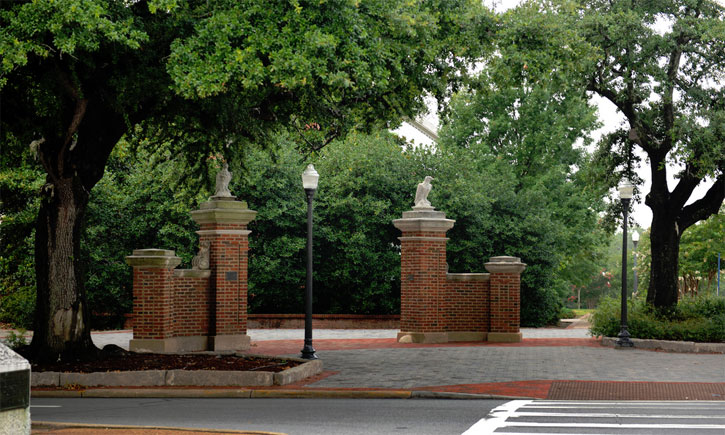
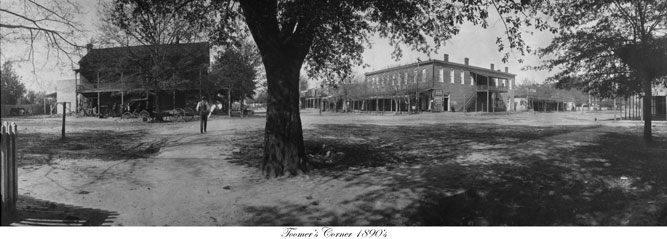
Pictured top: Toomer’s oaks rolled after the BCS Championship Game. Pictured inset: The Toomer’s oaks today. Pictured bottom inset: Toomer’s corner in the 1890’s. Courtesy photos for NorthEscambia.com, click to enlarge.
Scott Rejects $2.4 Billion In Federal Funding For Florida High Speed Rail
February 16, 2011

Saying the government cannot spend more than it takes in, Gov. Rick Scott on Wednesday rejected the federal government’s $2.4 billion offer to bring high speed rail to Florida saying the ridership studies don’t support an effort that he says is not in the best interest of the state.
Speaking to reporters at a hastily called news conference, Scott blasted the Obama administration specifically and federal government in general for spending policies that make the United States and Florida uncompetitive.
Scott, who has always been wary of funding the Tampa to Orlando project, had said recently he would consider letting it go forward if private money could be found to match the federal effort. If the project were to operate in the red, Florida would be on the hook, Scott said.
Federal officials and state lawmakers plotted an uncertain path to revive high speed rail in Florida Wednesday after Gov. Rick Scott rejected $2.4 billion that was on the table for a Tampa-to-Orlando bullet train with little notice.
Scott joined newly-elected Republican governors in two other states in rebuffing President Barack Obama’s effort to build a nationwide network of trains, leaving U.S. House Transportation Committee Chairman John Mica of Orlando looking for a plan B.
“We haven’t raised the white flag of surrender on the project,” Mica said in a conference call. “We’re going to explore every option, the secretary (of transportation) said he would review all of his options. But at this particular point, quite frankly I don’t know what they are.”
The bewilderment ran from the nation’s capitol to Tallahassee, when Democrats and quite of few of Scott’s fellow ruling Republicans fumed that the new governor had left them in the dark in his decision to turn out the lights on the long-sought high speed rail project. The chairman of the Senate Transportation Committee, Sen. Jack Latvala, said that he spoke with Scott yesterday, at the governor’s request, and he was not informed of the decision.
“I didn’t get any notice of it,” a clearly disappointed Latvala, R-St. Petersburg, told the News Service of Florida. “I’m disappointed because I was in his office…discussing transportation issues and I had no idea this was coming nor did he ask for my opinion.”
Like Mica, Latvala said the Legislature would explore its options for reviving the off-again, on-again, off-again train, though he said Scott was within his right to reject the money.
“The implementation is in the department (of transportation),” he said. “We appropriated about $300 million for the project. He can choose not to spend it.”
Though governors in Wisconsin and Ohio made splashy announcements when they rejected rail money shortly after winning office in November, neither of those states were offered 90 percent of the projected cost of their proposed trains like Florida was for its Tampa to Orlando line. That made Scott’s decision the highest profile rejection yet of the White House’s push to get the country on board with rail, and other states quickly began jockeying for the money.
The most likely recipient is California, which was the only state that topped Florida’s award in federal rail money over the last two years.
But Mica said that the Florida Congressional Delegation was going to see if they could stop that from happening.
“The (U.S. transportation) secretary and I have decided to look at our options, by end of the week and soon as the highly paid folks analyze them,” a new plan will be formed, Mica said.
The timing of Scott’s announcement clearly caught lawmakers in Washington and Tallahassee off-guard, but it was a decision he has hinted at since taking office in January. Making it official Wednesday, Scott said he just thought it was too risky for Florida taxpayers to let the train roll.
“As you know, my background is in business, not politics. But you don’t have to be economic experts to understand if you spend more than you take in, you will fail,” Scott said in a hastily-arranged news conference. “Government has become addicted to spending beyond its means, and we cannot continue to do that, in Washington or in Tallahassee.”
“President Obama’s high speed rail program is not the answer for Florida’s economic recovery,” Scott continued. “The answer is to reduce government spending, cut government’s reach on our state’s job creators and then hold that government accountable for the investments it makes. That is what I was elected to do…and that’s how I’m going to govern the state of Florida.”
Scott said three factors made him put the brakes on the rail project, including the potential for construction cost overruns, which he said could put the state on the hook for $3 billion dollars. Also problematic, Scott said, is that train ridership and revenue estimates have been historically overly optimistic and the fact that Florida would have had to return the money to Washington if it decided at a later date to stop the project. Scott noted that the existing Tri-Rail commuter train in Broward, Miami-Dade and Palm Beach counties receives subsidies from the state.
“I believe the risk far outweighs the benefits,” Scott said. “My job is to represent the taxpayers of this state, and I’m not comfortable that this project we ought to be doing, it’s not a project that I’m comfortable is going to get return for the investors and I represent the investors of Florida, the taxpayers.”
Democrats nationally and in Florida sharply criticized Scott’s decision as being short-sighted.
“If Florida would’ve had a governor who rejected President Eisenhower’s idea, we wouldn’t have an interstate system,” U.S. Sen. Bill Nelson, D-Fla., who has been vocally supportive of the project even as conservatives attacked him for it, said via Twitter Wednesday afternoon.
“Since taking office, the governor has done a great job at shutting down transportation projects which would have kept employed or put to work thousands of Floridians,” Florida Senate Democratic Leader Nan Rich, D-Westin, said in a statement. “The decision to reject Washington’s offer to return billions in our tax dollars to pay the bulk of a high speed rail project between Orlando and Tampa being the latest. ‘Let’s get to work’ is starting to ring hollow in the face of a resilient 12 percent unemployment rate.”
Scott’s decision is likely to play well with the tea party movement in Florida that powered his political rise, but another key element of the Republican establishment has vocally backed the project: the state’s business lobby. One of the state’s main business advocacy groups, Associated Industries of Florida, pushed lawmakers to pass legislation in special session in 2009 that enabled the construction of another train in Orlando, SunRail, to show federal transportation officials they were serious about rail. The organization carefully chose its words to express its disappointment in Scott’s decision, but ultimate support of the governor.
“While Associated Industries of Florida has been a proponent of bringing high speed rail to Florida, and was hopeful we could do so with the backing of private-sector investment, we understand and respect Gov. Scott’s decision to reject the Tampa to Orlando project,” AIF President Barney Bishop said in a statement. “Given these tough economic times and a past culture of deficit spending, we recognize that Floridians do not have an open checkbook and we as a state cannot afford to operate on credit.”
The rejection from the new governor was another big blow to a project that is well on its way to having as many lives as any cat in Florida. A high speed train connecting central and South Florida was originally placed in the Florida Constitution by voters in 2000, but it was removed by the same electorate in 2004 after a successful campaign backed by former Gov. Jeb Bush, who argued the state could not afford it.
Backers had hoped that the promise of most of the money being paid for by the federal government would be enough to really get the train rolling this time, but by Wednesday, proponents of the plan were making comparisons to sinking boats.
“The ship has taken on a broad side hit,” U.S. Rep. Mica said. “It hasn’t sunk. It has taken on a lot of water. We’re seeing if the vessel can be salvaged.”
Supporters said the train could have begun running in 2015. As recently as last week, state transportation officials were telling a Florida House committee that they were optimistic the federal government might provide up to 80 percent of a second leg of the train from Orlando to Miami that was projected to be even more costly than the central Florida portion.
But Scott was never a believer.
“Here’s my experience in business: if you enter into a project where it’s not a good transaction for the other side, it always come back to be a problem for you,” he said. “You look at ridership studies; I don’t see any way anyone’s going to get a return, so I’m very concerned about the Florida taxpayers.”
Pictured: Gov. Rick Scott speaks to reporters Wednesday shortly after notifying U.S. Transportation Secretary Ray LaHood that he would reject $2.4 billion in federal money to build a high speed rail system in the state. Photo by Michael Peltier for NorthEscambia,com, click to enlarge.