

Cantonment Farmer’s Market Seeking Vendors
March 27, 2012

The Market at St. Monica’s is now accepting applications from vendors for another season.
The market will be held on the first and third Saturday of each month, May through October, at Saint Monica’s Episcopal Church at 699 South Hwy 95A in Cantonment.
Any vendor wishing to sell produce, plants, crafts or other items may obtain market rules and an application at www.st-monicas.org/market.html or by calling the church office at (850) 937-0001. The normal vendor fee is a cash or food donation to the Manna Food Pantry.
The all-volunteer ran farmer’s market was launched in May 2011 on an 8-acre site. The Market at St. Monica’s will celebrate its grand re-opening on Saturday, May 5 with a Cinco de Mayo theme.
Organizers said the purpose of The Market is to connect residents of the community with local farmers and producers dedicated to producing high-quality produce, crafts and other products.
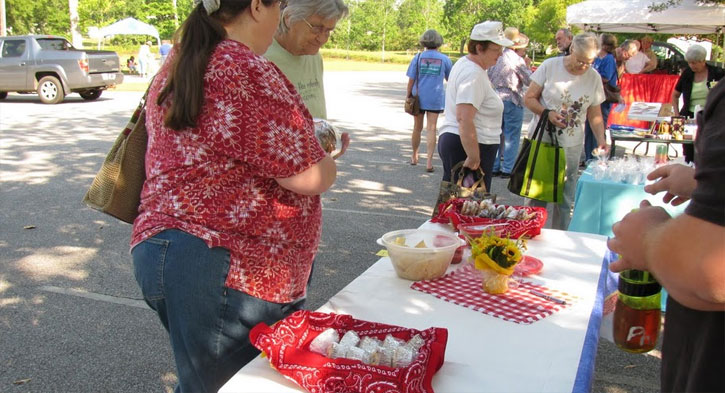
Pictured: Scenes from last year’s Market at St. Monica’s in Cantonment. NorthEscambia.com file photos, click to enlarge.
New Florida Senate Maps Headed For Passage
March 27, 2012
The Legislature’s second shot at drawing new districts for the state Senate is on the cusp of passing the House as early as Tuesday, setting up the next stage in the once-a-decade process of crafting Florida’s political boundaries.
Republican and Democratic leaders said Monday that they would likely go ahead and vote on the new Senate map on Tuesday, finishing up an extraordinary session called to address a Florida Supreme Court ruling nullifying the plan. This marks the first year justices reviewed the plans under the anti-gerrymandering Fair Districts amendments, approved by the voters in a November 2010 referendum.
The House, which saw its map initially approved by the court, is expected to defer to the Senate and give the plan the go ahead, at which point the Supreme Court will again review the Senate proposal.
In a likely preview of the floor fight, the plan (SJR 2-B) passed the House Redistricting Committee on a party-line, 13-7 vote Monday. Republicans hailed the plan as a better attempt at following the Fair Districts plan than the upper chamber’s last effort.
“The Senate responded to what the court asked and it’s time to send this map on to the court,” said Rep. Ritch Workman, R-Melbourne.
Democrats were less impressed, saying that the Senate map still seemed to be aimed at protecting incumbents while pretending to comply with the new standards. They pointed out that only two incumbents appeared to be headed for a primary challenge under the Senate plan.
“While it is better, I’m not quite sure if it gets us over the hump at the Supreme Court,” said Rep. Evan Jenne, D-Dania Beach.
Jenne offered his own plan, then withdrew it before a committee vote but promised to bring it back when the measure hits the House floor. That proposal would apparently give the GOP a smaller edge in the upper chamber; Gov. Rick Scott would have carried 22 of the 40 Senate districts in 2010 under Jenne’s proposal to the 18 won by Democratic CFO Alex Sink, though she would have carried one of the seats by less than 1 percent.
Scott would have won 25 districts to Sink’s 15 under the Senate proposal.
Even Jenne admitted that his plan, drawn with the help of Tallahassee Community College student Ryan Terrell, had little chance of passing the House and was aimed more at showing the Supreme Court another alternative, should justices choose to scrap the second Senate map and draw their own.
“If Republican members were allowed to vote the way they want to vote, I think the Jenne amendment would have an excellent chance of passing,” said House Minority Leader Ron Saunders, D-Key West.
All sides agree that the House is likely to do little more than approve the Senate plan, barring any unforeseen problems. Rep. Erik Fresen, R-Miami, said some members of his county’s delegation were likely to raise concerns about the lack of a fourth district in Miami-Dade likely to elect a Hispanic senator.
But he also tamped down expectations that the concerns raised by members like House Majority Leader Carlos Lopez-Cantera, R-Miami, would lead to an amendment that could break the “gentlemen’s agreement” between the two chambers.
House Redistricting Chairman Will Weatherford, R-Wesley Chapel, said he was also working to ease the concerns of lawmakers with problems about the map — including Lopez-Cantera.
“Whenever you’re drawing maps, there’s always going to be concern,” he said. “Nobody ever gets what they want and that’s kind of part of the process.”
By The News Service of Florida
Supreme Court Rejects Big Tobacco Apeals, Including Escambia Case
March 27, 2012
The U.S. Supreme Court on Monday refused to take up appeals of four Florida lawsuits that will force R.J. Reynolds Tobacco Co. to pay tens of millions of dollars to the families of dead smokers.
The cases, part of a flood of tobacco litigation moving through Florida’s courts, were the first of their kind to reach the Supreme Court. One of the cases involved a $28.3 million judgment in an Escambia County case, while another totaled $15.75 million in an Alachua County case.
John Mills, an attorney who worked on the $15.75 million case stemming from the death of Arthur Hall, described R.J. Reynolds’ appeals to the U.S. Supreme Court as a “last gasp.” While the company could seek a rehearing, Mills said that has little chance of success.
“As to whether these judgments have to be paid, it’s over, it’s final,” he said.
Robert Peck, a Washington attorney who represented plaintiffs in the Supreme Court in two of the cases, said justices did not explain their reasons for turning down the appeals.
That leaves questions about how the decisions could affect thousands of other Florida sick-smoker cases that have become known as the “Engle progeny” cases.
The Florida Supreme Court ruled in 2006 that such cases should be heard individually instead of as a class action. But the ruling also established critical findings that could be used in the cases — such as establishing that cigarettes cause a wide range of diseases, that nicotine in cigarettes is addictive and that tobacco companies concealed information about the health effects of smoking.
Tobacco companies have argued that the Engle findings are not being applied properly to individual cases. For example, R.J. Reynolds argued in state court that plaintiffs’ attorneys in the $28.3 million judgment were not required to prove that dead smoker Benny Martin relied on deceptive advertising about the dangers of smoking.
“The Supreme Court’s decision today does not represent a ruling on the merits of Reynolds’ constitutional argument,” Jeff Raborn, vice president and assistant general counsel for R.J. Reynolds, said in a prepared statement Monday. “We remain confident in our position that the Florida courts’ use of general findings in one case to establish specific claims in subsequent cases violates our bedrock constitutional rights.”
Jim Gustafson, a Tallahassee-based attorney whose firm has filed more than 400 lawsuits against tobacco companies, said he expects the industry to continue appealing Engle-progeny cases to the U.S. Supreme Court.
“They are genetically incapable of taking their medicine,” said Gustafson, whose firm, Searcy, Denney, Scarola, Barnhart & Shipley, represented the surviving husband of smoker Betty Jean Campbell in one of the cases decided Monday.
R.J. Reynolds last year included what is known as an “accrual” in its third-quarter financial statement to account for the possibility of having to pay $53 million in damages in the lawsuits and another $11 million in attorneys’ fees and interest. That came after the Florida Supreme Court also turned down its appeals in the cases.
The most closely watched of the cases has been the $28.3 million judgment for Mathilde Martin, the widow of Lucky Strike smoker Benny Martin who died of lung cancer in 1995. The judgment includes $3.3 million in compensatory damages and $25 million in punitive damages.
While an Alachua County jury approved the $15.75 million judgment for Amanda Jean Hall, the widow of smoker Arthur Hall, the other two cases stemmed from Escambia County.
In one, R.J. Reynolds, was ordered to pay $6.2 million to Carolyn Gray, the widow of Charles Robert Gray. The company also would have to pay most of the $3.35 million verdict in an Escambia County case filed by Franklin Campbell in the death of his wife, Betty Jean. Cigarette makers Philip Morris USA and Liggett Group also would have to pay small parts of that judgment.
By The News Service of Florida
Flomaton ‘Canes On 12-Game Winning Streak
March 27, 2012
The Flomaton Hurricanes beat the Excel Panthers 10-4 Monday.
James Dean got the win for the Hurricanes and Chazhn Taylor took the lose for the Panthers. The ‘Canes are now 13-3 and are on a 12-game winning streak.
Flomaton’s next game is at home against the T.R. Miller Tigers Tuesday. The junior varsity begins at 4:00, and the varsity steps up the plate at 6:00.
Batting
Andrew Cash 1-4 1B
Hunter Bonds 1-4 RBI 2 runs
James Dean 2-4 2B, 3B 2RBI 1 run
Zack Watson 2-4 1B, 2B 2RBI
Jacob Newton 1-3 2B 1 run SB
Tyler Dove 2-4 HR, 3B 2RBI 2 runs
Cody Nolan RBI SB
Joseph Parker 1-1 2 runs
Pitching
James Dean 4IP 3ER 4K 7 hits allowed
Tyler Harris 3IP ER 3K 1W 2 hits allowed
New Restaurant Coming To Atmore
March 27, 2012

Construction will soon begin on a new restaurant in Atmore.
Waffle House will open later this year at the Rivercane development at I-65 and Highway 21. It will join McDonald’s, Hardee’s, Holiday Inn Express and Hampton Inn in the city’s 740 acre development adjacent to the Wind Creek Casino.
The Waffle House was announced at a Monday afternoon meeting of the Atmore City Council.
Supreme Court Health Care Arguments Begins With Tax Issue
March 27, 2012
In the first day of landmark hearings, the U.S. Supreme Court on Monday listened to arguments about whether a tax law should block a ruling on the constitutionality of the 2010 federal health overhaul.
The Obama administration and the Florida-led opponents of the federal Affordable Care Act agree that the tax law —- known as the “anti-injunction act” — should not short-circuit a ruling in the case. The anti-injunction act is designed to prevent legal challenges to taxes until after they have taken effect.
The federal health overhaul would impose financial penalties, which could be considered taxes, on people who don’t comply with a requirement that they have health insurance. But that requirement will not take effect until 2014, raising questions about whether it is premature for justices to rule on the constitutionality of the Affordable Care Act.
Gregory Katsas, an attorney for the opponents, said the tax law does not bar justices from ruling on the broader issues.
“The purpose of this lawsuit is to challenge a requirement — a federal requirement to buy health insurance,” Katsas said, according to a transcript of the hearing. “That requirement itself is not a tax. And for that reason alone, we think the anti-injunction act doesn’t apply.”
U.S. Solicitor General Donald Verrilli made a similar argument. “This case presents issues of great moment, and the anti-injunction act does not bar the court’s consideration of those issues,” Verrilli said.
But attorney Robert A. Long, who argued that the anti-injunction act applied, said the act is a central part of tax litigation and requires that “you must pay the tax first and then litigate. That’s the baseline.”
Justices repeatedly questioned the attorneys during the 89-minute hearing but likely will not rule on the issue for months.
The court will move Tuesday into the main event of the hearings — whether the insurance requirement, known widely as the “individual mandate” — is constitutional. The hearings will end Wednesday, with arguments about the constitutionality of part of the Affordable Care Act that would expand Medicaid.
By The News Service of Florida
Drive-by Nets 20 Years For Repeat Offender
March 27, 2012
An Escambia County man was sentenced Monday to 20 years in state prison under the 10-20-Life law.
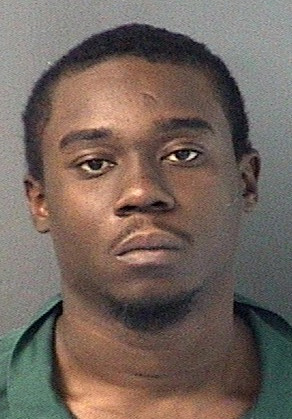 Tarrence Dwayne Webb received the sentence after being convicted in February 2012 of three counts of aggravated battery with a firearm, one count of aggravated assault with a firearm and one count of shooting into an occupied vehicle.
Webb was sentenced in his part in a triple shooting on November 3, 2011, at The Fast Link on Cerny Road. The victims drove themselves to a crowded Publix shopping center on Mobile Highway.
Two 19-year old victims were shot in the hand, while a male about 19-years old was hit in the head. Two other people in the vehicle were not injured as gunfire shattered the car’s windows.
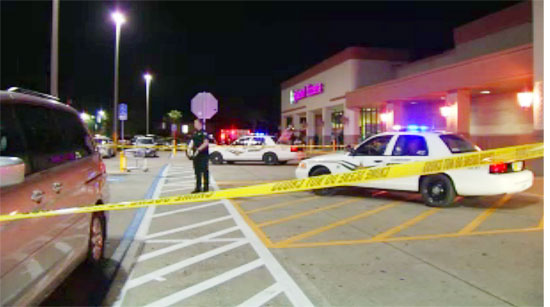
Pictured top: Three men shot in a drive-by shooting drove themselves to this Publix store on Mobile Highway on November 2. Photo courtesy WEAR TV for NorthEscambia.com, click to enlarge.
Flippin’ For A Cure Pancake Breakfast To Benefit Relay
March 27, 2012
The Atmore Community Hospital Relay for Life team will be “Flippin’ For a Cure” Saturday with an all you can eat pancake breakfast.
The breakfast will include endless pancakes, with a side of sausage, juice and coffee. The event is $8 for adults, $5 for children 10 and under. The breakfast will take place from 6:30 a.m. until 10 a.m. at Nan’s Main Street Grill (the former Pintoli’s) in downtown Atmore.
Florida Special Olympics Torch Run Begins In Century (With Gallery)
March 26, 2012
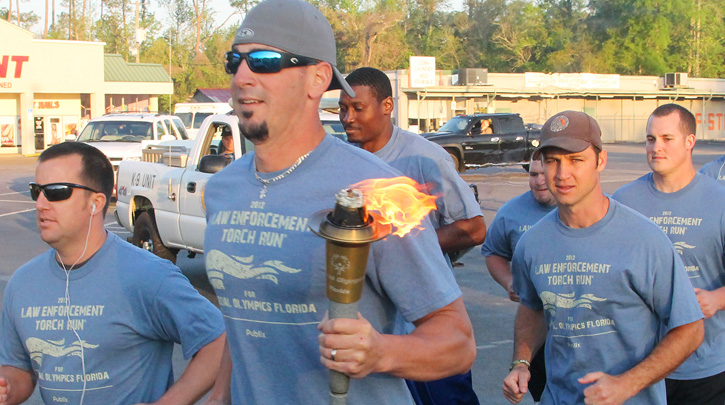
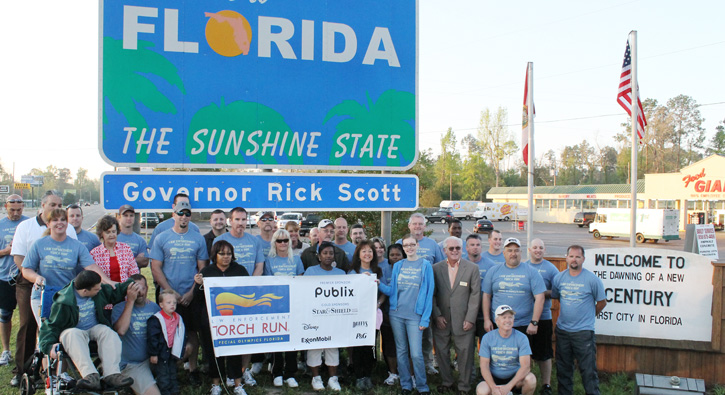
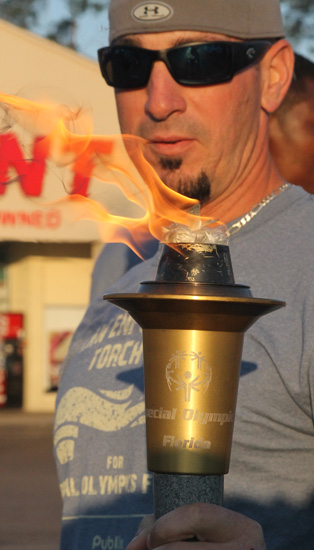 The 2012 Law Enforcement Torch Run in support of Florida Special Olympics began in Century Monday morning.
The torch run started at the Florida/Alabama state line in the Food Giant parking lot about 7:15 Monday. Employees from Century Correctional Institution escorted the torch down Highway 29.
The Law Enforcement Torch Run is an event to raise awareness and support for the Special Olympics.
Law enforcement officers from over 300 Florida agencies (police departments, sheriff’s offices, Florida Department of Corrections, Florida Department of Law Enforcement, Federal Bureau of Investigation, Drug Enforcement Agency, U.S. Customs, Air Force Police and Marine Patrol) all participate in the state-wide torch run to benefit the athletes of Special Olympics Florida. Each year, over 5,000 officers carry the torch on a 1500-mile relay through 66 counties in Florida.
For a photo gallery from the start of the run, click here.
Pictured: The 2012 Law Enforcement Torch Run in support of Florida Special Olympics begins in Century Monday morning. NorthEscambia.com photos, click to enlarge.
4-H Kids Vote Delayed On Sale Of Langley Bell To Navy Federal
March 26, 2012
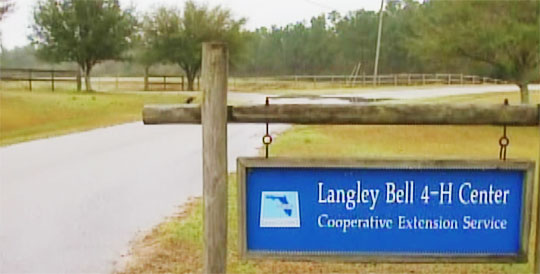
It will now likely be April or even later before the youth of Escambia County 4-H vote on a multimillion dollar offer from Navy Federal Credit Union for the Langley Bell 4-H Center in Beulah.
A definite date for the vote has not yet been set as the 4-H group works to get more answers to their questions about the land sale to Navy Federal and land swap with the county.
Under the Langley Bell 4-H Center property deed, the children that make up the 4-H County Council must approve any sale of the 240 acres.
Navy Federal has offered $4.5 million for the property, plus Escambia County is willing to spend $1.5 from local option sales tax monies to build the 4-H’ers a new facility at the Escambia County Extension Office on Stefani Road in Cantonment. The facility would include a new building and pond on the 23-acre parcel.
Navy Federal has said that if the sale is rejected, new jobs for the company in Escambia County would be difficult. The company is adding about 400 jobs per year, soon reaching capacity at their current 65-acre campus.
At a late February meeting, many 4-H members made it clear they were not immediately sold on the ideal of selling the property.
Escambia County Commissioners are trustees of the land, according to the deed. Commissioners could possible overrule the 4-H Council should they vote against the land sale, but that’s not totally clear.
4-H supporter Dr. M. Langley Bell, Jr. donated 400 acres to Escambia County for the Langley Bell 4-H Center. The center, which is now 240 of the original 400 acres, is used for events such as 4-H camps, retreats, timber projects, livestock projects, and as a meeting site for extension agents. The Langley Bell 4-H Center comprises about 240 acres of the original 400 acres. Four cabins, a kitchen, meeting hall, nature trails, forestry and livestock educational areas, barns, pastures, a 5-acre lake, and a campfire circle are part of the 4-H center’s learning environment.
Pictured top: Navy Federal wants to purchase the The Langley Bell 4-H Center and their 240 acres in Beulah. NorthEscambia.com file photo, click to enlarge.