

Job Fair In Pensacola: 1,900 Openings At Ingalls Shipbuilding
November 5, 2012
Workforce Escarosa will hold a job fair Thursday in Pensacola to assist Huntington Ingalls Industries with the current recruitment and hiring of over 1,900 positions for their Pascagoula, jobsite.
 Position openings include; welders, pipefitters, shipfitters, hydraulic and sheetmetal mechanics, mobile crane operators and helpers. Positions range between $13.68 and $23.10 per hour.
Individuals with correlating experience and credentials may apply in-person on Thursday, November 8, from 8 a.m. until 2 p.m. at the Workforce Escarosa Pensacola One-Stop Center located at 3670 North L Street. Applicants should bring a resume, related credentials or certifications, and a valid driver’s license. Prior military should also bring a copy of their DD214. Representatives from Huntington Ingalls Industries will be on-site and may choose to conduct interviews with selected applicants during the hiring event.
Huntington Ingalls Industries (HII) designs, builds and maintains nuclear and non-nuclear ships for the U.S. Navy and Coast Guard while also providing after-market services for military ships around the globe. HII employs over 38,000 individuals throughout the U.S. with primary business divisions in Virginia and Mississippi. Daily van pools from Pensacola to Pascagoula are available for those who do not wish to relocate.
Additional information and job descriptions are available on the Employ Florida Marketplace, www.employflorida.com, under job order 9720937.
Down To The Wire For Florida Women’s Vote
November 5, 2012
There’s a difference between how women and men decide who to vote for – but it’s not really clear just how big the difference is. Women favored Barack Obama by double digits earlier in the campaign, but Mitt Romney has erased that lead since shortly after the first presidential debate, in early October.
Now, in the dash to the finish line, the race has tightened in Florida yet again, and women may well tip the balance.
The key to winning the state is suburban women who voted for Obama in 2008 but went Republican in 2010, suggests political scientist Susan MacManus of the University of South Florida.
“That group is really the big question mark, and if they swing towards Romney, he will probably win Florida,” said MacManus. “And if they can be brought back in by the Obama campaign, then he may have a good shot at the state.”
Obama’s time in Florida has been cut short by Hurricane Sandy’s assault on the East Coast, but on Friday the president was represented by arguably his best surrogate – former President Bill Clinton, who barnstormed five cities statewide. Romney’s backers have also been heavily active in Florida in recent weeks – with polls showing him slightly ahead of Obama in the nation’s biggest swing state.
While the Obama campaign has tried to suggest that Republicans are out of touch with values many women care about, women who back Romney have said that Obama is out of step with broader American values.
“We know the difference between taking care of the poor and the needy the way we’ve been taught in the Bible and the consequences of socialist programs,” said Beatriz Macia, president of the Tallahassee Tea Party at a “Women for Romney” rally last month at the Capitol.
Women vote differently from men, said MacManus. They have less tolerance for negative campaigning, and they tend to be late deciders. But in Florida’s 2008 presidential election, women out-voted men by 597,000, the largest gap among battleground states – so the candidates have courted them.
Although both sides say the economy is the main thing for all voters this year – including women – they disagree on how much so-called “women’s issues” are at play. Many Democrats say issues like abortion and access to contraception are driving women to their side. Republicans say those concerns are dwarfed by the economy for most women.
Retiring state senator Paula Dockery, R-Lakeland, said Democrats made a mistake by focusing more on abortion and contraception than pocketbook issues.
“I think the Democrats naturally do have a better position with women,” Dockery said. “But they have not stated that in the proper way in this campaign season, and that’s why you’ve seen the gap close.”
Congresswoman Kathy Castor, a Tampa Democrat, agrees that most women are focused on the economy, but pointed out that the first bill Obama signed as president was the Lilly Ledbetter Fair Pay Act, which was about how the economy effects women, and which Romney’s running mate, Congressman Paul Ryan, R-Wisconsin, voted against.
While Republicans argue that women suffer more in the economic downturn than men – and that Obama should be held to account for that – Democrats argue that it’s because they still aren’t paid the same wages for the same work.
Castor also noted that the election season has seen some provocative comments on violence against women, reproductive issues and access to contraception. She pointed to her House colleague, GOP Senate candidate Todd Akin of Missouri, who said women don’t get pregnant from “legitimate rape.”
And Indiana Senate candidate Richard Mourdock, a tea party favorite, became the center of a national firestorm when he said it was “God’s will” if a woman gets pregnant from having been raped.
“The Republican Congress and now Mitt Romney’s Republican platform take a hard right turn and say when it comes to women’s health and reproductive choice, women don’t have a say – and they have to carry pregnancies to term even in the case of rape and incest,” Castor said.
“I have a lot of moderate Republican friends who think that is too extreme.”
Not Carlie Rogers, a Republican state committeewoman from Brevard.
“I’ve met people whose mothers were raped,” Rogers said. “And when you see them, you know that (to give birth) was the right decision for that mother. So I think you shouldn’t make an exception. It’s not the child’s fault.”
Former Florida Chief Financial Officer Alex Sink, who narrowly lost to Gov. Rick Scott in 2010, is campaigning for Democrats statewide. She said she’s “very upset” to hear women quoted as dismissing the idea that birth control should be a campaign issue.
“Well, that is not so,” said Sink. “Women have to be very, very concerned when you have candidates out there saying things like, ‘Oh, Planned Parenthood? We’ll just get rid of that.”
Betty Castor, the first woman to serve in the Florida Cabinet (and the mother of Kathy Castor), said she thinks women are losing ground on issues they fought for decades ago.
“I think we’re going backwards,” she said. “It is a big fight. And of course, choice has always been a divisive issue – and it’s still a divisive issue. But I never thought that the issue of contraception would become front and center.”
MacManus said Obama’s ability to make up the gender gap depends on his campaign’s get-out-the-vote efforts.
“Much has been touted of their organizational superiority, the hundred-plus offices to less than 50 for Romney,” she said. “But late deciders in Florida tend to be young people and women. And consequently, Obama has still got a shot at the women’s vote.”
By Margie Menzel, The News Service of Florida
Vote 2012: A Look At The Florida Constitutional Amendments
November 4, 2012
Here is a synopsis of the proposed constitutional amendments on Tuesday’s ballot in Florida. The amendments must receive at least 60 percent of the vote to pass.
There is no Amendment 7.
AMENDMENT 1, HEALTH CARE SERVICES
THE AMENDMENT: This amendment is aimed at prohibiting the government from directly or indirectly compelling employers to buy or provide health care coverage for their employees. It also makes clear in the constitution that people may pay health care providers directly for care – and don’t have to have insurance, and can’t be forced to pay a penalty or tax for paying out of pocket for health care.
CONTEXT: Opponents say the proposal would have no effect at nullifying its intended target, the federal health care individual mandate, because of the supremacy of federal law over state law. Backers say it would prevent future attempts to put similar health care requirements on residents.
AMENDMENT 2: HOMESTEAD EXEMPTION FOR VETERANS
THE AMENDMENT: The proposal would provide an additional homestead exemption to wounded veterans who were not residents of the state when they entered military service. The proposal would exempt from taxation a property’s value between $50,000 and $75,000.
CONTEXT: Florida law already provides an additional homestead exemption to military personnel disabled while in combat. The amendment simply expands the exemption to disabled veterans who may have been residents of other states when the disability occurred but who now reside in Florida.
AMENDMENT 3: REVENUE LIMITATION
THE AMENDMENT: Proposed Amendment 3 would replace the existing state revenue cap, which is based on personal income growth in Florida with a new one based on inflation and population changes. If the state were to collect more in taxes than the formula allows, it would have to be put into a reserve fund, and not spent, and at some point would have to be used for reducing local property taxes for schools or returned to taxpayers. The cap could be raised only with a super majority vote in the Legislature.
CONTEXT: The state has never actually hit the current cap.
AMENDMENT 4: PROPERTY TAX RESTRICTIONS
THE AMENDMENT: The proposal would reduce the cap on tax assessment increases from 10 percent to 5 percent a year on commercial property. The plan also would provide an additional, temporary property tax break for first-time homebuyers and prevents tax assessments from going up when the market value of the property goes down.
CONTEXT: Backers say the amendment will continue efforts to rein in the increase in property taxes by expanding protections now afforded to homeowners. Opponents, including the Florida Association of Counties, say the measure will further hamstring cash-strapped local governments, which rely on property tax revenue for the bulk of their funding.
AMENDMENT 5: RULES FOR STATE COURTS
THE AMENDMENT: Proposed Amendment 5 would require Senate confirmation for state Supreme Court justices appointed by the governor make it easier for lawmakers to influence court procedural rules, allowing them to change them with a simple majority vote, rather than a super majority. The proposal also would give lawmakers more access to confidential files involving judges accused of misconduct.
CONTEXT: Many lawyers and judges who oppose the amendment say lawmakers are trying to assert more control over a judiciary that many Republican legislators think has surpassed its own authority too often.
AMENDMENT 6: ABORTION RIGHTS AND FUNDING
THE AMENDMENT: The proposal exempts abortion-related matters from protection under Florida’s Constitutional privacy clause, saying that the state constitution can provide only as much protection as the U.S. Constitution when it comes to abortion. The proposal also prohibits the use of state taxpayer funds to pay for abortions or insurance that covers abortions except in the case of rape, incest and when the health of the mother is in danger.
CONTEXT: Efforts by the state Legislature in recent years to place further restrictions on abortions have been overturned by the courts, which cite the Florida Constitution’s privacy clause. It was used, in particular, to nullify the state laws that required notice of parents before a minor gets an abortion, and consent of parents in the same situation. The constitution was subsequently changed to allow for parental notice – and those who oppose abortion rights say this would allow a new parental consent law. Supporters say the state should not provide protections beyond those afforded women under the U.S. Constitution, which contains no privacy clause. Critics say the proposal would affect more than abortion and strip away privacy clause protections for other issues surrounding women’s health and could be used as a precedent to whittle away other rights now protected under the state constitution’s privacy clause.
AMENDMENT 8: RELIGIOUS FREEDOM
THE AMENDMENT: If the amendment is approved, the government would be barred from denying funding to organizations or institutions based on “religious identity or belief.” The proposal also deletes the current constitutional ban on using state money “directly or indirectly in aid of any church, sect, or religious denomination, or in aid of any sectarian institution.”
CONTEXT: The amendment arises out of fears by backers of faith-based institutions, including prison ministries at the center of a court fight, that the current wording of the constitution could prevent state money from going to those groups. The issue is also embedded in the debate over school vouchers. While Florida’s main voucher program was rejected by the courts for other reasons, some backers of private religious schools fear students who attend them could be denied support because it could be deemed in aid of a sectarian institution.
AMENDMENT 9: TAX RELIEF FOR SURVIVING SPOUSES OF MILITARY/RESPONDERS
THE AMENDMENT: The proposal would provide additional property tax exemptions for the surviving spouse of a military veteran who died from service connected causes or while on active duty. The exemption, which could equal the entire assessed value, would also extend such benefits to surviving spouses of first responders such as firefighters, paramedics, corrections and law enforcement officer.
CONTEXT: The proposal – one of several aimed at recognizing the contributions made and risks taken by military personnel and first responders – had no public opposition. State economists said the proposal’s financial impact would be minimal, but it would reduce local tax collections.
AMENDMENT 10: RAISING TANGIBLE TAX EXEMPTION
THE AMENDMENT: Amendment 10, if approved, would increase the exemption on tangible personal property from $25,000 to $50,000.
CONTEXT: The proposal has the backing of small business groups, which say the tax is an unnecessary burden on small business owners. State economists say the proposal, if enacted would reduce local tax collections by at least $21 million a year beginning in2013.
AMENDMENT 11: ADDITIONAL HOMESTEAD EXEMPTION: LOW-INCOME SENIORS
THE AMENDMENT: The amendment would authorize the Legislature to allow counties and cities to grant an additional homestead tax exemption equal to the assessed value of homestead property if the property has a just value less than $250,000 to an owner who has kept a permanent residency at the property for at least 25 years, is at least 65 years-old and has a low household income, as defined by law.
CONTEXT: This measure would allow lawmakers to grant a new tax break to certain low-income seniors.
AMENDMENT 12: SUS BOARD OF GOVERNOR’S STUDENT MEMBER
THE AMENDMENT: The proposal would change the way the student member of the State University System’s Board of Governors is chosen. The new student member would be the chairperson of the Council of Student Body Presidents and not the president of the Florida Student Association. The proposal also requires that all universities be part of the council of student body presidents.
CONTEXT: Backers say the current system discriminates against state universities that are not part of the Florida Student Association.
Written by The News Service of Florida
Escambia Voter Turnout Already Near 40%, Over 42,000 Vote Early
November 4, 2012
Almost 40 percent of Escambia County voters have already cast their ballots in advance of election day.
Saturday was the final day of early voting with a record setting 6,745 ballots cast for a total of 42,832 during an eight day period. With early votes and absentee ballots received to date, Escambia County is already at almost 40 percent voter turnout.
The busiest early voting site was the Tryon Library with 15,748 votes cast, followed by Cantonment with 8,574.
Local Family, Army Sergeant And Working Dog Reunited
November 4, 2012
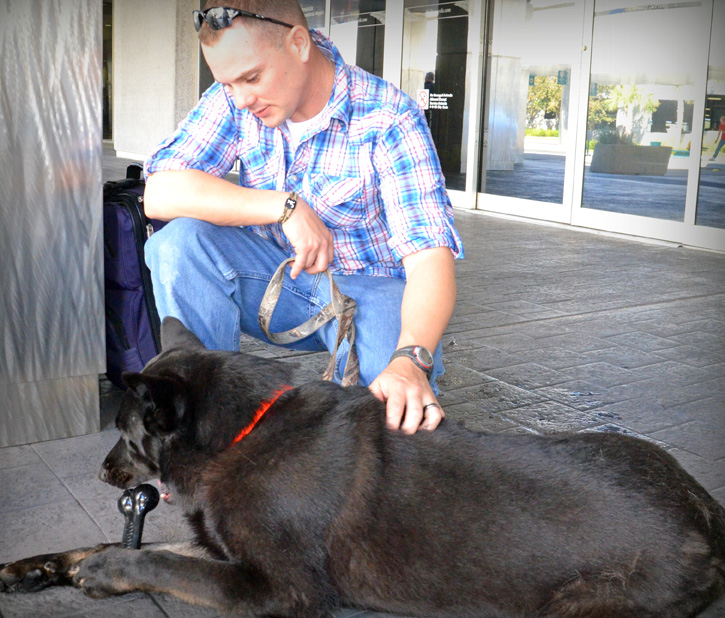
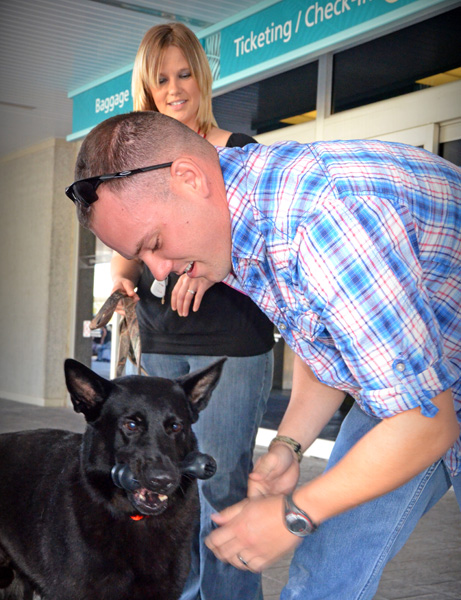
There was a special reunion Saturday at the Pensacola airport between a local family, an Army sergeant father, and a former Army service dog from half a world away.
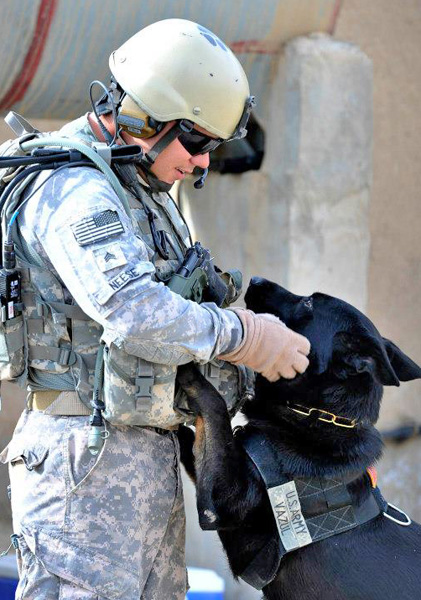
 Vazul is a six-year old German Shepherd who has served his life in the U.S. Army. He has served his country well, serving in Iraq at least twice and earning several honors as an explosives detection dog.
In 2008, Vazul was introduced to Sgt. Robert Neese of Cantonment at the Fort Polk Military Working Dog Section. Sgt. Neese and Vazul served a one year deployment together as a military working dog team in Iraq in 2009. In 2011, Sgt. Neese received a permanent change of duty station to Vicenza, Italy. He had to say goodbye to Vazul…..at least for the time being. The Neese family made it known that Vazul would have a home with them if he never needed one.
Vazul took a turn for the worse in June of 2012. He was diagnosed with degenerative lumbosacral stenosis and was given a life span of about three more years. His military working dog career was over, and he was placed for adoption.
Dr. Michael D. Ratcliff of the Fort Polk Veterinary clinic remembered the bond that Vazul shared with the Neese family and informed Sgt. Neese’s wife Leighann of Vazul’s situation.
 Leighann quickly agreed to the adoption, and Vazul had a new home.
“He is so special to us, and is a part of our family,” Leighann Neese said.
Saturday morning, Sgt. Neese arrived home for leave from Italy and was reunited with his former partner at the Pensacola International Airport.
Sgt. Neese and his family have selected an experienced military working dog surgeon in Italy, and they are raising funds to get Vazul the spinal surgery he needs to prolong his life and greatly improve his quality of health and living.
Donations can be made to the Paypal account leighann_neese@yahoo.com. Checks can be mailed to: Attention: Leighann Neese,For Vazul, P.O. Box 31, Cantonment, FL 32533.
Submitted and NorthEscambia.com photos by Kristi Smith, click to enlarge.

Photos: Blue Angels Homecoming Air Show At NAS Pensacola
November 4, 2012


Tens of thousands attend the Blue Angels annual homecoming show Friday and Saturday at NAS Pensacola’s Sherman Field.
For a photo gallery, click here.
NorthEscambia.com photos by Perry Doggrell and Kristi Smith, click to enlarge.

Weekend Gardening: Colorful Bedding Plants Can Brighten A Winter Day
November 4, 2012

Decreasing day length is a signal to start preparing for winter. Soon, deciduous shrubs will drop their leaves and the landscape will appear stark and less impressive. To keep the gloomy days of winter at bay, add cool season bedding plants to the landscape.
 Bedding plants are those that are commonly used in residential and commercial landscapes to provide color and interest. No other group of plants can so quickly and economically create a colorful landscape.
Most bedding plants are annuals. These short-lived plants grow from seed, bloom and die within one growing season. The transient nature of annuals means that at the end of their season when they are no longer attractive, annuals are removed and replaced with new plantings.
Many flowering plants prefer a very specific season; therefore, bedding plants are classified into two groups based on the temperatures they prefer. Cool season bedding plants do best in the cold to mild temperatures of October through early May and generally tolerate typical winter freezes without protection.
According to a University of Florida/IFAS publication, bedding plants that can be added to the North Florida landscape now include alyssum, baby’s breath, calendula, carnation, dianthus, dusty miller, foxglove, hollyhock, ornamental cabbage and kale, pansy, petunia, snapdragons and violas.
 Most annual bedding plants prefer to be in a sunny location. Prepare the planting beds several weeks before planting. First, remove any weeds or other unwanted plants from the bed. Next, turn the soil to a depth of about eight inches. Spread a two- to four-inch layer of compost, rotted leaves, aged manure, composted finely ground pine bark or peat moss over the bed, and then evenly sprinkle a light application of an all purpose fertilizer. Thoroughly blend the organic matter and fertilizer into the bed, rake smooth and you’re ready to plant.
Gardeners are accustomed to (and even demand) that bedding plants be in bloom when they are purchased. Some cool season bedding plants, however, will provide far superior results if they are purchased when young and before the colorful display begins.
Bedding plants are typically planted to make a dramatic statement. To accomplish that, place multiple plants of the same kind in a bed. Bedding plants generally look best and the beds will fill in better when the rows are staggered. Lay out the first row of plants spaced properly. The second row is laid behind the first row at the appropriate spacing from it, but the plants are placed between the plants of the first row so that they form triangles with those plants.
Flower beds of colorful bedding plants add a lot to the landscape but require a fair amount of maintenance to stay looking their best. Keeping beds well weeded is critical. A two-inch layer of mulch will help considerably in keeping weeds from growing, and using preemergence herbicides (weed preventers) may help in some situations. However, always plan on having to do some hand weeding.
Theresa Friday is the Residential Horticulture Extension Agent for Santa Rosa County.
Deadline for Conservation Assistance and Funding is Approaching
November 4, 2012
The USDA-Natural Resources Conservation Service (NRCS) in Florida is encouraging landowners, farmers and producers to visit their local NRCS office now to receive more information and apply for conservation technical assistance and possible cost share opportunities.
The application process for 2008 Farm Bill conservation programs is continuous, but funding selections are typically made once a year. The Florida NRCS application cutoff date for consideration for Federal Fiscal Year 2013 funds is November 16, 2012.
“Applications received after that date will be considered for future funding periods,” said State Conservationist Carlos Suarez. “We’re urging producers to contact their local service center as soon as possible to be considered for this year’s funding.”
NRCS works with landowners through conservation planning and assistance designed to benefit the soil, water, air, plants, and animals that result in productive lands and healthy ecosystems.
Cost share funding may be available to eligible applicants for the following Farm Bill programs:
The Environmental Quality Incentives Program (EQIP) is a conservation program that provides financial and technical assistance to farmers and ranchers who face threats to soil, water, air, and related natural resources on their land. Through EQIP, NRCS develops contracts with agricultural producers to voluntarily implement conservation practices. Persons engaged in livestock or agricultural production and owners of non-industrial private forestland are eligible for the program. Eligible land includes cropland, rangeland, pastureland, private non-industrial forestland, and other farm or ranch lands.
The Wildlife Habitat Incentive Program (WHIP) is a voluntary program for developing or improving high quality habitat that supports fish and wildlife populations of National, State, Tribal, and local significance. Through WHIP, the NRCS provides technical and financial assistance to eligible private and Tribal landowners for the development of upland, wetland, aquatic, and other types of wildlife habitat.
The Conservation Stewardship Program (CSP) is available on Tribal and private agricultural lands and non-industrial private forest land. CSP encourages producers to address resource concerns in a comprehensive manner by undertaking additional conservation activities; and improving, maintaining, and managing existing conservation activities.
NRCS encourages interested parties to visit with their staff as soon as possible. Applicants who apply early have more time to resolve any program or land eligibility issues, officials said.
The Escambia County Field Office is located at 151 Highway 97 in Molino (in the Escambia County Farm Bureau Building) For more information, call (850) 587-5404 ext 3, or visit www.fl.nrcs.usda.gov.
Florida Republicans Dominate Chase For Campaign Cash
November 4, 2012
In an advantage that could ripple through races statewide, the Republican Party of Florida has raised nearly $14 million since Aug. 10 — while the Florida Democratic Party has collected about $7.5 million, according to campaign-finance reports filed Friday.
The GOP, which totally controls state government, tapped major donors such as Florida Power & Light, which contributed $435,000, and Blue Cross and Blue Shield of Florida, which chipped in $425,000.
Democrats, meanwhile, received $535,000 from the Florida Education Association teachers union and $475,250 from Florida Justice PAC, a political offshoot of the Florida Justice Association trial-lawyers group.
The latest party totals, which covered the period from Aug. 10 until Thursday, widened a fund-raising gap that has been evident in campaigns across Florida. In all, the Republican Party has raised about $26 million this year, more than double the $10.8 million raised by Democrats.
That money provides a huge advantage, in part because it can be used to buy television ads and crank out mail pieces in competitive races. Also, the Republican Party has contributed tens of thousands of dollars directly to numerous legislative campaigns, including to some candidates and races that have drawn little attention or are not considered particularly competitive.
The parties, candidates and political committees faced a Friday deadline for filing campaign-finance information, giving a final glimpse of how — and where — money is flowing before Tuesday’s elections. Candidates and committees, which must disclose information more often than parties, provided reports detailing activity from October 13 to Thursday.
By Jim Saunders, The News Service of Florida
Pensacola To Canceled New York Marathon Runners: C’mon Down
November 4, 2012
After Superstorm Sandy left devastation in the northeast and canceled the New York Marathon, the Pensacola Marathon is inviting displaced runners to head to Pensacola.
“The Pensacola Marathon sends our thoughts and prayers to those affected by the storm. Pensacola and the Gulf Coast have experienced terrible, event changing storms as well, and are familiar with what the people affected are going through. We also know the importance of all the hard work and training the runners prepared for such an event,” local race officials said Saturday.
The Pensacola Marathon is opening slots in the ninth running of the Pensacola Marathon on November 11 for displaced New York Marathon runners.
The Pensacola Marathon, already at an all-time registration high, will be ordering special commemorative t-shirts for the additional runners and will be ordering additional Pensacola Marathon medals, which will be mailed to the runners upon their delivery. The registration fee will include the race, event t-shirt, medal, and post-race party, which features a taste of Pensacola with food vendors providing samples of their local specialty. Special hotel rates are still available for all runners, including staying on the white sandy beaches of Pensacola Beach.
For more information, visit www.marathonpensacola.com.