

Gulf Spill Money Reaches Escambia County, Waiting Game For Others
March 12, 2013
The Florida Department of Environmental Protection expects to have a list of desired restoration and conservation projects in place this summer for its share of the money from the BP oil spill disaster.
As part of a $1 billion agreement signed by the five state National Resource Damage Assessment Project Trustees and BP in April 2011, $100 million was designated to Florida.
So far, the state has been able to use $11.4 million for four boat ramps and a dune restoration project in Escambia County and a pair of coastal conservation projects — nesting bird and sea turtle habitat – along the Panhandle.
When the federal pipeline for additional money to reach the state and local governments will be turned on remains unknown.
The state must wait for the U.S. Treasury to establish a list of regulations on how the Restore Act and other money from BP and Transocean settlements are distributed, said Mimi Drew, special advisor to DEP Secretary Herschel Vinyard.
“We’re reading the law, but we don’t have the rules,” Drew said.
The money is separate from the more than $1.7 billion that the BP-backed claims paying agency has paid out since last summer, of which about $332 million has gone to individuals and businesses in Florida.
The state continues to see tar balls wash ashore on Panhandle beaches and recorded a drop in Gulf fishing. There also was a decline in beach tourism, with a drop in reservations from the April 2010 disaster.
State officials have been holding listening sessions along the Gulf Coast to get local input for conservation and restoration projects. Public meetings on the plan will be scheduled later this spring.
“Right now we’re just talking about the kind of projects we’ll be funding, but we hope to have a draft plan in about a month or two,” Drew said after appearing Monday before the Senate Agriculture Committee.
Through the Restore Act, the state expects Florida counties will receive $56 million, with the governor getting to direct a share of $240 million heading to the Gulf Coast Ecosystem Restoration Council.
“We are concentrating on trying to restore what we call the loss of human use,” Drew said. “They have to have a direct connection to the spill. You have to prove that the project offsets the damage from the spill.”
By The News Service of Florida
Learn How To Do Business With ECUA
March 12, 2013
On Friday, the Florida Small Business Development Center with the UWF Procurement Technical Assistance Center Program, will offer a free workshop entitled, “How to do Business with the Emerald Coast Utilities Authority” (ECUA).
The informational meeting will educate attendees about the potential of doing business with the ECUA, while increasing participation in obtaining future ECUA contracts. Participants will learn about the bidding process, qualification requirements, future business opportunities, and how the ECUA hiring process is conducted.
ECUA speakers will include Bill Johnson, director of engineering, Peter Wilkinson, purchasing and store manager, and Frances Webb, HR generalist.
The event will be held in Pensacola at 401 East Chase Street, Suite 100, from 9 a.m. until noon.
The workshop is free; however, pre-registration is recommended. For additional information contact, Laura Subel, PTAC procurement specialist, lsubel@uwf.edu (850) 595-0089 or register online at clientsfloridasbdc.org/center.
Save Over Half On Groceries? Learn To Be A Coupon Queen (Or King)
March 12, 2013
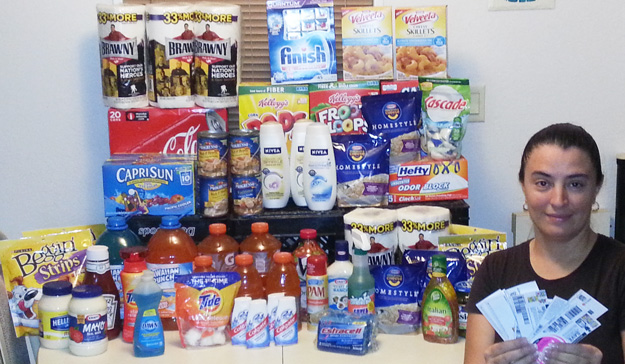
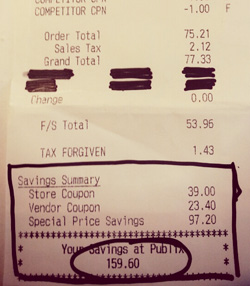 Area residents can learn to be a coupon queens (or kings) at a class this weekend in McDavid.
“I have been couponing for years,” said Science of Couponing Class teacher Candace Capps. “I am no extreme couponer but have saved normally between 60 and 70 percent on my stuff.”
The class will be held from 10 a.m. until 1 p.m. on Saturday at Rays Chapel Baptist Church. The cost is $10 per person, with childcare available for $5. Proceeds benefit church mission trips.
For more details or to sign up, call Candace Capps at (850) 554-0683 or register on Facebook.
Pictured: Science of Couponing Class teacher Candace Capps saved $159.60 – almost 70 percent — on a recent grocery shopping trip. Submitted photos for NorthEscambia.com, click to enlarge.
Florida Senate Panel Reject Medicaid Expansion, Looks At Option
March 12, 2013
With some Republicans saying they didn’t want to expand a “broken” system, a Senate select committee Monday rejected adding hundreds of thousands of Floridians to the Medicaid program under the federal Affordable Care Act.
Senators, however, said they want to pursue an alternative plan that would use federal money to help uninsured low-income people get coverage through private insurers. The select committee’s vote came a week after a House panel also rejected the Medicaid expansion — despite Gov. Rick Scott’s support for the idea.
“I oppose the Washington plan, and I want a Florida plan,” said Sen. Joe Negron, a Stuart Republican who is chairman of the select committee and presented the alternative. “I think we have an opportunity to build a better program than what Washington is trying to force on us.”
The committee rejected the expansion in a 7-4 vote along party lines. Democrats said the Affordable Care Act, sometimes called Obamacare, offered a chance to help hundreds of thousands of people get health coverage.
“We have a moral and economic responsibility to seize this moment for the good of Floridians,” said Sen. Eleanor Sobel, a Hollywood Democrat and vice-chairwoman of the select committee.
The chances of the Republican-dominated Legislature approving the Medicaid expansion dimmed last week when House Speaker Will Weatherford, R-Wesley Chapel, and a House select committee publicly opposed it. But senators had not taken a formal position until Monday’s vote.
Weatherford issued a statement praising the Senate move and vowing to work on seeking other options for offering health coverage to the state’s uninsured. The House speaker, in part, has questioned the future expense to the state of a Medicaid expansion — though the federal government says it will pay all of the expansion costs during the first three years.
“I look forward to working with Senate President (Don) Gaetz as we investigate alternatives that will strengthen the safety net while also ensuring that we do not put future funding for our schools, public safety and protection of our beaches and springs at risk,” Weatherford said.
Scott, whose support of Medicaid expansion was harshly criticized by some conservative supporters, issued a brief statement saying he is “confident that the Legislature will do the right thing and find a way to protect taxpayers and the uninsured in our state while the new health-care law provides 100 percent federal funding.”
The Affordable Care Act, which President Obama and congressional Democrats approved in 2010, calls for expanding Medicaid eligibility as a key part of its goal to provide health coverage to most Americans. The law would allow enrollment of people whose incomes are up to 138 percent of the federal poverty level and, in a major change for Florida, allow enrollment of childless adults.
While the federal government would pay 100 percent of the expansion costs during the first three years, its share would gradually drop to 90 percent in 2020, with the state picking up the rest of the tab. Analysts last week estimated that the expansion would cost the state about $3.5 billion over a decade — with the federal government paying about $51 billion.
Numerous details still need to emerge about the possible alternative plan that Negron presented to the Senate select committee Monday. But broadly, it would create a voucher-like program for people to buy private health insurance.
The plan would target the same people who would be newly eligible under the Medicaid expansion and also would rely on federal money to help subsidize coverage. But instead of enrolling people in Medicaid, it would build on an already-existing program, the Florida Healthy Kids Corp., to offer coverage through private insurers.
Florida Healthy Kids provides subsidized private health-insurance to about 240,000 children of low- and moderate-income families, as part of the federal Children’s Health Insurance Program. Families pay $15 or $20 a month for coverage, with the state and federal governments subsidizing the rest of the costs.
Rich Robleto, executive director of Florida Health Kids, said the program’s structure could be broadened to also include the type of expansion discussed by the Senate select committee.
“It’s the kind of thing that we can do,” Robleto said. “It’s the kind of thing we have been doing for 20-something years.”
Florida lawmakers in 2011 approved a major overhaul of the Medicaid program that eventually will lead to almost all beneficiaries enrolling in HMOs and other types of managed-care plans. But the possible Obamacare alternative would be separate from that effort.
Negron said he will ask Gaetz, the Senate president, to send the possible alternative to another committee to work out details. But among the big questions are whether the federal government would go along with the concept and whether it would approve such moves as requiring enrollees to be charged co-payments for medical services — something Negron said he would like to see.
The Obama administration recently indicated it would allow Arkansas to funnel people into private coverage instead of Medicaid. But the Arkansas proposal, which has not been finalized, includes a crucial difference from the Senate idea: It would use health-insurance exchanges, which are part of the Affordable Care Act, to serve as the vehicle for people to sign up for private coverage.
Despite seeing Republicans vote down the Medicaid expansion, Senate Democrats issued a statement after Monday’s meeting that appeared to indicate support for the possible alternative. That statement noted that the alternative would also address many of the goals of the Medicaid expansion.
“Although Republicans voted against what they called ‘traditional Medicaid expansion’ they turned around and endorsed a program that still relies on the same federal dollars and still extends affordable health care to 1 million Floridians,” Senate Minority Leader Chris Smith, D-Fort Lauderdale, said. “Whatever name they opt to give the program, the bottom line is that money allocated by the federal government for Medicaid expansion will be the mechanism. In the Senate, the remaining question is no longer ‘if,’ but ‘who.’ ”
But Senate Republicans, who have long complained about the costs and size of Medicaid, sought during the meeting to distance themselves from a potential expansion of the program.
“I think fixing health care is not expanding a broken system,” said Senate Health Policy Chairman Aaron Bean, R-Fernandina Beach. “Medicaid … it’s not good.”
By The News Service of Florida
AG’s Want FDA To Make It Harder To Abuse Generic Pain Pills
March 12, 2013
The attorneys general from Florida and Alabama are behind an effort to make generic pain pills tougher to get a hold of and abuse.
The four attorneys general – Florida’s Pam Bondi , Alabama’s Luther Strange, Kentucky’s Jack Conway and North Carolina’s Roy Cooper – spearheaded a letter that asks the U.S. Food and Drug Administration to adopt standards requiring manufacturers and marketers of generic prescription painkillers to develop tamper- and abuse-resistant versions of their products.
The letter, signed by 44 other state and territorial attorneys general, is a follow up to a letter Bondi sent to the FDA in October calling for tamper-resistant formulations of prescription opioids.
A release from Bondi’s office noted that makers of name-brand versions of painkillers such as OxyContin have taken steps to make it harder to crush to inject or snort.
By The News Service of Florida
Escambia Westgate To Hold 5K Fun Run, Walk And Wheel
March 12, 2013
The Escambia Westgate School will host a 5K Fun Run, Walk, and Wheel on April 13.
The first 200 racers to register will receive a t-shirt. All proceeds will be used to expand the Lacey A. Collier Sensory Complex. This expansion will include a fully accessible gymnasium.
The race begins 8:00 am. The race fee is $20 in advance registration or $25 the day of the race.
For more information and a registration form visit the Escambia Westgate School website or contact Ashley McCombs, (850) 494-5700 Ext. 231, lrhodes@escambia.k12.fl.us; or Laren Leptrone, (850) 494-5700 Ext. 227, LLeptrone@escambia.k12.fl.us.
Bratt Renter Sentenced For Grand Theft After Moving Out With Appliances
March 11, 2013
A North Escambia man was convicted last week on a felony charge for moving out of a rental property in Bratt with the owner’s appliances.
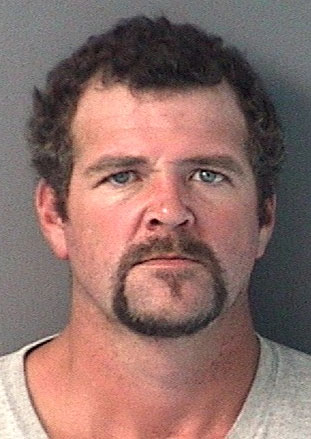 The owner of the property in the 5300 block of North Highway 99 told the Escambia County Sheriff’s Office that Israel Dewayne Wiggins, 36, moved out after about a year and took a stove, refrigerator and a freezer. He then sold the appliances, valued at $1,870, to another man for $60.
Wiggins was found guilty of one count of felony grand theft and sentenced by Judge Gary Bergosh to 60 months probation and ordered to pay $3,500 in restitution to the victim.
4th DUI: Man Charged In Fatal Crash
March 11, 2013
A Pace man with three previous drunken driving convictions was charged with DUI manslaughter Sunday morning in connection with a crash that killed a Milton man.
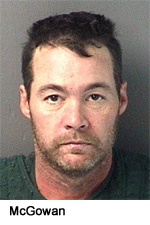 Stephen Craig Hughes, 52, was killed when his 2013 Harley was hit by a 1998 Chevrolet 1500 pickup driven by 39-year old James Ashley McGowan about 3 a.m. Sunday at Highway 90 at Smith’s Fish Camp Road, according to the Florida Highway Patrol. The side of the pickup hit Hughes’ motorcycle, and Hughes was ejected into the side of the pickup.
The FHP said McGowan failed to observe Hughes approaching and made a left turn in front of him.
The on scene investigation revealed there was probable cause to arrest McGowan for driving under the influence of alcohol and causing the death of another, the FHP said. He was booked into the Escambia County Jail with bond set at $205,000.
Evers Wants Public Input On Legislative Session Issues
March 11, 2013
State Senator Greg Evers is asking residents of his district to take his “Session Issues Survey”.
“I am conducting this survey to get opinions about some of the issues we will be addressing this Legislative Session,” Evers said. The 2013 Legislative Session continues through May 3.
In addition to mailing the survey to voters in Escambia, Santa Rosa and Okaloosa County areas, Evers has included an electronic version of the survey online.
“I have chosen an online survey because it will save my constituents postage, helps get the survey out to more people and allows for easier tabulating of the results,” he said. “Anyone is welcome to complete this survey. I value the opinions of my neighbors and I believe that I owe it to them to reach out and gather their opinions on the issues that will be affecting them.”
To take Evers’ online survey, click here.
Kindergarten Registration Begins
March 11, 2013
Kindergarten registration for Escambia County students started Monday.
Students who will be five years old on or before September 1, 2013, are eligible to register for the 2013-2014 school year. Registration will occur at the school which serves the student’s housing area.
At the time of registration, parents/guardians should bring the following:
- Child’s birth certificate
- Child’s Social Security card
- Proof of residence, such as an electric bill or rent receipt (please note, telephone and cable bills are not acceptable)
- Immunization record (also known as the Florida Blue Card, which is provided by the health department or family physician)
- Physical form completed by family physician
To find the school your child is zoned to attend, visit www.myescambiaschools.com and click on “Find Your School.”
For additional information, contact the elementary school which serves the student’s housing area