

Florida Tax Holiday Continues For Energy Saving Appliances
September 20, 2014
State officials are promoting the potential for long-term savings on utility bills as they tout sales-tax breaks this weekend for shoppers who buy energy-saving and water-conserving appliances.
The discount period is the third sales-tax “holiday” offered by Florida lawmakers as part of an election-year package of tax cuts.
 Through Sunday, sales taxes won’t be collected on the first $1,500 of the purchase price of certain Environmental Protection Agency-designated Energy Star and WaterSense products, including new refrigerators, dishwashers, ceiling fans and even light bulbs.
“You don’t have to spend a lot to save, but every little bit you save on your taxes this weekend will also save on your electric and water bill in the future,” said Florida Department of Agriculture and Consumer Services spokeswoman Erin Gillespie. “People that buy the appliances can save anywhere from $1 to $100, but more than that, you’ll save on your electric bill every month that you have that appliance or product in your house.”
The discount period isn’t anticipated to drive as many shoppers to the stores as the more popular back-to-school tax “holiday,” which was held in August, or even a tax-free period in June on certain hurricane supplies.
Many of the discount items this weekend are considered bigger-ticket items purchased more out of necessity than on a whim — refrigerators, clothes washers, dishwashers, swimming pool pumps, water heaters, weather-based irrigation controllers and high-efficiency toilets.
But not everything on the exemption list is a costly purchase, as Energy Star and WaterSense-approved products include light bulbs, air purifiers, ceiling fans, shower heads and bathroom sink faucets.
State economists, sitting as the Revenue Estimating Conference, have projected that the overall savings for shoppers this weekend could dent the revenue of state and local governments between $890,000 and $2.67 million.
By comparison, the same economists projected the “holiday” period for back-to-school items reduced state revenue by $32.3 million and local revenue to the tune of $7.3 million.
Agriculture Commissioner Adam Putnam, who pitched the energy-savings tax discount nearly a year ago as part of his 2014 legislative agenda, put the consumer savings around $900,000. But he also sees the products as helping the state long-term.
“The sales-tax holiday will not only put money back in the pocket of hard-working Floridians, it will also help conserve water and energy for our future generations,” Putnam said in a prepared statement.
The Tallahassee-based Florida Retail Federation is looking at closer to the $2 million number, expecting the sales-tax discount to be popular for shoppers who have been looking to replace aging appliances.
“This is a great opportunity for Floridians to upgrade those appliances and make those purchases that they’ve been waiting to make,” said Samantha Stratton, a federation spokeswoman. “Previously, the economic downturn sort of inhibited those purchases. And now that consumers are feeling more confident, they’re ready to go out and make these purchases that will last them longer.”
Female Jogger Attacked In Attempted Rape After Woman Carjacked From Gas Station, Assaulted
September 19, 2014
The Escambia County Sheriff’s Office is searching for a carjacking and aggravated assault suspect after a Thursday morning incident in Cantonment. And deputies now say the suspect may be responsible for an incident a short time later in which a female jogger was attacked.
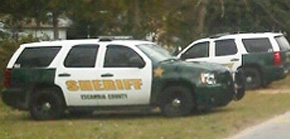
At approximately 8:15, a carjacking was reported at a gas station at Highway 29 and Muscogee Road. The victim had pumped gasoline and entered the store when an unknown black male suspect entered her unlocked vehicle and concealed himself in the backseat. The victim did not see the suspect and drove away from the store, according to information released Thursday afternoon by the Escambia County Sheriff’s Office.
The suspect confronted the victim once the vehicle was moving. He told her that he had a knife and to keep driving or he would “stick” her. She drove around randomly and eventually drove to a neighbor’s residence. Once there she honked the car’s horn in distress to get someone’s attention. The suspect struck her and pushed her from the vehicle.
He left in the car, heading back towards Highway 29. The victim was treated at the scene for minor injuries. Shortly afterward, the vehicle was located on Pine Street.
NEW INFORMATION
New information released Friday morning the Sheriff’s Office says that about 8:35 a.m. deputies received a call about the attempted sexual battery of a female jogger on Rocky Avenue.
The victim reported that as she was jogging when an unknown black male suspect grabbed her from behind and dragged her into a wooded lot. Once there he struck her in the face and attempted to remove her clothing but the victim fought back and was able to escape. The suspect fled deeper into the wood lot while the victim contacted authorities. The victim was transported to a local hospital where she was treated for minor injuries and released.
Due to the time and location of the incident, description of the suspect and the vehicle found at the location, investigators believe this incident may be connected to the carjacking.
In both cases, the suspect was described as a black male with short hair, a mustache and dark clothes. The Sheriff’s Office said investigators are actively working the case at this time and more information will be released as it becomes available. Anyone having information on this incident is asked to contact CrimeStoppers at (850) 433-STOP.
Scott Picks Patronis, Brown For PSC; Skips Escambia’s Murzin
September 19, 2014
Looking to a political ally to fill the job, Gov. Rick Scott on Thursday named state Rep. Jimmy Patronis to a seat on the Florida Public Service Commission.
Scott also reappointed Commissioner Julie Brown to a four-year term on the panel that regulates utilities. Both appointments take effect in January, when the current terms of Brown and outgoing Commissioner Eduardo Balbis expire.
 Scott chose Patronis and Brown from a list of seven finalists that also included former state Rep. Dave Murzin, R-Pensacola.
Patronis, 42, a Panama City Republican, is scheduled to leave the House in November because of term limits. Patronis, vice president of the family-run Captain Anderson’s Restaurant, was an early political supporter of Scott in 2010 and most recently has served as chairman of the House Economic Affairs Committee.
“Representative Patronis has faithfully served Florida families during his years of service in the Florida House of Representatives,” Scott said in a prepared statement. “I am confident that Jimmy will make an excellent addition to the Public Service Commission as he continues to put Florida families first.”
Brown, 39, an attorney from Tampa, has served on the Public Service Commission since January 2011. Balbis declined to seek another term.
by The News Service of Florida
Pictured: Dave Murzin.
Girlfriend’s Facebook Selfie Helps Land Cantonment Burglar Behind Bars
September 19, 2014
A Flomaton man has been busted in connection with a Cantonment burglary after his girlfriend posted a “selfie” Facebook photo showing stolen goods in the background, according to the Escambia County Sheriff’s Office.
 Colby Wayne Satterwhite, 22, was charged with armed burglary of a residence, grand theft and criminal mischief.
Residents of a home in the 300 block of Jacks Branch Road reported that their home had been burglarized sometime during a two day period in which they were gone. They returned home to find a exterior door pushed open, and missing items including $200 in cash, a large collection of collectable coins, a camera, a Mossberg shotgun in a tan case and ammunition. The total estimated value of missing items was $15,060.
Acting on a tip, the burglary victim checked the Facebook page of Satterwhite’s girlfriend and spotted what she believed to be her shotgun case in the background of one of the girlfriend’s “selfie” photographs.
There’s no word from the Sheriff’s Office if the stolen items were recovered.
Impact 100 Names Finalists For $102,500 Grants
September 19, 2014
 Impact 100 Pensacola Bay Area has announced its 15 grant finalists for 2014.
Ten of the projects will each receive a grant of $102,500 when the winners are announced after final voting on October 19.
ARTS & CULTURE
- Ballet Pensacola — Technology and Infrastructure for Production – Moving Ballet Pensacola Forward with IMPACT
- First City Arts Alliance dba First City Art Center — Increasing Capacity, Building Community
- The Santa Rosa County Creek Indian Tribe — Infrastructure Development of Tribal Grounds
EDUCATION
- East Hill Academy — The IMPACT 100 Autism Learning Center: “Use Your WORDS”
- Escambia County Public Schools Foundation for Excellence — Shoot For The Stars!
- The Pensacola MESS Hall — The MESS Hall Express
ENVIRONMENT, RECREATION & PRESERVATION
- Miracle League of Northeast Pensacola — Field of Dreams: Finishing the Work
- Navarre Beach Sea Turtle Conservation Center — Conservation and Protection: Sea Turtle Center Improvements
- Rotary Club of Pensacola Foundation — Rotary Centennial Playground
FAMILY
- Big Brothers Big Sisters of Northwest Florida — 100 Men in 100 Days
- Manna Food Pantries — Preparing for a Brighter Tomorrow
- Society of St. Vincent De Paul Alfred Washburn Center — Living on the Edge
HEALTH AND WELLNESS
- Alzheimer’s Family Services — Project Lifesaver
- Health and Hope Clinic — Strengthening the Safety Net
- Our Lady of Angels St. Joseph Medical Clinic — Improving and Expanding Patient Services
Chamber Celebrates Accomplishments During Annual Meeting
September 19, 2014
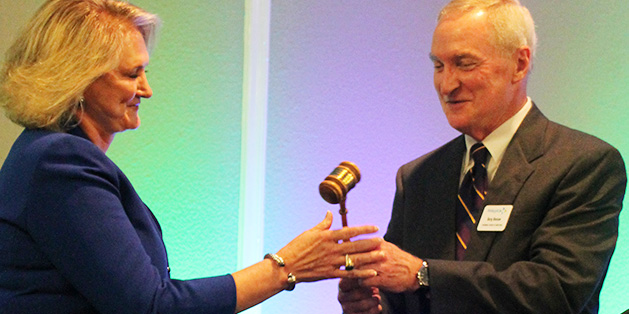
Thursday, over 400 community, business, state and regional representatives gathered for the Greater Pensacola Chamber’s 124th Annual Meeting in Downtown Pensacola. The event featured a commemorative year in review, as well as the official passing of the gavel from past Chamber Board of Directors Chair Gary Huston to current Chair Carol Carlan, the president of Sacred Heart Foundation.
“The Chamber is dedicated to driving economic prosperity, enhancing our region’s quality of life and supporting local businesses through public advocacy and partnership support,” said Carlan. “I am honored to serve as the Chair for an organization that continues to have positive impacts on our community and enhances our region.”
“As one of Northwest Florida’s oldest and largest business associations, the Chamber continues to stand united as an organization of passionate and innovative leaders driven to provide professional, personable and positive assistance to companies in our region,” said Greater Pensacola Chamber President Jerry Maygarden. “This annual event enables us to reflect on our year-long accomplishments that have contributed to making our organization a valuable voice for the business community.”
Pictured top: Gary Huston (right), 2013-2014 Chair of the Greater Pensacola Chamber Board of Directors, officially passes the gavel to the 2014-2015 Chair Carol Carlan (left) during ther chamber’s annual meeting Thursday. Photo for NorthEscambia.com, click to enlarge.
JV Football: Northview Beats West Florida 16-14
September 19, 2014
Nortview High School’s JV football team beat West Florida tonight 16-14.
 Northview scored in the first quarter on a touchdown run by Toney Harrison. They converted a two-point conversion on a run by Jared Aliff.
The JV Chiefs scored on the first play of the 4th quarter on a touchdown run by Hunter Edwards. Toney Harrison converted the two-point conversion to put Northview up 16-0. West Florida countered with two late touchdowns, cutting the lead to 16-14.
Toney Harrison also had a sack and forced fumble in the first quarter.
Northview’s JV will travel to Baker on October 16 and round out their season when they host West Florida on October 23.
All About Peanuts: 48th Annual Santa Rosa Farm Tour Held
September 19, 2014
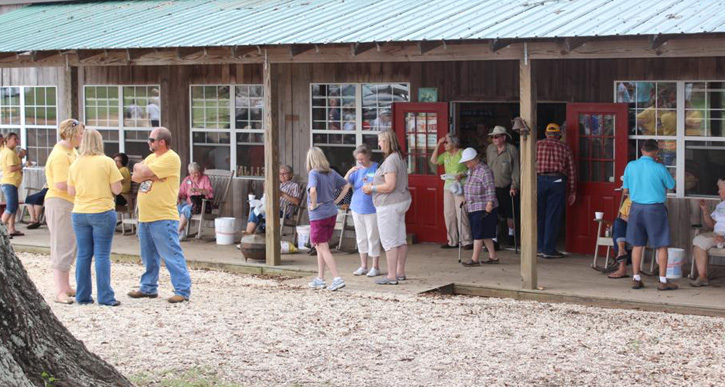
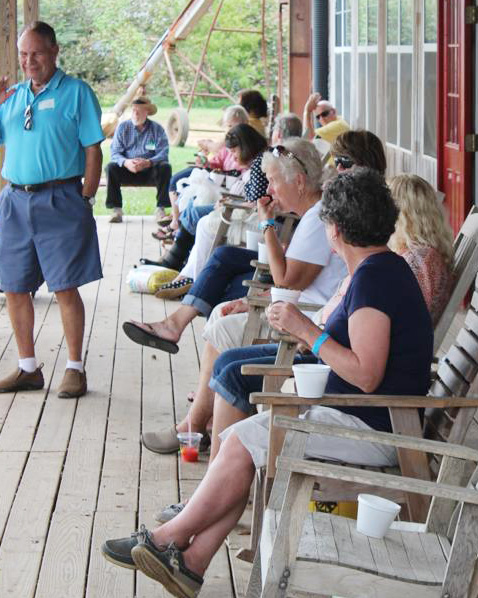 The 48th Annual Santa Rosa Farm Tour was held Thursday.
Participants had the opportunity to watch a peanut digging demonstration at the Roy Ward Farm in Chumuckla and learn about the science of peanut farming at the UF/IFAS West Florida Research and Education Center in Jay.
The day’s events also included visits to the Golden Peanut Company in Jay and Holland Farms for boiled peanuts.
Pictured: Participants in the 48th Annual Santa Rosa Farm Tour enjoy boiled peanuts at Holland Farms. Courtesy photos for NorthEscambia.com, click to enlarge.
Volleyball: Lady Chiefs Split Games With Central
September 19, 2014

The Northview Lady Chiefs split volleyball games with Central High Thursday.
In junior varsity action, Central won 11-25, 20-25.
In varsity action, Northview won 25-11, 25-22, 23-25, 25-14
The varsity Lady Chiefs will take part in the Spanish Fort Tournament Friday and Saturday. The JV will be back on the court Monday in Chipley at 4:00, with the varsity to follow at 5 p..
NorthEscambia.com file photo, click to enlarge.
Three Charged After Car Stolen In Florida, Burned in Alabama
September 18, 2014
[Updated 8 a.m.] Three people have been arrested in connection with a vehicle that was stolen in Florida early Tuesday morning and burned a short time later in Alabama.
The third suspect, Dale Lynn Carnley, was taken into custody at 7:21 a.m. Thursday after being discharged from the Monroe County Hospital in Monroeville, Ala. He was arrested by the Monroeville Police Department after being recognized from media reports by hospital staff. He will be transported to the Escambia County (AL) Detention Center in Brewton.
 The incident began about 1:30 a.m. Tuesday after a female victim picked up acquaintance Dale Lynn Carnley, age 32 of Flomaton, and former live-in boyfriend Shawn Earl Barrows, age 35 of Century. She gave them a ride to her home in the 7500 block of Killam Road outside Century, where both suspects began to “drink beer and hang out”, according to an Escambia County (FL) Sheriff’s Office arrest report.
The victim told deputies that Barrows became angry and began to hit and shove her. She said she tried get away, but was stopped by Carnley who kicked her to the floor before both men continued to beat her. The victim told deputies that she managed to run out of the house to a neighbors for help, and she watched as they two men took her 2006 Pontiac G6 without permission.
The female victim was transported by Escambia County (FL) EMS to Atmore Community Hospital with non-life threatening injuries.
According to Flomaton Police Chief Brian Davis, the Pontiac G6 was then driven into Alabama to a location on Highway 31 in Flomaton, near the former Bondurant Lumber Company, It was reported to be on fire at 2:38 p.m. According to Davis, 40-year old Christopher Vanhoosen of Titi Street in Flomaton has knowledge that his friends, Barrows and Carnley, were going to burn the car.
 Barrows was arrested at his Tedder Road address in Century and booked into the Escambia County (FL) Jail on charges of grand theft of a motor vehicle and first degree battery. The Flomaton Police Department also has charges against Barrows for the vehicle fire.
Carnley will be charged by the Flomaton Police Department for receiving stolen property first degree and criminal mischief first degree. He is also expected to face additional charges in Florida.
Vanhoosen, who police said had knowledge of that the vehicle would be burned, was charged by Flomaton Police with criminal conspiracy to commit criminal mischief first degree.
Anyone with information on Dale Lynn Carnley’s whereabouts is asked to call the Flomaton Police Department at (251) 296-5811 or their local law enforcement agency.