

Blooming Century Plant Turning Heads
June 11, 2015

Travelers and residents on Jordan Road northeast of Flomaton have been treated to a unique site — a blooming agave americana, more commonly known as a century plant.
The plants were once thought to bloom every 100 years, this the name, but scientists say the plants actually bloom about every 10 to 30 years. The bloom stalk may reach up to 30 feet high. The plants die after blooming, but shoots from the base may continue growning.
The century plant is located at the home of Shirley Petty in the 1100 block of Jordan Road, near Wolf Log Road.
Submitted photos by Andrea Boutwell for NorthEscambia.com, click to enlarge.

Police Chase Ends, Vehicle Crashes Into Loaded Van
June 11, 2015
A stolen vehicle crashed into a church van Wednesday following a police chase in Escambia County, sending four people to the hospital and landing two teen in jail.
Escambia County Deputy Mitch Craft responded to a suspicious vehicle call and observed a stolen Chevrolet Impala with out of state tags. He lost sight of the vehicle in the area of Gulf Beach Highway and Patton Drive. A short time later, he observed the vehicle on Navy Boulevard. He attempted to initiate a traffic stop on the stolen Chevrolet Impala off Druid Drive late Wednesday morning, but discontinued his pursuit after the vehicle failed to stop.
 The driver of the Chevrolet Impala continued eastbound on Druid Drive at a high rate of speed, running a stop sign and hitting a church van with 13 passengers. according to the Florida Highway Patrol. After the collision, four or five people in the Chevrolet Impala fled on foot.
Two 16-year olds – Dixon Malcolm Hall and Marquist Alvin Vincent Page — were apprehended and charged with grand theft, grand theft of a motor vehicle and resisting an officer without violence. The stolen vehicle was found to contain property from several recent burglaries.
Four passengers in the van were taken to Sacred Heart Hospital for treatment of minor injuries. The investigation into the incident in continuing.
Scott Signs ‘Right To Try’ Law
June 11, 2015
Gov. Rick Scott signed 55 bills into law Wednesday, including the “Right to Try Act” — will let terminally ill patients starting July 1 have access to certain experimental drugs (HB 269). Also, doctors under a separate bill (HB 751) will be able to prescribe a type of drug known as an “opioid antagonist,” which can be injected in emergency situations to halt overdoses.
Meanwhile, Scott vetoed a single measure (HB 1305) on Wednesday that would have allowed certain physicians and chiropractors to sell or rent electrostimulation medical equipment directly to patients without incurring license fees.
Scott — in a letter explaining the veto to Secretary of State Ken Detzner — said he agreed with the Legislature’s attempt to “remove burdensome regulations.” But he expressed concern that the bill would create “carve-outs,” which he said can create “additional levels of complexity to regulatory requirements” and “present an unfair advantage to certain entities competing within the same industry.”
As with Scott’s two other vetoes this year, the bill was approved without opposition in the House and Senate during the regular session.
A Public Service Commission reform law (HB 7109), which goes into effect July 1, will limit future commission members to three consecutive four-year terms, require utilities to notify customers of the best available rates and prevent electric utilities from charging higher rates through extensions of billing cycles.
The “Right to Try Act” focuses on drugs that have been through what is known as “phase 1″ of a clinical trial but have not been approved for general use by the U.S. Food and Drug Administration. Patients with terminal conditions could have access to the experimental drugs, and the bill would provide liability protections to doctors and drug manufacturers.
Another newly signed law (HB 41) known as “Gabby’s Law for Student Safety,” revises how “hazardous walking conditions” are identified and handled. The law will allow district superintendents to make formal requests to the government agencies with jurisdiction over roads to correct the hazards. The government agencies would have to include the work in their next annual 5-year capital improvements programs or declare why the corrections aren’t being planned.
by Jim Turner, The News Service of Florida
Florida To Require 24 Hour Abortion Waiting Period
June 11, 2015
In a widely expected move, Gov. Rick Scott on Wednesday signed a measure that will require a 24-hour waiting period before women can have abortions.
The bill (HB 633), sponsored by Rep. Jennifer Sullivan, R-Mount Dora, prompted passionate debate during this spring’s regular legislative session, but passed overwhelmingly in the Republican-controlled House and Senate.
“The importance of this bill is to give women an opportunity to reflect on a major decision that they are about to undertake — a major medical procedure that will have lifelong effects, not just physically but mentally as well,” said Sen. Anitere Flores, a Miami Republican who sponsored the Senate version of the bill.
The bill, which goes into effect July 1, adds to an already-existing law that requires physicians performing abortions to provide information to women to obtain their consent. Under the bill, the information must be provided in person to the women at least 24 hours before the procedures are performed.
The bill includes exceptions for victims of rape, incest, domestic violence or human trafficking — but those victims can waive the 24-hour wait only if they can produce police reports, restraining orders, medical records or other documentation.
“The idea that a woman who has been raped or violated has to now go get a police report in order to prove that, I find absurd and frankly insulting,” said Sen. Jeff Clemens, a Lake Worth Democrat who opposed the bill.
Other opponents called the bill unconstitutional. Sen. Darren Soto, D-Orlando, said during floor debate in April that because the Florida Constitution guarantees the right to privacy, the bill is vulnerable to a challenge.
“I would not be surprised to see it challenged immediately,” he said.
Sullivan, however, said she studied legislation passed by other states to help ensure the bill would withstand a constitutional challenge.
“I was very particular about how I worded it. I know Florida’s constitution is a little bit different than some others,” she said. “Even knowing that, I did try to go above and beyond in working with staff, to make sure that it would hold up in court.”
The 24-hour waiting period will join already-existing requirements for informed consent, including discussing medical risks to the woman and fetus, a description of the fetus, and help finding alternatives to ending a pregnancy.
Senate Minority Leader Arthenia Joyner, D-Tampa, said the bill is part of a long-term effort to whittle away at abortion rights.
“There are those who are not content unless they continue the effort to deny a woman the right to choose,” she said.
Critics have argued, in part, that the waiting period would particularly affect women from rural areas who might have to travel long distances to abortion clinics. The requirement means women will have to make two trips to clinics.
“Planned Parenthood provides every woman with counseling, support and information about all of her options,” Barbara A. Zdravecky, president and chief executive officer of Planned Parenthood of Southwest and Central Florida, said in a prepared statement Wednesday. “This law targets women who already have the least access to care and forces abortions later in pregnancy.”
But Flores said women can still have abortions after the waiting period if they so decide, “but we feel that it’s important to, as many other states have done, to give some time for women to reflect on this very important decision.”
by Margie Menzel, The News Service of Florida
Suns Top Wahoos
June 11, 2015
Pensacola Blue Wahoos third baseman Ray Chang hit a walk-off single but his mother, Wendy, wanted to know about his throwing error.
In the eighth inning, Chang threw the ball in the dirt to first base that allowed the Jacksonville Suns to score two runs and tie the game, 6-6.
However, Chang got an opportunity to redeem himself in the ninth inning and hit a sharp line drive to left field that scored first baseman Marquez Smith with the winning run, 7-6.
The Blue Wahoos took the final game of the five-game series, 7-6, to beat in-state rival Jacksonville Suns in front of 5,038 at Pensacola Bayfront Stadium. On fireworks night for kids who finished school, the game became the first Wednesday night sellout since the Blue Wahoos inaugural season on May 23, 2012.
The 31-year-old minor league veteran, used mostly as a utility player, said he really wanted to get a hit in that last at bat and drove an inside fastball hard to left. Chang went 4-5 in the game with a triple, two doubles, a run scored and three RBIs. He now has 10 RBIs on the season and is hitting a team-leading .325.
“I wanted it so bad because I almost blew it on that throwing error,” said Chang, still drenched from a water and Gatorade baths. “(My mom) actually didn’t sound too excited. She hates when I make errors. She’d rather I go 0-4.”
His last walk-off came on a single Aug. 16, 2011 for the Minnesota Twins Triple-A Rochester Red Wings. His last four-hit game came the following season with Rochester on Aug. 5, 2012.
This season for the Blue Wahoos, Chang has been on fire at the plate. In the past 25 games since May 2, Chang has hit .403, going 29-72. In the series against Jacksonville, he had a 3-3 game in the series opener and then four hits Wednesday night to bat .538 (7-13).
Pensacola manager Pat Kelly said he wanted to know the names of Chang’s previous managers who failed to start him, including himself in April. Kelly has inserted him in the regular lineup or to pinch hit over the past month.
“That’s why a veteran presence is so nice,” Kelly said. “He felt bad about his throwing error. But you get redeemers in this game. He got a redeemer and won us the ball game.”
Pensacola scored a season-high six runs on a season-high six hits in the second inning to go ahead, 6-0. But Jacksonville chipped away with two runs in the fourth on a Matt Juengel two-run homer. They added two more on a two-run single by centerfielder Kenny Wilson in the sixth, and then tied it in the eighth.
Chang’s game-winner improves Pensacola’s record to 23-35 and they are last place in the Southern League South Division. The Suns drop to 26-33 and remain in fourth place in the division.
The victory snapped Pensacola’s five-game losing streak and evened the record between the teams this summer at 5-5 for the Golden Skillet that goes annually to the winner. Pensacola still has the Southern League’s worst record in one-run games at 7-17 for a .291 winning percentage.
“You never want to win a game that way but maybe it’s a blessing in disguise because it’s exactly how we’ve been losing,” Chang said. “Baseball is a crazy game. Hopefully, this will get us back on the winning side.”
Pensacola Federal Judge Nixes Mediation In Scott ‘LIP’ Lawsuit
June 10, 2015
A federal judge in Pensacola Wednesday rejected a request by Gov. Rick Scott for mediation in a legal battle between the state and federal government about health-care funding.
 Chief U.S. District Judge M. Casey Rodgers issued an order that said she has already scheduled a hearing next week on a Scott motion for a preliminary injunction in the case.
“The hearing is scheduled for June 19, 2015, and will require extensive preparation on the part of all parties,” Rodgers wrote. “Requiring them, on even shorter notice, to also attend court-ordered mediation, which is not guaranteed to result in any resolution of this case, would be unduly burdensome, expensive, and not likely to advance the process any faster than the expedited proceeding currently scheduled.”
Scott filed the lawsuit in April, contending that the Obama administration was trying to unconstitutionally link continuation of the state’s Low Income Pool health-funding program with expansion of Medicaid. The federal government has called those arguments “baseless” and has indicated that the state will receive about $1 billion in Low Income Pool funding for the fiscal year that starts July 1.
While the $1 billion is a reduction from the current year’s funding for the so-called LIP program, state lawmakers are using that number as they negotiate a budget during an ongoing special session.
In Wednesday’s order, Rodgers pointed to a short time frame with the July 1 start of the fiscal year. She also said she will hold a full hearing June 19 on Scott’s preliminary-injunction request, including hearing live testimony.
“The court needs to have a thorough understanding of the LIP extension or amendment process and the history of the negotiations between the parties in order to resolve the questions raised,” she wrote.
FDOT: Molino Intersection Is Dangerous, New Traffic Light Can Cut Crashes
June 10, 2015

The intersection of Highway 29 and Highway 97 in Molino is dangerous and needs the traffic signal that was activated Thursday to cut injury crashes, according to state officials.
A Florida Department of Transportation study found that there were 37 documented crashes at the intersection during the 2008 to 2013 period, and the FDOT said 22 of the reported crashes could have been prevented by a traffic signal.
Of the 37 total crashes, one or more people were transported to the hospital as the result of 10 accidents.
In the last three years, the number of reported crashes at the intersection was significantly greater than the statistical average of similar roadway facilities in FDOT’s District 3, which is made up of the 16 westernmost counties in the Panhandle.
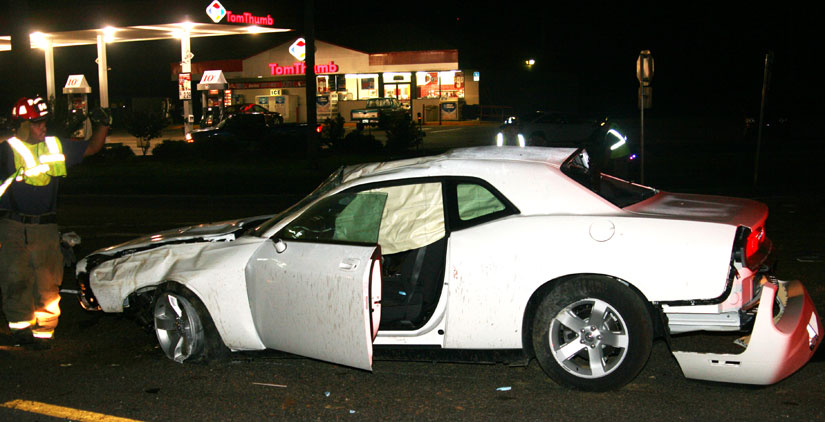
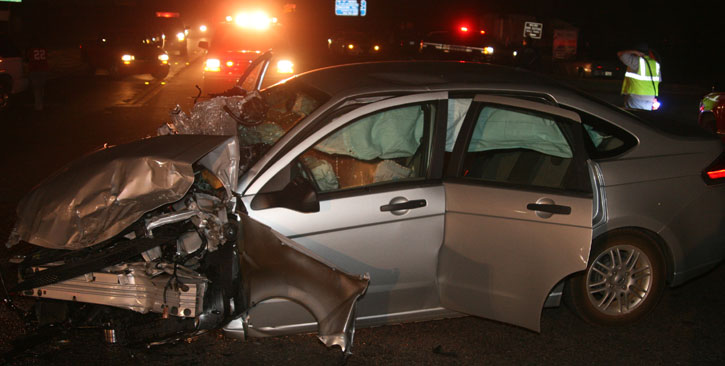
Crash statistics for 2014 and 2015 have not been released, but there were numerous additional serious crashes at the intersection, including one that claimed the life of a 16-year old high school student.
 Led by District 5 Commissioner Steven Barry, the Escambia County Commission agreed to fund the signal installation. Sen. Greg Evers, Rep. Clay Ingram, Rep. Doug Broxson, Rep. Mike Hill, Rep. Matt Gaetz and Senate President Don Gaetz all advocated for FDOT to make safety improvements at the intersection.
The new signal at the intersection of Highway 29 and Highway 97 was activated Thursday.
Pictured: Traffic crashes at the Highway 29 and Highway 97 intersection in Molino. NorthEscambia.com file photos, click to enlarge.
Bumped Budget Issues Include Key Hospital Program
June 10, 2015
Dozens of budget issues — including the one that threw lawmakers into a special session to finish work on the state budget — moved up the legislative ladder Tuesday, starting the next round of talks aimed at resolving differences between the House and Senate spending plans.
One of the largest issues “bumped” from lower-level negotiators to the House and Senate budget chiefs was how to structure payments from the state’s Low Income Pool program to hospitals and other health-care providers that care for large numbers of low-income patients. A dispute over the so-called “LIP” program — as well as a plan to provide insurance coverage to poor Floridians — helped derail the regular session this spring.
The issue will now be handled by Senate Appropriations Chairman Tom Lee, R-Brandon, and House Appropriations Chairman Richard Corcoran, R-Land O’ Lakes, in the next phase of budget negotiations, which are set to begin Wednesday. If Lee and Corcoran can’t agree, the issues will be directly negotiated by Senate President Andy Gardiner, an Orlando Republican and hospital executive, and House Speaker Steve Crisafulli, R-Merritt Island.
“We just ran out of time, to be honest with you,” said Senate Health and Human Services Appropriations Chairman Rene Garcia, a Hialeah Republican who led Senate negotiators on the health-care budget.
Lawmakers are trying to come up with a model for LIP that will soften the blow from the federal government’s decision to reduce the program from nearly $2.2 billion in the current budget year, which ends June 30, to $1 billion next year. Lawmakers are also pouring $400 million in state tax dollars into an increase in Medicaid reimbursements for hospitals — drawing down almost $610.9 million in federal matching money — to offset the loss.
“I’d much rather make sure that it’s right than to rush through it and to be worried about a deadline for what time we need to bump or any of those kinds of things,” said House Health Care Appropriations Chairman Matt Hudson, a Naples Republican and the lead House negotiator. “We pushed it and we got an awful lot of agreement, and we’re very close. But taking another day to make sure that we’re appropriately handling in excess of a billion dollars, I think, is appropriate.”
The Legislature is racing a June 30 deadline to get a budget agreement or face the prospect of a government shutdown.
Meanwhile, the federal government asked a judge Tuesday to reject Gov. Rick Scott’s request for court-ordered mediation in a lawsuit about health-care funding. Scott filed the lawsuit this spring arguing that the Obama administration was trying to unconstitutionally link continuation of the Low Income Pool program with expansion of Medicaid.
The lawsuit has continued after the federal agency that oversees Medicaid told state officials they can tentatively expect $1 billion in state and local funds next year for LIP, followed by $600 million the year after that.
“There is no basis for mediation as to the core issue alleged in plaintiffs’ (the state’s) complaint because the secretary (of the U.S. Department of Health and Human Services) has already stated definitively that she will not deny a LIP extension based on the state’s failure to expand its Medicaid program and has already preliminarily concluded that a LIP can be approved for the next two years,” the filing said.
Scott’s office responded Tuesday by blasting the federal government.
“Sadly, the Obama administration continues to delay any final agreement on funding for the Low Income Pool,” Scott spokeswoman Jackie Schutz said in a statement. “The state is continuing to request this issue be immediately resolved by any means possible.”
Lawmakers have been moving ahead with the $1 billion number and seem content to do so while letting the lawsuit play out.
“I’ve focused entirely on our process,” Hudson said. “What might be going on in the courts and what-not, I don’t want to even ponder, frankly, when the outcome of that may or may not be relative to our special session timeframe.”
Other budget issues were “bumped” across the board Tuesday. Many of them are projects and other spending items sought by lawmakers for local constituencies back home.
But there were some agreements reached Tuesday. The House and Senate struck a deal to modify the performance funding system for state universities. The Senate had wanted to plow $200 million of state money into the system while having universities put $200 million of their current budget at risk; instead, the state will pay $150 million while universities contribute $250 million to the plan.
The Senate also dropped a demand to use a budget-related bill to place limits on new four-year degrees at state colleges in exchange for other concessions from the House. But several other pieces of education policy, including broader eligibility for personal learning scholarship accounts for students with disabilities, remain unresolved.
Negotiators, though, focused primarily on a 3 percent increase in per-student funding for education. While the new number is short of a record on a per-pupil basis, the total amount of funding sent to schools will be the largest ever. Sen. Don Gaetz, who oversees his chamber’s education budget, said some had seen that as unlikely given the state’s budget situation.
“And in fact, I think we can turn in a report showing that education in many cases in many ways will have its best year in Florida history,” said Gaetz, R-Niceville.
by Brandon Larrabee, The News Service of Florida
Florida House Takes Aims At Hospital Regulations
June 10, 2015
With supporters saying a free-market approach would spur more competition and more choices for patients, a House panel Tuesday approved a proposal that would eliminate key regulations on building hospitals.
The bill (HB 31A), approved in a party-line vote, is part of a series of proposals that House Republican leaders have pushed to make changes in the health-care industry. The measure would eliminate what is known as the hospital “certificate of need” process, which requires state review and approval of building new hospitals, replacing hospitals and offering certain complex, costly medical services such as organ transplants.
House Health & Human Services Chairman Jason Brodeur, a Sanford Republican who is sponsoring the bill, argued that eliminating the regulations would spur more innovation in the hospital industry and competition for patients.
“This bill … removes a regulatory barrier that hinders competition and disincentives the innovation that we see happening in other industries,” Brodeur said. “It creates a free market with more competition and, ultimately, more options for those seeking health care.”
But critics said they are concerned, in part, that the bill would lead to new hospitals that would focus on attracting patients with health insurance, leaving behind uninsured patients at already-existing hospitals. Opponents included the Florida Hospital Association, the state’s largest hospital-industry group.
“No one wants to compete with us for uncompensated patients,” said Bill Bell, the hospital association’s general counsel. “They only want to treat the paying patients, and that’s why they would siphon off those paying patients, increase our costs, and we would have to shift those costs back to our paying patients and businesses.”
With lawmakers in the middle of a special legislative session called to pass a budget, it remains unclear whether the House certificate-of-need proposal has any chance of passing. The Senate has not filed a similar bill for the special session, though the Senate Health Policy Committee is slated to discuss the issue Wednesday during a workshop.
Nevertheless, the debate during the special session could be a step toward House Republican leaders pushing to eliminate hospital certificates of need in the future. The House Health Innovation Subcommittee voted 9-3 to approve Brodeur’s bill, with all of the panel’s Republicans supporting it.
The certificate-of-need process has long been controversial and can lead to legal battles within the industry.
by Jim Saunders, The News Service of Florida
FHSAA Creates New Baseball, Softball Classification, Keeping 1A As ‘Rural’
June 10, 2015
In the final meeting of the 2014-2015 school year, the Florida High School Athletic Association’s Board of Directors approved a proposal that will add a ninth classification for baseball and softball for the 2015-16 campaign.
 The ninth classification for baseball and softball in the upcoming 2015-16 season, using a format similar to what is currently in place for football. In this model, schools will be ranked by student population and divided into nine classifications—the highest two-thirds by population would be divided as evenly as possible into Class 5A through Class 9A and the remaining one-third will be divided as evenly as possible into Class 1A through Class 4A, keeping Class 1A designated as rural.
This model is designed to alleviate concerns about the large enrollment gaps that existed primarily in the lower classifications that were thought to affect competitive balance and this model is scheduled to be implemented for boys and girls basketball and girls volleyball in the 2016-17 school year.