
Florida Gov’t Weekly Roundup: The Hunts In Gray October
October 4, 2015
The state is inching closer to a bear hunt, but ursine mammals aren’t the only things being targeted in Florida government and politics.
 In Leon County, a judge is hunting for the right map of the state’s congressional districts to send to the Florida Supreme Court. And Gov. Rick Scott is aiming at what he calls “price-gouging” by some of the state’s hospitals — raising the prospect of another health-care showdown in the legislative session that begins in January.
The bear hunt, scheduled to kick off a week before Halloween, was a more immediate concern as the suns of September gave way to a dreary opening of October in Tallahassee. But given the other battles already brewing, there was the feeling that much larger game would soon be in play.
REDISTRICTING, TAKE 53
After more than three years of grinding legal conflict, the end of the latest fight over the state’s congressional lines might be drawing to a close. Emphasis on “might.”
Leon County Circuit Judge Terry Lewis on Monday closed a three-day hearing over the shape of the 27 districts by saying he hoped to issue a ruling as soon as next week. Lewis is supposed to recommend a plan to the Florida Supreme Court after the Legislature failed to approve a new map during an August special session.
Lewis is considering seven maps to see which plan or combination of plans should be in place for the 2016 elections. The Supreme Court ruled in July that the existing map, approved by the Republican-controlled Legislature in 2012 and tweaked two years later, violates a voter-approved ban on political gerrymandering.
The key dispute among a few points of contention on the new map focuses on South Florida. The Legislature’s plans would unite the city of Homestead — something the Supreme Court said lawmakers should do — but in a way that the voting-rights organizations and voters say favors Republicans, particularly Congressman Carlos Curbelo.
“What we are doing now is we are dealing with District 26 in a remedial process, where we have a context, where the Republican-controlled Legislature has a habit of picking options that perform best for Republicans,” said David King, a lawyer for the League of Women Voters of Florida and Common Cause Florida.
But Raoul Cantero, a former Supreme Court justice representing the Senate, said King’s clients and others challenging the map were the ones taking partisan considerations into account. Throughout the trial, legislative aides involved in crafting the South Florida districts maintained that they didn’t look at the political effects as the lines were being drawn.
“You cannot look at reds and blues, you simply look at the map and draw and let the chips fall where they may. … I submit to you that we have shown that ours were drawn with colorblindness, and they have not shown that,” Cantero said.
For his part, Lewis seemed just as interested in Congressional District 5, currently represented by Democratic Congresswoman Corrine Brown. The district, created to make sure that African-American voters could elect a candidate of their choice, now sprawls from Jacksonville to Orlando. The Supreme Court ordered the Legislature to reorient it from east-to-west.
In that case, lawmakers adopted a proposal from the groups that challenged the 2012 map, running the district from Jacksonville in the east to Gadsden County in the west, but the judge clearly didn’t care for the idea.
“Look at this thing. That’s not a very compact-looking district,” Lewis said.
It seemed doubtful that Lewis would draw a new district for Brown on his own. But in a legal proceeding that would soon be old enough to go to preschool, the unexpected might be the safest bet of all.
Meanwhile, Florida Secretary of State Ken Detzner asked a federal judge to toss out a lawsuit challenging the constitutionality of the anti-gerrymandering “Fair Districts” standards, saying he doesn’t enforce the requirements.
Attorneys for Detzner filed a 16-page motion in federal court in Pensacola arguing that the plaintiffs’ arguments stemmed from actions taken by the Florida Supreme Court, a Leon County circuit judge and the Legislature, not Detzner.
“By contrast, there is not a single allegation of any action taken by the secretary, let alone any action he might take to enforce the Fair District amendments being challenged,” the motion for dismissal said.
The federal lawsuit against Detzner was filed Aug. 27 by plaintiffs including state Rep. Mike Hill, R-Pensacola Beach, Republican and Democratic activists and a group called the Conservative Coalition for Free Speech and Association. It argues that the Fair Districts standards, as interpreted by the Florida Supreme Court, violate federal free-speech and due-process rights. It also argues that Detzner, the state’s chief elections officer, should be barred from carrying out redistricting plans drawn under the Fair Districts process.
RULING UNBEARABLE FOR HUNT OPPONENTS
The proper pronunciation of “bear” in some parts of the South is “bar” — but a judge refused to bar the Florida Fish and Wildlife Commission from allowing the state’s first black-bear hunt in more than two decades.
Leon County Circuit Judge George Reyonlds III said Thursday that the science used by the commission is sufficient to justify unleashing hunters, although he added the agency could have done a better job in establishing the rules.
Speak Up Wekiva, a Seminole County group which is also pursuing a broader lawsuit to block bear hunting, is expected to appeal Reynolds’ decision. The commission has approved a bear-hunting season that is scheduled to begin Oct. 24 and last two to seven days.
Chuck O’Neal, director of Speak Up Wekiva, said after Thursday’s hearing that he’ll have to huddle with his legal team to determine the next steps.
“We’re not giving up,” O’Neal said. “This is not a short effort. This was not our original plan to end at this point, because we feel this hunt is unconstitutional.”
The broader lawsuit, which is still in the discovery phase and may take a year to be heard in court, contends the rules for the hunt go against a 1998 voter-approved constitutional amendment that created the Fish and Wildlife Conservation Commission as an independent body “to conduct management, preservation and conservation decision-making based upon sound science.”
Commission officials testified that the hunt will be safe, with hunters complying by the rules. And while attention has focused on a number of recent attacks by bears on humans in suburban areas of Florida, the “goal is to manage the bear population at a level compatible with humans in Florida,” testified Thomas Eason, director of the commission’s Division of Habitat and Species Conservation.
The agency’s goal is to reduce the bear population in Florida by 320, about 10 percent of the estimated number of bears in the state. As of Thursday, 2,360 bear-hunting permits had been purchased. Among the permit holders are state Rep. Frank Artiles, R-Miami, and rock star Ted Nugent.
Eason and Diane Eggeman, director of the commission’s Division of Hunting and Game Management, testified that quota numbers are “conservative.” Both said the rules for the hunt, including permitting, are based on experience in other states that have similar hunt rules — such as prohibiting unleashed dogs — and have shown a “relatively low” success rate for hunters. There is no word on whether the bears take comfort in that.
SCOTT’S PRESCRIPTION FOR HOSPITALS
After a legislative session this year dominated by debate about health-care funding and coverage, Scott has not let up in his tussle with the Florida’s hospital industry. On Monday, Scott said he will push a series of proposals targeting “price gouging” in the hospital industry, including a proposal that would require hospitals to post online the prices and average payments for services they provide.
The proposals are the latest in a series of moves by the governor — who made millions of dollars as a hospital-company CEO and was pushed out of one company in a Medicare fraud scandal — to try to revamp the industry.
“The high cost of health care continues to hurt some of our most vulnerable families in Florida, and the best way to guard against unfairly high hospital costs being passed on to patients is to require hospitals to be fully transparent with their own costs and patient charges,” Scott said in a news release.
Scott’s handling of the matter didn’t sit well with hospitals. Bruce Rueben, president of the Florida Hospital Association, said his group is working on proposed legislation that could help increase transparency in the health-care industry. Rueben said he was disappointed in Scott’s statements Monday and said the governor never talked with the association before releasing the proposals.
“It doesn’t help the discourse to make mean-spirited accusations that are completely unfounded,” Rueben said.
The proposals outlined Monday include requiring all hospitals to post on their websites the prices and average payments received for products and services that they offer. Also, Scott called for patients to be able to pursue complaints of hospital “price gouging” with law-enforcement and regulatory agencies. Another move would require non-profit hospitals to post on their websites Internal Revenue Service documents that include detailed financial information.
STORY OF THE WEEK: Members of Congress and others waited for the outcome of a Leon County judge’s ruling on the state’s congressional districts.
QUOTE OF THE WEEK: “Until they find the remaining bodies, they should never let any kind of buildings be put on that property. Those boys … you know when we were sent there, we didn’t expect to be beaten, and we certainly didn’t expect to die.”— Charles Fudge, a former resident of Dozier School for Boys, on his concerns that the history of Dozier may be lost if the site is overly redeveloped. Gov. Rick Scott and the Florida Cabinet began discussions on the site’s future this week.
Bank Robbed Saturday Morning
October 3, 2015
Pensacola Police are searching for a man who robbed a bank Saturday morning and escaped with an undisclosed amount of cash.
 The incident occurred just after 9:30 a.m. at Wells Fargo, 4441 Bayou Boulevard.
Officer Dennis Salon said the suspect handed a teller a note demanding cash. She complied and he was last seen headed southbound from the bank. Salon said there were approximately 10 employees and one customer in the bank at the time; no one was injured.
The suspect was described as a light-skinned black male, 5 feet 6 to 5 feet 8 inches tall, thin build, and possibly in his 30s. He was wearing a charcoal gray to green long-sleeved sweater with thick blue horizontal stripes, dark jeans, and a lime green skull cap.
Anyone having information on the incident is asked to contact the Pensacola Police Department at (850) 435-1900 or Crime Stoppers at 850) 433- STOP.
Fire Damages Molino Mobile Home
October 3, 2015
 Fire damaged a double wide home in Molino Saturday morning.
The fire was reported about 10:50 a.m. on Dewey Rose Lane off Barrineau Park Road. The fire was reportedly contained mostly to a laundry room.
There were no injuries reported.
Iconic Fran’s Country Grill Closes, Sold To New Owner
October 3, 2015
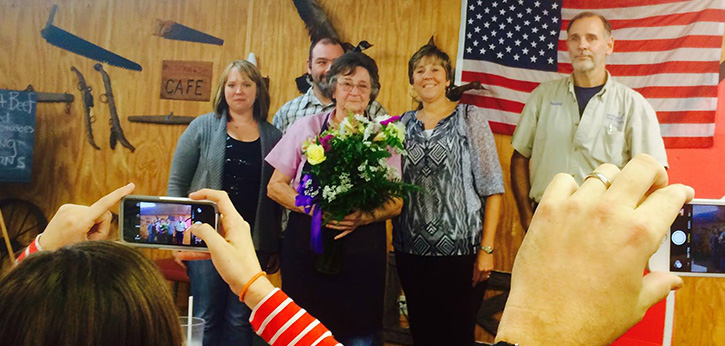
The iconic Fran’s Country Grill in Molino closed for good Friday night after a farewell and retirement party. The restaurant has been sold to nearby competitor Jimmy’s Grill and will reopen in a few weeks under that name.
 “There is only one Ms. Fran,” said Roy Wiggins, who has been eating at Fran’s for about 30 years. Friday night — as he enjoyed his final Fran’s meal of fried catfish, hush puppies and baked beans — he reflected on all the things the landmark restaurant and owner Fran Hampton has stood for over the years.
“She helped may people who otherwise would have gone to bed without food; she gave away many free meals,” Wiggins said. “She was just an icon in the community.”
New owner Jimmy Carter, of Jimmy’s Grill fame, said he will be open in the former’s Fran’s location in about three weeks — after a little remodeling.
“We are going to keep a few of her things on the menu,” he said. “She’s agreed to share a few of her recipes.”
“And we are looking forward to the move,” Carter said.
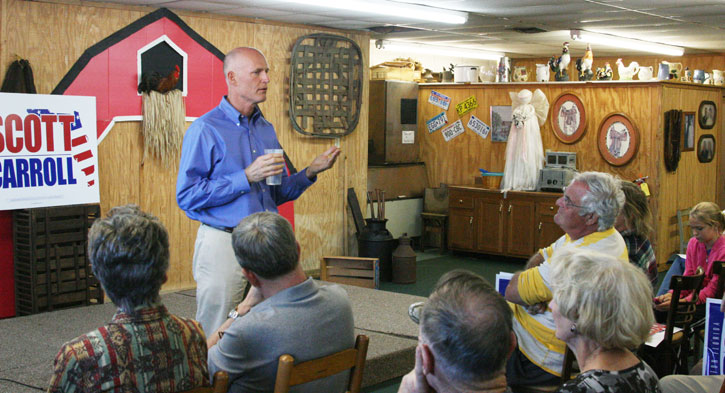
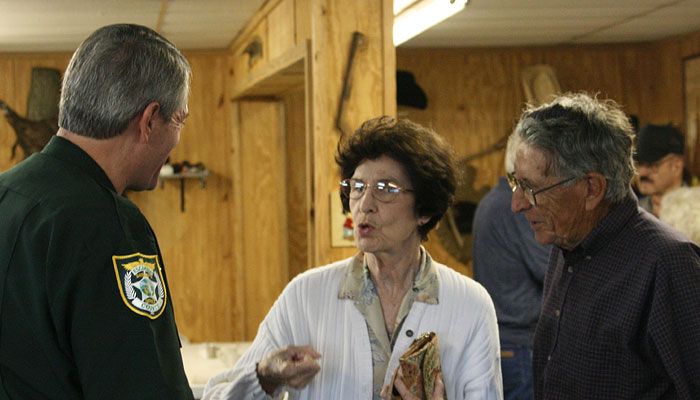
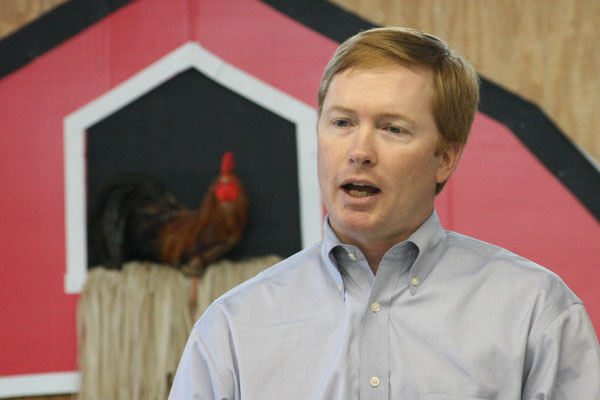
Pictured top: A farewell dinner was held Friday night as Fran’s Country Diner in Molino closed for the very last night. Pictured inset: “The” Fran, owner Fran Hampton, is retiring. (Photos courtesy Roy Wiggins). Pictured below: Fran’s Diner has always been at the center of local and state politics, with candidates like Gov. Rick Scott, Sheriff David Morgan and Commissioner of Agriculture Adam Putnam campaigning in recent years. NorthEscambia.com photos, click to enlarge.
Tate Earns District Win Over Washington (With Photo Gallery)
October 3, 2015

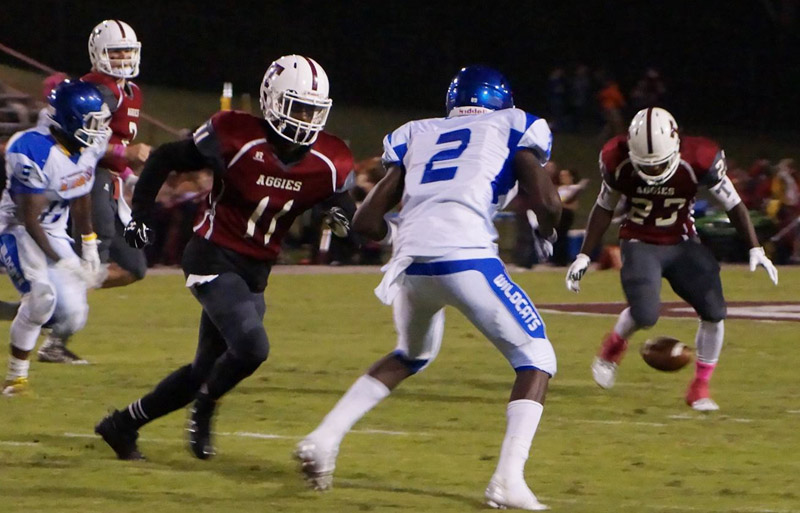
The Tate Aggies won their first district game Friday night as they powered past the Washington Wildcast 38-21.
 Washington took the lead 7-0 with 8:43 to go in the fist quarter at Pete Gindl Stadium in Cantonment following a 16-yard touchdown dash. A 57-yard drive ended for Tate with 5:23 to go in the first with a two-yard quarterback keeper from Sawyer Smith. Alonte Thompson was in on the two-point conversion to put the Aggies up 8-7.
Jake Henry hit paydirt from 34-yards out and, along with a good kick from Evan Legassey, the Aggies were up 15-7 with 37 seconds on the clock in the first.
Tate expanded their advantage to 22-7 with 8:28 to go in the second quarter on a touchdown dash from Alondo Thompkins. The Wildcats answered, with the score 22-13 Tate at the half.
The Aggies scored again with 7:50 in the third, with Thompkins from a couple of yards out. Tate missed a later field goal attempt, and Washington pulled within one TD, 29-21 with 9:30 to go in the ballgame.
Thompkins scored again in the fourth for the Aggies on a 49-yard run to put Tate on top 35-21. Then, with 4:08 in the ballgame, Legassey chipped in a 35-yard field goal for the final score 38-21.
The Tate Aggies (4-1, 1-0)) will take the short drive across the river to Pace next Friday night to take on the Patiots at 7:30 p.m.
NorthEscambia.com photos by Keith Garrison, click to enlarge.

Friday Night Finals
October 3, 2015
Here is a look at tonight’s final scores from high school football games across the North Escambia area.
FLORIDA
- Maplesville 32, Northview 0 [Read more, photo gallery...]
- Baker 48, Jay 26 [Read more, photo gallery. ..]
- Tate 38, Washington 21 [Read more, photo gallery...]
- Pine Forest 21, Escambia 17
- Bay 23, PHS 7
- Catholic High 19, Florida High 13
- Gulf Breeze 48, Milton 26
- Navarre 42, Pace 27
- Niceville 55, FWB 6
- South Walton 41, Freeport 8
- OFF: West Florida
ALABAMA
- Flomaton 38, Choctaw County 20
- Miller 27, Opp 26
- W.S. Neal 57, Monroe County High 20
- Escambia County (Atmore) 26, Faith Academy 14;
- Monroe Academy 41, Escambia Academy 12
Maplesville Downs The Northview Chiefs (With Photo Gallery)
October 3, 2015
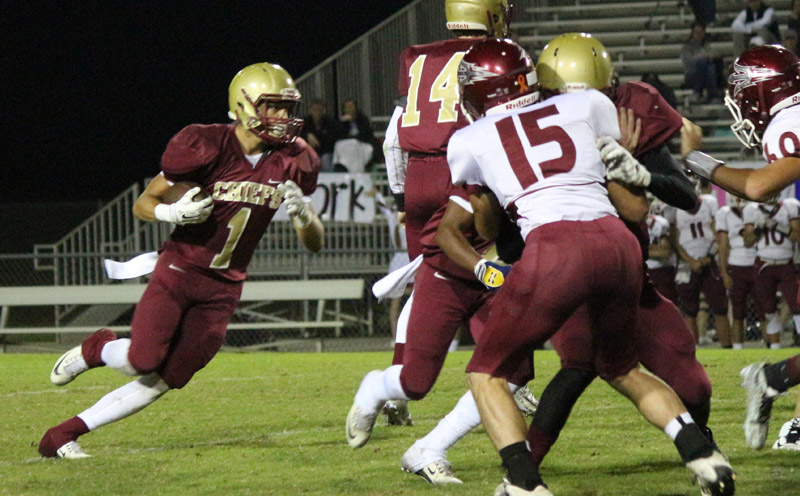
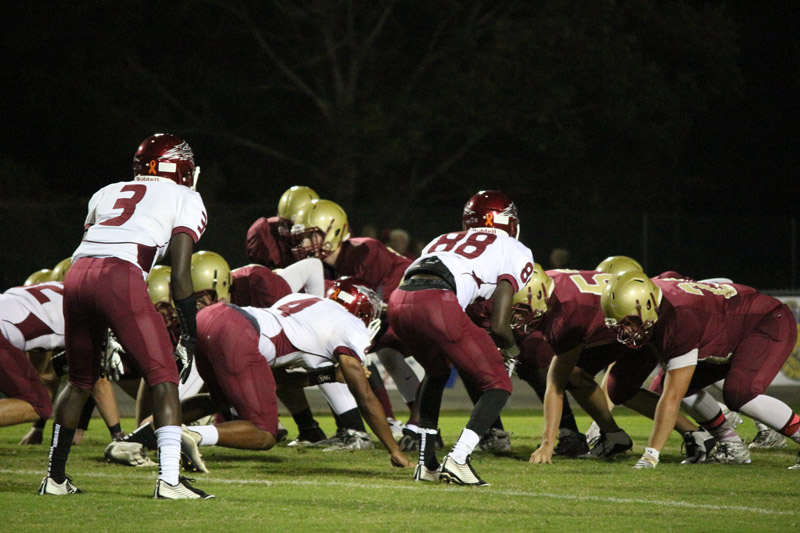
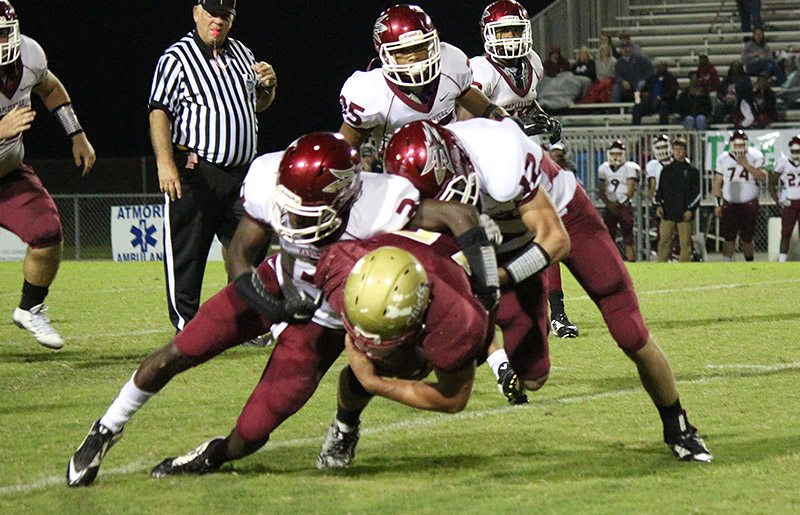
Alabama 1A powerhouse Maplesville shut out the Northview Chiefs 32-0 Friday night in Bratt.
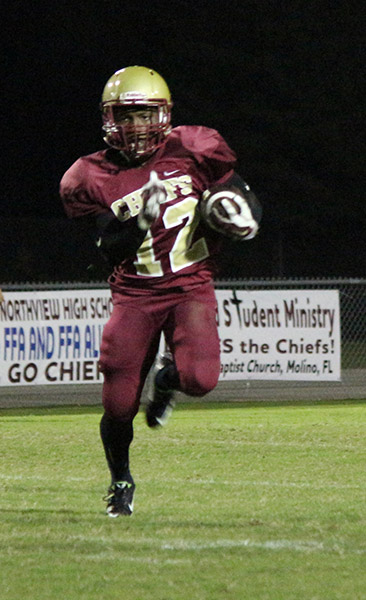 “We just beat ourselves,” Northview head coach Sid Wheatley said after the loss. “Nobody likes to lose, obviously, but when you beat yourself, you are not giving yourself a chance. And in my opinion, we firmly beat ourselves tonight.”
The Chiefs suffered through multiple turnovers that pushed Maplesville to the red zone, after the Red Devils took the lead on their first possession.
A pass from Northview quarterback Gavin Grant was intercepted by the Red Devils for an 11-yard touchdown dash following a 57-yard Maplesville run.
“It could have been 14-7 at the end of the second quarter,” Wheatley said, “but, again, we beat ourselves.”
Instead, Maplesville held a 13-0 lead at the half. A Northview turnover in the third set up another Red Devil touchdown, and a Northview fumble led to another Red Devil TD.
And after another Northview turnover, the Red Devils scored again.
“I liked the effort; I just did not like the execution,” Wheatley said. “We didn’t finish them off when we had those opportunities.”
Next week, it’s back to the basics for the Chiefs. “We’ve got to make sure we can take care of the football and have great ball security.”
The Chiefs will be back in Bratt next Friday night as they host Liberty county for the Chiefs’ homecoming.
NorthEscambia.com photos, with additional gallery photos by Gary Amerson for NorthEscambia.com, click to enlarge.


Forest Service, Fire Departments Watching Island Fire On Escambia River
October 3, 2015

Firefighters from the Florida Forest Service responded to reports of a wildfire in western Santa Rosa County along the shores of the Escambia River Friday afternoon. The fire was contained to a small parcel of land in the Escambia River marsh but crews cannot make access and will monitor it throughout the weekend.
The fire is in the area known as Noriegas Island and is surrounded by water. Aerial estimates put the island at about 10 acres and a fire size at less than 1 acre late Friday afternoon.
Smoke may persist throughout the evening and into the night and could impact U.S. 90. Drivers are urged to use caution if they encounter smoke on the roads and treat as if they were driving in fog. Motorists should turn on their low beam headlights or pull safely off the road until conditions improve.
Cantonment Man Charged With Burglary, Vehicle Theft
October 3, 2015
A Cantonment man is behind bars, charged with a burglary and a vehicle theft.
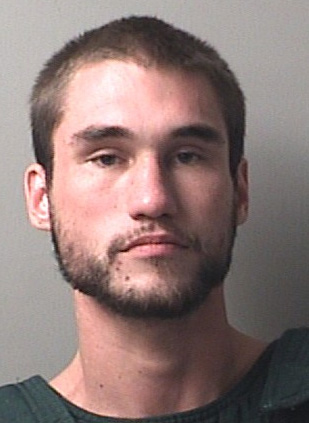 Sundown West Brown, 21, was charged with grand theft of a motor vehicle, burglary of an unoccupied dwelling, grand theft and criminal mischief. He was also cited for operating a motor vehicle without a license. Brown was also arrested on outstanding Pensacola Police Department warrants for burglary of an unoccupied dwelling and grand theft. He remained in the Escambia County Jail with bond set at $91,000
Brown was implicated in a September burglary at a home in the 1800 block of Bradley Avenue in Cantonment in which and iPad a nd cash were taken.
Deputies spotted Brown driving 1998 Ford Explorer that had previously been reported stolen from Etta Street.
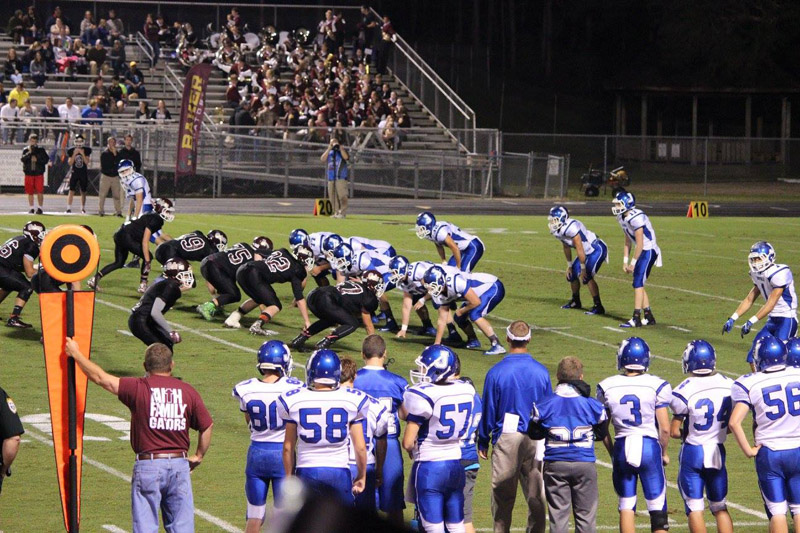
Baker Gators Top Jay (With Photo Gallery)
October 3, 2015
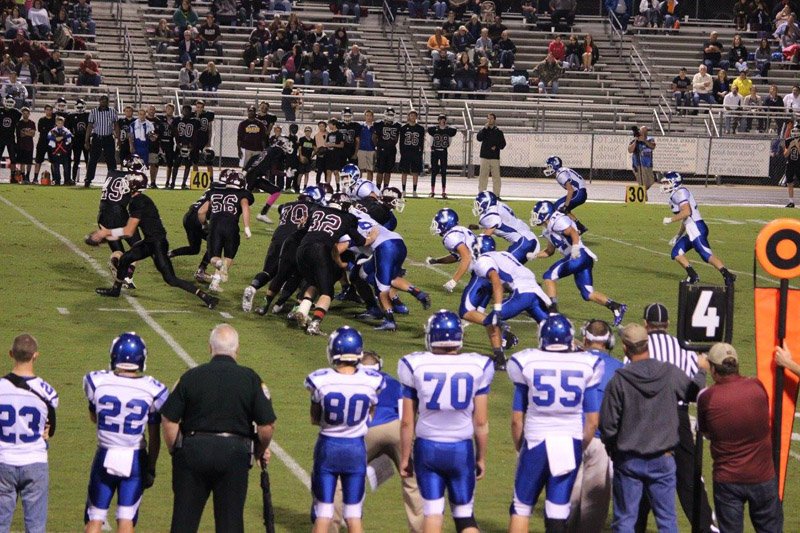
The Jay Royals opened district play Friday night with a 48-26 loss to the Baker Gators.
Next week, the Royals will host Cottondale.
Photos by Michele Gibbs for NorthEscambia.com, click to enlarge.