

Two Injured In Century Highway 29 Crash
April 1, 2018

Two people were injured in a two vehicle crash Saturday afternoon in Century.
The wreck occurred at the intersection of North Century Boulevard (Highway 29) and East Highway 4 about 3:35. Both of the injured were transported to area hospitals by Escambia County EMS.
Further details were not available as the Florida Highway Patrol continued their investigation.
NorthEscambia.com photos, click to enlarge.

Five Reported Injured In Cantonment Highway 29 Crash
April 1, 2018

Five people, including four minors, were reported to be injured in a two vehicle wreck in Cantonment Saturday afternoon.
The accident happened about 2:25 p.m. on Highway 29 in the area of Power Boulevard, south of Quintette Road.
Further details have not been released by the Florida Highway Patrol as they continued their investigation.
File photo.
Perfect Easter Weather Continues
April 1, 2018

Here is your official North Escambia area forecast:
Tonight: Patchy fog after 1am. Otherwise, increasing clouds, with a low around 56. South wind 5 to 10 mph becoming light after midnight.
Monday: Patchy fog before 9am. Otherwise, partly sunny, with a high near 82. Calm wind becoming south around 5 mph in the afternoon.
Monday Night: Partly cloudy, with a low around 64. South wind around 5 mph.
Tuesday: Partly sunny, with a high near 81. South wind 5 to 15 mph, with gusts as high as 20 mph.
Tuesday Night: Showers and possibly a thunderstorm after 1am. Low around 58. South wind 5 to 10 mph becoming west after midnight. Chance of precipitation is 80%.
Wednesday: A 50 percent chance of showers and thunderstorms before 1pm. Partly sunny, with a high near 67. North wind 10 to 15 mph, with gusts as high as 20 mph.
Wednesday Night: Mostly clear, with a low around 41. North wind 5 to 10 mph.
Thursday: Sunny, with a high near 70. North wind 5 to 10 mph becoming southeast in the afternoon.
Thursday Night: Mostly clear, with a low around 47. South wind around 5 mph becoming calm in the evening.
Friday: Mostly sunny, with a high near 76.
Friday Night: Mostly cloudy, with a low around 59.
Saturday: A 50 percent chance of showers and thunderstorms. Mostly cloudy, with a high near 75.
Saturday Night: A 40 percent chance of showers and thunderstorms. Mostly cloudy, with a low around 56.
Sunday: A 20 percent chance of showers. Mostly sunny, with a high near 75.
Firefighters Respond To Structure Fire Call In Molino
April 1, 2018
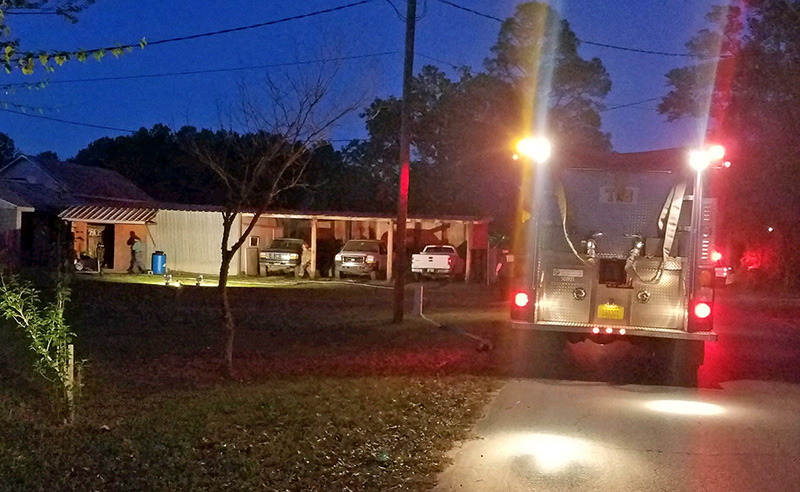
Firefighters responded to a reported structure fire in garage in the area of Fairground Road and Brickyard Road Saturday about 7:15 p.m. No major damage was reported. NorthEscambia.com photo by Kristi Barbour, click to enlarge.
Pace Man Killed In Boat Crash With Atmore Man
April 1, 2018
A Pace resident was killed Saturday when his boat collided with a boat operated by an Atmore man near Stockton, AL.
A bass boat operated by Wesley Scott Feely of Atmore collided with the driver’s side of a bass boat operated by Jackie Dewayne Cox of Pace, according to Alabama State Troopers.

The occupants of both boats were ejected into the water but were wearing personal flotation devices. Several boaters who heard the boat crash rushed to assist the victims. Several boaters who heard the boat crash rushed to assist the victims. They pulled Mr. Cox and his passenger, Lee Grandquest, of Semmes from the water, rendered first-aid and stopped one of the boats that was still circling without an operator. Acting Baldwin County EMA Director Jessie Peacock and his son Hayden were also fishing nearby and helped provide treatment and coordinated with Crossroads VFD and a Medstar EMS crew to guide them to the scene.
Cox was pronounced deceased at the scene. Grandquest was flown to USA Medical Center in Mobile, where. Feely was treated at North Baldwin Infirmary and released.
The cause of the accident is still under investigation by the Marine Patrol Division of the Alabama Law Enforcement Agency.
File photo.
Rubio: No Sure Bet That Year Round Daylight Saving Time Will Pass Senate
April 1, 2018

“I don’t think there’s any wrong or right answer, this is not a moral question,” the Miami-Dade Republican said Tuesday while meeting with reporters in Tallahassee. “Basically, it’s if you want it to get darker later or earlier. And it depends who you are. If your (children) are young, you don’t want them in the dark at the bus stop. If you like to play outdoors or go fishing in the morning, while it’s still dark, you’re in favor.”
Gov. Rick Scott signed legislation (HB 1013) last week aimed at putting Florida on year-round daylight-saving time, but such a change requires congressional approval.
Rubio submitted a pair of bills (S. 2537 and S. 2536) this month — one would keep Florida on daylight-saving time, while the other would make such a change for the nation. He said he was reflecting the will of state legislators.
U.S. Rep. Vern Buchanan, R-Fla., filed the House companion bills (H.R. 5279 and H.R. 5278).
“No matter what we do, I wish we were on one time the whole year,” Rubio added. “That would make it a lot easier.”
The idea of year-round daylight-saving time has been promoted as a way to help Florida’s tourism industry, as people would be able to stay out later with the additional sunlight. Hawaii and most of Arizona don’t participate in switching from standard time to daylight-saving time and back. They stay on standard time throughout the year.
Daylight-saving time this year started March 11 and ends Nov. 4.
A news release from Rubio’s office when he filed his bills pointed to several potential benefits from the change, including that additional daylight in evenings could reduce car crashes, help lead to more physical activity that would reduce childhood obesity and reduce the number of robberies.
But the Florida PTA Legislative Committee has opposed the change due to the potential impact on students, who could be waiting more at dark bus stops in the morning.
The Florida Chamber of Commerce on Tuesday noted it has received numerous inquiries regarding the legislation and sent out an explainer to members.
As part of a summary, the chamber said, “Here’s the key takeaway: despite all the rhetoric, changes are not imminent and are, in fact, very unlikely to occur anytime soon.”
Monday: A Look At A Local Weekend Car Show
April 1, 2018

Coming up Monday on NorthEscambia.com, we’ll take you to the Branden Penegar Memorial Car Show on Gonzalez with a look at (almost) every vehicle . NorthEscambia.com, click to enlarge.
Spring Fest Held At Victory Assembly Of God (With Photo Gallery)
April 1, 2018

 Victory Assembly of God hosted their annual Spring Fest on Saturday with an Easter egg hunts for all ages, an Easter egg hay ride, games, bounce house and prizes. The event also included exhibits from the Escambia County Sheriff’s Office, the Molino Station of Escambia Fire Rescue and more.
NorthEscambia.com photos, click to enlarge.


Florida Gov’t Weekly Roundup: Taking Odds On A Special Session
March 31, 2018
Capitol insiders heaved a collective groan Thursday after legislative leaders revealed they’re in the midst of behind-the-scenes talks that could lead to a special session before mid-summer.
Sen. Bill Galvano and Rep. Jose Oliva, Republicans who will take over as the leaders of their chambers later this year, have resuscitated persistently elusive gambling issues, as they explore a deal with the Seminole Tribe.
In the waning days of the 2018 session, Galvano and Oliva scrambled to reach consensus on byzantine gambling legislation that addressed a panoply of issues, including blackjack, roulette, craps and slot machines.
 But a school-safety measure prompted by the Feb. 14 massacre at Marjory Stoneman Douglas High School in Parkland eclipsed the gambling proposal, along with much other business, as the regular session drew to a close in early March.
The main reason for the revived interest in gambling issues, according to the GOP leaders, is a $400 million ante; that’s about how much the Seminoles currently pay the state for the “exclusive” right to run banked table games, such as blackjack, at most of the tribe’s casinos and to operate slots outside of Miami-Dade and Broward counties.
After a protracted legal battle, a federal judge sided with the tribe in a clash over whether lucrative “designated player games,” operated by many of the state’s pari-mutuel facilities, breached the exclusivity guarantee granted to the Seminoles.
The state and the tribe reached a temporary settlement, in which the Seminoles agreed to keep making the payments until Saturday. The weekend deadline sparked the push for the latest round of negotiations, Galvano and House Speaker Richard Corcoran said Thursday.
The designated player games are just part of the gambling puzzle. The tribe and the gambling industry in general are awaiting the outcome of litigation over controversial electronic games found in bars, strip malls and restaurants. Critics and a Tallahassee judge contend the “pre-reveal” games are unregulated slot machines.
The tribe also is paying close attention to so-called “internet cafes,” which the Seminoles’ lawyer, Barry Richard, claims are hosting illegal slot machines.
The Seminoles won’t reduce or stop payments to the state unless the disputed games have caused a “material economic impact” or “they feel they’re paying more money for the exclusivity than they’re getting value for,” Richard said.
“They (the Seminoles) have an increasing number of businesses that are coming in and that are blatantly violating their exclusivity,” he said in an interview. “They’re easy things to fix. … The Legislature hasn’t fixed those things. I don’t think it’s the tribe’s purpose to punish the state of Florida, but I think they want to get a fair value for their money.”
Lawmakers like Galvano, who’s been a chief legislative gambling negotiator for years, are eager for the cash-related certainty a new compact with the Seminoles would provide.
“The goal would be to have stability, and to know what to expect in terms of revenue share from the tribe and not be left in this ambiguous state where the tribe can stop paying, legally or not, and point to unresolved issues as the basis for their cessation,” Galvano, R-Bradenton, told The News Service of Florida.
But not all legislators are convinced of the urgency a special session implies.
According to Sen. Audrey Gibson, a Jacksonville Democrat who will take over as the Senate minority leader after the November elections, Galvano and other lawmakers had plenty of notice that the Seminoles’ payments could come to a halt.
“One full year after talks began on an agreement with the Seminoles, the subject was barely discussed until the last days of session when the budget conference was convened, too late for any real chance to pass a bill,” Gibson said in a statement Friday.
Gibson’s message also included a few words that could create even more dread for those whose anticipated time away from the Capitol could turn gloomy, should a special session come to fruition.
If they’re coming back to deal with gambling, Gibson urged lawmakers to add “a more thorough vetting of the measly” increase on school spending to the special session. While public schools will get more money next year, critics say the amount that can go to covering basic school operations would amount to 47 cents a student.
Whether an extra month or two will help gambling negotiators resolve what’s been a perpetually perplexing matter involving not only the tribe but the state’s numerous pari-mutuel operators and anti-gambling interests, such as Disney, remains a mystery.
“The tribe is always willing to talk to the Legislature,” Richard said, noting that legislative leaders hadn’t presented a proposal to the Seminoles as of Thursday evening. “The tribe is always open to discussion.”
YO, ADRIAN!
For the second time, a federal judge this week smacked down Gov. Rick Scott and the Florida Cabinet, who make up the state Board of Executive Clemency, for their willy-nilly process of restoring voting rights.
U.S. District Judge Mark Walker on Tuesday permanently blocked the state from moving forward with what he called a “fatally flawed” process of restoring the right to vote to convicted felons. Walker gave the state until April 26 to come up with a new system after striking down the current process as unconstitutional.
The Tuesday order came after Walker issued a ruling Feb. 1 that sided with the voting-rights group Fair Elections Legal Network. In that ruling, Walker found the state’s voting-restoration process is arbitrary and violated First Amendment rights and equal-protection rights under the U.S. Constitution’s 14th Amendment.
Also in the Feb. 1 ruling, Walker asked both sides to propose a new method to restore voting rights to ex-felons, who now must wait five or seven years after their sentences are complete to apply to have their rights restored in a process Walker said gives “unfettered discretion” to the board.
In a brief filed last month, attorneys for the state argued that Florida could permanently do away with the restoration of civil rights, sparking a rebuke from Walker in Tuesday’s order.
“This court is not the Vote-Restoration Czar. It does not pick and choose who may receive the right to vote and who may not,” Walker began Tuesday’s 22-page order.
Relying on a footnoted quote from legendary screen character Rocky Balboa, Walker mocked the defendants, writing that they claimed “the current scheme is all sunshine and rainbows.”
Walker accused the state of choosing to “essentially repackage the current scheme” that would allow Scott and the clemency board “to do, as the governor described, ‘whatever we want’ in denying voting rights to hundreds of thousands of their constituents.”
“This will not do,” the federal judge scolded.
Under the current system, felons must wait five years before applying to have their civil rights, including the right to vote, restored. Felons who have been convicted of certain violent crimes or sexual offenses must wait at least seven years before seeking a hearing to have their rights restored.
Once an application is made, the process can take years — and big bucks — to complete, and involves extensive documentation, such as certified copies of charges, judgments and other court documents.
Since the changes went into effect in 2011, Scott — whose support is required for any type of clemency to be granted — and the board have restored the rights of 3,005 of the more than 30,000 convicted felons who’ve applied, according to the Florida Commission on Offender Review. There’s currently a backlog of 10,085 pending applications, according to the commission.
In contrast, more than 155,000 ex-felons had their right to vote automatically restored during the four years of former Gov. Charlie Crist’s tenure, according to court documents.
Scott hasn’t said whether he intends to appeal Walker’s decision, but a spokesman said Florida elected officials, not judges, have the power to make decisions about clemency.
“This is outlined in Florida’s Constitution and has been in place for more than a century and under multiple gubernatorial administrations,” Scott spokesman John Tupps said in a statement. “The governor continues to stand with victims of crime. He believes that people who have been convicted of felony offenses including crimes like murder, violence against children and domestic violence, should demonstrate that they can live a life free of crime while being accountable to our communities.”
STORY OF THE WEEK: A federal judge permanently blocked Florida’s “fatally flawed” process of restoring voting rights to convicted felons, giving the state until April 26 to come up with a new method.
QUOTE OF THE WEEK: “Speech is an essential mechanism of democracy, for it is the means to hold officials accountable to the people. … Florida’s current scheme inverts that important democratic mechanism. It cannot do so anymore.” U.S. District Judge Mark Walker, in an order permanently blocking the state’s vote-restoration process.
by Dara Kam, The News Service of Florida
Escambia Man Gets 20 Years For Shooting His Landlord
March 31, 2018
An Escambia County man is headed to prison for shooting his landlord.
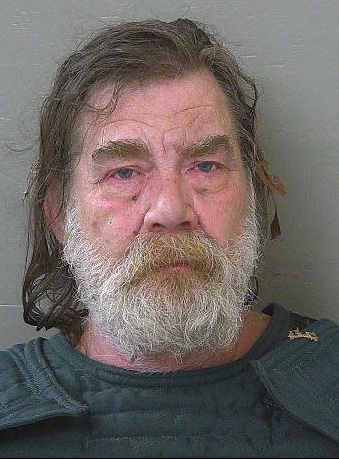 John Scott Borchert, age 63 of Pensacola, pleaded guilty to attempted first degree premeditated murder with a firearm, aggravated assault by threat with a deadly weapon, and possession of a firearm when subject to a domestic violence injunction.
Circuit Judge Jan Shackelford immediately sentenced Borchert to 20 years in state prison.
Prosecutors said Borchert got into an argument with his landlord. The victim asked Borchert to vacate the premises due to code violations. Borchert pulled out a firearm and shot the victim in the abdomen before threatening a witness with the gun.
After a brief struggle, Borchert was detained by the witness until law enforcement arrived. The firearm was recovered with Borchert’s DNA.