

McDavid Man Details Storm’s Destruction Of His Home
March 10, 2011
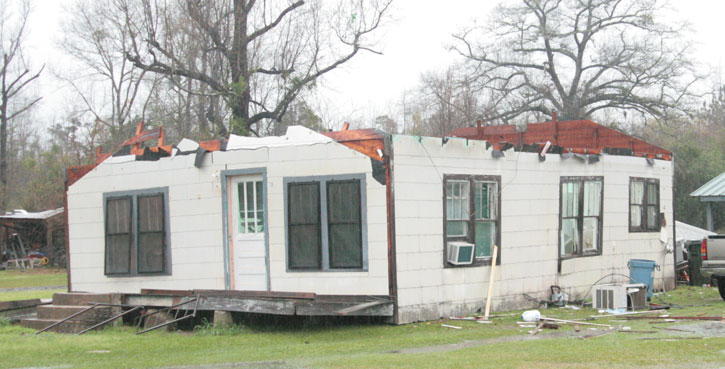
 James Milstead was a remarkably calm man Wednesday morning, considering that as he huddled in the hallway of his McDavid home, the roof was ripped from over his head and the entire house was moved from its foundation.
“I could tell something; you could feel something in the air,” Milstead said as he stood outside the Main Street home that had been in his family for 60 years. “It happened real quick. The windows started blowing out…the roof. And I’m trying to hold the doors, and it just pulls the doors out of my hands.”
He said he just dropped to the floor and pulled a jacket over his head for protection. The howling winds, he said, only lasted for five to 10 seconds.
But during the ordeal, he said his primary concern was not his home, but the mobile home and safety of his next door neighbors. The trailer survived intact, but the roof was severely damaged, wood and tin from other homes sticking out.
 Milstead, 58, did not immediately know where he would spend Wednesday night, but he was considering the small shed behind his home. It survived mostly intact.
“I have a generator,” he said. “I might just stay in there until I get this cleaned up.”
Milstead’s home was one of nine homes damaged or destroyed in small area either side of Highway 29 on Highway 164 or Main Street in McDavid. The American Red Cross worked to provide shelter to those that had no where to go after the storm.
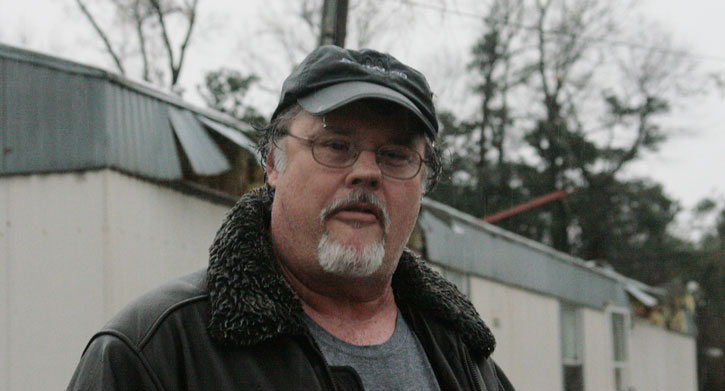
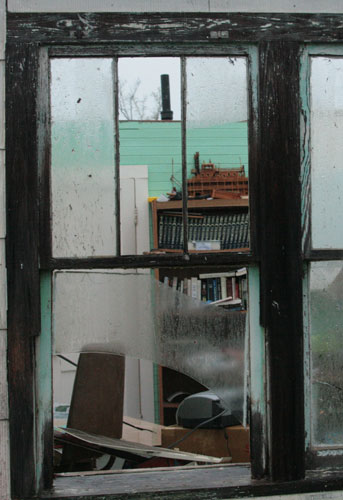
Pictured top: The roof was ripped from James Milstead’s McDavid home as the entire house shift several inches off its foundation. Pictured top inset: Milstead details his ordeal. Pictured bottom inset: Looking through a broken window of Milstead’s home into a room and up into the open sky. NorthEscambia.com photos, click to enlarge.
Photos: ‘The Sky Was Boiling’
March 10, 2011
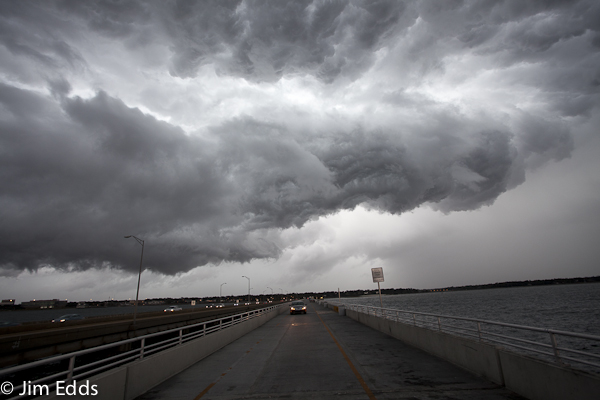
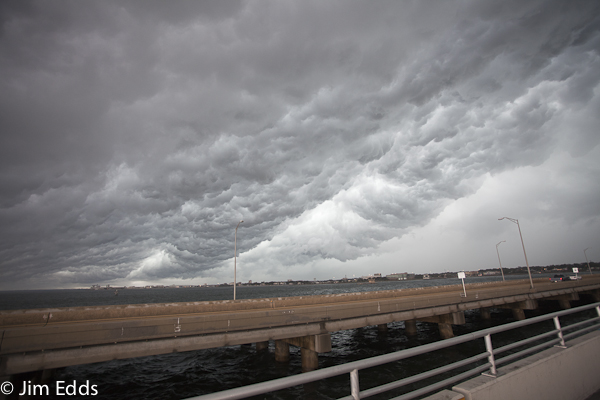
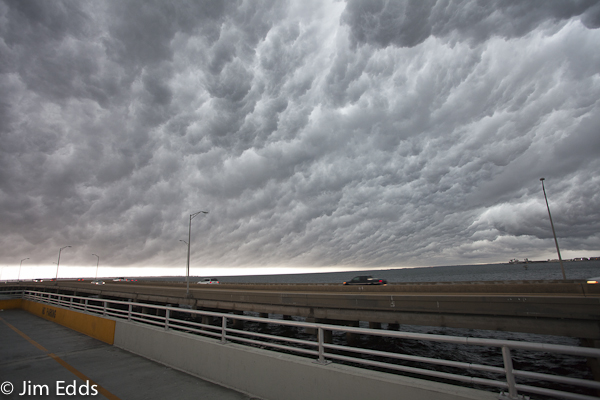
Professional storm chaser Jim Edds of Pensacola captured these unique images of Wednesday’s storms as they moved across Pensacola Bay.
“The sky was boiling,” is how Edds described what he saw.
Edds’ storm chasing footage has been aired on the National Geographic Channel, The Weather Channel, the Travel Channel and more. For more photos of the Pensacola storm, click here.
Pictured above and below: A line of storms moves across Pensacola Bay Wednesday morning. Photos by Jim Edds for NorthEscambia.com, click to enlarge.
Century Plans To Post Town Ordinances Online
March 10, 2011
The Town of Century is in the process of publishing its municipal codes online.
The town will spend $1,418 for the Municipal Code Corporation to publish seven copies of a printed supplement containing updates to the town’s ordinances. The town will also spend $500 per year for Municode.com to publish those ordinances online in a searchable format for the public. The yearly fee will includes updates each time a new ordinance is approved.
The Municipal Code Corporation is one of the nation’s largest municipal code publication companies. The company currently provides code services for hundreds of governments, including Escambia and Santa Rosa counties and Pensacola.
Evers’ Gun Bill Changed To Remove College Campus Carry
March 10, 2011
The National Rifle Association and Sen. Greg Evers were handed defeat Wednesday when Florida Senate Republicans decided that guns have no place on college campuses.
Robert Cowie, father of a Florida State University student who died in an accidental shooting, gave emotional testimony in a Florida Senate committee two weeks ago about the death of his daughter, Ashley Cowie, 20, who died on January 9 after another student’s rifle accidentally discharged at a party.
When that same committee met Wednesday, it voted to dramatically change Evers’ open carry bill. The measure (SB 234) allowed concealed weapons permit owners to “open carry” their weapons. Until Wednesday, it would have also allowed carrying of weapons on college campuses.
The intent of the bill, explained Evers, who represents the North Escambia area, was to make it so someone with a concealed weapons permit would not get in trouble for accidentally allowing glimpses of their gun.
Evers said he was saddened by Cowie’s testimony earlier, but pointed out the bill wouldn’t have changed the circumstances of Cowie’s death. What he meant was the student who allegedly shot her was under 21, the minimum age for someone to have a concealed weapons permit.
Evers has said in previous media interviews that he believes bringing guns on to school campuses actually improves safety. He told the Tallahassee Democrat that he had “no reservations about pushing the bill.”
Sen. Paula Dockery, R-Lakeland, offered an amendment during the Senate Criminal Justice Committee meeting on Wednesday that essentially keeps current law as it applies to campuses, banning the carrying of guns at colleges.
Dockery said she had heard from many universities and parents of college students who were opposed to the bill. She doesn’t like the concept of allowing guns on college campuses because of the “maturity level,” she said.
“This bill has caused a lot of anguish for parents and college students,” Dockery said.
Prior to the amendment by Dockery, the bill was opposed by many Florida university police forces and business groups, but backed by the powerful National Rifle Association.
Now the bill allows people with concealed license permits to carry their guns in full view in stores but not at schools and other prohibited areas. Randy Miller, a lobbyist for the Florida Retail Federation, said he is still opposed to the bill because it allows concealed weapons permit holders to openly carry weapons in stores.
Cowie’s Senate testimony two weeks ago was so emotional it moved some in the audience to tears.
“Allowing guns in an atmosphere of college parties puts everyone involved at increased and undue risk,” Cowie told senators. “Would you feel more or less at risk today if I were carrying a gun?”
The committee ran out of time Wednesday and didn’t take a vote on the bill, though Evers said he would bring it up again at the committee’s next meeting.
Tornado Hits McDavid; 9 Houses Damaged, 7 Homeless (With Photo Gallery)
March 10, 2011

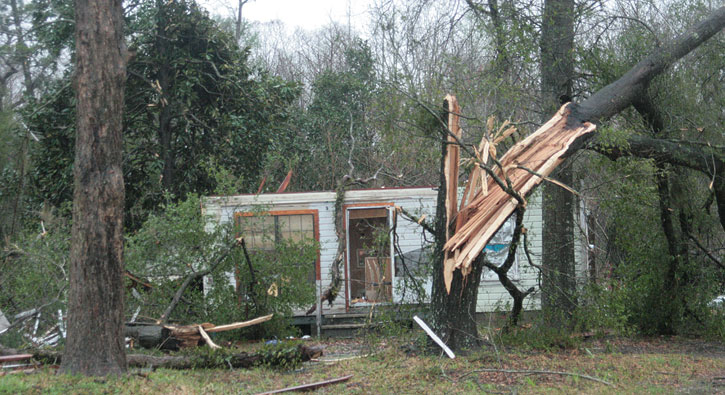
Nine homes were damaged or destroyed as an EF1 tornado hit McDavid Wednesday morning. There were no injuries reported.
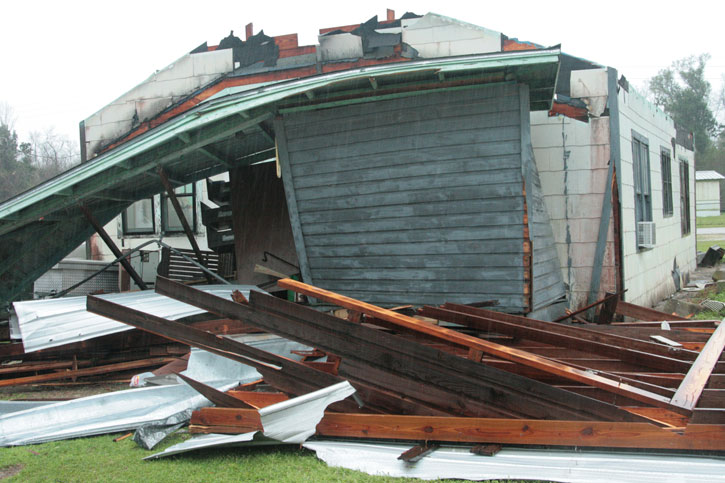 Four of the homes were demolished, two had moderate damage, while three suffered minor damage, according to an on-scene emergency command. A total of seven people in three structures were left homeless by the storm.
Three of the homes were Highway 164 just east of Highway 29, and six were on Main Street in McDavid.
FOR A PHOTO GALLERY FROM THE SCENE, CLICK HERE.
The first report of the possible tornado came from an Escambia County Sheriff’s deputy at Highway 99 and Mayhaw Road in Walnut Hill as he observed a possible funnel cloud picking up debris in a field. Minor damage was reported a short distance away, with trees down and a few windows broken at homes on Velor Road and Lambert Bridge Road. Trees were downed along Highway 164 several miles east of Highway 29.
But most of the damage was concentrated in McDavid, along Highway 164 near Highway 29 and on Main Street.
The American Red Cross is working to assist those that were left homeless by the storm.
NorthEscambia.com photos, click to enlarge.
EXCLUSIVE VIDEO: Watch As Possible Tornado Begins To Form
March 10, 2011
NorthEscambia.com shot video of storm clouds swirling and rotating Wednesday morning in Walnut Hill. The video was shot on Highway 97 near, and almost directly over, Ernest Ward Middle School. Moments later, an Escambia County Sheriff’s deputy reported a funnel cloud on the ground near North Highway 99 and Mayhaw Road, about one mile away.
Within minutes, the storm with an unconfirmed tornado had damaged or destroyed several homes near McDavid.
If you do not see the video at the top of the page, it is because your home, work or school firewall is blocking external YouTube videos.
NorthEscambia.com exclusive video.
Three Years In Prison For McDavid Man That Sold Gun For $40 In Marijuana
March 10, 2011
A McDavid man was sentenced to three years in state prison Wednesday for selling a firearm to a 16-year old in exchange for $40 in marijuana, eventually leading to a shot being fired into a deputy’s tire.
 David Dewayne Simmons, 49, was sentenced by Judge Ronald Swanson to three years in state prison for selling a firearm to a minor and possession of a firearm by a convicted felon.
In July, 2010, Simmons sold a .22 caliber handgun to Ladarrious Tamiraye Lett, 16, of Ivey Street, Century. Lett was later found guilty of possession of a firearm by a convicted delinquent under 24 years of age, tampering with evidence and culpable negligence. Lett was sentenced to nine months in the county jail.
The incident began at 3:23 a.m. on July 14, 2010, when Deputy Scott Rivkin conducted a traffic stop on a black Eagle Talon with no headlights near North Century Boulevard and Henry Streets. The driver of the vehicle was given a warning for failing to use his headlights. Lett was the passenger in the vehicle. Both left the area.
About five minutes later, Rivkin was traveling on North Century Boulevard in the same area as the traffic stop when when he heard what he believed to be a gunshot. Upon investigation, he discovered a .22 caliber pistol in the middle of North Century Boulevard. When the right rear wheel of the deputy’s cruiser rolled over the weapon, it had fired a round, flattening the tire. Next to the revolver, the deputy discovered one empty shell casing and five live rounds of ammunition.
While Deputy Rivkin was still parked on North Century Boulevard, he noticed the driver from the previous traffic stop and Lett approaching him on foot. The two were separated and questioned as the Flomaton Police Department responded for backup.
The driver told authorities that Lett had dropped the gun out of the vehicle’s window just prior to the traffic stop and that the pair had returned to the area to retrieve the gun. The 16-year old told deputies that he had purchased the gun from Simmons with a $40 bag of marijuana, and he provided a bill of sale. Lett admitted to dropping the gun out of the vehicle window, according to his arrest report.
Lett was originally charged as a juvenile in connection with the incident, but he was tried and convicted as an adult in Escambia County Circuit Court.
Storms Cause Injury, Damage In Santa Rosa County
March 9, 2011
The following is a summary of damage reported in Santa Rosa County as a result of Wednesday’s storms.
Structure Damage from high winds (The National Weather Service makes the determination if damage was caused by straight-line, microburst or tornadic activity):
- Damage to four homes in the 5000 block of Timber Ridge Drive off of Hamilton Bridge Road
- One home with major damage, approximately 50 percent of roof destroyed and water damage in the home, damaged estimates for structure approximately $100,000
- Three homes with minor roof damage
- Downed tree caused approximately $5,000 damage to a detached shed and above ground pool in the 4500 block of Teston Drive in Avalon.
Four fires were reported believed caused by lightning strikes as determined by fire departments:
- 8000 block of Molina Street in Holley-Navarre- residential fire
- 3900 block of Floridatown Road- residential fire
- 4900 Thoroughbred Drive- shed fire
- 5000 block of Persimmon Hollow Road- residential fire, lightning strike to propone operated stove
Other:
- One injury- Indirect lightning strike to a teenager at the Learning Academy, 5800 block of Stewart Street. The patient was touching a door handle when lightning struck nearby and was transported in stable condition to Santa Rosa Medical Center.
- Sporadic power outages, including several blocks of the downtown Milton.
- No official road closures.
After The Storm: What You Need To Know
March 9, 2011
After storms like Wednesday’s possible tornado in Molino, there are important next steps for those that have damage.
NorthEscambia.com has tips residents and business owners below. At the bottom of this page, you will find a list of important phone numbers to know.
Your Need To Know: Making The Claim
Contact your insurance agent as quickly as possible. Let them know about your losses. If you are relocated temporarily, provide the address and phone number. The claim process may begin in one of two ways. Your insurance company may send a claim form for you to complete or an adjuster may visit your home first, before you are asked to fill out any forms.
Most homeowners policies cover additional living expenses. Your insurance company should advance you money if you need temporary shelter, food and clothing because you can no longer live in your home and your clothes have been ruined. They will also advance you money if you need to replace major household items immediately to continue living there.
Keep receipts for everything you spend. Make sure the check for additional living expenses is made out to you and not your mortgage, the bank or other lender. This money has nothing to do with repairs to your home and you may have difficulty depositing or cashing the check without their signature.
Make only those repairs necessary to prevent further damage to your home or business. This must include covering breaks or holes in the roof, walls or windows with plywood, canvas or other waterproof material. Your insurance company will reimburse you for the costs of your repairs, so keep receipts for any materials you buy. Do not have permanent repairs made without first consulting your agent. Unauthorized repairs may not be reimbursed.
Avoid using electrical appliances, including televisions and stereos, which have been exposed to water, unless a technician has checked them.
If your car was damaged and you have “comprehensive” coverage in your auto insurance policy, you should also contact your auto insurance company.
Make as many photographs as possible of damage for documentation.
Your Need To Know: Preparing For The Adjuster’s Visit
An adjuster is a person professionally trained to assess the damage. The more information you have about your possessions the faster your claim can be settled. You should already have a complete inventory of the items in your home that includes a description of the item, model and serial numbers (if applicable) and the original cost and what it would cost to replace it.
Make a list of damaged items. Take photographs of the damage and put together a set of records for each item that includes any old receipts or bills. Don’t forget to list items such as clothing, sports equipment, tools, china and linens, etc.
Don’t throw away damaged furniture or other items because the adjuster will want to see them.
Identify the structural damage to your home and other buildings on your premises. Make a list of everything you want to show the adjuster when they arrive. In some cases, the adjuster may recommend hiring a licensed engineer or architect to inspect the property. You should also get the electrical system checked. Most insurance companies will pay for these inspections.
If possible, get written bids from reliable, licensed contractors on the repair work. This should make adjusting the claim faster and simpler.
Homeowners insurance policies usually don’t cover flood damage but they do cover other kinds of water damage. For example, they would generally pay for damage from rain coming through a hole in the roof or a broken window as long as the hole was caused by a hurricane or other disaster covered by the policy. You need a separate flood insurance policy to cover flood damage from any rising water. Contact your insurance agent regarding your coverage and the need for flood insurance.
If your home was severely damaged, you may have to rebuild sections in accordance with current building codes. In some cases, complying with the code may require a change in design or building materials and may cost more. Generally, homeowners insurance policies will not pay for these extra costs. Some insurance companies offer an endorsement that pays for a specified amount toward such changes.
Most insurance companies will pay for removal of trees that have fallen on your home but they will not pay to remove trees that have fallen and haven’t caused any damage to your home. Neither will they pay to replace trees or shrubbery that have been damaged by the storm.
Now is the time you should get an “insurance checkup”. Contact your insurance agent and make sure what your policy covers and doesn’t cover. After a disaster is not the time for surprises and finding out that you are not covered for losses.
Your Need To Know: Phone Numbers
- Emergencies: 911
- Gulf Power Company: 505-5711 or (800) 487-6937
- Escambia River Electric Cooperative: 1-877-OUT-EREC (1-877-688-3732)
- Frontier Communications: 611 or 587-5119 or (800) 476-4001 (611 will not reach Frontier from a cellular phone)
- ECUA: (850) 476-0480
- Bright House Cable: (866) 876-1872
- Energy Services of Pensacola (ESP): 474-5300
- DirecTV: (800) 494-4388
- Dish Network: (888) 284-7116
- Escambia County Sheriff: 436-9630
- American Red Cross: 432-7601
- Salvation Army: 432-1501
- Florida Department of Insurance: 800-22-STORM
- Florida Department of Agriculture: 800-435-7352
- Attorney General (Consumer Fraud): 850-414-3600
- Crisis Counseling & Referral: 888-532-4006
No Damage At Area Schools
March 9, 2011
There was no damage reported at any of the North Escambia area schools Wednesday morning as a possible tornado crossed the county just a few miles away.
Because a tornado warning had been issued by the National Weather Service, students were already in hallways and other safe locations.
The first report of a funnel cloud came from an Escambia County Sheriff’s deputy only about a mile from Ernest Ward Middle School.