

Following His Calling: Dentist Helps Those In Need
January 16, 2011
Dr. T.J. Morris is engaged in the work he loves at his dental clinic in Atmore, a full-time practice made possible largely by tuition loan repayment assistance from the National Health Service Corps.
Morris (his full name is Terry Jack Morris, Jr., but he goes by T.J. to avoid confusion with his father) has treated both adults and children at the clinic since the spring of 2010. “I fell in love with the people and the community here,” said Morris. “It has been a blessing from God to be able to serve these people, do what I love, and be compensated for it.”
 Morris is one of the few Medicaid providers in the tri-county area. He sees patients from neighboring counties, which is a big help to those who cannot afford to pay for dental care. Payments are charged on a sliding scale based on income, but no patient is turned away. Patients have shown their appreciation by offering him squash, fudge and homemade cakes.
“This is what God has called me to do,” he said. “I have never enjoyed working like this before.”
Atmore is located in a dental health shortage area, which is defined as an area where there are not enough dentists to serve the needs of patients in a particular geographic region.
After the death of Dr. Thomas Rice and the closure of another dental practice in Brewton, there was a definite need for dental services in Atmore and surrounding areas. Dr. Morris learned about the opening through a dentist in Mobile.
With special permission granted by the Alabama Board of Dental Examiners, Morris was able to purchase the established practice from the estate of the late Dr. Rice. He said this would not have been possible without federal financial support because he had a sizable student loan debt. Without the repayment assistance, he would not have qualified for additional loans.
For almost 40 years the National Health Service Corps has helped thousands of healthcare professionals practice in communities where they are most needed because of the financial assistance provided through student loan repayments and scholarships. Thanks to the American Recovery and Reinvestment Act of 2009, an additional $300 million was allocated to assist more professionals repay student loans.
Pictured: Dr. T.J. Morris provides dental care to a young patient at his Atmore office. Courtesy photo for NorthEscambia.com, click to enlarge.
Poarch Creek Indians To Open Florida Poker, Horse Racing Facility
January 16, 2011
The Poarch Creek Indians are expanding their gambling enterprises in Florida, announcing a new poker gaming center and horse track in Gretna, Florida.
Creek Entertainment’s Gretna will bring an estimated 400 jobs to the small town of 1,700 about eight miles south of the Florida-Georgia border. The 100 acre facility is expected to have a $2.5 million economic impact in Gadsden County initially. After a hotel and retail facilities are added during the second year, the facility is expected to have a $6 to $7 million impact according to Gretna officials.
The facility, to be located just off I-10, is expected to open in winter of 2011.
The facility is not the first Poarch Creek Indian gaming location in Florida — the tribe currently offers poker at the Pensacola Greyhound Park.
Scott: No Offshore Drilling Off Florida’s Coast Until It’s Safe
January 16, 2011
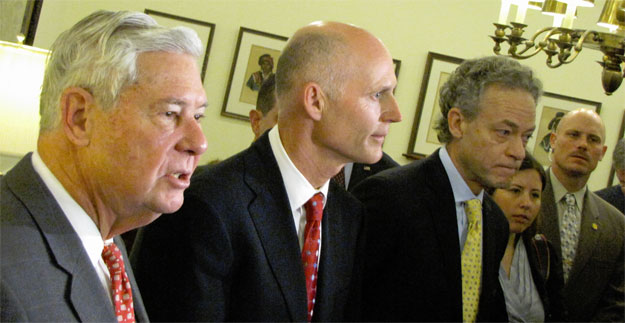
The two men may have different takes on offshore oil drilling, but former U.S. Sen. Bob Graham and Gov. Rick Scott agreed that no drilling should occur until adequate safeguards are in place to prevent a repeat of the worst oil spill in U.S. history.
“Neither of us wants any drilling until we are very comfortable that it is safe,” Scott told reporters after the meeting. “We can’t’ afford the environmental damage or the economic damage for our state.”
Graham met with Scott to discuss the findings of a federal commission set up to find out what went wrong with the BP Deepwater Horizon oil rig. Graham, co-chairman of the National Oil Spill Commission, was in Tallahassee as part of a national swing to publicize findings of the report that found untested drilling materials, lax government oversight and rig worker error combined to cause the tragic spill.
Scott has said he supports offshore drilling if proper safeguards can be guaranteed. During his campaign for governor, Scott said he agreed with a moratorium on drilling put in place after the spill by President Barack Obama.
But later in December, Scott was critical of a broader decision by the administration to ban most drilling in the eastern Gulf for seven years.
“I think the further away they are from the coast ,the more protection the coast will have,” Graham said.
Pictured: Gov. Rick Scott, center, and former U.S. Senator Bob Graham, left, speak to reporters after meeting to discuss the findings of the National Oil Spill Commission, co-chaired by Graham. Photo by Mike Peltier for NorthEscambia.com, click to enlarge.
More Residents Turn To Lifeline Reduced Rate Phone Service
January 16, 2011
More and more low income Floridians are taking advantage of a program that offers a reduced rate for basic telephone service.
The Florida Public Service Commission’s (PSC) annual report on Lifeline Assistance and Link-Up Florida shows enrollment continues to rise. Customers benefiting from the telephone discount programs increased by 3.8 percent from July 2009 through June 2010, reaching 642,129 participants.
Florida continues to be the largest net contributor to the federal Universal Service Fund (USF) supporting the programs, according to the PSC report Number of Customers Subscribing to Lifeline Service and the Effectiveness of Procedures to Promote Participation, which was sent to the Governor and Legislature this week.
All telecommunications service providers and certain other providers must contribute to the USF based on a percentage of their interstate and international end-user telecommunications revenues. Companies may pass these costs on to their customers. Service providers include wireline phone companies, wireless phone companies, paging service companies, and certain Voice over Internet Protocol (VoIP) providers. In 2008, Florida paid $482 million into the USF and received only $178 million back.
“I’m pleased that many consumers needing assistance continue to benefit from the Lifeline programs, but my goal is to make sure Florida receives an equitable share of benefits from the funds we’re contributing,” said PSC Chairman Art Graham.
Initiated by the PSC and Florida’s Department of Children and Families, the automatic enrollment process is the primary reason for the increase in Lifeline participation, according to the report. Other factors contributing to enrollment increase were the PSC’s Lifeline Awareness Week on September 13-19, 2010, and community outreach.
The federal Lifeline Assistance program offers customers who participate in certain public assistance programs a basic telephone service discount of at least $13.50 per month, or $162 per year. Link-Up Florida provides a 50 percent reduction in the telephone service installation charge, up to a maximum of $30, for qualifying households that do not currently have telephone service. Both landline and wireless providers offer the Lifeline program.
Applying for Lifeline is easy. Florida residents can call their local phone company, the PSC at 1-800-342-3552, or the Office of Public Counsel at 1-800-540-7039 for assistance. Information is also available at www.floridapsc.com and www.floridaopc.gov/lifeline.cfm.
Featured Recipe: A Twist On Grilled Cheese And Tomato Soup
January 16, 2011
This weekend’s featured recipe from Janet Tharpe is “Grilled Cheese And Tomato Soup”. No popping a can and American cheese here — wholesome ingredients are used for a homemade tomato soup and a blend of cheese combine for the sandwiches.
To print today’s “Just a Pinch” recipe column, you can click the image below to load a printable pdf with a recipe card.

Fire Departments Respond To Former Grocery Advantage
January 15, 2011
Fire stations from across the area were dispatched to the former Grocery Advantage in Molino Saturday evening.
Sparks were reported to be coming from a heating unit about 5:25 p.m., but firefighters reported the heater unit checked out with no problems. The burning smell was determined to be coming from a light ballast inside the building. No fire and no damage was reported.
The former grocery store is located on Highway 29 at Molino Road.
Sinclair, Bright House Extend Talks – Again
January 15, 2011

WEAR TV 3 did not disappear from the cable television lineup in Century and Cantonment Friday night as negotiations continue between Bright House Networks and the Sinclair Broadcasting Group. But the contract extension agreed to on Friday only lasts another week.
The original contract between Bright House and Sinclair, owner of WEAR TV 3, expired on December 31. But hours before that deadline, both sides agreed to extend it two weeks until midnight January 14 as contract talks continued.
Shortly before Friday’s deadline, both sides agreed to extend negotiations another week until January 21.
At issue is the fees that Bright House must pay Sinclair for the right to carry its broadcast stations such as WEAR. Nationwide, contract includes 33 Sinclair stations in 21 markets.
“We will continue to work diligently to reach a long term agreement and fair deal for our customers,” Bright House stated on their web site.
Weekly State Roundup: Legislature’s Turn To Get To Work
January 15, 2011
If last week was about Gov. Rick Scott fulfilling his campaign slogan and getting to work, this week it was the Legislature’s turn.
Lawmakers came back to Tallahassee for the first really substantive committee meeting in preparation for the 2011 session, and while they were here, they dove head first into a host of controversial issues, including immigration, pension and tort reform and gambling. It was all against a backdrop a budget shortfall that crept up to $3.6 billion this week, leaving them with plenty of work to get to.
 That news was enough to make even Senate President Mike Haridopolos, who made clear this week he is running for U.S. Senate, declare that always-popular tax cuts were likely off the table this year.
“If we see some opportunities for tax relief that we feel absolutely confident will create more jobs and actually grow the economy, we’re open to them,” Haridopolos said. “At this point, we are struggling so much with a $3.5 billion shortfall that tax cuts are not part of our equation.”
Gov. Rick Scott disagreed, providing the first glimmers of daylight between the more conservative governor and the more conservative legislative leaders. Scott campaigned on cutting the state’s property taxes by $1.4 billion and phasing out the corporate income tax over seven years – with a first-year reduction of $835 million.
“We’re going to deal with the deficit,” Scott told reporters during a visit to the state’s emergency operations center. “But…the way to get the state back to work is to cut property taxes and phase-out the corporate income tax, and we’re going to get that done.”
It wasn’t clear, though, just how to do that, even to the Senate’s long-time budget chief, Sen. J.D. Alexander, R-Lake Wales.
“We have 300,000 homes in Florida that the power is turned off on, we have 23 percent of all residential mortgages are not current. These are very challenging times for the people of Florida….we’ve got to live on what we have,” he said.
Meanwhile, on the first floor, Gov. Scott was settling in as his regulations office was beginning to work through the 900 or so agency-drafted rules it now must vet before they can go into effect. Scott has kept hims promise to slow down rule making, and his office has cleared about five of the regulations to go ahead and get to work.
The governor’s office signed off on about $80 million in road and bridge projects that were held up, and cleared new rules for Lottery scratch-off games. Another rule that is now free to go is one affecting Medicaid reimbursement for hospitals. Contracts and grants were also starting to come unfrozen, with hundreds of millions in environmental projects and local grants allowed to resume.
Also this week, the Senate waded into the controversial immigration debate, which figures to be a hot topic in several state legislatures as they look to replicate an Arizona law that inflamed national debate last year.
But the Senate only stuck its toe in the water, holding a three hour meeting to gather information from homeland security officials, the state Department of Education, the Department of Corrections and the Department of Highway Safety on how both legal and illegal immigration affects the state. Sen. Anitere Flores, R-Miami, who chaired the meeting and is Hispanic, said it was just intended to get people talking.
And it did.
“If they bring something similar [to Arizona's law], it will be a good sign that they are ignoring Floridians,” Juan Chavez, a membership organizer for the Florida Immigrant Coalition, said. “And that’s basically a good sign to destroy the economy of the state. So we’d be basically legalizing racial profiling if they bring something similar.”
Sen. Mike Bennett, who so far is the sponsor of the Senate measure to give police additional powers to check immigration status, also did some interesting talking. He said after hearing from interested parties, he’s not even sure he could vote for his bill in its current form.
Later this week, Agriculture Commissioner Adam Putnam, whose office promotes and regulates an industry that depends in part on immigrant labor, urged caution.
“Florida policy makers have to be very thoughtful about this issue,” Putnam said. And simply “cutting and pasting” the Arizona law is not very thoughtful, he said.
Not only is the ag industry concerned about how immigrants perceive the state’s attitude toward them – the whole state depends on having a good image among foreigners. “We are an international tourist destination,” Putnam pointed out. And, he said, a business magnet for Latin America. Hostility doesn’t go over well when trying to get people to invest here, he said.
“We have to be very careful about the messages that we send,” cautioned Putnam, who bemoaned the fact that he was unable to get the federal government to come up with a solution to the immigration problem while he was in Congress.
Gaming was also in the cards this week as lawmakers began playing their hands after Scott played his last week – though he quickly tried to pick them back up. Doing the dealing this week was the same panel of lawmakers that helped orchestrate the Legislature’s gaming compact with the Seminole Indian Tribe. They’re shuffling the deck to see if authorizing non-Indian, Vegas style casinos or online poker might increase the state’s winnings.
Senate Regulated Industries Committee Chairman Dennis Jones is betting on it. He told reporters this week he is in the process of drafting legislation to allow more gambling options if the committee decides to proceed. Inviting Las Vegas style gaming to the state could be appealing because it would allow cities to attract big convention business, Jones said.
WHICH WAY IS THE TRAIN GOING?
Senate President Mike Haridopolos had to explain this week why he was for rail before he was against it.
First, members of a committee that Haridopolos created made it clear they’re more interested in a high speed rail connecting Tampa and Orlando than he is. Haridopolos has said recently that even if the state has to pay $280 million instead of the $2.6 billion the train is projected to cost – the feds have offered to pick up most of the tab – it still would be too expensive.
But Sen. Paula Dockery, a member of the Senate Tourism and Commerce Committee, noted that Haridopolos supported another train that the state is paying to buy the tracks for: SunRail.
Haridopolos explained the difference by saying the trains themselves were different.
“(SunRail) is something I chose to support because it is a mixture of funds,” he said. “It’s federal, state and local. This is a project that has been worked on in Central Florida for over 10 years. It is supported by Republicans and Democrats alike and the local governments and that particular DOT region chose to use some of their road money for rail because they thought it would be very important to that region.”
Many of the same things could be said of the high speed rail project, but Haridopolos said a key difference is that voters have weighed in on the high speed train twice. One time they were for it, one time they were against it, which is what critics were saying of his position this week.
Associated Industries of Florida, one of the state’s major business lobbies, announced it was forming a high-speed rail coalition, which it said would include “private-sector companies that want the jobs, the work and the prestige that will come from being a part of Florida high speed rail.”
“Decisions to abandon the project can always be made further down the road if the conditions are not ideal,” AIF said in a statement. “Right now, we have an opportunity to leverage private investment to secure billions in federal dollars for a project that will have an incredibly positive impact on our state. Let’s not derail high speed rail.”
Elsewhere, Attorney General Pam Bondi likely surprised some of her supporters by asking a federal court to dismiss a case filed by two members of Congress that attempts to strike down a recently passed amendment to the Florida Constitution changing the way congressional districts are drawn. Those amendments, 5 & 6, are widely presumed to help Democrats, making it odd that a new Republican AG would object to the lawsuit.
Bondi didn’t come out against the effort, she merely said the plaintiffs were in the wrong court. The voting rights act issues should be before the D.C. federal circuit.
STORY OF THE WEEK: The issues that will shape the 2011 legislative session continued taking shape this week, with lawmakers taking issues such as immigration, pension and tort reform and gambling. But looming in the background on all those issues is a budget deficit that got a little bit bigger this week, increasing to $3.6 billion.
QUOTE OF THE WEEK: “We have some significant work ahead of us. Our first priority will be to make a budget work,” Senate Ways and Means Committee Chairman J.D. Alexander, though it wasn’t immediately clear this week how.
By Keith Laing
The News Service Florida
Donations Needed For Molino Family That Lost Everything In Fire
January 15, 2011
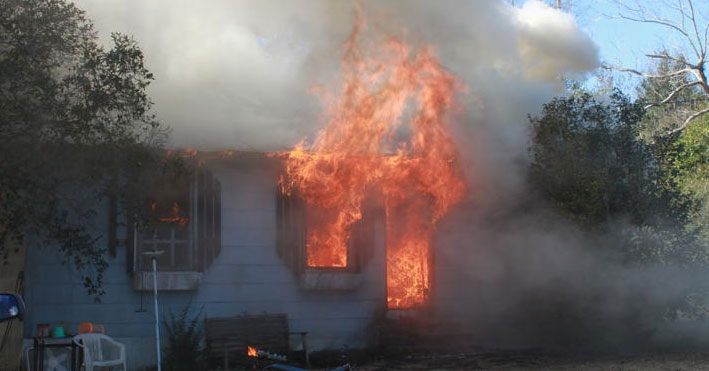
Donations are needed to assist a Molino family that lost everything in a Wednesday morning house fire.
Three people were left homeless by the fire that killed several family pets about 11 a.m. on Jahaza Road.
Clothing sizes needed by the family are:
- Adult female: Pants, size 8. Medium/large shirts
- Adult male: Pants size 32/30. Large shirts.
- 16-year old female: Pants size 7 tall. Adult medium shirt, shoes size 7½ to 8.
The family also needs household items.
Donations for the family can be dropped off at Southern Mill and Supply on Highway 97 just north of Molino Park Elementary School from 8 a.m. to 6 p.m. Monday-Friday or from 8 a.m. until noon on Saturday.
For more information, contact Jess at (850) 777-7141.
For more photos and information about the fire, click here.
NorthEscambia.com file photo, click to enlarge.
Escambia Elementary Targeted For Closure
January 15, 2011

The Escambia County School Board is targeting another elementary school for closure and consolidation.
Superintendent Malcolm Thomas is recommending that the board approve the closure of Spencer Bibbs Elementary School, one of the oldest in the county due to low enrollment numbers and high costs. Thomas said that last year the district lost $600,000 by keeping the school open with just 241 students. This year, he estimates the drain on the county system to be up to $1 million to keep the doors open.
If the school is closed, just over half of the students would be shifted to a new, yet-unnamed downtown elementary school that opens in the fall. The remainder would attend O.J. Semmes Elementary.
Hallmark and Allie Yniestra elementaries will also be closed and consolidated into the new downtown elementary school.
Also during Thomas’ term as superintendent, he recommended the closure and consolidation of Carver/Century K-8 with students shifted to Bratt Elementary and Ernest Ward Middle schools.
Pictured top: Escambia County Commissioner Marie Young reads to students at Spencer Bibbs Elementary School. Courtesy photo for NorthEscambia.com, click to enlarge.