

Septic Tank Inspection Program Delayed
January 20, 2011
A new law went into effect January 1 in Florida requiring that septic tanks be inspected every five years, but now that law has been put on hold. Gov. Rick Scott let a bill providing for the delay become law this week without his signature, undoing the controversial mandate.
The bill, which was passed during a veto override special session last November, targets a provision in a wide-ranging springs protection bill that the requirement was included in last year.
 Scott had 15 days from receiving the bill (SB 2A) to sign it or let it become law anyway. The bill had been on Scott’s desk since he took office January 4.
Senate Majority Leader Andy Gardiner, R-Orlando, called Scott’s inaction on the bill “a decisive step” which “postpones the implementation of septic tank inspection regulations, enabling lawmakers to analyze whether or not such a mandate is necessary and saving taxpayer dollars in the mean time.”
SB 2A is sponsored in part by Greg Evers, who represents the North Escambia area.
“The septic tank regulations are especially close to home for Northwest Florida residents, and Senators Evers, Dean and Gaetz have been instrumental in addressing concerns and preparing legislation that offers more time to assess such impactful regulation,” Senate Majority Leader Andy Gardiner said. “This provides us with time to thoroughly vet options and gain feedback from constituents in order to make the most well-informed decisions.”
“It doesn’t make any sense to me, and I want it repealed. Why is the state government involved in that? It makes no sense,” Scott told NorthEscambia.com about the septic tank inspection requirement during an exclusive campaign trail interview last November.
Schools Could Face $31 Million In Fines For Missing Class Size Goals
January 20, 2011
School districts in Florida — including Santa Rosa County — could share in $31 million in fines for failing to comply with the state’s class size law.
House Speaker Dean Cannon told reporters Wednesday that the House Education Committee will likely examine the fines that schools must pay if they do not comply with the state’s class size law.
 Escambia County was among 32 of Florida’s 67 school districts that met the mandate that dictates how many students can be in certain classes at each grade level, but Santa Rosa County had a total of 393 classes not in compliance, according to a state report.
In 2002, voters approved a constitutional amendment that capped classroom sizes at 18 students in a classroom in lower grades, 22 in the middle grades and no more than the current cap of 25 students in a high school classroom. The caps were phased in over the last few years, but this was the first school year where schools had to fully comply with a hard cap on a per classroom basis.
About 5 percent of the state’s schools could not meet the caps, according to the Department of Education.
The State Board of Education this week recommended $31 million in fines for districts across the states, which will now go before the legislative budget commission for final approval.
Cannon said Rep. Bill Proctor, R-St. Augustine, who chairs the House Education Committee, is looking at that issue and it will probably be one of many education issues on the legislative agenda this spring. There is no set form on how the issue will proceed though.
“And again, it depends I think in large part to degree, to the extent that most districts worked very, very hard to come close to compliance,” Cannon said. “I think they should get credit for that. But it may have to be done on a case by case basis.”
To The Editor: Nadine McCaw Thanks Community For Support
January 20, 2011

I wanted to write a letter to the editor to express all the appreciation that we have to you and everyone that reads your online news source for the north end of Escambia County. You have published every event fundraiser to help build awareness of my Clear Cell Renal Carcenoma (Kidney Cancer)and the struggles we have faced since my insurance has dropped my coverage. I was able to find some help through some of your readers with the medical bills that have come in so far.
I have a few good days but more bad than good. I have a LONG fight ahead and will be on chemo for at least 6-8 more months to fight the cancer that has spread to my lungs and lymph node system. This has been very trying on me and my whole family, emotionally, physically and financially. The prayers and the support the community have given to me has been more than I could have ever asked for. You have helped me to keep my faith strong to fight the fight of this horrible disease.
I have found many angels that walk about the streets of Century, and I hope that they continue to touch the lives of the different people of our town. The food that had been brought, the donations to help with the medical bills that have been piling up, the benefits that have been held and the participants that helped out during those functions has been more than I ever expected to receive. I pray that God blesses each and every one in the way that I have been blessed.
Nadine McCaw
Century, Florida
To submit a Letter To The Editor, email your letter to news@northescambia.com. You must include your real name, address and contact phone number for verification. Letters are limited to 400 words, are subject to editing and must meet our editorial guidelines.
Rabies Alert For Santa Rosa
January 20, 2011
The Santa Rosa County Health Department is warning residents to avoid raccoons and other animals after two residents came in contact with raccoons that may have had rabies.
A raccoon that possibly had rabies came in contact with a family pet; the pet had to be euthanized because it had not received the rabies vaccine.
Rabies is a disease that affects the central nervous system. The virus is carried in the saliva of infected animals and is usually transmitted to people and other animals through a bite or scratch. Most cases of rabies occur in wild animals such as raccoons, foxes, skunks and bats, but domesticated animals can carry it as well. The disease is fatal to humans and animals.
The following precautions should be taken to avoid exposure to rabies:
- Avoid all contact with wild and unfamiliar domesticated animals.
- Do not place feeders in the yard – the food will attract unwanted animals such as raccoons and foxes.
- Vaccinate your pets against rabies and keep their shots up-to-date.
- Do not leave your pets outside unsupervised.
- Bring in pet food at night and secure trash cans with fasteners.
- Cover bird feeders. Most squirrel-proof coverings also deter wild animals.
- Vaccinate pets against rabies and keep their vaccinations up-to-date. Follow your veterinarian’s recommendation for revaccination
- If bitten or scratched by a wild animal or stray domesticated animal, wash the wound immediately with soap and water. Seek medical attention immediately and report the incident to the Santa Rosa County Health Department at 983-5275 from 8 a.m. to 5 p.m. Monday – Friday, or after hours call 418-5566.
If you see a suspicious animal in your yard or neighborhood, please call animal control at (850) 983-4680. If a dead wild animal is on your property, please contact the Florida Fish & Wildlife Conservation Commission’s regional office at (850) 265-3676, or their 24-hour law enforcement hotline at (888) 404-3922.
Escambia Seeks Rights Of Way For Nicholson Drive In Molino
January 20, 2011
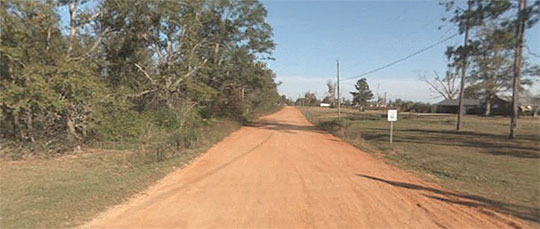
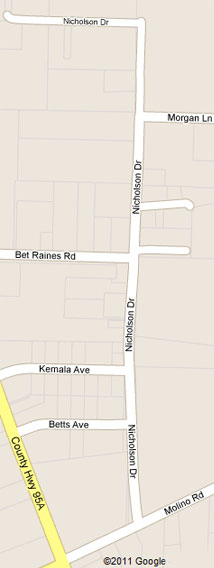 Escambia County is moving forward to obtain rights of way and easements for a proposed paving and drainage project for a portion of Nicholson Drive in Molino.
Nicholson Drive is a county maintained road that extends north off Molino Road for approximately 4,000 feet. The southern 2,000 feet, between Molino Road and Bet Raines Road, is unpaved.
The Escambia County Commission has authorized county staff to move forward with the acquisition of property for rights of way and easements on or adjacent to Nicholson Drive so that the southern portion of the road can eventually be paved.
Scott Says Tax Breaks Are Coming
January 20, 2011
Gov. Rick Scott said Wednesday that he expects his budget blueprint to sail through the Legislature, promising it will include deep program cuts and more than $2 billion in tax reductions.
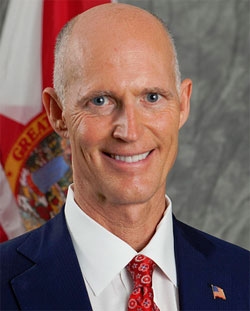 Two weeks into his first elected job, the governor promised that the budget proposal he plans to roll out Feb. 4 will include sharp spending reductions aimed at covering a $3.6 billion shortfall caused by the end of federal stimulus dollars flowing to Florida and a three-year decline in tax collections caused by the feeble economy.
But Scott still promises to make good on his campaign pledge to phase-out the state’s corporate income tax and cut property taxes.
“I’m going through every line item in the budget,” Scott said. “But I don’t think we should be spending this much money. I don’t think we do a good enough job of how we buy things.”
Scott shrugged off growing skepticism from fellow Republicans in the Legislature about whether the budget balancing act – which the new governor conceded was “thankless” – could include his promised property tax cut of $1.4 billion and a first-year rollback of more than $800 million in the state’s business tax.
House Speaker Dean Cannon, R-Winter Park, said lawmakers were struggling to close the state’s budget gap, and saw little chance of tax cuts being handed out this spring.
 “If there’s a way they can be reduced and still meet the critical needs, I’m open to it, but…it’s going to be very difficult, ” Cannon said, adding that it would be up to the governor to show lawmakers the path to tax-cutting. “I haven’t seen a way (to cut taxes) yet that I’m persuaded is doable,” Cannon said. But he added, “If there’s a workable way they can be reduced, great. I haven’t seen proposals yet that I think can achieve that.”
Scott didn’t provide any plans Wednesday. But he did offer a general condemnation to the state’s current approach to spending – a product of a dozen years of Republican control of the governor’s office and Legislature.
Scott said the state spends far too much on unnecessary services and that too many people see state government as a money-making venture.
“We’re not here to solve every problem,” Scott said. “We’re here to make life better and help people get jobs.”
The former health care executive also broadly described his approach to budget-making, likening it to his experience in private business. “You’ve got to pick and choose,” Scott said. “You can’t do everything. You’ve got to do the things that are the most important at the time.”
Scott reaffirmed his commitment to cutting state regulations, overhauling state agencies, and courting business leaders across the globe to help blunt Florida’s roughly 12 percent unemployment rate. He touted Tuesday’s announcement by Vision Airlines that it was adding flights through Destin in the Florida Panhandle as an example of an early success by his office in achieving his job-creating goal.
Scott said that if Vision’s expansion brought 150 jobs to Florida, it would slightly winnow down his promise of creating 700,000 new jobs over the next seven years.
By John Kennedy
The News Service Florida
Photos: Chinese Acrobats Perform At Byrneville Elementary
January 20, 2011


Students at Byrneville Elementary School recently enjoyed a performance by a group of Chinese acrobats. With plate spinning, impressive hula-hooping , basketball tricks and lots of acrobatics, the group amazed the BES audience.
Pictured above: Chinese acrobats perform a plate spinning demonstration. Pictured let: Chloe Smith from Mrs. Dunsford’s third grade class, gets quick instructions before hula-hooping with the group. Pictured below: A group of Byrneville students enjoy the show. Submitted photos by Candice Thornton for NorthEscambia.com, click to enlarge.

Ag Comm. Introduces Forestry Resolutions
January 19, 2011
At Wednesday’s meeting of the Governor and the Cabinet, Agriculture Commissioner Adam Putnam introduced a resolution in honor of the 75th anniversary of the Florida state forest system. Beginning this month and throughout the year, the Division of Forestry at the Department of Agriculture and Consumer Services will hold numerous special events in state forests to commemorate this milestone in Florida’s overall public land management program.
“For 75 years, Florida’s Division of Forestry has worked diligently to protect the forests of Florida from the dangers of wildland fire and to ensure our forests will be preserved for generations to come,” Commissioner Putnam said. “The Division of Forestry also plays an important role in educating the public of the value of Florida’s state forests and the steps we must take to preserve this natural resource.
In 1936, the Florida Department of Agriculture and Consumer Services’ Division of Forestry began managing state lands with the establishment of Pine Log State Forest near Panama City. Today, more than 1,250 dedicated employees across the state work together to manage 35 state forests, encompassing more than one million acres.
Each year thousands of people visit the state forests of Florida to enjoy a multitude of diverse outdoor recreational opportunities such as hiking, horseback riding, canoeing, camping, off highway vehicle (OHV) riding and hunting. The Division of Forestry also manages the popular Trailwalker and Trailtrotter programs, which reward participants who hike and/or horseback ride in state forests.
At the meeting, Commissioner Putnam also introduced a resolution declaring the fourth week in January as “Prescribed Fire Awareness Week.”
“Florida is the most progressive state in its use of prescribed fire to manage land,” Commissioner Putnam said. “Prescribed fire is a safe way to apply a natural process, ensure ecosystem health and reduce wildfire risk.”
Prescribed fire is used to reduce hazardous fuel buildups, thus providing increased protection to people, their homes and the forest. Prescribed fire provides better forage for wildlife and livestock, returns nutrients to the soil, helps to control certain plant diseases and reduces hazardous fuel buildups.”
Florida has the most extensive prescribed burning programs in the country. There are currently more than 1,500 certified prescribed burn managers in Florida helping to prescribe burn more than 2.7 million acres of agricultural and natural lands annually.
Escambia Student Drug Testing Plan Advances
January 19, 2011
The Escambia County School Board is moving forward toward a policy of random student drug testing next school year for students that take part in extracurricular activities or park on a school campus.
Tuesday night, school board members weighed in on the plan before voting unanimously to set a public hearing on February 17.
Jeff Bergosh, an outspoken proponent of the idea, said random drug tests would be part of a comprehensive plan to battle drug abuse in Escambia’s schools. “Will we win the war on drugs with this? I don’t think so,” Bergosh said. “But if we keep one student on the right path from making a wrong decision, it was worth it.”
 Bill Slayton, District 5 board member, said he has concerns about testing middle school students due to their maturity level “handling the testing and the way it goes on”. He expressed concerns that young middle school students might not understand why they were singled out for testing. But Slayton said he supports the random drug tests at the high school level. “Anything we can do to make a student think twice, I am all for,” he said.
Describing the random drugs test as a “hard thing to consider doing”, Board member Patty Hightower said she believes the random testing will serve as a deterrent. She said that schools were being forced to step more and more into the role of parents.
“It is unfortunate that we are having to step more and more into the parental role and help the parents with these issues,” Linda Moultrie, District 3 member said. “We have to do our part as well. It is sad that we have to get to this point, but this is where we are in today’s times.”
Moultrie also expressed concern about students transitioning from elementary to middle school that could be effected by the tests.
 Board Chairman Gerald Boone said, “we do have to take the role of parent in a lot that we do, sadly….if this policy can be yet another deterrent…to have a kid even think of trying it the first time, I think it’s great,” Boone said.
“If it just gives a reason to say ‘no’,” Superintendent Malcolm Thomas said Tuesday night that he supports the program, but does share some of the concerns about testing some of the younger students. “There may be some room there to carve out what we think is right,” he said. “It can be effective, and it will be a deterrent.”
The Proposed Plan:
Under the proposed policy first presented to the school board in December, students that participate in athletics, extracurricular activities or park on campus would be subject to the random urine tests. A signed parental consent form would be valid during the entire school year, not just for the duration of the athletic season or extracurricular activity period.
Students whose parents do not consent to the tests would not be allowed to participate in the activities — including any practice, tryout, rehearsal or even sit with the team, club or organization at a game or pep rally.
 The drug tests will be conducted by the school health nurse or technician under the plan. If there is a positive result, the student would be required to take a follow-up drug test at a District-approved licensed laboratory within 24 hours. Failure to take the follow-up test would be considered a positive result, according to the proposed plan.
If a student refuses to participate in a random drug test, it will be considered a positive result.
A positive result would result in the student being removed from all extracurricular and athletic activities, including practices, for at least 30 days and would be suspended from driving on the school campus. The student would be referred to a District-approved drug assessment and rehabilitation program.
A student with a positive drug test result would be required to pass a second drug test before participation in future activities at the expense of their parents. They would be subject to additional random drug tests, and they would remain on probation for the rest of their school years in the Escambia County School District. The student would not be allowed to return to any leadership position — such as captain of a squad, club officer or class officer — for the remainder of the school year.
A second positive result would prohibit a student from participation in all athletics and extracurricular activities and from driving on campus for one full calendar year.
Before the random drug testing plan is implemented for the 2011-2012 school year, it must first be approved by the Escambia County School Board. That approval can come anytime after the February 17 public hearing.
(To read the full text of the proposed policy, click here.)
Area Flu Cases Increase
January 19, 2011
Hospitals across the area are beginning to see an increase in flu cases.
During the second week of January, 158 patients were tested for flu-like symptoms by Sacred Heart Health System, with 14 percent receiving positive results for influenza.
“Many patients are not officially tested for flu when they have flu-like symptoms,” says Donna Mayne, Microbiology Lab Manager at Sacred Heart Hospital in Pensacola. “That means the actual number of people suffering from the influenza virus could be much greater than our percentages indicate.”
At Sacred Heart’s Urgent Care Center on Highway 29 in Pensacola, family medicine physician Dr. Fred Mixon has noticed an increase in patients presenting with flu-like symptoms. “In December we were seeing on average five patients a day with flu-like symptoms. In the past three weeks we have seen that number increase to eight to 10 patients a day.” says Dr. Mixon.
 January and February typically are the worst flu months, but the flu season can also drag into March. Although colds and flu seem to be more common in cold weather, the colder temperatures are not the culprit in making people sick. Many experts believe the increase is due to people spending more time indoors with others during the winter months, which increases the chance of spreading viruses.
This year, most of the flu cases seen in the U.S. have been due to a Type A virus called H3N2. This particularly virulent virus has been known to trigger more pneumonia and other complications than other forms of influenza. The 2010/2011 seasonal flu vaccine does offer triple protection — against last year’s “swine flu” (Type A H1N1), the prevalent H3N2 strain, and the Type B flu that tends to be less severe.
Influenza is caused by very contagious viruses which infect the nose, throat and lungs and cause symptoms such as fever, chills, dry cough, muscle aches, extreme fatigue, sore throat, headache and nasal congestion. A person can spread the flu as early as one day before he or she even feels sick, and can continue to pass the flu virus to others for five to seven days after symptoms start.
There is still an ample supply of this year’s flu vaccine available in the United States, but because it takes about two weeks for the vaccine’s protection to take effect, those interested in being vaccinated should do so right away. The U.S. Centers for Disease Control and Prevention (CDC) recommends vaccine for most everyone, except infants younger than 6 months and people with severe allergies to eggs.