

Escambia Man Gets 20 Years For Robbing Pizza Delivery Driver
May 20, 2011
An Escambia County man was sentenced Thursday to 20 years in prison for the robbery of a pizza delivery driver.
 Dymielle Chandler, 19, was convicted by an Escambia County jury in January of robbery with a weapon, burglary of conveyance armed with explosives or deadly weapon, and aggravated battery with great bodily harm.
On January 27, 2010, Chandler was waiting inside the victim’s pizza delivery truck when he robbed her with a knife to her throat then fled on foot. Chandler was located by the Escambia County K-9 Unit hiding under a house which was located directly behind the parking lot where the victim’s car was parked. Also, the victim’s blood was found on the jacket that Chandler was wearing when he was apprehended, according to the State Attorney’s Office.
Chandler faced a maximum of life in prison.
NOAA Issues Forecast For Above Normal Hurricane Season
May 20, 2011
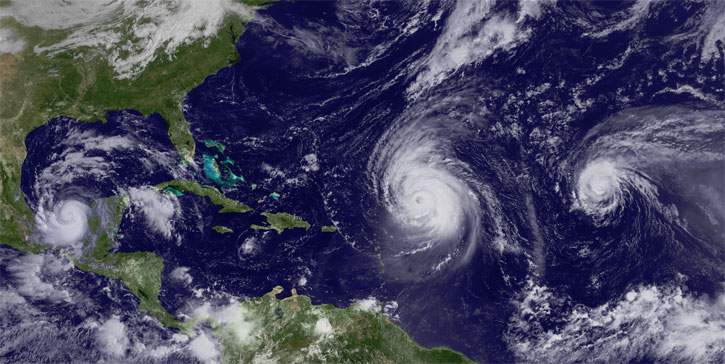
The Atlantic basin is expected to see an above-normal hurricane season this year, according to the seasonal outlook issued by NOAA’s Climate Prediction Center – a division of the National Weather Service.
Across the entire Atlantic Basin for the six-month season, which begins June 1, NOAA is predicting the following ranges this year:
- 12 to 18 named storms (winds of 39 mph or higher), of which:
- 6 to 10 could become hurricanes (winds of 74 mph or higher), including:
- 3 to 6 major hurricanes (Category 3, 4 or 5; winds of 111 mph or higher)
Each of these ranges has a 70 percent likelihood, and indicate that activity will exceed the seasonal average of 11 named storms, six hurricanes and two major hurricanes.
“The United States was fortunate last year. Winds steered most of the season’s tropical storms and all hurricanes away from our coastlines,” said Jane Lubchenco, Ph.D., under secretary of commerce for oceans and atmosphere and NOAA administrator. “However we can’t count on luck to get us through this season. We need to be prepared, especially with this above-normal outlook.”
NOAA’s seasonal hurricane outlook does not predict where and when any of these storms may hit. Landfall is dictated by weather patterns in place at the time the storm approaches. For each storm, NOAA’s National Hurricane Center forecasts how these weather patterns affect the storm track, intensity and landfall potential.
“The tornadoes that devastated the South and the large amount of flooding we’ve seen this spring should serve as a reminder that disasters can happen anytime and anywhere. As we move into this hurricane season it’s important to remember that FEMA is just part of an emergency management team that includes the entire federal family, state, local and tribal governments, the private sector and most importantly the public,” said FEMA Administrator Craig Fugate.
“Now is the time, if you haven’t already, to get your plan together for what you and your family would do if disaster strikes. Visit ready.gov to learn more. And if you’re a small business owner, visit www.ready.gov/business to ensure that your business is prepared for a disaster,” added Fugate.
Hurricane impacts are not limited to the coastline; strong winds and flooding rainfall often pose a threat across inland areas along with the risk for tornadoes.
Bar Employee Pleads In Underage Alcohol Case; Purchaser Arrested
May 20, 2011
A Century bar employee has entered a plea on a charged that she sold alcohol to a man under 21, and the purchaser has now been arrested.
 Daniel Dontavious Woods, 20, of Flomaton was arrested on an outstanding warrant for liquor possession by a person under 21. He was released from the Escambia County Jail on $250 bond.
Bonnie Blackmon, 29, of Jay, was charged in March with selling alcohol to a person under 21. Blackmon pleaded no contest to the charge last week and adjudication was withheld. She was ordered to pay $303 in court costs.
An Escambia County deputy observed Woods at the drive-up window of Odoms Bar in Century with a blue Pontiac parked beside him. As he turned around to pass the bar again, the deputy said the same vehicle nearly collided with his patrol vehicle on Ivey Street.
After conducting a traffic stop on the car, the deputy determined that Woods, the driver, was the person that had made the alcohol purchase moments before at Odoms Bar. There were, according to the Escambia County Sheriff’s Office report, three other people in the vehicle, all under the age of 21.
Woods said the person that sold him the Seagrams Blue Beast for about $13 did not ask for his identification. According to the ECSO report, Blackmon admitted selling a bottle of Blue Beast “to a black guy”. She first told the deputy that she asked for his identification. She later recanted that statement and admitted to deputies that she did not card him, but she said she did recognize him from previous purchases in which he was carded.
The Seagrams Blue Beast was seized as evidence.
FBLA, DCT Learn About Job Opportunities At Navy Federal
May 20, 2011
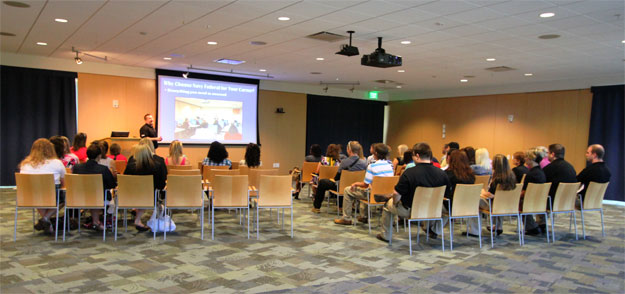
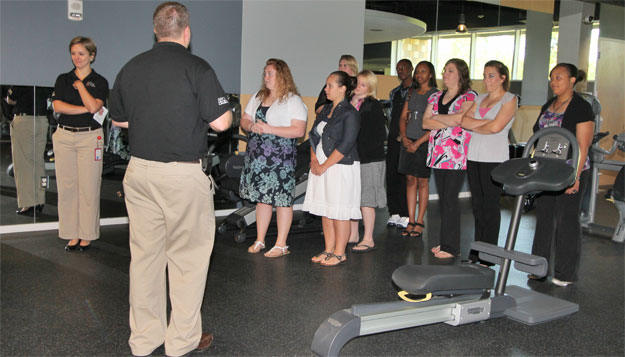
The Northview High School FBLA and DCT class toured Navy Federal Credit Union in Pensacola this week.
The combined group was give an overview of operations at the Pensacola facility and learned about potential employment opportunities with Navy Federal.
“I did not realize that such an opportunity existed in this area,” said Samuel Ortis, Northview DCT student. Organizers said several students expressed interest in applying for employment at Navy Federal after graduation.
Navy Federal is the world’s largest credit union with nearly 3.6 million members worldwide. There are 1,700 current employees on the Pensacola campus, with over 3,000 employees expected when the campus is fully occupied.
The FBLA students are under the direction of Donna Smith, FBLA advisor and DCT coordinator is Tommy Weaver.
Pictured above: Students watch a presentation in the Navy Federal events room. Pictured below: Students tour the employee fitness center. Courtesy photos for NorthEscambia.com, click to enlarge.
Suspect Named In Wednesday Shooting
May 20, 2011
Escambia Sheriff’s investigators have identified a suspect in the shooting that occurred Wednesday night on Sonnyboy Lane in Ensley.
A warrant has been signed by a judge charging Marcel K. Mickles, 34, of Pensacola with aggravated battery with a deadly weapon with a bond of $50,000.
Investigators believe the Wednesday night shooting may have been in retaliation for the deadly shooting Monday night in which Broderick J. Johnson was shot and killed and another man was injured by gunfire on Diego Circle.
The investigation into both shootings are still active and investigators are continuing to follow up on tips and leads in both shootings, according to the Escambia County Sheriff’s Office.
Anyone knowing the whereabouts of Mickels is asked to call the Sheriff’s Office at (850) 436-9620 or Crime Stoppers at (850) 433-STOP.
Scott Signs Controversial Elections Overhaul Into Law
May 20, 2011
Gov. Rick Scott signed a controversial elections bill Thursday, sending ripples through a looming special election in Miami-Dade County and, opponents of the measure say, potentially altering the playing field for the 2012 presidential vote.
Meanwhile, Secretary of State Kurt Browning said he would issue a directive that could remove some of the sting from a provision limiting when voters who move from county to county can change their addresses.
The measure (HB 1355) takes effect in 62 counties, but not in the five counties where federal authorities must preclear the measure because of Florida’s history of racial discrimination.
Opponents blasted the decision to move forward across part of the state and continued to pin their hopes on the chances that the Department of Justice could ultimately knock down the law.
The only immediate impact was to back up the decision of elections officials in Miami-Dade County to shut down early voting on Sunday for that city’s special mayoral election; former Republican lawmaker Marcelo Llorente has challenged that move in court.
Scott’s office announced his decision on the bill, one of the most fiercely contested measures of the legislative session, without comment. He had said earlier in the week that he wants people to be able to vote – but doesn’t want fraud.
But little more than an hour after the announcement, Browning, the state’s top elections official, addressed reporters to defend a bill that he conceded he had not asked for.
On the address provision, which would require voters who have moved from county to county to cast provisional ballots if they haven’t changed their address before the election, Browning said he believed lawmakers were trying to close off a potential avenue for fraud before it became an issue.
“To me, it wasn’t one of those issues that rose to the level that we needed to fully address. … (But) I believe that Florida, as has been my policy, wants to be more proactive than reactive,” he said. “I’d much rather address problems before they arise, or the potential of problems arising, than you getting hit in the face with a full-blown problem and don’t have a plan to solve it.”
But Browning said he would use his increased authority under the bill to direct local elections officials that “unless there is evidence of fraud in provisional ballots, they shall count those provisional ballots.”
That move is an attempt to blunt criticism that provisional ballots are rarely counted and any for moving voters would likely be thrown out because they were not cast in the precinct the voter is registered to vote.
Even so, groups opposed to it poured more scorn on a measure they say was aimed less at protecting Florida’s elections and more at demobilizing President Barack Obama’s electoral coalition in a key swing state ahead of the 2012 elections.
In addition to the address change, the measure reduces the number of early-voting days; increases regulations for third-party voter registration organizations; and creates a new panel, chaired by Browning, to set a date for the state’s presidential preference primary.
“If it weren’t so grotesquely un-American, you’d almost want to congratulate them for the audacity and efficiency of the attack,” said Howard Simon, executive director of the American Civil Liberties Union of Florida. “Governor Scott and the anti-civil liberties State Legislature have achieved an astonishing voter suppression trifecta. With just one bill, they made it harder to register to vote, harder to cast your vote, and harder to have your vote counted.”
The League of Women Voters of Florida has said the group would stop registering voters when the law takes effect. National groups concerned with the impact on minority voters also laced into the bill.
“The NAACP is outraged that Governor Scott signed this bill that blatantly and maliciously attacks, restricts and suppresses the voting rights of Florida’s racial and ethnic minorities, women, students and working communities,” the NAACP’s national President and CEO, Benjamin Todd Jealous, said in a statement. “We are calling upon all Floridians to stand up for the rights of all Florida citizens and repeal this deplorable new law.”
Opponents also vowed that additional moves will be taken against the measure.
“We are confident that this bill, which is nothing more than a power-grab by Republicans, will be overturned by the courts and rejected by the U.S. Justice Department,” Florida Democratic Party Chairman Rod Smith said.
By Brandon Larrabee
The News Service of Florida
Santa Rosa Fugitive Nabbed In Century After TV Program
May 19, 2011
A wanted fugitive featured on a Wednesday night television program was nabbed at his mother’s house in Century.
 Brian Arnette Moore, 36, was taken into custody without incident by Escambia County Sheriff’s Office deputies at a home on Sellers Road. He was wanted for grand theft auto for stealing a 1998 Hyundai Sonata from his roommate on Rice Road in Milton back on April 27. Miller was being held Wednesday night in the Escambia County Jail awaiting transfer to Santa Rosa County.
Santa Rosa County Sheriff’s deputies appeared on WEAR 3’s “Fugitive Task Force” segment during the evening news Wednesday to feature Moore. A tip then led Escambia deputies to look for Moore in Century.
The victim told Santa Rosa investigators that Moore, who was her roommate, took her car without permission. He first told the victim that the car was at the Escambia County Jail, but it was not. He then told her it was at the Century jail, but it was not there either — Century does not even have a jail. The vehicle has since been recovered.
Sellers Road runs north off West Highway 4 adjacent to the Century Care Center.
Soles4Souls Shoe Collection To Benefit Earthquake, Tornado Victims
May 19, 2011
The Ernest Ward Middle School Student Government Association has teamed with the non-profit organization Soles4Souls to collect shoes in good condition for the victims of the earthquake in Japan and the recent tornadoes in Alabama, Mississippi and Georgia.
 The school is collecting the new and gently used shoes (no holes, separated soles or missing laces) from students, staff and the community through May 27.
Soles4Souls has given away over 12 million pairs of shoes through its five year history, currently delivering an average of one pair every seven seconds.
Soles4Souls began as a small team effort to make a difference in peoples’ lives with the gift of shoes after Hurricane Katrina roared into the Gulf Coast in August, 2005. The group’s collections are now distributed to those in need worldwide.
Verizon Turns On 4G For Faster Phones, Internet
May 19, 2011
Verizon Wireless was set to turn on their new 4G LTE network in the area Thursday, allowing customers with the correct phone or modem to surf the web, download files and share music and photos up to 10 times faster than before.
“We are proud to help Pensacola residents, small businesses and local government connect faster and more fully with each other and those outside our community,” said Kay Henze, president of the Houston/Gulf Coast region for Verizon Wireless. “Our 4G LTE network is revolutionizing the way people communicate, and we know this connectivity will be a key communications and technology enabler for many years to come.”
In order to take advantage of the new 4G speeds, Verizon customers must have a phone, modem or wi-fi access point rates designed to work with the 4G network. So far, the company only offers two 4G phones — the Droid Charge (introduced just last Saturday) and the HTC Thunderbolt.
Verizon said 4G LTE users should experience average data rates of 5 to 12 megabits per second (Mbps) on the downlink and 2 to 5 Mbps on the uplink. In areas outside the 4G network, the 4G LTE devices function slower on the existing 3G network.
Florida Textbook Adoption Process May Be In For Big Changes
May 19, 2011
Fewer people will approve what textbooks Florida students should use under a bill that dramatically changes the state’s textbook adoption procedures.
The measure eliminates the current process of using statewide committees of teachers, school board members, administrators and ordinary citizens to select textbooks, and instead gives more power to the Education Commissioner.
Teachers and school board members critical of the change say it weakens the voice of teachers and the public in the textbook adoption process, opening it up to a potentially more politics and corruption. But others defend the change as a minor tweak that saves the state money and shifts responsibility for textbook reviews to experts.
The proposal (SB 2120) is contained in an education budget bill that will likely be approved by Gov. Rick Scott this month. The bill requires the commissioner to select three state or national “subject matter experts” to review books for each subject, with only two reviewing the books and the third acting as a tie-breaker.
Then, school districts can appoint one teacher or district curriculum specialist to review a handful of the recommendations by the state reviewers. Ultimately, school districts have to spend 50 percent of their textbook budgets on books approved by the state reviewers, giving districts the ability to stray beyond the list.
The Department of Education pushed for this change as a way of correcting what was seen as an arduous and expensive process of reviewing textbooks. Mary Jane Tappen, who is in charge of curriculum for the department, said it had become difficult finding people to sit on the committees.
“It’s volunteer and it requires a lot of independent time reviewing resources, followed by face-to-face meetings away from home,” Tappen said. And it is costly for an education department facing budget cuts. The department had to reimburse districts for the cost of substitute teachers and pay for travel and a per diem.
“We felt like going to a review process where first experts review the content to ensure it is error free and factual, followed by every district in the state participating in a second review,” Tappen said.
But some who have sat on these textbook committees say they like having the ability to work with a diverse group of people and worry that with fewer reviewers the process will be more vulnerable to corruption or a particular political slant. In Texas, for instance, the textbook selection process has been rife with conflict for years, with battles over whether to include references to evolution in science textbooks and emphasize history with a conservative slant.
“We are going to see what happened in Texas, with curriculum being challenged and changed,” said April Griffin, a school board member from the Hillsborough County School District who also served on the state adoption committee for high school mathematics textbooks more than a year ago. “We are going to see favoritism shown for certain companies. I think we are going to lose the voice of the front lines in this process.”
Griffin, as well as other past textbook reviewers, agreed that it could be a daunting task. Reviewers describe entire rooms taken up with boxes and hours spent pouring over dry textbook material.
“If you want to do a thorough job you need to really devote some time to reviewing the materials,” said Lisa Greco, a curriculum supervisor for the Osceola County School District who helped pick high school mathematics books two years ago. “One of the concerns that I really had was guarding against myself saying ‘this a big nationally recognized publisher, don’t spend too much time on it.’ ”
But some reviewers say the process is enhanced having more people in it. Under current law, the committees have to include a “lay citizen” as well as teachers and school board members. Some of the people involved in textbook selection in recent years have included a personal injury lawyer and a dentist.
“This is government in the sunshine and a volunteer committee that is doing public good,” said Daniel McFarland, a high school science teacher in Hillsborough County who served recently on a state committee that picked biology and environmental science textbooks. “Every time you take one of those citizen committees and you move it to the back of one of those smoke-filled rooms we are less transparent, we are less accountable.”
Rep. Marti Coley, who helped craft the education budget that included the textbook changes, said concerns about public input were not brought to her attention until after the bill had been approved by the Legislature. Coley said there are copyright issues that prevent the department from wholesale posting curriculum online for review.
Coley, R-Marianna, said she will work with the department to include more public comment. “This is a valid concern and we will work to try to figure out a way to allow the public to comment on that process,” Coley said.
The Florida Education Association said the new process could work if those appointed reviewers “are highly qualified and seek out different perspectives,” according to spokesman Mark Pudlow. He said either approach in theory could work fine, but by allowing the Commissioner to appoint reviewers it could lead to a “highly politicized DOE” that appoints reviewers who share the same political philosophies.
At least one school administrator who had reviewed textbooks said the new approach wasn’t worrisome.
With a planned conversion to a national standard for curriculum in 2014, it becomes less important to have teachers and other reviewers who are intimately familiar with Florida standards, said John Miller, a curriculum administrator for the Polk County School District.
“Given the fact that we are moving to (national standards), I tend to think this is a good move,” Miller said.
Florida has typically been a powerful player in the textbook publishing industry because it is one of the more populous states. It’s more cost effective for publishers to write books nationally based on standards of the bigger states.
Sen. Bill Montford, head of the Florida Association of District School Superintendents, said initially the proposal caused the group “some concern.”
The bill permits school districts to organize their own textbook adoption committees, but it weakens their ability to influence the state approved list by lowering the number of reviewers.
Districts have to use the state’s list for some, but not all, of their textbook purchases.
“We have to have confidence in the commissioner that he will appoint the right people,” Montford said. “The old way served us well. We are moving so rapidly and this particular change, the jury is still out.”
By Lilly Rockwell
The News Service of Florida