

Hazard: Century To Demolish Portion Of Old Store Owned By Town
June 8, 2011

Worried that it is a hazard and a code violation, the Town of Century is once again exploring options for an abandoned building owned by the town.
In October 2008, the Century Town Council voted to explore tearing down the building on Mayo Street because they believed there was little chance of repairing the structure.
The white, mostly brick building at 7601 Mayo Street (across from the old hospital) housed doctors’ offices and even a pharmacy and soda fountain years ago. It has been abandoned for several years and is in an obvious state of disrepair with roof and structural problems.
The town council’s actions in 2008 came after a comment posted on NorthEscambia.com pointed out that the building was in obvious violation of the codes and ordinances about to be enforced by the town.
“The town of Century itself needs to do some enforcing of their own property before the town council deems others in town to be a disgrace. I was visiting the pharmacy on Mayo street and noticed that the town of Century has let the “old” pharmacy building go into total disrepair,” a NorthEscambia.com reader commented on a September 26, 2008, story about Century discussing code enforcement options with Escambia County.”The town must set the example don’t you think? Just as parents do their children.”
“I’m sure you’ve read on NorthEscambia.com that people think we need to clean up our own,” Council member Ann Brooks told the council in October 2008.
Fast forward to June 2011…Mayor Freddie McCall told the town council Monday night that the front, two-story portion of the old building will have to come down. He said that once that is done, he wants to install a new wall to create a front for the metal part of the building. He said he will get a preliminary estimate and then bid out the project.
Pictured above: Town of Century will tear down the two story portion of this building owned by the town at 7601 Mayo Street. Pictured below: The interior of the building just inside the front door as seen in October 2008.NorthEscambia.com photos.


School Sales Tax Holiday To Return
June 8, 2011
Gov. Rick Scott has signed a bill that creates a three-day holiday from the state sales tax on many items starting August 12.
The sales tax holiday will include clothes and shoes up to $75 and school supplies valued at $15 or less. The popular sales tax holiday at back-to-school time saves 6 cents on every dollar spent. While it’s a sales tax cut for the careful shopper, retailers say it’s actually a big tax collection increase for the state.
Many consumers actually increase their purchases of non-covered items during that period, which often coincides with sales.
List, Photos: Bratt Elementary Academic Awards
June 8, 2011

The following students received awards at Bratt Elementary School.
For a photo gallery featuring award winners from the third and fourth grades, click here.
Kindergarten
Outstanding Citizen:
- Kennedy Long
- Lily Sullivan
- Bailie Merchant
- Caitlyn Gibson
- Da’mius Wesley
- Emma Gilmore
- Gabrielle Franklin
- Vivyan Smith
Progress Award:
- Lia Bradley
- Ryan Dove
- Tony Hall
- Travis Sunday
- Leonte’ Wright
- Jimmie Boyington
- Ar’Quavian Smith
- Summer Harrell
Outstanding Attendance:
- Luke Bridges
- Trent Knighten
- Jamyla Feagin
- Jake Warner
- Jasmine Robinson
- Alyssa Stabler
- Landon Chavers
- Jimmie Boyington
- Anastasia Bryan
- Lily Sullivan
- J.P. Gilman
- Wyatt Jarvis
- David Stokes
- Emilee Cabral
- Clay Wilson
P.E. Award
- Landon Chavers
- Leont’e Wright
- Wyatt Jarvis
- Bailei Merchant
Art:
- Kadence Burklund
- Kerry Hicks JR.
- Abrianna Downey
- Caitlyn Gibson
Music:
- Trent Knighten
- Kennedy Long
- Mckenna Simmons
- Rosa Carter
Book It Awards:
- Sarah Branch
- Jamyla Feagin
- Luke Bridges
- Landon Chavers
- Jake Warner
- Trent Knighten
- Gabby Franklin
- Jasmine Robinson
- Adyn Barrow
- Brody Black
- Jimmie Boyington
- Chloe Criswell
- Makayla Dove
- Kerry Hicks
- Kennedy Long
- Braeden McGhee
- Matthew Pruitt
- Nicholi Sanderson
- Lily Sullivan
- Emilee Cabral
- JP Gilman
- Emma Gilmore
- Wyatt Jarvis
- Mckenna Simmons
- David Stokes
- Travis Sunday
- Clay Wilson
- Aiden Broadhead
- Rosa Carter
- Jakyia Newton
- Summer Harrell
- Connor Wolfe
- Caitlyn Gibson
- Bailie Merchant
- Travis Scott
- Carter Sigafoose
- Ar’Quavian Smith
First Grade
Outstanding Citizenship Award:
- Anna Lee
- Anna Adams
- Miyhanna Davidson
Progress Award:
- AJ Broadhead
- Nicholas Ingraham
- Ashton Knicley
- Braxton Peebles
- Kayci Garrett
- Tymiriana Wesley
- Mary Grace Rice
Academic Achievement Award All A’s:
- Shelby Rice
- Anna Adams
- John Bashore
- Sarah Margaret Hetrick
- Haley Baker
Honor Roll A’s & B’s:
- Anna Lee
- Angel Merchant
- Travis Nelson
- Kiara Wesley
- Dallon Rackard
- Ashton Cloud
- Tanner Boone
- Zane Gurganus
- Kara Hawkins
Attendance Award:
- Emilee Bomba
- Shelby Rice
- AJ Hasty
- John Bashore
- Dallon Rackard
- Anna Adams
- Haley Baker
- Anyis Cabral
- P.E. Award:
- Kiara Wesley
- Tanner Boone
- Braxton Peebles
Art Award:
- Shelby Rice
- Kara Hawkins
- Kaleigh Macks
- Music Award:
- Miyhanna Davidson
- AJ Hasty
- Rachael Sanders
2nd Grade
Outstanding Citizenship Award:
- Libby Pugh
- Joshuwa Merchant
- Shelby Godwin
- Haleigh Dean
- Madison Peterson
- Hannah Hughes
Progress Award:
- Jayden Jackson
- Olivia Gibson
- Andrianna Cooper
- JD Ward
- DaKota Bryan
- Kiwianna McPherson
- Peggy Sunday
- Destiney Bradley
- Cadarius Poindexter
- Nona Wilson
Acadimic Achievement Award All A’s:
- Libby Pugh
- April Johnson
- Savannah Doremus
- Mary Paige Nassar
- Autumn Williams
- Anna Sullivan
- Amber Gilman
- Madison Peterson
- Hannah Hughes
- Michael Merchant
- Tyler Ray
Honor Roll A’s & B’s:
- Kaylee Sawyer
- Summer Waters
- Jacob Conley
- Haleigh Dean
- Breyden Freeman
- Martina Howard
- Taviana Parker
- Kenna Redmond
- Maggie Amerson
- Shelby Godwin
- Conner Byrne
- Aaron Downey
- Jacob Findley
- Madelin Sheedy
- Savannah Stokes
- Abigail Nelson
- Jaylon North
- Kayla Campbell
- MaKayla Garrett
- Kyiah Bailey
- Franki Daw
- William Wilson
Attendance Award:
- Franki Daw
- April Johnson
- Jaylon North
- Libby Pugh
- William Wilson
- Abigail Nelson
- Stone Presley
- Kayla Campbell
- Aaron Downey
- Savannah Doremus
- Savannah Stokes
- Madelin Sheedy
- Maggie Amerson
- Amber Gilman
- Jacob Conley
- Andrianna Cooper
- Madison Peterson
- Cody Thomas
- Hannah Hughes
- Angelina Heritage
- Jonathan Windham
P.E. Award:
- Libby Pugh
- Joshuwa Merchant
- Maggie Amerson
- Hannah Hughes
- Madison Peterson
- Music Award:
- Andrianna Cooper
- Kollin Ward
- Peggy Sunday
- Isaiah Gaines
- Nona Wilson
- Art Award:
- Kyiah Bailey
- Autumn Williams
- Destiney Bradley
- Kaylee Sawyer
- Kenna Redmond
3rd Grade
Outstanding Citizenship Award:
- Anna King
- Teriana Redmond
- Meagan Wilburn
- Makenzie Moorer
- Keaton Brown
- Amanda Franklin
- Progress Award:
- Myles Harrelson
- Meionni Findley
- Brianna Washington
- E’monee Long
- Luke Smith
- Jalexis Robinson
- Tyler Kite
- Wyatt Rhinehart
- Melissa Sunday
Academic Achievement Award All A’s:
- Meagan Wilburn
- Colton Dockens
- Joseph Parker
- Keaton Brown
- Bailey Van Pelt
Honor Roll A’s & B’s
- Shelby Bartley
- Amanda Franklin
- Juliana Bryan
- Kinzie Rackard
- James Wyatt Windham
- Cassidy White
- Cassandra Mullins
- Brianna Carter
- Sheyenne Dillon
- Savannah Roley
- Savannah Spence
- Lexi Broadhead
- Cameron Findley
- Anna King
- Colby Morris
- Christopher Nordman
- Teriana Redmond
Attendance Award:
- Cassidy Boutwell
- Anna King
- Ansleigh Maholovich
- Christopher Nordman
- Dalton Philyaw
- Braiden Rice
- Meagan Wilburn
- Savannah Spence
- Lexi Broadhead
- Cameron Findley
- Devon Cohen
- Savannah Roley
- Logan Brown
- Jalexis Robinson
- Beverly Skaggs
- James Wyatt Windham
- Cheyenne Philyaw
- Keaton Brown
- Juliana Bryan
- Zy’Kia Davis
- Shane Hardin
- Kinzie Rackard
- Brandon Berry
- Trevor Bomba
- Karlee Criswell
- Neionni Findley
- Myles Harrelson
- Travone Tyrese Smith
P.E. Award:
- Teriana Redmond
- Savannah Spence
- Jackson Gipson
- Bailey Van Pelt
- Natalee Gipson
Art Award:
- Melissa Sunday
- Diamond Brown
- Cassie Mullins
- Jayden Sanderson
- Jackson Edwards
Music:
- Anna King
- Wyatt Rhinehart
- Cassidy White
- Kinzie Rackard
- Neionni Findley
4th Grade
Outstanding Citizenship Award:
- Lexi Baggett
- Delaney Reynolds
- Lydia Smith
- Ann-Margaret Boothe
- Progress Award:
- Ja’Quan Barton
- Danielle Stuckey
- Isaak Armstrong
- Brandon Dean
- Cody Comalander
- Reini Bodiker
- Aaliyah Tucker
- Joshua Johnson
Academic Achievement Award All A’s:
- Delaney Reynolds
- Cailee Wilburn
- Ann-Margaret Boothe
Honor Roll A’s & B’s
- Caren Cannon
- Tanner Deese
- Samantha Roux
- Madison Sherouse
- Alabama Gilley
- Allison Rice
- Lydia Smith
- Cameron White
- Logan Chavers
- Cameron Long
- Madison Nassar
- Gabbrielle Peebles
- Lexxi Baggett
- Justin Cruce
Attendance Award:
- Lexxi Baggett
- Justin Cruce
- Roger Dockens
- Madelyn Plant
- Cameron Simpkins
- Matthew Windham
- Susannah Amerson
- Shelby Bashore
- Logan Chavers
- Cameron Long
- Jeremiah Woods
- Delaney Reynolds
- Jordan Capps
- Allison Rice
- Cailee Wilburn
- Lydia Smith
- Briar Bass
- Larry Philyaw
- Keosha Davis
- Aaliyah Tucker
- Meggan Brown
P.E. Award
- Reini Bodiker
- Lydia Smith
- Logan Chavers
- Justin Cruce
- Art Award:
- Lexxi Baggett
- Shelby Bashore
- Cammie Carter
- Meggan Brown
Music Award:
- Keosha Davis
- Javontaye’ Wright
- Aurora McCann
- Gabrielle Kline
5th Grade
Outstanding Citizenship:
- Celeste North
- Hannah Godwin
- Kamryn Mothershed
- Trace Franklin
- Shelby Comalander
- Progress Award:
- Chase Gifford
- Derek Rice
- Kendrell Redmon
- Hannah Godwin
- McKenna Miller
- Tori Smith
- Triston Seagers
Academic Achievement Award All A’s:
- Triston Long
- Hannah Nelson
- Latavia Grace
- Tara Windham
Honor Roll A’s & B’s:
- Dawson Brown
- Clayton Findley
- Celeste North
- Hunter Spence
- Hunter Carter
- Raegan Harrell
- Fisher Spence
- Korbin Bryan
- Eli Deese
- James Sullivan
- Alayan Brown
- Logan Duremas
- Jason Fischer
- Trace Franklin
- Logan Hall
- Angel Philyaw
Attendance Award:
- Dawson Brown
- Beau Bryan
- Clayton Findley
- Tanyia Fletcher
- Tyanna Magee
- Celeste North
- Hunter Spence
- Hunter Carter
- Clint Gunter
- Triston Long
- Lari McCann
- Jacob McCullough
- Hannah Nelson
- Fisher Spence
- Myisha Syria
- Camilla Windham
- Korbin Bryan
- Jarrod Davison
- Wesley Hardin
- McKenna Miller
- James Sullivan
- Logan Dorumas
- Jason Fischer
- Michael Harrelson
- Andrew Sharpless
- Tara Windham
- Justin Elliott
- Shavon Hall
- Shavell Hall
- Angel Philyaw
P.E. Award:
- Celeste North
- Jacob McCullough
- Rebecca Hawthorne
- Jason Fischer
- Art Award:
- Haven Shores
- Triston Long
- Tori Smith
- Tara Windham
- Music Award:
- Tyanna Magee
- Shavon Hall
- Korbin Bryan
- Alayna Brown
NorthEscambia.com photo, click to enlarge.
Escambia, Ala. Gets Grant To Crackdown On Highway Offenders
June 8, 2011
Alabama Gov. Robert Bentley has awarded a $$75,874 grant to crackdown on highway safety and improve seat belt usage in three south Alabama counties.
The grant was split between Escambia, Baldwin and Mobile counties to enable police, deputies and state troopers to increase their presence on Alabama roads during the “Click It or Ticket” seat belt campaign. A portion of the grant will also be used to increase enforcement efforts during peak holiday periods later in the year.
The grants will help pay overtime wages for officers and enable law enforcement agencies to establish checkpoints and patrols to ensure motorists are obeying traffic laws. Most of the increased enforcement will occur around holidays when more motorists are on the roads.
The grants, administered by the Alabama Department of Economic and Community Affairs, were made possible by funding from the National Highway Administration.
Grand Theft Charges Dropped In Molino Couple Cancer Scam Case
June 7, 2011

 Felony grand theft charges have been dropped by the state against the Molino couple accused of faking her cancer diagnosis in order to scam people out of thousands of dollars.
Sonja Marsell Luker, 42, and Gerald Christopher “Chris” Luker, 43, are both still facing felony fraud charges in the alleged scheme.
According to the Escambia County Sheriff’s Office, numerous fundraisers were held between May 2004 and October 2010 that raised over $19,000. Evidence shows that about $14,000 was used in 2009 to avoid foreclosure on their home in the 4700 block of Pine Circle Drive and about $4,000 in cash was used by Chris Luker to purchase a 1997 Harley motorcycle.
The Sheriff’s Office investigation found that Chris and Sonja Luker personally received money from friends, family, church members and co-workers under a “scheme” that Sonja Luker was being treated for cancer. Investigators believe both Chris and Sonja Luker are guilty of fraud in the scheme; witnesses said the couple was observed together at fundraisers talking about her cancer treatments.
Trial for both Lukers is set to begin August 1. They have each pleaded not guilty to the charges against them.
Pictured above: Sonja and Chris Luker (in black shirts) are seen in a 2009 NorthEscambia.com photo from a motorcycle ride fundraiser that benefited her alleged fight against cancer. NorthEscambia.com file photos, click to enlarge.
Churches Schedule VBS, Other Childrens’ Events
June 7, 2011
Vacation Bible Schools and other events are scheduled at churches across the North Escambia area this summer.
To add a VBS for church event for children to the list, email news@northescambia.com.
Flomaton First Baptist
Vacation Bible School at Flomaton First Baptist Church, June 6-10, 8:30 – 11:30 a.m. Ages 5 through 6th grade. (251) 296-2453 for more information.
Atmore First Assembly of God
“Samson-God’s Strong Man” Vacation Bible School at Atmore First Assembly of God, 1120 South Main Street, June 6-10, 8-11:30 a.m. For ages 5 though 6th grade. More info: (251) 368-4637 or www.atmorefirstassembly.org for a registration form.
Brooks Memorial Atmore
Vacation Bible School at Brooks Memorial Baptist Church in Atmore, 8:30 a.m. until 11:30 a.m., June 6-10. More info: Megan Gorum (251) 368-8580.
First Baptist Church of Bratt
Vacation Bible School at the First Baptist Church of Bratt, June 13-17 from 8:30-11:30 daily. Ages 3-years to 5th grade are all invited to attend the “Big Apple Adventure”.
Ray’s Chapel Baptist
Vacation Bible School at Ray’s Chapel Baptist Church in Bogia, June 13-17 from 6-8:30 p.m. Kick-off and registration on Sunday, June 12 at 5 p.m. Ages 5 through the 6th grade. (850) 256-3422.
VBS — Walnut Hill Mennonite
Walnut Hill Mennonite Church will hold Vacation Bible School “Let Your Lighthouse Shine” June 13-22 from 6-8:30 p.m. Ages 5 to ninth grade. Everyone welcome.
VBS — Canoe Baptist Church
Vacation Bible School “The Big Apple” at Canoe Baptist Church, Sunday June 12 through Thursday, June 16 closing with Family Night. Ages 3 years through sixth grade, 5:30-7:30 p.m. Fun Day will begin VBS on Saturday, June 11 at 2 p.m.
VBS — Cora Baptist Church
VBS at Cora Baptist Church, Highway 197, Jay, June 13-17 from 5-8:30 p.m. Ages 3 through teens. All are invited.
VBS- — Flomaton Pentecostal
Vacation Bible School at Flomaton Pentecostal Holiness Church, June 13-17, 5:15 until 8:15 p.m. Grades 1-6. For more info: Martha Samson (251) 296-2214.
Camp Kidventure
Camp Kidventure Sports and Recreation Camp June 20-24 at Highland Baptist Church in Molino. 9 :30 a.m.- 12:30 p.m. daily. Cost $50, includes daily field trips, lunch and camp T-shirt. Registration deadline and tuition due by June 12.
VBS — Walnut Hill Baptist
Vacation Bible School at Walnut Hill Baptist Church, July 11-15, 6-8:30 p.m. Bring a swimsuit for VBS Kickoff on Saturday, July 9 from 11 a.m. until 2 p.m. at the church.
Hero Headquarters Camp — Victory Assembly
Hero Headquarters Adventure Camp 2011 will be held Monday, June 13 through Friday, June 17 from 9 a.m. until noon for grade kindergarten to fifth. Family night on Sunday, June 19. More info (850) 587-2295 or register online at victorycan.org.
First Baptist Atmore
Vacation Bible School “Pandamania”, June 13-17 from 5:30 until 7:30 each evening. Ages 3 (by 9/1) through 6th grade. Click here to register.
Jay First Baptist VBS
Vacation Bible School at Jay First Baptist Chuch, June 13-17 from 5:30 until 8:30 p.m. daily. More info: (850) 675-4587.
Heritage Baptist Church
Vacation Bible School at Heritage Baptist Church, 3065 Highway 297A in Cantonment. PandaMania, 6-8:45 p.m. daily June 13-17. For ages completed kindergarten to complete fifth grade. Register online at www.excitingheritage.com or call (850 478-3316.
Gonzalez UMC
Vacation Bible School at Gonzalez United Methodist Church, 2026 Pauline Street, Cantonment. “Shake It Up Cafe”, 6-8:45 p.m. Monday-Friday, June 27-July 1. Details: (850) 968-6006.
Abundant Life Century Kids Day
Abundant Life Assembly of God in Century will hold a “Kids Day” instead of VBS this year on July 9. Mark your calendar now; more details will be available soon.
Highland Baptist VBS
Vacation Bible School “Big Apple Adventure — Where Faith and Life Connect” 5:30 = 8 :30 p.m., July 11-15 at Highland Baptist in Molino. Family Night “Pizza In The Park” on Sunday, July 17.
Christian Home VBS
Vacation Bible School at Christian Home Freewill Baptist Church, 3131 North Pine Barren Road in McDavid. July 11-15 from 6-8:30 p.m. for ages 2 – 6th grade. For more info, call the church at (850) 327-4730 or Karmen at (850) 327-6362.
Faith Bible Baptist VBS
Faith Bible Baptist Church in Bluff Springs wil hold VBS “Rev It Up – Full Throttle for God” June 11-15 from 6-8:30 p.m. for ages 5-12. (850) 256-5483.
St. Monica’s VBS – Cantonment
Saint Monica’s Episcopal Church in Cantonment will go “Hog Wild” for Son Harvest Country Fair Vacation Bible School July 11-15, 9 a.m. until 1 p.m. A morning snack and lunch will be provided. Registration forms at the church office or www.st-monicas.org. For more info, call Ray at (850) 477-0242 or 208-1032 or Susan at (850) 968-5612 or 324-8362.
VBS — First Baptist Cantonment
Vacation Bible School at the First Baptist Church of Cantonment, June 13-17 from 8:30 a.m. until noon. (850) 968-9135.
Camp Quarternote
Highland Baptist Church in Molino, Camp Quarternote Music and Drama Camp for students who have complete kindergarten through fifth grade. August 1-5, 9:30 a.m. – 12:30 p.m. Musical production of “Jailhouse Rock” on Sunday, August 7 at 6 p.m. Cost is $15, includes lunch daily. Registration and tuition deadline is July 24.
VBS — Aldersgate UMC Molino
Aldersgate United Methodist Church, Hwy 29, Molino will host “Shake It Up Café Vacation Bible School, July 25-29th from 5:30-8:30 p.m. Dinner will be served each evening. No cost. For more information or to sign up online, go to www.aumcmolino.org or call church office at (850) 587-5294 or Sandra Greenwell at (850) 587-2489.
VBS — First Baptist Cottage Hill
First Baptist Church of Cottage Hill Vacation Bible School “PandaMania Where God Is Wild About You”, July 25-29, 5:45-8:30 p.m. Pre-K – 5th grade, middle school, high school.
VBS — Family Worship Center, 9 Mile
Vacation Bible School at Family Worship Center, 1251 West 9 Mile Road, July 25-29 from 9 a.m. until noon. Family night, Friday, July 29 at 7 p.m. (850) 432-6911.
Newly Released FCAT Results Mixed For Area Schools
June 7, 2011
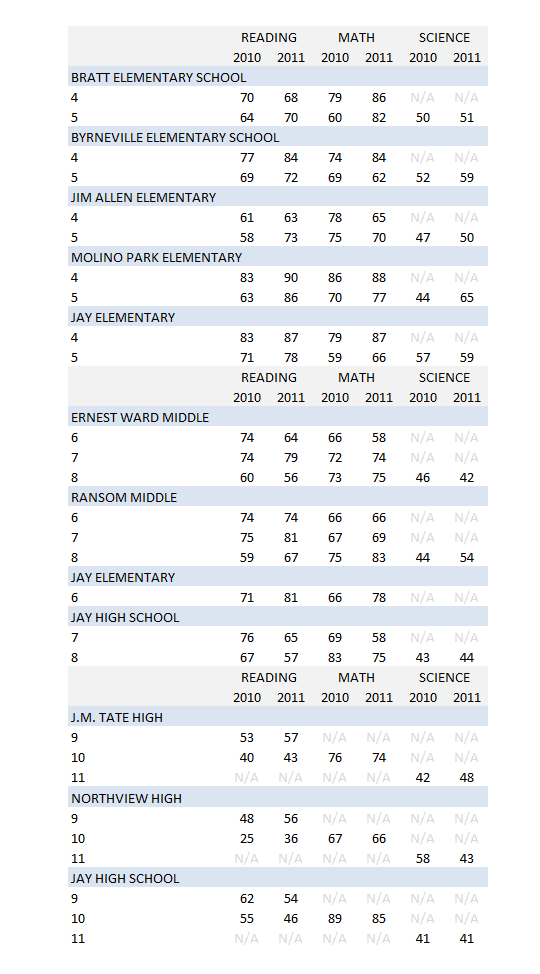
Florida Comprehensive Assessment Test scores were released Monday morning with mixed results for schools in the North Escambia area.
The FCAT scores released Monday included reading in grades 4-10, math in grades 4-8 and 10, and science in grades 5, 8, and 11. Results are below for North Escambia are schools for both 2011 and 2010.
Jay High School Class of 2011 Graduates (With Photo Gallery)
June 7, 2011

 The Jay High School Class of 2011 graduated Monday night at the school.
Nicklaus Adam McMellon was the valedictorian for the Class of 2011, while Emerlee Michelle Trevino was salutatorian.
For a photo gallery, click here. (Photos submitted by Pat Birdsall for NorthEscambia.com.)
Graduating students are listed below. Numbers following each name indicate honors; a key to the numbers is at the bottom of the list.
- Travis Neal Allen — 2
- Alicia Kay Ashworth — 2, 3, 4, 7, 8
- Kayley Rene’ Baggett
- Haley Anna Marie Baker — 1, 3, 4, 5, 6, 8
- Silas Buck Ballard
- Miranda Paige Berry
- Ronald Lukas Berry
- Brandon Lee Black
- Robin Nicole Blackman — 1, 3, 4, 5, 8
- Trenton Lynn Blair
- Mary Kathleen Borders
- Steven Hunter Brown
- Randall Eugene Burks
- Jenna Ann Marie Campbell
- Sarah Lucile Campbell — 2
- Clifton Randel Dannelly
- Deanna Marie Davis
- Bethany Dawn Diamond — 2, 4
- Brenan Wesley Dykes
- Kirstiana Nicole Edwards
- Megan Brittany Flinn — 2, 3, 4
- Zachary Tyler Gavin — 1, 3, 4, 8
- Derek Michael Gilmore — 2
- Andrew Dean Goble — 2, 3, 4, 5, 6
- Toni Erin Griggers
- Jeffrey Bernard Harrison
- Austin Wayne Hawthorne
- Bethanie Marie Herring
- Micah Raeshel Herring — 6, 8
- Colt Mitchell Hitt
- Cory Thomas Jones
- Julie Marie Knight — 2
- Mathew Douglas Layman-Kinder
- Delana Christine Magaha
- Cody Lee Maxwell
- Sarah Jean McLean — 1, 3, 4, 6, 8
- Nicklaus Adam McMellon — Val.,1, 3, 4, 6, 8
- Tyler Amon McMellon — 2, 3, 4
- Haley Denise Odom — 2, 3, 4, 5
- Brandon Jared Parker
- Courtney Paige Penton — 1, 3, 4, 6, 8
- Justin Ryan Poley — 2, 3, 4, 8
- Robert Jack Rivenbark
- Payden Thomas Roberts — 1, 3, 4, 8
- Samantha Brooke Roney
- Hannah Marie Rutherford — 2, 3, 4, 8
- Julia Danielle Skaggs — 1, 3, 4, 5, 8
- Gage Scott Southard — 2, 8
- Kevin Wesley Stanton — 2, 3, 4
- Ashley Margree Stokes
- Keely Shaye Strawbridge
- Jennifer Lee Sutler — 2, 3, 4, 8
- Trenton Earl Sweeney — 2, 3, 4, 5, 8
- Krista Marie Tegenkamp
- Emerlee Michelle Trevino — Sal., 1, 3, 4, 6, 8
- Brandon William Urnick
- Whitney Lauren Walther — 2, 3, 4, 8
- Jami Danielle Wessel — 1, 3, 4, 6, 8
- James Paul Whitehead
- Benny Dwayne Wolfe
- Trevor Ryne Wolfe
- Eric Lee Wyche
- Eric William Young
HONORS KEY:
V = Valedictorian
S = Salutatorian
1 = High Honors (Gold Tassels) Top 10
2 = Honors (Silver Tassels) G.P.A. of “A”
3 = National Honor Society (White Collar Stole)
4 = National Beta Club (Gold Stole/Officer Medal)
5 = National Art Honor Society (Rainbow Cord)
6 = Tri-M Music Honor Society (Pink Cord)
7 = National FFA Organization (National Blue and Corn Gold Cords)
8 = Rho Kappa (White Cord/Medal)
NorthEscambia.com photos by Pat Birdsall, click to enlarge.
Federal Health Care Law Argued In Court This Week
June 7, 2011
When U.S. District Judge Roger Vinson in Pensacola declared last year’s federal health overhaul unconstitutional, the ruling vindicated Florida Republicans and other critics of the law.
But Wednesday, three appellate judges in Atlanta — including two appointees of former Democratic President Bill Clinton — will get their shot at the case.
Despite the political cacophony surrounding the law, the case largely boils down to this question: Does the Commerce Clause of the U.S. Constitution allow the federal government to require that most people have health insurance starting in 2014?
Florida and other states spearheading the lawsuit also make another key argument: The federal government is improperly trying to “coerce” them with the law’s expansion of Medicaid eligibility.
Ultimately, the U.S. Supreme Court is expected to decide those issues. But with 26 states involved in the case, Wednesday’s arguments at the 11th U.S. Circuit Court of Appeals will be closely watched.
The Obama administration will argue the law complies with the Commerce Clause, at least in part, because health care is part of a broad system of interstate commerce. That interstate commerce is affected by uninsured people who need health care but can’t afford to pay for it.
“Millions of people without health insurance have consumed health-care services for which they do not pay,” administration lawyers said in a brief filed in the appeals court. “They have thereby shifted the uncompensated costs of their care … to health-care providers regularly engaged in interstate commerce.”
But the states and other opponents argue that using the Commerce Clause to require Americans to buy insurance is unprecedented. Allowing it, they contend, would justify Congress making decisions about consumer spending on such products as food and housing.
“In the over 200 years that Congress has sat, it has never before attempted to exercise its Commerce Clause power in this manner,” the attorneys for the opponents wrote in a brief.
Vinson, a senior judge who was appointed to the federal bench by former Republican President Ronald Reagan, ruled in January against the Obama administration on the Commerce Clause issue. Vinson also went further, throwing out the entire federal law because he said the insurance requirement was a vitally interconnected part.
The requirement has always been the most-controversial part of the mammoth health law, which Obama and a Democratic-controlled Congress approved in March 2010. People who remain uninsured in 2014 will face financial penalties.
Bill McCollum, then Florida’s Republican attorney general, immediately filed the lawsuit last year in Pensacola and made the insurance requirement a centerpiece. Officials in 25 other states also joined the case, as did the National Federation of Independent Business and two individual plaintiffs.
As an indication of how politically charged the insurance requirement has become, the two sides in the lawsuit even describe it differently in the briefs. Obama administration lawyers describe it as the “minimum coverage provision,” while opponents call it an “individual mandate.”
While Vinson agreed with Florida and the other states on the insurance requirement, he rejected their argument that the law would improperly expand Medicaid eligibility.
The expansion, which would raise income-eligibility levels to allow more people to qualify for Medicaid, would help meet the law’s goal of almost all Americans having health coverage. During the first few years, the federal government would cover all of the costs of the newly eligible people, though states would have to pay 10 percent of the costs by 2020.
States that refuse to expand eligibility would lose billions of dollars in federal Medicaid funding. The law’s opponents contend that is unconstitutional, saying Congress may not “employ its spending power to coerce states into capitulating to federal demands.”
But Obama administration lawyers argue that state participation in Medicaid is voluntary and that Congress has the right to change the conditions of federal funding for the program.
Always shadowing the lawsuit has been the fierce partisan political fights about the health law. Those fights have played out in Washington and state capitals, such as Tallahassee, and also will be prominent during the 2012 presidential campaign.
That has also created scrutiny of the political backgrounds of the judges hearing the case. The judges Wednesday will include Clinton appointees Frank Hull and Stanley Marcus and Chief Judge Joel Dubina, who was appointed by former Republican President George H.W. Bush.
Dubina has received scrutiny in recent weeks because his daughter, U.S. Rep. Martha Dubina Roby, R-Ala., is an outspoken critic of the federal health law.
Gulf Power Offers Cash For Old Refrigerators Or Freezers
June 7, 2011
Gulf Power customers can claim a $35 reward and arrange for free pick up of an older refrigerator or freezer. The new recycling program is part of the utility’s new EarthCents energy-efficiency programs, which are designed to save customers money and energy.
After they are picked up, the older units are sent to a de-manufacturing plant where they are dismantled, returning approximately 95 percent of the materials to the manufacturing stream.
“Refrigerators and freezers made before 1990 use three times more electricity than newer models,” said Jeff Rogers, spokesperson for Gulf Power. “Getting rid of an inefficient refrigerator or freezer will put about $150 a year in savings in your pocket. This is a great way for our customers to save on their electricity bills while helping to protect the environment.”
Since 2001, federal standards require new refrigerators and freezers to consume less energy. Current models use about 450 kilowatt-hours (kWh) annually, compared to older units that use an average of 1,500 kWh per year.
To schedule the pickup of a refrigerator or freezer for recycling, Gulf Power’s electricity customers can call 1-855-559-2523 or visit www.gulfpower.com/earthcents. Customers will receive a check for $35 within four to six weeks after the collection of the appliance.
Both refrigerators and freezers are eligible for the recycling program. The program is limited to removal of two units per household. Appliances must be in working order with an inside measurement between 10 and 30 cubic feet.