

Tell On Teens Who Get Tickets, But Don’t Tell The Boss
January 10, 2012
Lawmakers want state officials to be able to send you a note to let you know if your kids get a speeding ticket. But if you get a caught going too fast, they don’t really want the state telling your boss.
Of course you – and your boss – can find out anytime you want if someone’s had a ticket: driving records are public under state law. Just go to the Department of Highway Safety and Motor Vehicles and give them your kid’s name – or an employee’s name – and pay the fee, and you can find out whether they have a lead foot or drive while drunk.
Almost any company that has employees who drive for work, from school bus drivers to package deliverers, checks on driver records.
But at issue on Monday was a bill that would turn the process around in some cases, letting parents sign up to be notified electronically anytime their child violates a traffic law. The parent wouldn’t have to periodically check their child’s record, the DHSMV would simply let them know any time their kids have seen blue lights in the rearview.
The bill (SB 854) enjoyed full support of the Senate Transportation Committee on Monday, sending the measure to the Budget Committee.
But not before the Transportation Committee firmly rejected a proposed amendment that would have also allowed employers to sign up with DHSMV to get notices when their workers – whether they drive for their job or not – get some sort of traffic ticket.
That would mean, for example, that instead of a school board simply checking up on bus drivers from time to time, it would now be automatically notified if a teacher had gotten a ticket, or a janitor, for example. Theoretically, the Senate president could also sign up to be notified if senators get pulled over and ticketed, noted Sen. Lizbeth Benacquisto, R-Wellington.
To have employers routinely notified of workers’ driving slip-ups, “for me, that goes a little bit too far,” Benacquisto said.
An official with the highway safety agency, which actually recommended the change, reminded legislators that employers can check up on their employees now. “It’s public record, they can do that today,” noted Steven Fielder, the agency’s legislative affairs director.
But having the agency proactively rat out employees to their bosses is different than having the agency go through the effort to find out, said several members of the committee.
“That’s a horse of a different color,” said Sen. Arthenia Joyner, D-Tampa. “There’s something that’s just not right about it,” added Sen. Larcenia Bullard, D-Miami.
No vote was even needed on the amendment.
“Is there anybody here besides (amendment and bill sponsor Sen. Greg) Evers who supports this?” asked the committee’s chairman, Sen. Jack Latvala, R-Clearwater, who had earlier called the provision a “Big Brother amendment.”
No one spoke up and Evers, R-Baker, withdrew the amendment before the panel approved the original bill.
By The News Service of Florida
Jim Allen To Present “What’s On The Menu” For Families
January 10, 2012
Parents and students at Jim Allen Elementary School will gather for an engaging and educational program called “What’s on the Menu.” This program is aimed at helping promote financial education among the students’ families. The program will be held Thursday from 6:30 p.m. to 7:30 p.m. in the school’s cafeteria.
For additional information, please contact Rachel Watts, Principal of Jim Allen Elementary School, 937-2260.
Pedestrian Killed Friday Night Identified
January 9, 2012
The name of a pedestrian who died from injuries he received Friday night after being struck by a vehicle in Escambia County has been released.
The man was identified through fingerprints as 38-year old Justin Langham of Pensacola, according to Pensacola Police.
Police said 90-year old Clyde Eddins was southbound on Ninth Avenue near Creighton Road in a 2011 Jeep Cherokee when Langham stepped into his path. Langham was transported to Sacred Heart Hospital were he passed away late Saturday morning.
No charges will be filed, according to police.
Drive By Shooting Suspect Shoots At Deputies
January 9, 2012
An Escambia County man is behind bars, accused of shooting and a house and sheriff’s deputies.
 Willie James Brazile, 21, was arrested Sunday night after deputies responded to a prowler call in the 5400 block of Tomlinson Road. While in the area, Deputy Daniel Dreadin observed someone in a silver car fire several shots towards a house. Dreadin gave pursuit, and deputies said someone in the vehicle fired shots at them.
After the vehicle came to a stop, two people fled on foot. A short time later, Brazile was taken into custody and a firearm recovered. Deputies later discovered that the vehicle was stolen.
Brazile, who deputies believed to be the passenger, was charged with four counts of aggravated assault , two counts of aggravated assault on law enforcement officer, use of firearm while committing a felony, discharging a firearm from a vehicle, firing deadly missiles into a dwelling, possession of a firearm by a convicted felon and resisting an officer without violence. He was booked into the Escambia County Jail with bond set at $101,000.
The other suspect remained at large Monday morning.
Anyone with information on the crime is asked to call the Escambia County Sheriff’s Office at (850) 436-9620 or Crime Stoppers at (850) 433-STOP.
Tate Grad Develops Product That Could Improve AIDS Treatment Worldwide
January 9, 2012
A Tate High School graduate has developed a product that could help make AIDS treatment faster, more effective and cheaper whether it is used in a local doctor’s office or a remote area of Africa. His research and innovation was recognized with the Baxter Young Investigator Award.
The annual Baxter awards are intended to stimulate and reward research applicable to the development of critical care therapies and medical products that save and sustain patients’ lives.
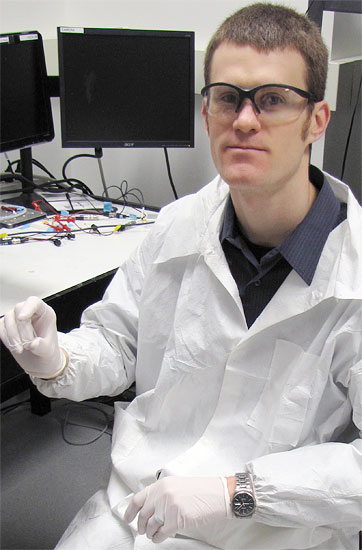 As a Ph.D. candidate at University of Illinois, Nicholas Watkins developed a CD4 counter, which counts a specific type of blood cell, called the Helper T cell. The cell normally fights off disease, but HIV attacks the T cells and uses them to create more viruses. An HIV positive patient will develop AIDS if the T cell count falls too low.
The final prototype of Watkins’s device will be hand held, requiring only one drop of blood from an AIDS patient. The device then counts the number of Helper T cells in the blood, providing a snapshot of the HIV patient’s immune system and determining which type of drugs the patients should receive.
Watkins’ current prototype can provide T cell counts in about 15 minutes or less — allowing a doctor to obtain a count and adjust a drug therapy in a single appointment.
Machines called flow cytometers exist and complete the same task, but these devices are large and expensive. Watkins said these machines are “very efficient,” but, they can cost over $100,000 and require highly skilled technicians to operate them.
When Watkins thought of making his CD4 counter at the University of Illinois, he had sub-Saharan Africa in mind — a long way from his former Cantonment residence.
“We’re trying to make a handheld, portable CD4 counter that can be deployed to regions that don’t have the money we have,” Watkins said. “We’re thinking of areas like sub-Saharan Africa, where HIV/AIDS is prevalent.”
But his device will not benefit solely one region in the world. Watkins said this type of machine would be necessary in any underdeveloped country that has a large portion of its population battling AIDS. He said millions of dollars are sent to these countries to help support the dispersal of medication, but the different medications are only effective when the correct one is given based on an individual’s Helper T cell count.
 “Each person’s immune system responds differently,” Watkins said. “You need a highly quantitative test like a CD4 counter to determine which drugs work better. These drugs do work, but the problem is that we’re having trouble figuring out which drugs work for each person.”
Watkins added that his portable CD4 counter can help improve the quality of life for people who do not live in bigger cities, where flow cytometers might be available.
The device is Watkins’s PhD project under the direction of his adviser, Department of Electrical and Computer Engineering Professor Rashid Bashir, director of the Micro and Nanotechnology Lab. He has been working on the project since 2009.
“It was very challenging but very rewarding knowing this is a very practical application and could be used in the next few years,” Watkins said. “It’s fulfilling to know that this research won’t just be published but will actually be used to help people.”
Courtesy photos for NorthEscambia.com, click to enlarge.
New Raceway Convenience Store Under Construction In Cantonment
January 9, 2012

A new RaceWay convenience store is under construction at the intersection of Highway 29 and Muscogee Road in Cantonment. NorthEscambia.com photo, click to enlarge.
Locals Run Disney Marathon; Jay’s Dobson Finishes 29th
January 9, 2012
 Several North Escambia area residents took part in the annual Walt Disney World Marathon and Half Marathon, including past winner Matt Dobson of Jay.
Dobson, who won the 2004 marathon, finished in 29th place in the 2012 event with a time of 2:49:50. The 42-year old was fourth overall in his division. The top finisher in the race was Costa Fredison of Brazil with a time of 2:19:02.
In the half marathon, Wayne Peacock of Cantonment finished 85th in his division with a time of 2:53:04.
Other North Escambia area runner results were:
Walt Disney World Marathon
13478 Finishers
Matthew Dobson, Jay, 2:49:50 (29th overall, 4 in division)
Dana Stumfall, Cantonment, 5:41:33
Darlene Dickey, Molino, 5:52:21
Wayne Peacock, Cantonment, 6:01:08
Amy Bodie, Cantonment, 6:06:55
Pam Stafford, Cantonment, 6:06:55
Vicki Sue Merry, Cantonment, 6:26:25
Walt Disney World Half Marathon
22421 finishers
D. Garrett Smith, Cantonment, 2:14:48
Pam Stafford, Cantonment, 2:35:41
Mike Bodie, Cantonment, 2:42:09
Sharon Peacock, Cantonment, 2:53:04
Wayne Peacock, Cantonment, 2:53:04 (85th men 65-69)
Vicki Sue Merry, Cantonment, 3:05:33
Wayne Boulanger, Cantonment, 3:20:36
Kathy Boulanger, Cantonment, 3:20:36
Former Walnut Hill Resident Dies In Louisiana ATV Crash
January 9, 2012
A former Walnut Hill resident died Sunday in a Louisiana crash involving a pickup and the ATV on which he was riding.
 According to the Louisiana State Police, 36-year old Phillip Burt Victor Jr. of Wisner, LA, died in the crash about 9:30 a.m. in Harrisonburg, LA.
According to troopers, the crash was between a 1999 Ford pickup, driven by 48-year-old David W. Carroll of Grayson, LA, and an ATV driven by 42-year-old William R. McKenzie of Wisner. Troopers said the ATV and the Ford were traveling in opposite directions when they collided on Old Columbia Road near Louisiana Highway 124. Following the crash, the pickup ran over the top of the ATV and overturned. Both vehicles caught on fire.
Victor and McKenzie were both ejected from the ATV and were pronounced dead on the scene. The pickup driver was not injured.
The crash is still under investigation by the Louisiana State Police.
Victor was a 1995 Ernest Ward High School graduate. Funeral arrangements at Petty Funeral Home in Atmore are incomplete.
Legislative Session Preview: Health Care Under The Knife Again
January 9, 2012
By now, it’s a familiar scene: As Florida lawmakers deal with a budget shortfall, hospitals, nursing homes and other health providers scramble to fend off — or brace for — funding cuts.
The 2012 legislative session will be no different.
Already, Gov. Rick Scott has proposed deep cuts in Medicaid payments to hospitals, as he tries to free up money to boost spending on public schools. And while it’s too early to know whether lawmakers will go along with Scott’s proposal, they are almost certain to make cuts in health and human-services programs.
Hospitals, nursing homes and numerous other programs say they have been hammered by cuts during the past few years. The debate during the session, which starts Tuesday, will focus on where further cuts will be made — and by how much.
“Nursing homes have been hit with a tsunami of funding cuts to our Medicaid and Medicare reimbursements over the past six months,” Emmett Reed, executive director of the Florida Health Care Association, said this week in a document outlining the nursing-home group’s session priorities. “If we see more cuts this session, many facilities will have to make difficult decisions which could restrict further access to care; our state’s seniors deserve better.”
The budget likely will be the biggest health and human-services issue during the 2012 session. But lawmakers and industry groups also are preparing for debates about other high-profile issues, such as revamping the personal-injury protection auto insurance system and shielding doctors from medical-malpractice lawsuits.
Lawmakers focused heavily last year on approving a plan to overhaul Medicaid and move to a statewide managed-care system. That plan is undergoing a lengthy federal review, so it appears unlikely to play a major role during the 2012 session.
Florida’s budget has faced repeated shortfalls as the struggling economy has limited the amount of tax dollars flowing into the state. The shortfall for the 2012-13 fiscal year could be up to $2 billion, though estimates vary because of issues such as how much money lawmakers decide to put in reserves.
Republican leaders have long complained that growth in the Medicaid program is sucking up dollars that could be used for other priorities such as education. As a result, they have looked each year at ways to trim health and human-services spending, which is dominated by Medicaid.
Scott’s budget proposal, released last month, would make dramatic changes in Medicaid funding for hospitals. The key part of the proposal would seek to end widely varying Medicaid payment rates for hospitals and would cut about $1.8 billion, part of which would be used to help increase school funding.
Senate President Mike Haridopolos, R-Merritt Island, has indicated support for the broad concept of reducing differences in the amounts hospitals get paid to care for Medicaid patients.
“I think everyone would agree, if people are doing similar work in similar circumstances, their reimbursement should be similar,” Haridopolos said recently.
But the extent of the potential hospital cuts has raised concerns from lawmakers ranging from Senate Rules Chairman John Thrasher, R-St. Augustine, to Senate Minority Leader Nan Rich, D-Weston. Rich, in part, objected to what she described as “pitting education versus health care.”
Even if lawmakers don’t go along with Scott’s proposal, however, they likely will make cuts in health and human-services spending. During the 2011 session, for example, they chopped Medicaid rates for hospitals and nursing homes to help balance the budget.
Senate Health and Human Services Appropriations Chairman Joe Negron, R-Stuart, said he supports the idea of moving money from health programs to education. In the past, he has backed controversial ideas such as trimming money for adult substance-abuse and mental-health services and for the Medically Needy program, which provides care to people with debilitating illnesses who don’t qualify for Medicaid.
While trying to fend off budget cuts, health-industry groups also will closely watch major regulatory and legal issues. For instance, proposals to try to reduce fraud in the so-called “PIP” auto-insurance system could affect a wide range of health providers, including doctors, hospitals and chiropractors.
Also, groups such as the Florida Medical Association and Florida Hospital Association are calling for new limits on medical-malpractice lawsuits.
Rep. Jimmy Patronis, R-Panama City, filed a bill (HB 1233) this week that likely would make far-reaching changes in the malpractice system. That bill would set up a completely new system for handling medical-injury claims, somewhat akin to the way workers-compensation claims are handled.
Meanwhile, House and Senate members have filed bills that would help shield emergency-room doctors and workers from costly malpractice lawsuits. Those bills would extend a legal protection known as sovereign immunity, which typically is reserved for government agencies, to emergency providers.
If the medical-malpractice bills move forward, they are almost guaranteed to run into fierce opposition from lawyers who represent injured patients. But in documents outlining their priorities for the session, both the Florida Medical Association and the Florida Hospital Association said they backed extending sovereign immunity.
By The News Service of Florida
Cantonment Company Expanding, Hiring 15 Employees
January 9, 2012

A Cantonment based manufacturing company is expanding with a new Pensacola location, and they are looking to hire 15 people.
Custom Control Solutions will cut the ribbon January 27 for a location at 9165 Roe Street.
Headquartered at 1520 Power Boulevard in Contonment, CCS designs and builds analyzer systems, industrial control systems, instrument cabinets and system integration services. One of the company’s largest and most competitive markets is “building industrial equipment buildings.
Currently, CCS outsources the fabrication of these buildings, but through this project – a $520,000 community investment — the company plans to construct them at its new facility in Pensacola.
The company’s headquarters will remain in Cantonment.
“We are establishing manufacturing and service centers in the Pensacola area to serve industrial clients on the East Coast and Gulf States,” explained CCS President Manfred Laner. “CCS is using Pensacola’s available labor pool and is also providing training for candidates who would like to choose a career opportunity in manufacturing and industrial technology.”
For more information on Custom Control Solutions, visit ccsinc-florida.com.
Pictured top: The Cantonment headquarters of Custom Control Solutions. Courtesy photo for NorthEscambia.com, click to enlarge.